
Weight Loss Clinic Online UK Guide to Safe Care

You've searched for a weight loss clinic online after trying to manage your weight through diet, exercise, or repeated GP appointments. Perhaps you're comparing private treatment with the NHS, wondering whether medicines such as Wegovy or Mounjaro might be suitable, or trying to separate proper clinical care from a fast checkout page.
That uncertainty is reasonable. Online weight management can offer convenient access, but convenience mustn't replace assessment, prescribing judgement, medicine verification, or follow-up. The safest way to compare services is to ask what happens before a prescription is issued, who makes the decision, which pharmacy dispenses the medicine, and how your progress will be reviewed.
The UK has already shown that digital weight management can work at population level. The NHS Digital Weight Management Programme launched in 2021, expanded to referrals from general practices and community pharmacies in January 2022, and had received over 358,000 referrals by April 2024 (NHS England's programme overview). In its first year, 63,937 people were referred, 50% enrolled, and 14,268 completed the 12-week programme. Completers lost an average of 3.9kg over the programme (the NHS evaluation published on PubMed).
This guide uses clinical evidence and UK regulatory principles rather than a sales pitch. It explains how a digital clinic should operate, what NICE guidance means in everyday language, how to check prescribing safeguards, and whether private access makes sense while NHS tirzepatide access is phased in.
Table of Contents
- Introduction to Online Weight Loss Clinics in the UK
- What an Online Weight Loss Clinic Is and How It Works
- Medically Supervised Options and How Evidence Guides Choice
- What to Expect From Digital Consultations and Delivery
- Safety Regulation and Clinical Oversight You Should Verify
- How to Choose a Reputable Provider and Weigh Private Versus NHS Access
- Your Actionable Checklist Before Signing Up
Introduction to Online Weight Loss Clinics in the UK
A typical reader may be deciding between three routes. They might book a GP appointment, join an NHS pathway if eligible, or complete a private online consultation that promises a quicker answer. Each route can be appropriate in different circumstances, but none should reduce weight management to a medicine delivered without context.
An online clinic should function like a digital front door to healthcare, not like an online shop. The clinical team needs enough information to understand your weight, medical history, existing medicines, relevant health conditions, and treatment goals. A prescriber then decides whether treatment is suitable, whether more information is needed, or whether another form of support would be safer.
The NHS experience shows why digital care has become part of mainstream weight management rather than a novelty. The national programme is delivered through a smartphone or another internet-enabled device for adults living with obesity and related conditions in England (NHS England's account of the programme). Independent UK evidence also found that more than 25,000 adults accessed an online commercial weight-management service during a three-month study period, with 99% recording more than one weight measurement (the peer-reviewed analysis in PMC).
Those figures don't prove that every private clinic is safe or effective. They show that people can engage with structured digital support at scale when the service is designed around monitoring rather than a one-off transaction.
The useful question isn't “How quickly can I receive a medicine?” It's “How does this service decide whether medicine is appropriate, and what happens afterwards?”
As you read, keep four tests in mind:
- Clinical suitability: Does an independent prescriber assess your circumstances?
- Verification: Does the clinic confirm identity, height, weight, and BMI rather than relying only on unchecked answers?
- Regulation: Is dispensing connected to a properly registered pharmacy?
- Continuity: Can you obtain help with side effects, progress, dose changes, or stopping treatment?
Those questions matter whether you choose NHS care, private care, or a combination of both.
What an Online Weight Loss Clinic Is and How It Works
Think of an online clinic as a GP practice translated into a secure digital pathway. The screen replaces the waiting room, but it shouldn't remove the clinical steps. You still need assessment, a prescribing decision, dispensing by an appropriate pharmacy, and follow-up.
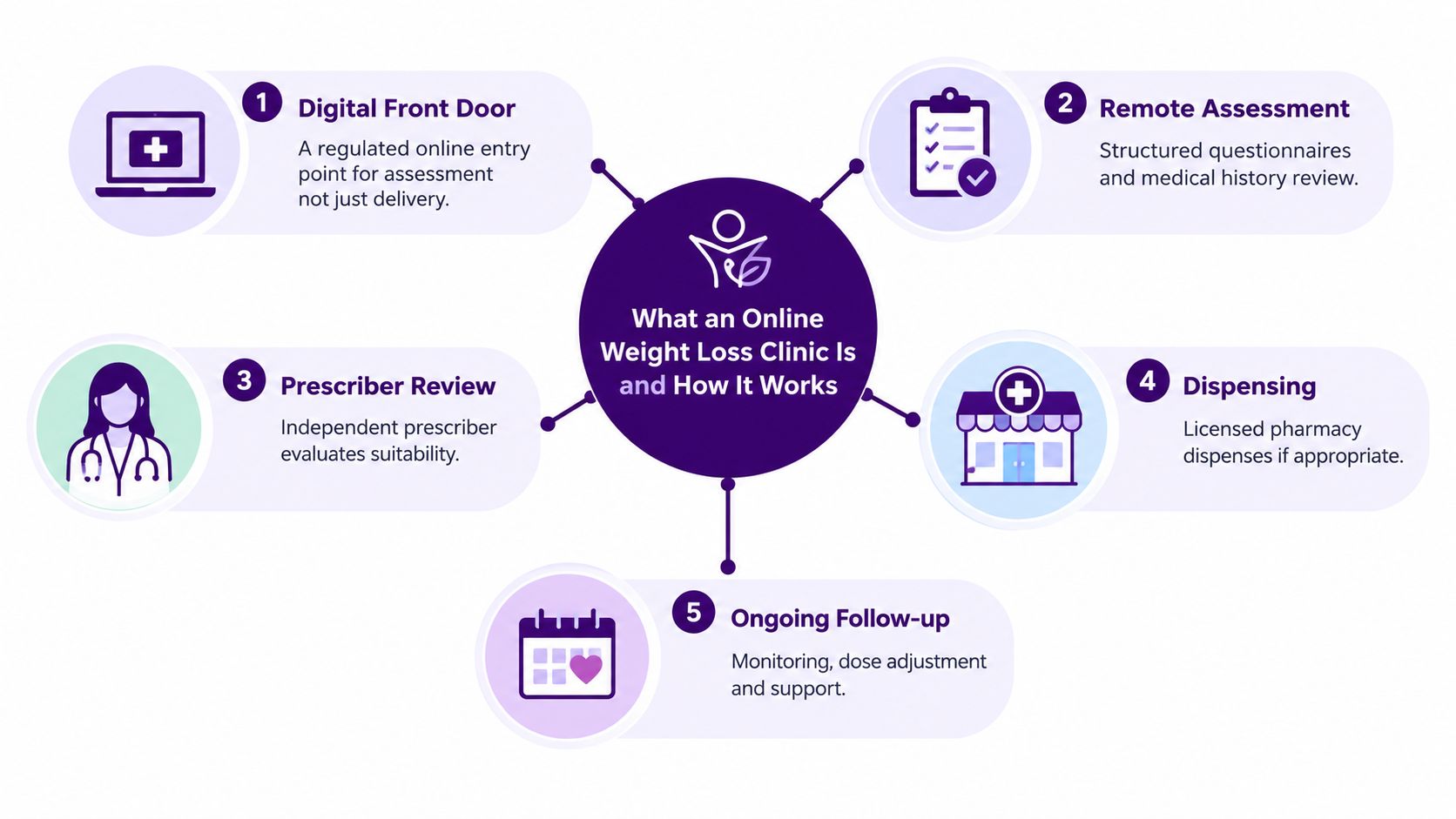
The digital pathway
First comes assessment. You provide information about your weight, height, health conditions, medicines, allergies, previous treatment, and lifestyle. The purpose isn't to create paperwork. It gives the prescriber the clinical context needed to identify suitability and risk.
Next comes verification. UK distance-selling guidance expects independent confirmation of key facts, including identity, weight, height, BMI, and clinical suitability. A clinic may ask for photographic evidence, measurements, or additional information. The exact method can vary, but a provider should be able to explain how it checks the information you submit.
Then comes prescriber review. An independent prescriber reviews the record and decides whether to prescribe. A genuine two-way consultation matters here. If your answers raise a concern, the clinician should be able to ask follow-up questions rather than allowing an automated system to approve treatment.
Dispensing follows only if appropriate. A regulated pharmacy prepares and supplies the medicine. The clinic and pharmacy may be part of the same organisation or separate partners, but you should be able to identify who is responsible for dispensing.
Follow-up completes the pathway. Weight, tolerance, side effects, eating patterns, activity, and wider health needs may change over time. Good care therefore includes a way to contact the clinical team and a process for reviewing whether treatment should continue.
A medicine is only one part of the model. Sustainable care usually combines:
- Medical assessment, including eligibility and risk screening.
- Evidence-based treatment, where medication is appropriate.
- Nutrition and behaviour support, adapted to the person rather than presented as a generic diet.
- Activity and strength guidance, helping protect physical function during weight loss.
You can read a more detailed explanation of how online weight loss medication consultations work, but the central principle is simple: the digital format changes where care happens, not the need for professional judgement.
Medically Supervised Options and How Evidence Guides Choice
Weight-loss medicines don't all work in the same way, and the most familiar option isn't automatically the right option. Clinicians consider BMI, related health conditions, other medicines, contraindications, expected benefits, possible adverse effects, pregnancy plans, and whether the person can engage with lifestyle support.
GLP-1 receptor agonists imitate an appetite-regulating gut hormone. In plain language, they can influence hunger and fullness signals and slow gastric emptying. Semaglutide is a GLP-1 medicine. Dual GIP/GLP-1 treatment, such as tirzepatide, acts on two hormonal pathways involved in appetite and glucose regulation. These descriptions explain the mechanism, not a promise about an individual result.
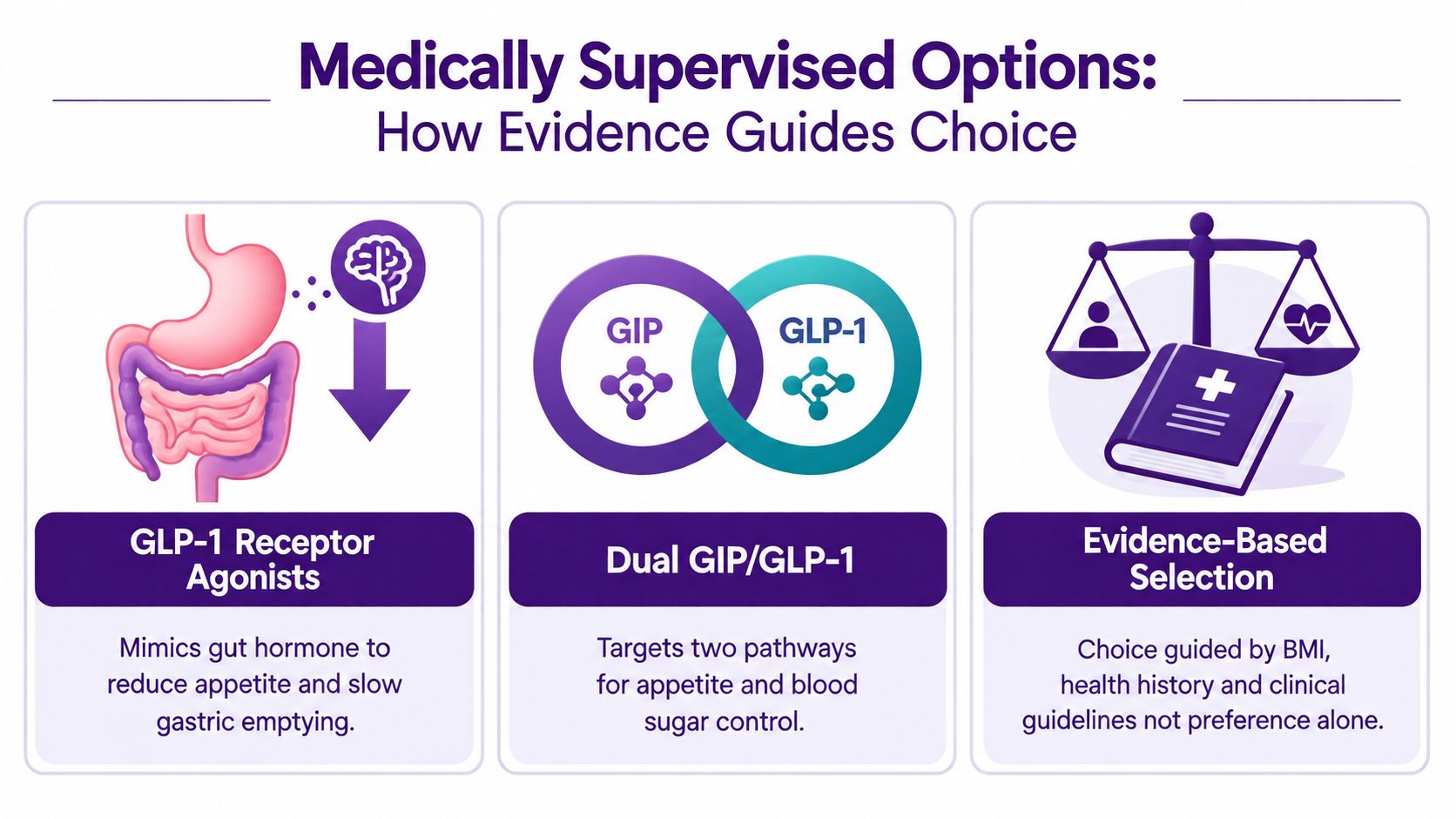
NICE's evidence review for semaglutide found that people lost more weight when semaglutide was used alongside supervised weight-management support than with support alone. NICE also reported that semaglutide produced greater weight loss than liraglutide in the relevant evidence, and that semaglutide plus lifestyle measures normalised blood glucose more often than lifestyle measures alone in people with non-diabetic hyperglycaemia (NICE recommendations for semaglutide). These findings support supervised use, not medication-only care.
Tirzepatide has a tightly defined NHS eligibility signal. NICE and NHS England recommend it for adults with obesity when BMI is at least 35 kg/m² and there's at least one weight-related comorbidity, alongside a reduced-calorie diet and increased physical activity (NHS England's implementation guidance). Private prescribing still requires an individual clinical assessment. A private consultation isn't a way around safe prescribing.
Orlistat works differently. It reduces the digestion and absorption of dietary fat and is used with diet and exercise. NICE-linked evidence summarises a systematic review of 30 randomised controlled trials, with a mean additional weight loss of 2.40kg versus controls across 22 studies involving 5,921 participants (NICE's medicine guide). The side-effect pattern and practical considerations differ from injectable appetite-regulating medicines, so suitability depends on the person.
UK weight management medicines at a glance
| Medicine class | How it works | NICE eligibility signal | Continuation principle |
|---|---|---|---|
| GLP-1 receptor agonist, such as semaglutide | Acts on appetite and fullness pathways and can slow gastric emptying | Semaglutide is restricted to defined BMI and comorbidity or specialist-referral criteria | Review progress, tolerance, and clinical benefit at agreed milestones |
| Dual GIP/GLP-1 treatment, such as tirzepatide | Targets two hormone pathways involved in appetite and blood sugar control | NICE recommends defined BMI and comorbidity criteria for NHS use | Use with diet and activity support, then reassess response |
| Orlistat | Reduces absorption of dietary fat in the gut | Licensed for adults with BMI at least 30, or at least 28 with relevant risk factors, according to NICE-linked information | Continue only when benefit and tolerability justify treatment |
For NICE weight-management medicines, a common continuation benchmark is at least 5% weight loss after 6 months. If that isn't achieved, treatment should be reconsidered or stopped (NICE medicine options for weight management). A responsible online clinic should discuss this before treatment begins, not after a payment has been taken.
What to Expect From Digital Consultations and Delivery
A safe digital consultation should feel structured rather than rushed. A short online form can be useful, but its length doesn't determine its quality. The important question is whether the information is clinically relevant and whether a prescriber reviews it independently.
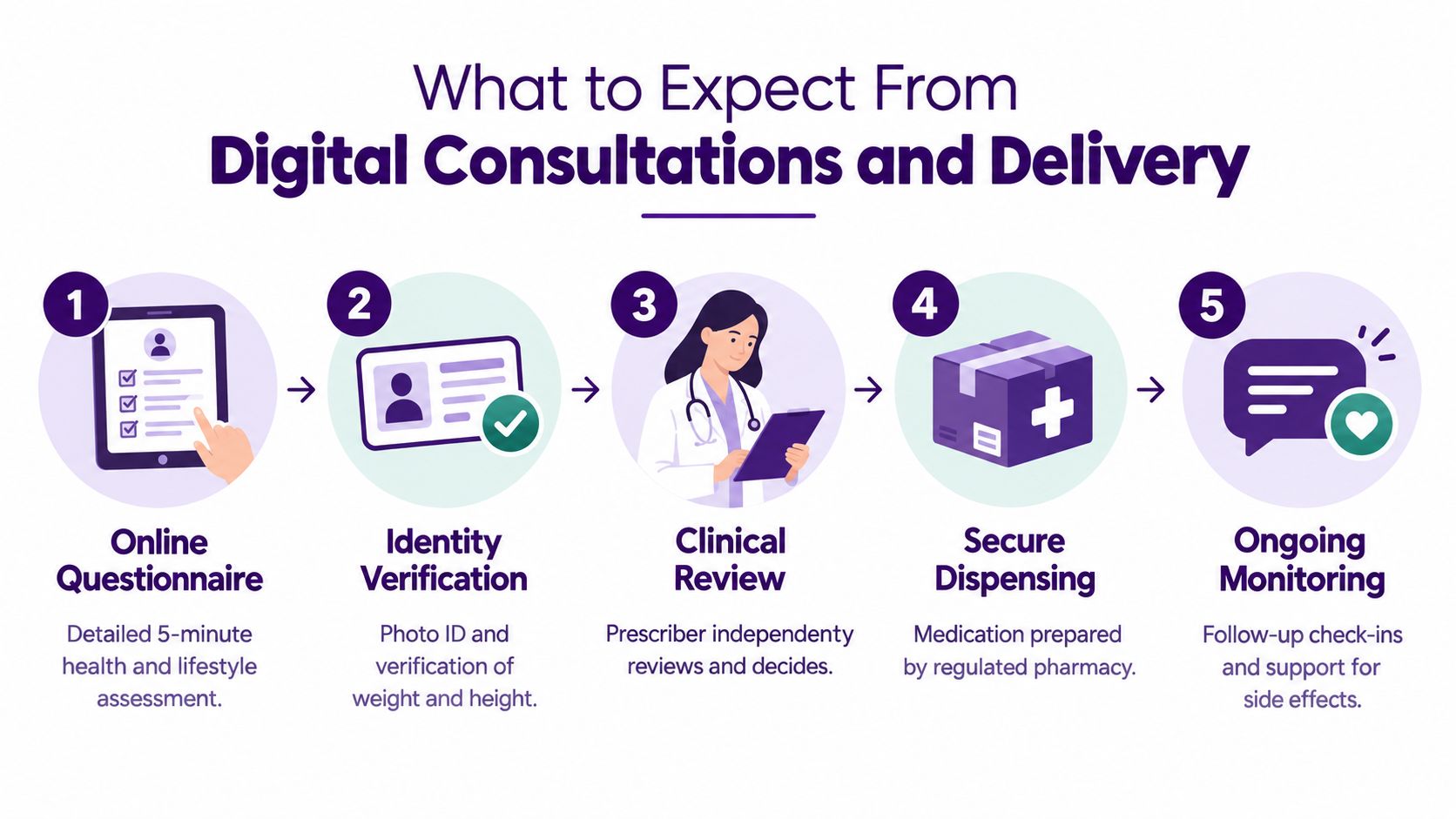
A practical patient journey
1. Complete the health assessment. Expect questions about current measurements, previous weight-management attempts, medical conditions, prescribed medicines, allergies, mental health, pregnancy or breastfeeding, and your goals. Answer accurately. Leaving out a condition can make a prescribing decision unsafe.
2. Confirm your identity and measurements. The provider may request photographic identification and evidence of weight and height. This protects you from unsuitable treatment and helps the prescriber calculate BMI using reliable information.
3. Have a clinical review. A UK-registered prescriber should assess whether treatment is appropriate. If something is unclear, the consultation should allow genuine dialogue. A clinic that supplies prescription treatment without meaningful clinical review is failing the central purpose of remote healthcare.
4. Receive a prescribing decision. Approval isn't guaranteed, and that's a safety feature. The clinician might prescribe, request more information, recommend GP involvement, or explain why medicine isn't suitable. You should receive instructions on use, expected effects, possible side effects, and when to seek help.
5. Use follow-up support. Monitoring may involve app-based weight records, symptom check-ins, messages, or scheduled reviews. A useful service tracks more than the number on the scales. It also considers appetite, food intake, activity, strength, hydration, treatment tolerance, and signs that the plan needs adjusting.
Delivery should come after the prescribing decision and pharmacy checks. It may be discreet and convenient, but speed shouldn't be treated as proof of quality. Read how online pharmacy delivery fits into a regulated weight-management service before comparing delivery promises.
The video below gives a visual overview of the consultation and fulfilment journey.
If treatment causes troublesome symptoms, the clinic should explain how to contact the team and what information to provide. If you don't meet the agreed response threshold, the prescriber should review whether continuing makes sense rather than automatically issuing the next supply.
Safety Regulation and Clinical Oversight You Should Verify
The strongest safety signal is not a polished website or a short sign-up form. It's an auditable clinical process. UK distance-selling guidance requires independent confirmation of important facts, including weight, height, BMI, identity, and clinical suitability, alongside a genuine two-way consultation and documented decision-making before supply (UK guidance on GPhC distance selling and remote prescribing).
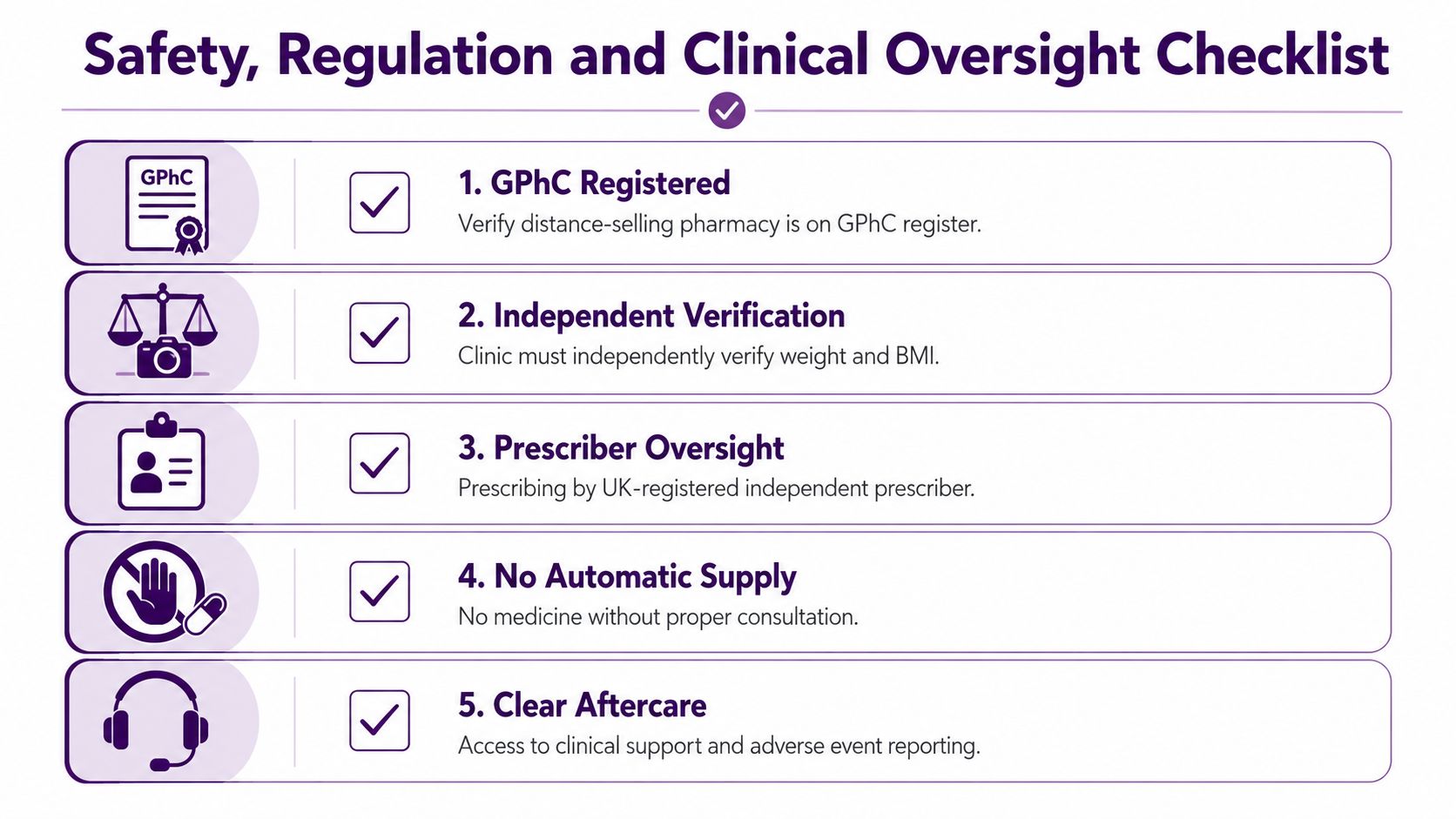
The checks that matter
- Find the dispensing pharmacy: Look for the pharmacy's name and verify its registration with the General Pharmaceutical Council. A clinic should make it clear who dispenses the medicine and how you can contact that organisation.
- Ask how measurements are checked: Questionnaire-only triage isn't enough for prescription weight management. The provider should independently verify identity, weight, height, and BMI.
- Identify the prescriber: You should know that a UK-registered independent prescriber is responsible for the decision. The service should document why the prescribed treatment is suitable for you.
- Look for two-way communication: A proper consultation allows the clinician to ask questions and allows you to raise concerns. Automatic approval without clinical dialogue is a serious warning sign.
- Review aftercare before paying: Check how you'll report side effects, request clinical advice, discuss dose changes, and report an adverse event. A prescription without a route back to the clinical team leaves you carrying too much responsibility.
NICE also makes continuation part of safe care. A common benchmark is at least 5% weight loss after 6 months, with treatment reconsidered or stopped if that response isn't achieved (NICE continuation guidance). This doesn't mean every person follows an identical timeline. It means the prescriber should agree how success, limited response, intolerance, and next steps will be assessed.
A regulated pharmacy checks the medicine supply. Clinical oversight checks whether you should receive that medicine in the first place. You need both.
You may also encounter general health resources outside weight-management services. For example, information from infrared therapy advisory experts can be considered separately, but it shouldn't replace a prescriber's assessment or evidence-based obesity treatment.
How to Choose a Reputable Provider and Weigh Private Versus NHS Access
Price can help with planning, but it should not be your first test of quality. UK comparison information shows variation in monthly cost, consultation model, turnaround, pharmacy arrangements, and follow-up. Reported private costs range from roughly £150 to £300 or more per month, depending on what the service includes (independent UK clinic comparison information). Treat this as market context, not a recommendation or promise of your own costs.
The private versus NHS decision also depends on timing. NICE recommended tirzepatide in December 2024. NHS England says funding began on 24 March 2025 through specialist weight-management services, with phased primary-care access from 23 June 2025. NICE says eligibility is due to widen further in June 2026 and March 2027, subject to final guidance (NICE technology appraisal TA1026). Since access is being introduced in stages, your local service may not offer the same route or timing as another area.
NHS England's implementation plan describes an eligible cohort of 220,000 people over the first 3 years of a 12-year rollout (NHS England's tirzepatide implementation plan). It also estimates 3.4 million eligible people in England, helping explain why availability is phased rather than immediate. Your practical questions are whether you meet the criteria, how referral works locally, and when treatment could begin.
A decision matrix
| Your priority | Private online care may be relevant when | Waiting or seeking NHS care may be more appropriate when |
|---|---|---|
| Speed | You need an assessment before local NHS access is available and can afford private care | Your circumstances are not urgent and you prefer NHS provision |
| Cost | You understand the ongoing cost and what follow-up includes | Private payments would create financial pressure |
| Clinical complexity | The provider can coordinate with your GP or arrange specialist review | Your conditions require integrated NHS or specialist care |
| Support | You want digital monitoring, nutrition guidance, and regular contact | Your GP or local service already offers suitable follow-up |
| Eligibility | An independent prescriber confirms that treatment is suitable | You do not meet the criteria or need further assessment |
Before choosing a clinic, check that its pharmacy is registered with the GPhC and that a UK-registered prescriber makes the clinical decision. The pharmacy is the controlled handover point for the medicine. The prescriber is the person who decides whether that medicine fits your health circumstances. A low price cannot compensate for missing either safeguard.
For background, read this guide to how Wegovy access and eligibility are assessed. Then ask whether private care addresses a genuine access or support need. Urgent wording on a webpage is not a clinical reason to pay.
Your Actionable Checklist Before Signing Up
Before choosing a weight loss clinic online, save the answers rather than relying on a reassuring homepage. A reputable provider should be comfortable explaining its process in plain English.
- Pharmacy: What's the legal name of the dispensing pharmacy, and can I verify its GPhC registration?
- Prescriber: Who makes the prescribing decision, and are they a UK-registered independent prescriber?
- Verification: How will you confirm my identity, weight, height, and BMI?
- Consultation: Can the prescriber ask follow-up questions and speak with me if my answers need clarification?
- Suitability: Which health conditions, medicines, allergies, pregnancy considerations, or previous treatments could change the decision?
- Evidence: Which NICE guidance informs the treatment pathway, and what lifestyle support accompanies medicine?
- Monitoring: How will you track weight, symptoms, appetite, nutrition, activity, and treatment tolerance?
- Side effects: Who do I contact if I develop concerning symptoms, and how quickly can I obtain clinical advice?
- Continuation: What happens if I don't achieve the agreed response, including the 5% weight-loss benchmark after 6 months where relevant (NICE guidance)?
- NHS planning: If I'm likely to qualify for NHS tirzepatide, should I discuss waiting or referral with my GP?
Prepare an accurate list of your medicines, diagnoses, allergies, recent measurements, and questions before the consultation. If your situation is medically complex, you're pregnant or breastfeeding, or you're unsure whether weight may be linked to another condition, speak with your GP or another appropriate clinician before paying for private treatment.
Trim offers a UK-based digital consultation with UK-registered clinician review, dispensing through a GPhC-registered pharmacy, progress tracking, nutrition and activity guidance, and ongoing one-to-one support. If that model matches the level of oversight you're looking for, visit Trim to review the service and begin with the clinical assessment rather than assuming treatment is automatic.