
What to Eat When Taking Orlistat: A Practical Guide

Orlistat blocks about 30% of the fat you eat, which is why what you eat with each dose matters as much as your overall calorie intake. The medicine isn't designed to make a high-fat diet harmless. It works alongside a lower-fat, calorie-controlled eating pattern, and meals that contain too much fat are more likely to cause oily stools, urgency and wind.
The practical question isn't “what foods are allowed?” It's how much fat is in each meal, where that fat is hiding, and how evenly you spread it through the day. The guide below turns NHS prescribing advice into usable meal targets, label-reading rules, familiar UK food swaps, a sample day and a clear plan for dealing with side effects.
Table of Contents
- Starting Orlistat and Why Your Diet Sets the Tone
- How Orlistat Interacts With the Fat You Eat
- Building a Daily Fat Budget That Actually Works
- Smart Low-Fat Swaps for Everyday UK Foods
- A Sample Day of Meals With Per-Meal Fat Counts
- Managing Side Effects and Protecting Your Vitamins
- Foods and Habits That Quietly Break the Plan
- When to Seek Clinical Advice and Key Takeaways
Starting Orlistat and Why Your Diet Sets the Tone
Orlistat is a dietary partner, not a standalone fix. UK guidance describes it as part of a broader approach involving a reduced-calorie, lower-fat diet and increased physical activity. Your prescriber should review how you're progressing after the initial treatment period, rather than leaving you to continue indefinitely without checking whether the plan is helping.
The most useful number to remember is the practical main-meal benchmark of about 22g of fat, based on a 2,000 kcal diet divided across three meals, as set out in UK prescribing guidance for orlistat. Some NHS-affiliated patient guidance uses a stricter ceiling of no more than 15g in any one meal, so follow the limit given by your prescriber or local leaflet if it differs.
Why the meal target matters
A lower-fat meal helps in two ways. It supports the calorie-controlled pattern needed for weight management, and it reduces the amount of undigested fat passing through your bowel. Concentrating most of your daily fat in one sitting can produce symptoms even if the rest of the day looks fairly sensible.
Practical rule: Treat each meal as its own fat allowance. Don't save all your fat for dinner and assume a low-fat breakfast will balance it out.
This guide shows how to create a daily fat budget, read food labels, choose lower-fat versions of familiar foods and assemble meals without guessing. It also covers takeaway food, hidden fats, vitamin protection, common side effects and situations that need clinical advice.
A clinical trial indexed by PubMed used orlistat alongside a reduced-energy diet containing 30% of energy from fat and an approximate 600 kcal daily deficit. That evidence supports the central message here: the medication was studied as part of a structured eating plan, not as permission to ignore dietary fat.
How Orlistat Interacts With the Fat You Eat
Orlistat is a lipase inhibitor. Lipase enzymes, including pancreatic and gastric lipase, normally break dietary triglycerides into smaller components that your gut can absorb. Orlistat interferes with that process, leaving roughly 30% of dietary fat undigested and unabsorbed, as explained by NHS guidance on orlistat.
Think of fat as a fuel your body normally unloads from the digestive tract into the bloodstream. Orlistat leaves part of that fuel in its original form, so it travels onwards through the bowel instead. The larger the fat load in one sitting, the more unabsorbed fat may remain in the bowel at the same time.
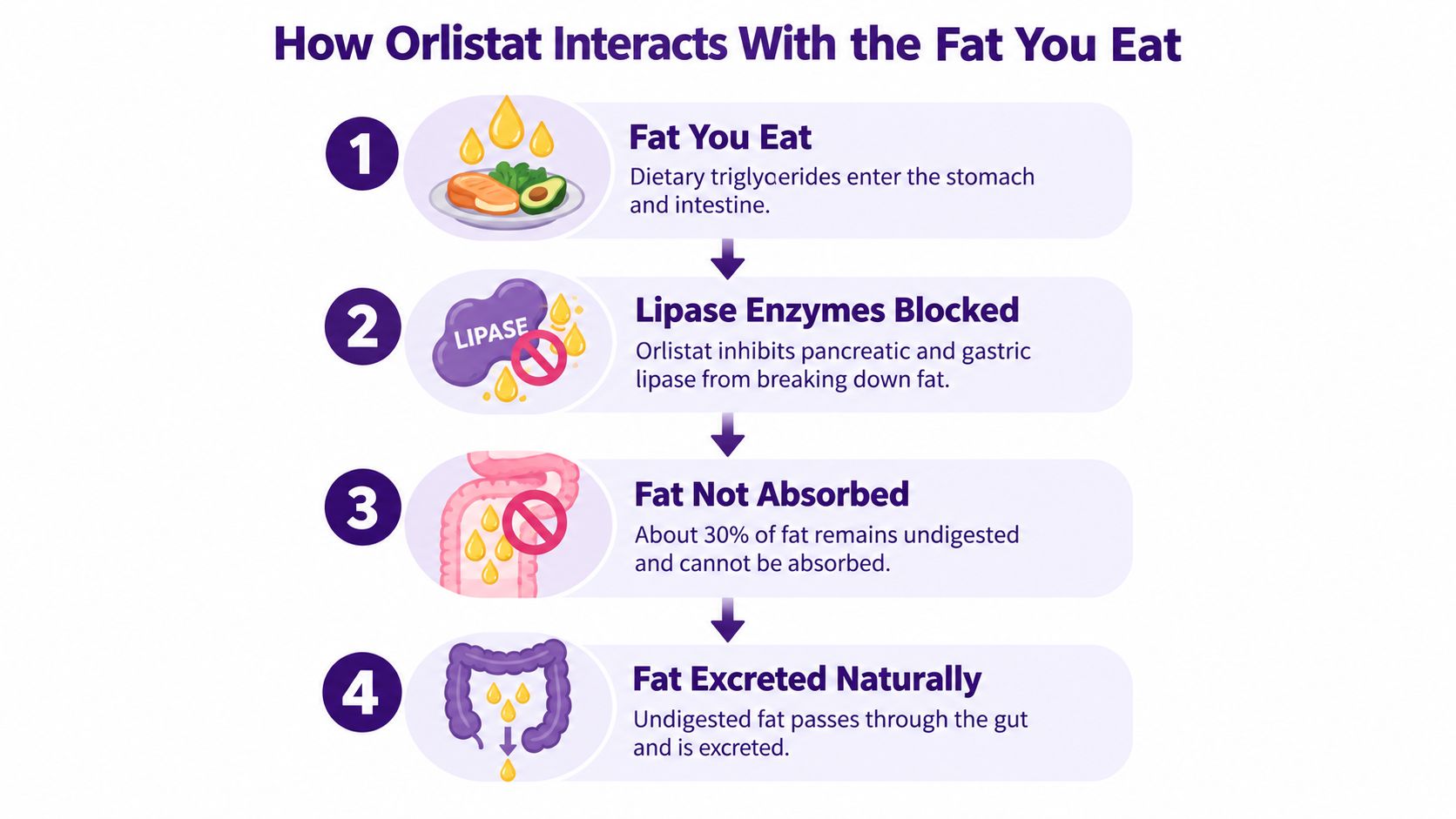
A simple illustration makes the mechanism easier to understand. A meal containing 40g of fat would leave roughly 12g unabsorbed if the medicine blocked about 30%. A meal containing 15g of fat would leave less than 5g unabsorbed on the same basis. These are illustrations of the mechanism, not a guarantee of how your body will respond, but they show why a very fatty meal is more likely to cause oily stools, urgency or flatulence.
Why distribution beats concentration
The total fat you eat over the day matters, but distribution matters too. Three moderate meals give your bowel a smaller amount to handle at each point than one very rich meal followed by unusually low-fat eating.
For practical information about digestive enzymes and related testing, you can read this resource on lipase testing from Repose Healthcare. It isn't a substitute for advice about your prescription, but it may help clarify the role of lipase in digestion.
Building a Daily Fat Budget That Actually Works
NHS and NHS-affiliated prescribing guidance commonly uses a pattern where fat provides roughly 30% of total daily energy. On a 2,000 kcal diet, that works out at about 70g of fat, while a 1,500 kcal diet gives a lower total of about 50g, as outlined in NHS Lanarkshire patient guidance.
Those totals are starting points, not personal prescriptions. Your clinician may set a different calorie target, and the right budget depends on your health, activity, current eating pattern and treatment plan.
Divide the allowance before you shop
A useful arrangement is to give each main meal a similar allowance, leaving a smaller amount for snacks. The table below translates the guidance into a working example.
| Meal | Target calories | Fat budget (g) | Fat per 100g rule |
|---|---|---|---|
| Breakfast | Personal calorie target | About 22g maximum | Prefer foods under 5g per 100g |
| Lunch | Personal calorie target | About 22g maximum | Prefer foods under 5g per 100g |
| Dinner | Personal calorie target | About 22g maximum | Prefer foods under 5g per 100g |
| Snack | Smaller calorie allowance | Under 10g as a practical guide | Check the serving and per-100g values |
The about 22g per meal figure comes from the 2,000 kcal example split across three meals. If your local leaflet says no more than 15g per meal, use that stricter ceiling. NHS hospital label-reading advice recommends choosing foods with less than 5g of fat per 100g, which is a quick way to avoid products that use up your allowance rapidly.
Read the label twice
First check the fat per 100g figure. Then check the fat in the portion you're going to eat. A product can look acceptable per 100g but become a high-fat choice if you eat a large serving.
Imagine two ready meals. A tomato pasta labelled 4.2g fat per 100g fits the under-5g screening rule. A creamy bake labelled 14g fat per 100g doesn't automatically become forbidden, but its portion can consume much more of your meal allowance. tracking macros for weight loss can help you organise your own records, provided you still check the manufacturer's current label.
To create your personal budget, start with the calorie target agreed with your clinician, apply the roughly 30% fat principle if appropriate, then divide the result across your usual meals. Keep the distribution even rather than trying to compensate for a high-fat meal later.
Smart Low-Fat Swaps for Everyday UK Foods
You don't need to replace familiar meals with an unfamiliar diet. Most useful changes involve portion size, cooking method and sauces. Aim to keep a main meal below the limit given by your clinician, with snacks kept modest, then check the complete label rather than relying on a food's health reputation.
| Instead of | Choose | Approximate fat saving |
|---|---|---|
| Full-fat yoghurt with granola | Fat-free yoghurt, berries and a small portion of plain cereal | Depends on brands and portions |
| Mayonnaise or creamy coleslaw | Mustard, lemon juice or a low-fat dressing | Depends on the amount used |
| Fried chicken or fish | Grilled, poached or oven-cooked chicken or fish | Depends on coating and cooking fat |
| Buttery mashed potato | Boiled potatoes or mash made with low-fat milk | Depends on the serving |
| Creamy pasta sauce | Tomato sauce with a measured amount of reduced-fat or strong cheese | Depends on recipe and portion |
| Full-fat cheddar | Reduced-fat cheddar in a measured portion | Around 5g less fat for 30g, depending on the products |
For breakfast, fat-free yoghurt with berries and a small amount of plain cereal is usually easier to control than full-fat yoghurt and a generous granola serving. At lunch, choose lean meat, chicken, tuna in spring water, egg or beans in a sandwich, and use mustard or lemon instead of mayonnaise-heavy fillings.
Dinner can stay satisfying without frying. Grill, poach or roast food on a tray, remove visible fat from meat, and measure any spread or oil rather than pouring it freely. A tomato-based pasta sauce usually gives you more control than a cream-based sauce, while a small portion of strong cheese can provide flavour without needing a large amount.
Snacks and eating out
Fruit, plain popcorn, low-fat yoghurt and a small handful of unsalted nuts can all fit, but nuts are concentrated in fat, so portion size matters. If you're comparing high-protein low-fat snacks, still check the current nutrition label because “high protein” doesn't guarantee a low-fat serving.
A whole-milk café latte may contain more fat than expected, while skimmed milk or an unsweetened plant drink can reduce it. Takeaways aren't automatically banned. Choose grilled items, request sauces separately and share richer sides.
A Sample Day of Meals With Per-Meal Fat Counts
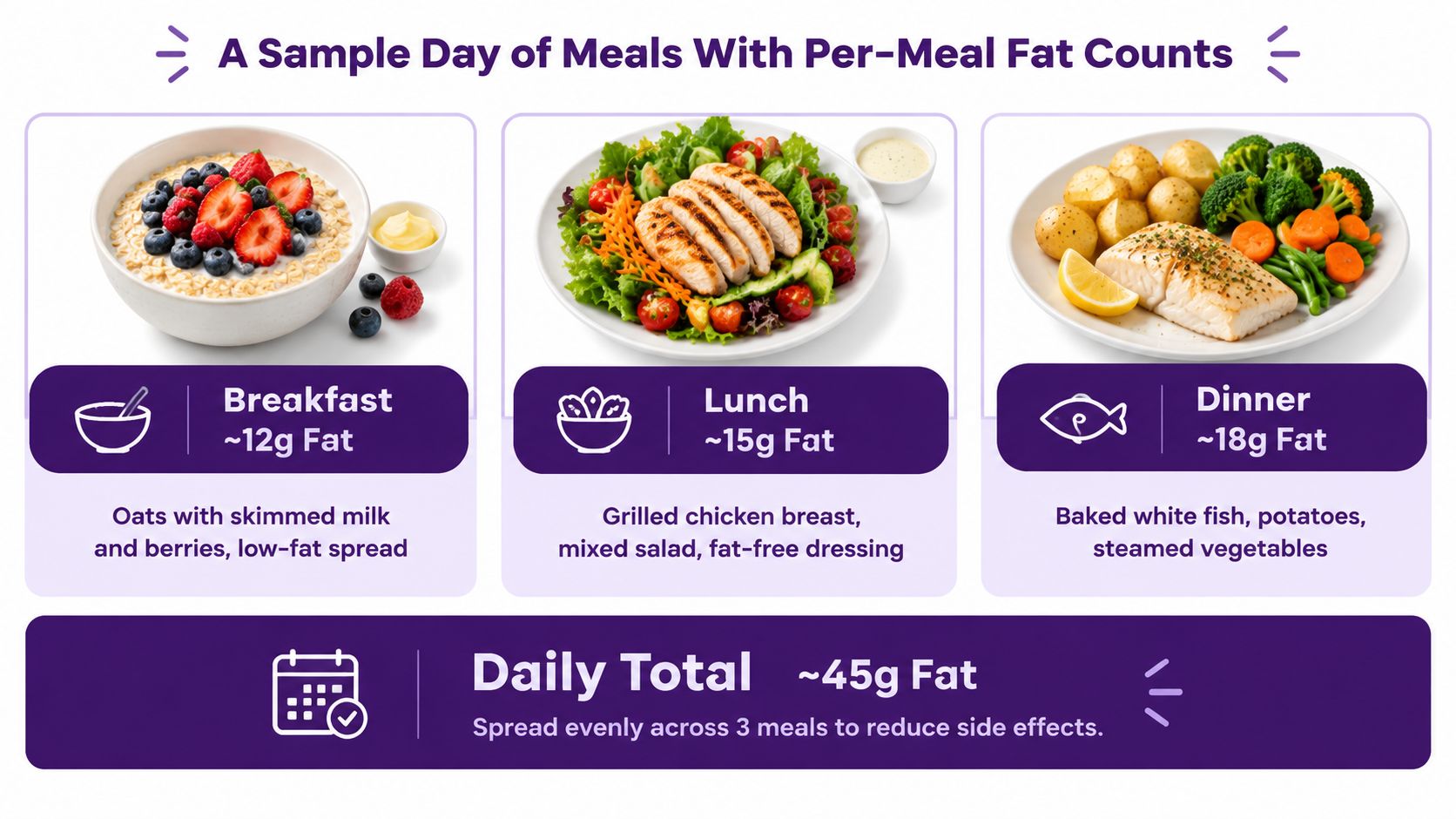
Use the label on the exact product you buy. Cereal recipes, yoghurt portions, bread sizes, mayonnaise and ready-made sauces vary, so the figures below are illustrative ranges, not universal values.
Breakfast and snacks
Breakfast could be 40g of high-fibre cereal, 150ml of skimmed milk and one sliced banana. Depending on the cereal, this may provide about 4 to 6g of fat. A mid-morning pot of fat-free Greek-style yoghurt with berries may provide around 0 to 2g.
For lunch, make a chicken and salad sandwich with 80g of skinless chicken, one thin spoon of mayonnaise and a medium slice of wholegrain bread, giving approximately 7 to 10g of fat, depending on the ingredients. Add an apple rather than crisps.
A small packet of unsalted nuts weighing 25g can contain around 12 to 15g of fat, so it may use most of a snack allowance. Fruit or low-fat yoghurt is often easier to fit into the day.
Dinner and the final check
Dinner could be 120 to 150g of baked salmon, a small baked potato with 2 teaspoons of low-fat spread, and plenty of vegetables or salad. That combination may contain approximately 14 to 18g of fat, depending on the salmon and spread.
Oily fish doesn't need to be excluded because it contains more fat. Keep the portion measured and reduce added fat elsewhere in the meal. The stated salmon portion is a guide, not a universal maximum.
A light yoghurt or fruit-based dessert may add around 1 to 3g of fat. This structure keeps each meal near the practical benchmark, but the packaging label remains the final check. For another perspective on low-calorie, protein-focused meal ideas, see these high-protein options.
Managing Side Effects and Protecting Your Vitamins
Orlistat's bowel-related effects often appear after a meal contains more fat than your body can comfortably handle. Oily spotting, urgency, loose stools, wind with discharge and abdominal discomfort can all be signals to examine the meal rather than reasons to panic.
Consider someone who eats a curry with rice and a creamy naan, then develops urgency later. The useful response is to identify the concentrated fat source, choose a lower-fat next meal and return to an even pattern. Severe restriction or trying to “make up for” the meal can leave you hungry and make the overall plan harder to sustain.
| Situation | Likely trigger | What to do |
|---|---|---|
| Oily spotting | Hidden fat in a sauce, dressing or cheese | Review the last meal and check labels |
| Urgent bowel movement | Large or rich meal | Choose a lower-fat meal next and avoid another concentrated fat load |
| Wind with discharge | Fat clustered in one sitting | Spread fat more evenly through the day |
| Repeated loose stools | High-fat meal, sometimes with other digestive triggers | Drink clear fluids and seek advice if symptoms persist |
| Severe pain, vomiting or blood | May not be a routine diet-related effect | Seek urgent clinical help |
Stop eating temporarily if repeated oily stools are accompanied by worsening symptoms, take clear fluids if you can, and seek urgent help for severe pain, vomiting, blood, black stools, faintness or an inability to keep fluids down. Persistent diarrhoea or vomiting can cause dehydration, particularly if you have kidney disease, are older or take medicines affected by fluid loss. The broader discussion of weight-loss medication side effects shouldn't replace individual assessment.
Vitamins and medicines
Orlistat can reduce absorption of fat-soluble vitamins A, D, E and K. A clinical trial reported vitamin supplementation requirements among orlistat-treated patients of 1.8% for vitamin A, 8.0% for vitamin D and 3.6% for vitamin E, compared with 0.9% for each vitamin in the placebo group, as reported in the PubMed trial record.
Follow your prescriber's advice, which may include a multivitamin taken at least two hours apart from orlistat, often at bedtime. Don't exceed the label dose. Ask a pharmacist to check interactions, including warfarin, ciclosporin, thyroid medicines, epilepsy treatments, acarbose and some HIV medicines.
Foods and Habits That Quietly Break the Plan
Many people who feel orlistat isn't helping haven't exceeded their fat target at every meal. More often, one or two foods use most of the day's allowance, especially when the fat comes from oil, cheese, creamy drinks or dressings that don't look substantial.
Common UK examples include a rich Friday takeaway, a creamy café latte, a cheddar-heavy sandwich, roast meat with the skin left on, a cheeseboard, pesto pasta, nut bars and avocado on toast. None of these foods is automatically forbidden, but several can become high-fat meals when portions and added ingredients combine.
| Usual choice (approx fat) | Lower-fat swap (approx fat) |
|---|---|
| 25g cheddar-heavy sandwich | Lean chicken or tuna sandwich with mustard, label value varies |
| Creamy coffee drink, 17g | Skimmed milk or unsweetened plant drink, label value varies |
| Takeaway meal, 70 to 90g | Grilled main with sauce separately, label value varies |
| 60g-fat meal | Smaller grilled meal with measured dressing, label value varies |
| Pesto pasta | Tomato-based pasta with a measured cheese portion, label value varies |
| Avocado on toast | Tomato, beans or a smaller measured avocado portion, label value varies |
The figures shown for the takeaway, creamy coffee and cheddar-heavy sandwich are examples supplied in the dietary brief, not universal product values. Always check the current nutrition information, particularly for restaurant meals where recipes and serving sizes change.
Look beyond the plate
Liquid fats are easy to miss. A drizzle of oil, a café topping or a dressing can add to the meal without making the portion look larger. “Healthy” also doesn't mean low-fat. Nuts, nut bars, pesto and avocado can have a place in a balanced diet, but they still count towards your orlistat meal budget.
A single 60g-fat meal would produce roughly twice the undigested fat load of a 30g-fat meal under the 30% blocking illustration. That can explain why symptoms appear suddenly after an otherwise careful day. Treat richer foods as occasional, portion-controlled choices, and plan the rest of that meal around lean protein, vegetables and a lower-fat carbohydrate.
When to Seek Clinical Advice and Key Takeaways
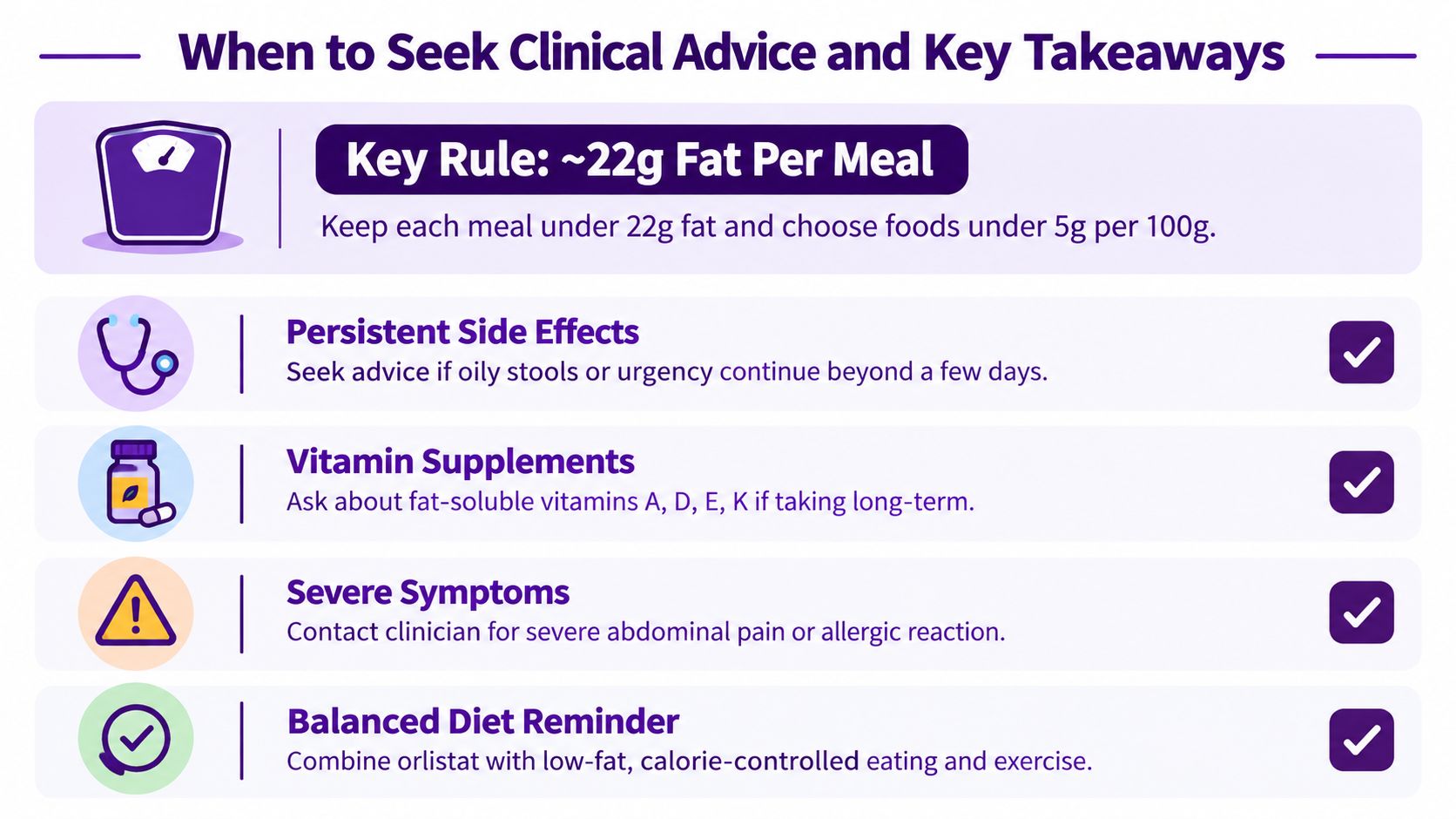
Keep the working rule visible: aim for about 22g of fat per main meal, spread across three meals, and prefer packaged foods with less than 5g of fat per 100g, based on NHS prescribing and patient guidance. If your prescriber or local leaflet gives a lower meal limit, use that instead.
A pharmacist or GP should review your treatment if:
- Symptoms are severe or persistent: Seek advice for ongoing oily stools, urgency, diarrhoea or abdominal pain rather than repeatedly adjusting your dose yourself.
- Red flags appear: Get urgent help for severe abdominal pain, blood in the stool, black stools, faintness, repeated vomiting or inability to keep fluids down.
- Liver symptoms develop: Dark urine or yellowing of the skin needs prompt medical assessment.
- Your period is missed: If you're taking orlistat and miss a period, particularly with any missed-dose history, contact a clinician for advice.
- The diet feels unmanageable: Ask for help if you can't maintain a balanced, lower-fat eating pattern after several weeks.
- Progress needs reviewing: Arrange the recommended weight review, commonly at 12 weeks, rather than increasing the dose to compensate for a high-fat meal.
Keep your multivitamin timing aligned with your prescriber's instructions, and mention orlistat whenever a clinician or pharmacist reviews your medicines. Blood pressure checks and weight reviews are useful routine touchpoints during supervised treatment.
Orlistat works best as a partner to modest, consistent dietary change. You don't need a perfect menu, and asking for help is part of safe treatment, not a failure. For questions about suitability and treatment choices, you can also read who can take orlistat.
If you want structured support with low-fat meal planning, medication suitability and ongoing weight-management reviews, visit Trim. Trim connects UK patients with registered clinicians and pharmacy support, so you can discuss your diet, side effects and treatment plan rather than trying to manage them alone.