
Online Pharmacy Delivery UK Guide How It Works Safely

You've completed a short online questionnaire for a weight-loss treatment, checked the delivery address twice, and now you're wondering what happens next. Will a clinician review the information properly? Is the pharmacy legitimate? If the medicine needs refrigeration, will it arrive at the right temperature?
Those are sensible questions. Online pharmacy delivery in the UK should be an extension of regulated pharmacy care, not a shortcut around it. A safe service connects a digital consultation with a qualified prescriber, a registered pharmacy, appropriate packaging, secure delivery and support after the parcel arrives.
This matters particularly for GLP-1 medicines such as Wegovy and Mounjaro, which may require careful prescribing and temperature-controlled transport. This guide is educational rather than promotional. It focuses on how the regulated journey works, what the clinical evidence says, which checks protect patients and what practical steps you can take when a medicine reaches your home.
Table of Contents
- Introduction to Online Pharmacy Delivery in the UK
- What Online Pharmacy Delivery Is and How It Fits UK Healthcare
- How Online Pharmacy Delivery Works Step by Step
- Legal and Safety Checks Every Trustworthy Provider Follows
- Delivery Options Timelines Costs and Privacy Explained
- Practical Support for Weight Loss Medication Users After Delivery
- How to Choose a Provider and Spot Red Flags With Confidence
Introduction to Online Pharmacy Delivery in the UK
A reader might start with a simple need: travelling to a pharmacy is difficult, privacy matters, or a local service doesn't stock the prescribed medicine. An online consultation appears to offer a more manageable route. You answer health questions at home, a prescriber assesses whether treatment is suitable, and an approved pharmacy prepares the medicine for delivery.
That convenience doesn't remove the clinical process. It moves parts of the process from a shop counter to a secure digital setting. The prescriber still needs enough information to make a safe decision, the pharmacy still has responsibility for dispensing, and the delivery company must handle the parcel in a way that protects the medicine.
Demand has grown, although use remains below stated interest. In a 2024 YouGov survey, 18% of British consumers said they had used a pharmacy delivery service in the past year, while 40% said they would use one in the next 12 months if available. The same survey identified difficulty getting to a pharmacy as the leading reason people would choose home delivery, with notable delivery gaps in the Midlands, Scotland and Wales. YouGov's research on pharmacy delivery demand provides that wider access context.
A useful distinction: convenience is a reason to choose online care, but it isn't evidence that a particular provider is safe.
For someone considering weight-loss medication, the journey has several connected parts. A five-minute digital consultation may collect the initial information, but it doesn't replace professional judgement. The clinician may ask follow-up questions, request records, recommend another form of care or decide that prescribing isn't appropriate.
The pharmacy then checks and dispenses the prescription. For a refrigerated product, the delivery stage becomes part of medicine safety rather than a simple courier transaction. By the time the parcel reaches your door, you should know how to store it, what to do if the packaging is damaged and who to contact if you feel unwell.
What Online Pharmacy Delivery Is and How It Fits UK Healthcare
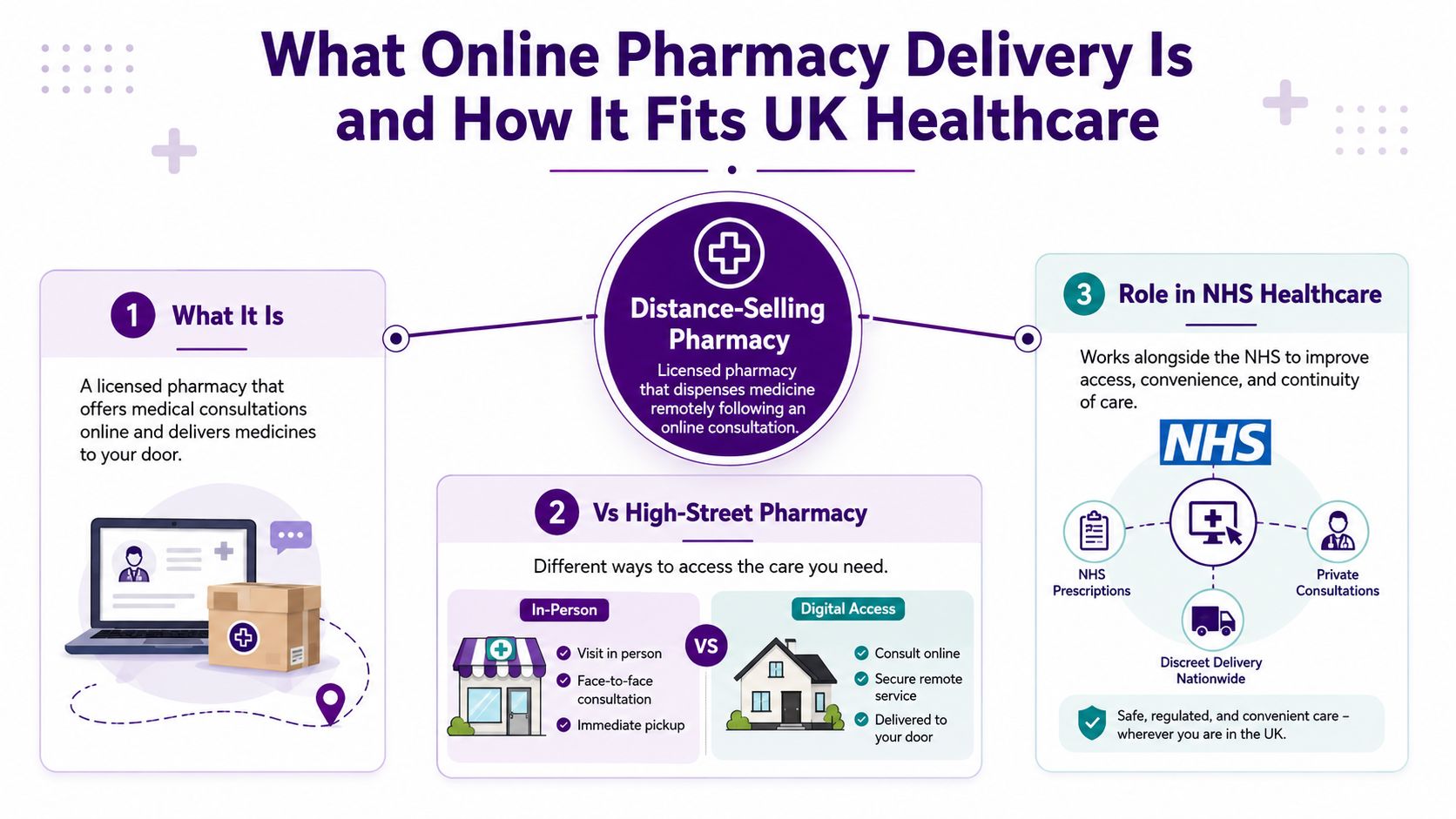
A distance-selling pharmacy dispenses medicines for people who aren't physically visiting the pharmacy. It has a digital front door, but the underlying responsibilities remain familiar. A prescriber assesses the person, a pharmacist supplies the medicine and a logistics partner transports it.
The easiest comparison is a high-street pharmacy with a secure digital entrance. At a high-street pharmacy, you can speak face to face with staff and collect a prescription. With online pharmacy delivery, you provide information remotely, communicate through the service's approved channels and receive the medicine at home. Neither route is automatically suitable for every situation.
The roles behind the parcel
The clinical handoff should be clear:
- Prescriber: reviews your history, current medicines, symptoms and answers, then decides whether treatment is suitable.
- Pharmacy: validates the prescription, checks the medicine and supplies it in accordance with professional standards.
- Delivery partner: transports the package using the process required for that medicine, including temperature controls where necessary.
- Patient: provides accurate information, follows storage instructions and contacts the clinical team when something changes.
Online services can support NHS prescriptions and private care, depending on the provider and the prescription route. They don't replace emergency services, urgent assessment or an in-person examination when a clinician needs to examine you. A remote consultation is most useful when the prescriber can make a safe decision from the information available and has a reliable way to communicate with you.
Growth without exaggeration
Distance selling has expanded rapidly in England, but its overall share remains relatively small. Distance-selling pharmacies dispensed 52,930,116 items in 2021, compared with 13,190,131 in 2016, a rise of 301% in five years. Across all community pharmacy contractors, dispensing rose from 1.104 billion to 1.129 billion items, an increase of 2.3%, and distance-selling pharmacies still accounted for just under 5% of all community pharmacy items in 2021. These figures are reported in the UK online pharma delivery report.
The lesson is balanced. Online pharmacy delivery is no longer unusual, yet it remains one part of the wider medicines system. Its value lies in appropriate access, not in bypassing safeguards.
How Online Pharmacy Delivery Works Step by Step
The process resembles a relay. You provide the information first, the clinician makes the clinical decision, the pharmacy takes responsibility for the medicine and the courier completes the physical journey. Each handoff needs accurate information.
1. Digital consultation
You complete a health questionnaire on a secure platform. Questions may cover your medical history, current medicines, allergies, previous treatment, relevant symptoms and the reason you're seeking care. For weight management, the prescriber may also need information about your health conditions and previous experience with treatment.
Answering accurately is more important than giving the answer you think will lead to a prescription. Omitting a medicine or condition can affect the safety assessment. A trustworthy service won't treat the form as a guaranteed route to a particular product.
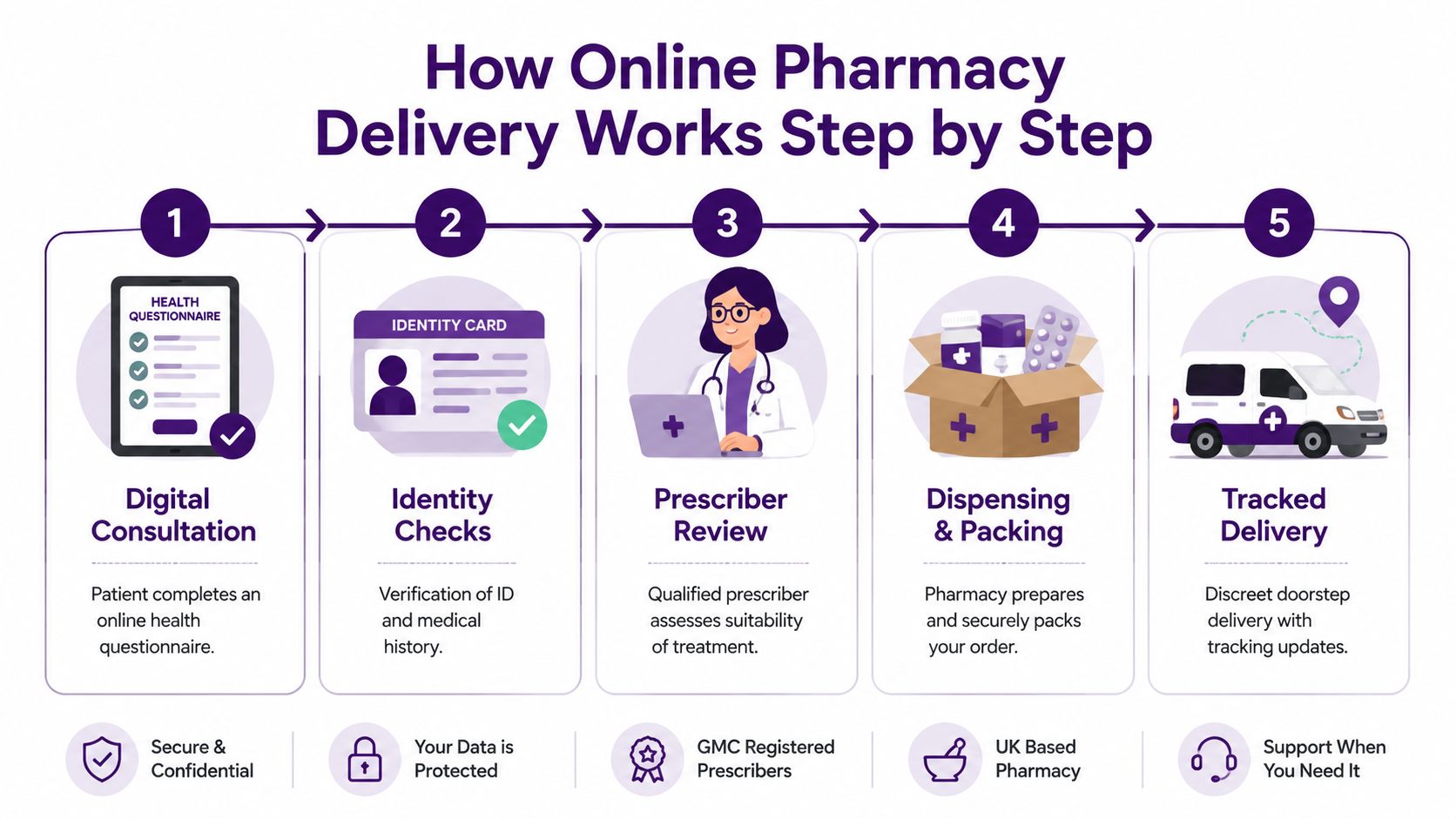
2. Identity and information checks
The provider may verify your identity and review the information you submitted. This helps connect the consultation to the correct person and reduces the risk of medicines being supplied on the basis of incomplete or misleading details.
The General Pharmaceutical Council's updated distance-selling guidance, published in February 2025, added safeguards including verification of initial questionnaire answers and two-way communication between the person and prescriber. The Centre for Pharmacy Postgraduate Education summary of the updated GPhC guidance explains these changes.
3. Prescriber review
A qualified prescriber assesses whether the requested treatment is clinically appropriate. The outcome isn't always a prescription. The prescriber may ask for more information, recommend an alternative, advise an in-person appointment or decide not to prescribe.
Two-way communication is important here. A questionnaire can start a consultation, but it can't always answer the follow-up questions that arise from your history. You should be able to contact the prescriber or clinical team through a clear, secure route.
4. Dispensing and preparation
If treatment is approved, the prescription goes to the pharmacy. Pharmacy staff select the prescribed medicine, check the prescription and prepare the package. The product, dose and instructions should match the prescription, and written information should explain use and storage.
Non-refrigerated medicines can generally follow a standard tracked delivery workflow. Medicines that are sensitive to temperature require a different preparation process, explained below.
5. Tracked delivery and handover
The courier delivers the package to the address you provided, with tracking information where offered. The parcel should be discreet, but discreet packaging doesn't mean the medicine can be left anywhere. Follow the provider's instructions for safe receipt, especially if the product needs prompt refrigeration.
If the prescriber needs more information, the process should pause rather than move automatically to dispatch. If the request is declined, the provider should tell you what to do next, which may include contacting your GP or arranging an in-person review.
Legal and Safety Checks Every Trustworthy Provider Follows
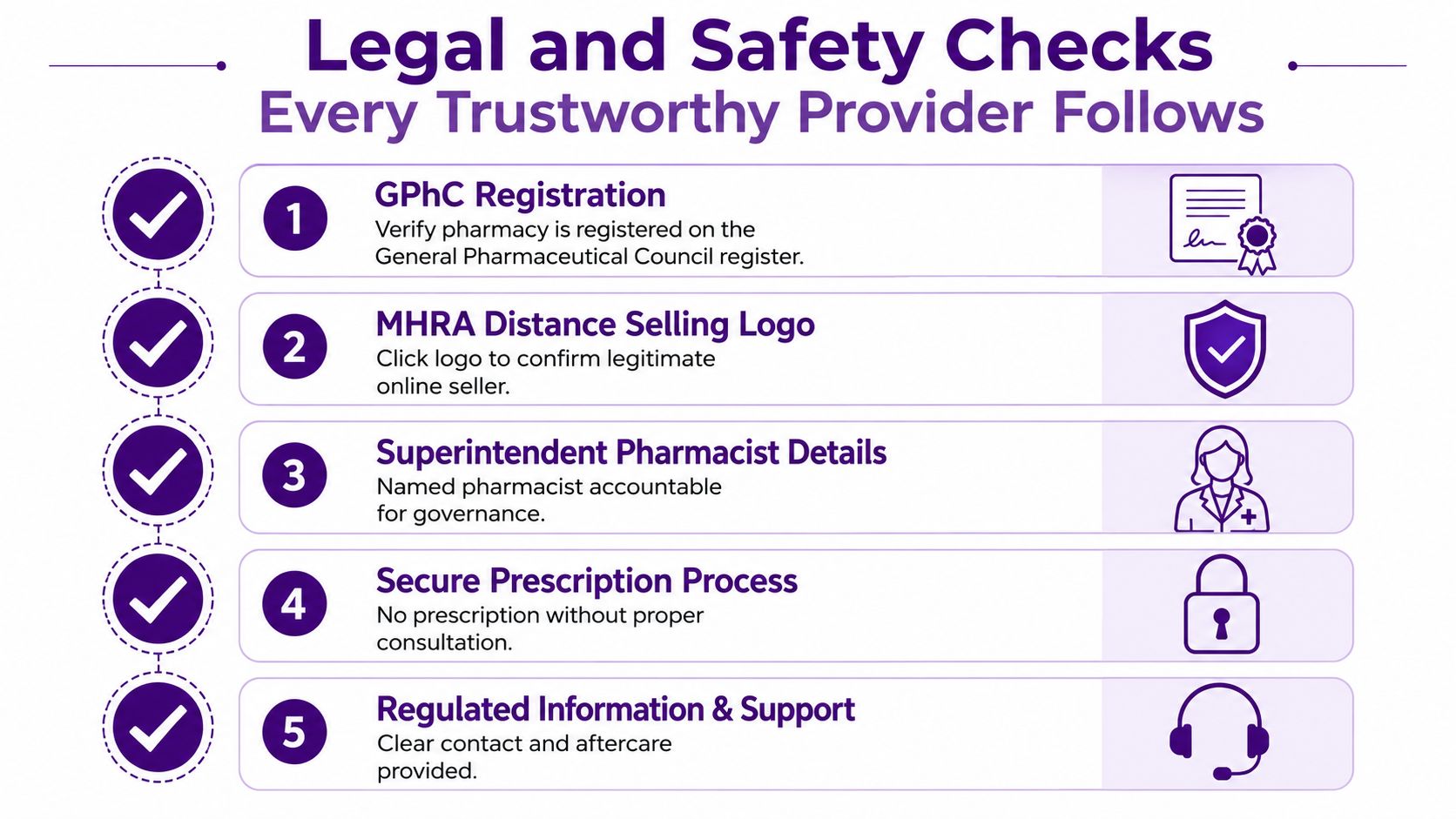
A legitimate online pharmacy should make its regulatory identity easy to verify. UK medicine-supply rules require online sellers of medicines to register with the MHRA and display the Distance Selling Logo on every page of a website offering medicines to the public. The logo should be clickable, allowing you to check the seller rather than treating the image as decoration. The relevant UK government factsheet on online medicine sellers sets out these requirements.
Registered pharmacies providing distance services must follow General Pharmaceutical Council standards. The prescriber must also work within national UK prescribing guidance. Look for the pharmacy's registration information, accountable pharmacist details, consultation arrangements and a realistic contact route.
What the February 2025 changes mean
The GPhC guidance update matters because it addresses how online consultations can fail. A provider shouldn't accept an unchecked questionnaire, allow a person to choose a medicine before proper clinical assessment or make prescribing a one-way process. The safeguards include:
- Verified answers: the service checks the information supplied at the start.
- Two-way contact: the prescriber can communicate with the patient before deciding.
- Responsible advertising: marketing shouldn't create misleading expectations about treatment.
- Controlled medicine selection: choosing a product shouldn't replace consultation.
Temperature control is another governance test. NHS Specialist Pharmacy Service guidance recommends suitable transit packaging, clear storage-condition labelling, specialist logistics where required and an audit trail recording logistics, times and temperatures for cold-chain items. Read the NHS Specialist Pharmacy Service guidance on transporting medicines for the operational principles.
| Check | What Good Looks Like | Why It Matters |
|---|---|---|
| Pharmacy registration | A verifiable GPhC-registered pharmacy | Shows that the pharmacy operates within professional standards |
| Seller verification | MHRA registration and the Distance Selling Logo | Helps confirm that the online seller is recognised |
| Consultation | Initial answers are checked and follow-up communication is possible | Supports a genuine suitability assessment |
| Prescriber accountability | Clear information about the prescribing service and UK guidance | Identifies who makes the clinical decision |
| Cold-chain process | Validated packaging, labelled storage conditions and temperature records | Protects medicines that may be damaged by unsuitable temperatures |
Readers wanting a broader explanation of online medicine risks can also consult this guide from FindMyScript on online pharmacies, while people specifically comparing prescription-based weight-management services can review this guide to online pharmacy prescriptions. Neither resource replaces checking the provider's current registration and consultation process yourself.
Delivery Options Timelines Costs and Privacy Explained
Delivery isn't one universal service. The right method depends on the medicine's storage requirements, the provider's courier arrangements and what happens if nobody receives the parcel.
For medicines that don't require refrigeration, a standard tracked next-day service may be appropriate after approval. For refrigerated products, the pharmacy needs validated packaging and a specialist workflow that can protect the product throughout transit. UK pharmacy logistics commonly use 2°C to 8°C as the refrigerated transport band and 15°C to 25°C for ambient pharmaceutical products, with systems for monitoring, calibration, vehicle mapping and responding to excursions. These operational distinctions are described in Pharmacy Network's cold-chain guidance.
| Delivery type | Typical use | What to check |
|---|---|---|
| Tracked standard delivery | Ambient medicines | Dispatch confirmation, tracking and clear missed-delivery instructions |
| Next-day tracked delivery | Medicines suitable for ordinary transport | Cut-off times, delivery coverage and what happens if the parcel is delayed |
| Specialist cold-chain delivery | Refrigerated or thermolabile medicines | Validated packaging, temperature monitoring and excursion support |
| Safe-place or unattended delivery | Only where the medicine and provider allow it | Whether the location protects the parcel and whether refrigeration is available immediately |
A delivery date isn't guaranteed just because a website uses the phrase “next day”. Ask when dispatch occurs, whether weekends and bank holidays affect the service and what the courier does after a failed attempt. A temperature-sensitive parcel may need a different response from an ordinary parcel.
Costs and privacy
Some providers include delivery in the treatment price, while others charge separately or offer different rates for delivery methods. Check the complete cost before you confirm an order. The price should be clear about the consultation, medicine, delivery and any ongoing clinical support.
Packaging is usually designed to avoid identifying the medicine from the outside. Privacy also depends on your account security, the provider's communication channels and who can access the delivery address. Use a private email account where possible and review whether text or email notifications could disclose sensitive information on a shared device.
Medicines generally can't be treated like ordinary retail goods. Don't return or dispose of a medicine through an informal arrangement because the packaging is damaged, the product was ordered in error or you missed the delivery. Contact the pharmacy for instructions, particularly if the parcel contains a refrigerated medicine. For more detail on delivery pricing questions, see this guide to online pharmacy delivery options in the UK.
Practical Support for Weight Loss Medication Users After Delivery
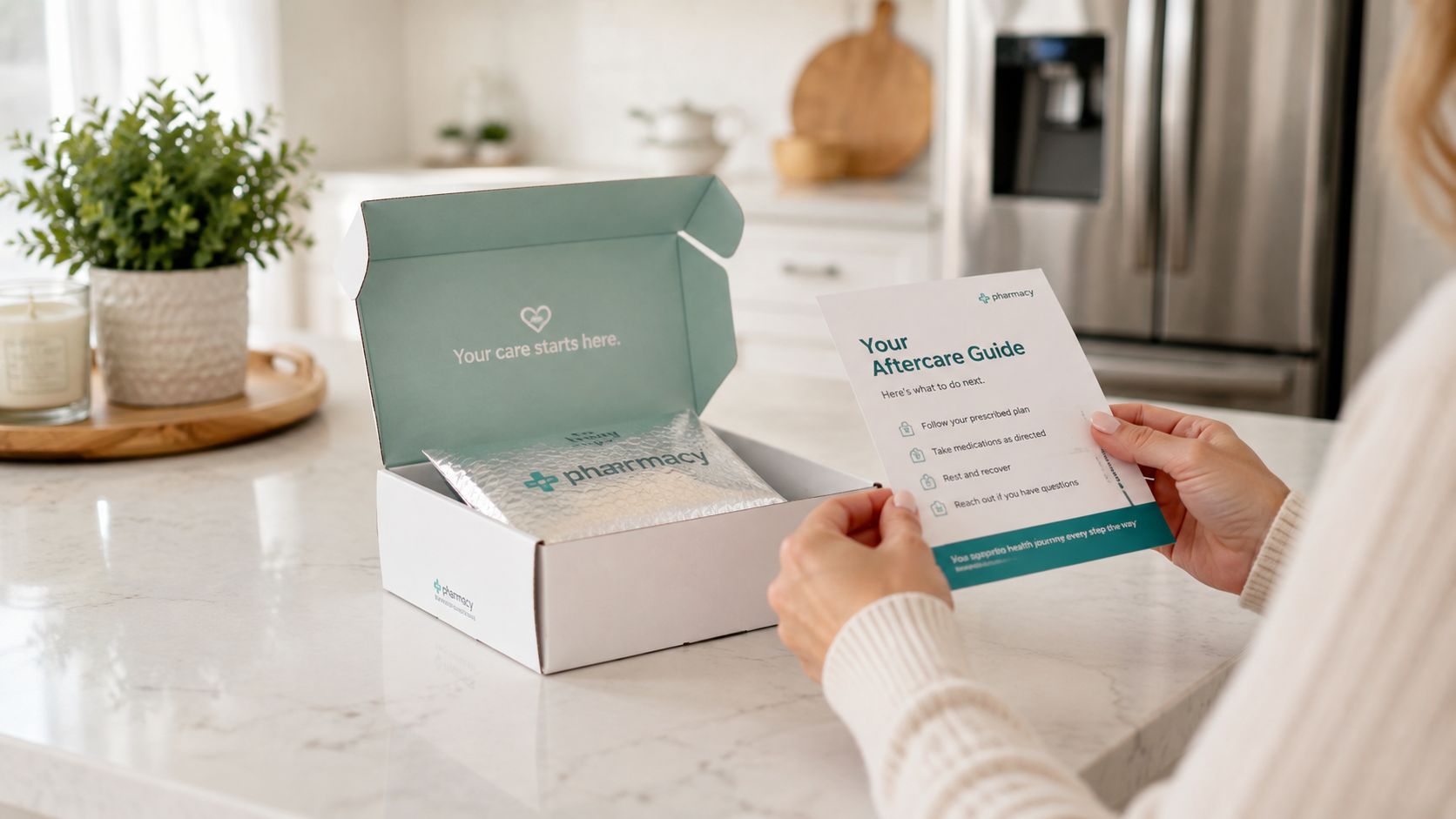
The delivery is the start of treatment, not the end of clinical care. Read the dispensing label and patient information, then store the medicine exactly as instructed. Refrigerated products need prompt attention after arrival, while products suitable for ambient transport still require protection from inappropriate heat, light or freezing.
If a cold-chain parcel feels warm, arrives damaged or appears to have been delayed, don't inject or use the medicine until the pharmacy or clinical team advises you. Keep the packaging and delivery information, note what you observed and contact the provider through its clinical support channel. A pharmacy can assess the circumstances and explain whether replacement or another step is needed.
What the evidence can and can't tell you
Clinical trials provide useful expectations, but they don't promise an individual result. NICE reports that participants in the STEP 1 randomised double-blind trial taking semaglutide lost an average of 12% more body weight than placebo, and a NICE briefing states that the STEP 1 population lost 14.9% of body weight over 68 weeks. NICE's evidence-based information on semaglutide puts those results in their proper clinical context.
For tirzepatide, NICE-reviewed trial evidence reported around 22.5% body-weight loss over 72 weeks in clinical trials. BMJ reporting on the NICE appraisal also noted that 96.3% of participants taking 15 mg lost at least 5% of body weight, compared with 27.9% taking placebo with diet and exercise advice. The figures appear in this rapid review of evidence for obesity-management medicines. Trial outcomes don't remove the need for prescribing supervision, gradual dose decisions and attention to nutrition and activity.
Mild side effects can occur, but symptoms that are severe, persistent or worrying need clinical advice. Seek urgent help for an emergency, rather than waiting for an online message. Ongoing one-to-one support, progress tracking, nutrition guidance and strength-focused activity can help turn a prescription into a broader health plan, without presenting the medicine as a substitute for those foundations.
For a patient-friendly explanation of treatment considerations, including how GLP-1 medications work for women, use a source that keeps the discussion educational and remember that personal suitability still requires a clinician's assessment. Practical storage questions are also covered in this guide to whether Wegovy needs refrigeration.
How to Choose a Provider and Spot Red Flags With Confidence
A provider shouldn't make you choose between speed and safety. The strongest signs are straightforward: verifiable GPhC registration, MHRA seller information and Distance Selling Logo checks, a named or identifiable clinical service, a genuine two-way consultation, transparent pricing and a delivery method suitable for the medicine.
Red flags include a medicine being selected before consultation, a service that never allows prescriber contact, unclear pharmacy details, pressure to buy immediately or promises of guaranteed outcomes. A fast form isn't automatically unsafe, but a form that leads directly to payment and dispatch without meaningful clinical review deserves caution.
Use this short checklist before ordering:
- Verify the seller: check the MHRA information and Distance Selling Logo.
- Verify the pharmacy: confirm the pharmacy's GPhC registration.
- Test communication: ask how you can contact the prescriber or pharmacist.
- Check delivery controls: ask how refrigerated medicines are packed, monitored and handled after a delay.
- Plan aftercare: confirm who supports you if side effects occur or the parcel arrives compromised.
Online pharmacy delivery may suit routine, clinically appropriate treatment when remote assessment is enough. It isn't the right route for an emergency, a situation requiring physical examination or a problem the provider can't safely assess remotely. If you're unsure, contact your GP, pharmacist or urgent care service.
Trim provides a UK-based online weight-management service through a GPhC-registered pharmacy, with a five-minute digital consultation, clinician assessment, discreet delivery and ongoing support. To review how its regulated online pharmacy delivery process works, visit Trim and check whether the service is appropriate for your circumstances.