
Online Pharmacy UK Free Delivery: A Practical Guide

You're comparing two online pharmacies for a medicine you need soon. One advertises free next-day delivery, while the other adds a delivery charge but gives clearer information about its pharmacy, prescriber and follow-up care. The first basket looks cheaper until a consultation fee, a higher medicine price or a subscription renewal appears at checkout.
That's why online pharmacy UK free delivery shouldn't be treated as a price-only search. Delivery matters, particularly when a medicine is time-sensitive, but the safer question is whether the pharmacy can dispense lawfully, assess you properly, protect your information and resolve problems when a parcel is late or compromised.
Table of Contents
- Why Free Delivery Is Only Part of the Story
- What Counts as a Legitimate Online Pharmacy in the UK
- Prescription, Pharmacy and Over-the-Counter Rules Online
- Delivery Types, Timelines and What Free Really Means
- Hidden Costs Behind the Free Delivery Headline
- Packaging, Privacy, Returns and What Happens When Things Go Wrong
- Red Flags, Green Flags and Medically Supervised Services
- Your Checklist and Quick Answers Before You Order
Why Free Delivery Is Only Part of the Story
A Manchester patient ordering a repeat inhaler might naturally choose the site promising free 24-hour delivery. A second provider charges for standard delivery, but clearly identifies its dispensing pharmacy and explains how prescription approval works. The apparently cheaper option may add a consultation fee, price the inhaler higher and provide no meaningful route back to a pharmacist once the parcel arrives.
The delivery line is only one part of the landed cost. You also need to compare the medicine price, consultation or prescription fees, whether the service dispenses from its own pharmacy, and what happens when the prescriber needs more information. A fast parcel isn't useful if clinical checks are rushed or supply stops after the first order.
The UK market shows why this distinction matters. YouGov's research into pharmacy delivery demand found that 18% of Britons had used a pharmacy delivery service in the past year, while 40% said they would use one in the next 12 months if available. Demand was particularly pronounced in the Midlands, Scotland and Wales, with convenience and difficulty reaching a pharmacy among the main reasons for choosing home delivery.
My view: free delivery should be a baseline service, not the main proof that an online pharmacy deserves your prescription.
Independent 2025 UK industry research reported that the seven largest online pharmacy platforms dispensed 36 million items in 2024, with 11% year-on-year growth. Yet only 12% offered same-day delivery, while 60% offered next-day delivery, so “fast” doesn't automatically mean “same day” or “clinically reliable”. The same report found that 80% of online pharmacies relied on Royal Mail for fulfilment, while 35% of users reported Royal Mail delivery issues in 2024, including 13% who experienced delays or missed parcels.
Judge the provider on four points: legality, clinical oversight, continuity of supply and delivery reliability. If free delivery is hiding weak answers to any of those questions, it isn't a saving.
What Counts as a Legitimate Online Pharmacy in the UK
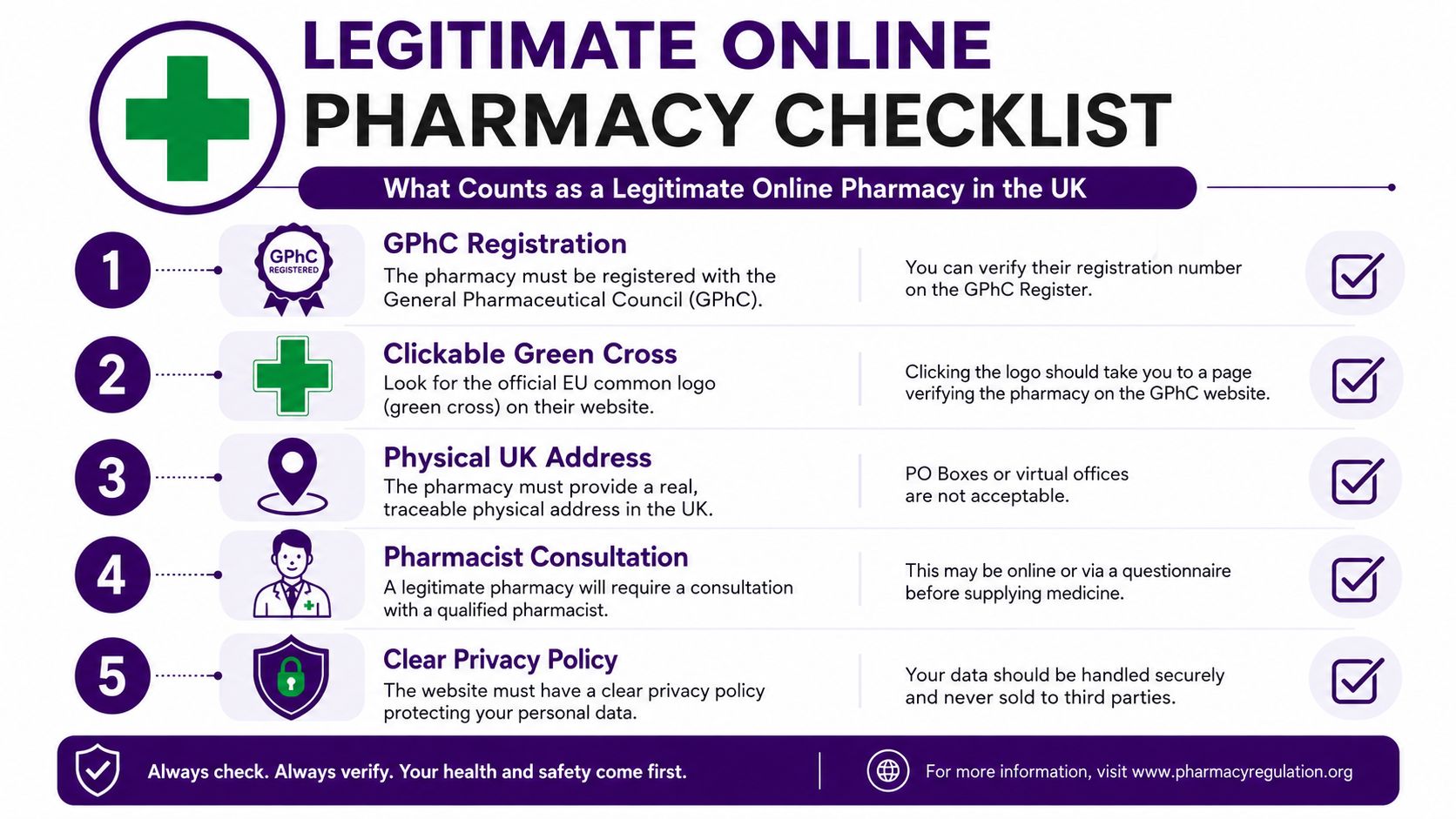
A legitimate UK distance-selling pharmacy should be verifiable before you enter payment details. Start with the General Pharmaceutical Council, or GPhC, the regulator for registered pharmacies in Great Britain.
Verify the pharmacy itself
Look for the pharmacy's GPhC registration details in the website footer. A genuine site commonly displays a clickable green cross that takes you to the pharmacy's entry on the official register. Don't rely on a logo that doesn't open a regulator record. Search the pharmacy directly on the GPhC pharmacy register.
The register should match the business name and physical premises shown on the website. Since 2015, GPhC-registered distance-selling pharmacies have been required to operate from registered UK premises and meet standards covering areas such as identity verification, prescription handling and record keeping. A registered pharmacy should also have a superintendent pharmacist and medicines should remain under a registered pharmacist's control.
Check who prescribes and dispenses
Prescription-only medicines must follow a proper prescription process. The provider should name the prescriber, identify the relevant professional registration and explain how the consultation works. A site that asks one superficial question before offering a prescription medicine isn't demonstrating adequate clinical assessment.
The dispensing pharmacy should be identifiable too. A delivery-led seller may look polished while outsourcing the clinical process or directing you to a third party. That arrangement needs scrutiny, particularly where the medicine has important contraindications, monitoring requirements or interactions.
For weight-management services, read beyond delivery claims. This guide to online pharmacies and prescriptions is useful for understanding why a valid prescription involves more than a checkout screen.
Confirm the location and accountability
The site should publish a physical UK pharmacy address, telephone contact and complaints route. It should explain how records are kept, how your GP may be involved and what support is available after dispensing.
Avoid any website that sells prescription medicines without a proper consultation, hides its UK address or provides no named UK pharmacist. Verify the registration independently before ordering. A trustworthy provider won't object to you checking its credentials.
Prescription, Pharmacy and Over-the-Counter Rules Online
The legal category of a medicine determines what must happen before an online pharmacy can supply it. Free delivery doesn't remove those requirements.
| Category | Consultation Required | Example Products |
|---|---|---|
| Prescription-Only Medicine, POM | A valid prescription following an appropriate clinical assessment | Weight-management injections, strong painkillers and some hair-loss treatments |
| Pharmacy Medicine, P | A registered pharmacist must assess suitability under the relevant sale protocol | Higher-dose ibuprofen, certain antihistamines and emergency contraception |
| General Sales List, GSL | No formal consultation is normally required for the sale | Paracetamol, vitamins and basic first-aid products |
POM medicines
A POM can be prescribed by an online prescriber after a clinical consultation, or supplied against a prescription transferred from a GP through the Electronic Prescription Service. The provider must gather enough information to make a safe decision, including relevant conditions, current medicines, allergies and clinical history.
Weight-management injections sit firmly in the clinically supervised part of this system. NICE recommends semaglutide, marketed as Wegovy, for adults with obesity only alongside a reduced-calorie diet and increased physical activity, where the person has at least one weight-related comorbidity and a BMI of at least 35 kg/m². In exceptional cases, specialist referral may apply for a BMI of 30.0 to 34.9 kg/m².
NICE's tirzepatide guidance also requires a reduced-calorie diet and increased physical activity, and applies to adults with a BMI of at least 35 kg/m² plus at least one weight-related comorbidity. NHS England describes use in primary care and specialist weight-management services.
P medicines
A P medicine isn't an unrestricted product. The pharmacist needs to assess whether it's appropriate, and the questionnaire should allow proper clinical review rather than a token yes-or-no answer. Emergency contraception, for example, requires questions about timing, other medicines, health conditions and pregnancy risk.
GSL medicines
GSL products can generally be sold without a formal consultation, although responsible sellers still provide instructions and safety information. A simple sale of paracetamol is very different from supplying a prescription injection. If a website treats both transactions identically, that's a warning sign.
Delivery Types, Timelines and What Free Really Means
“Free delivery” usually describes the last mile, not the full time from consultation to treatment. The pharmacy may still need to receive or validate a prescription, complete clinical checks, dispense the item and hand it to a courier. GP sign-off, weekends and bank holidays can extend the process.
| Delivery Type | Typical Cutoff | Realistic Timeline | Average Cost | Free Threshold |
|---|---|---|---|---|
| Standard tracked delivery | Depends on the pharmacy and carrier | Often slower than next-day, with working-day exclusions | Varies by provider | May be included or linked to an order condition |
| Next-day courier | Often an afternoon cutoff | Next working day after approval and dispensing | Varies by provider | May be limited to selected baskets or services |
| Same-day delivery | Usually an earlier local cutoff | Same day in selected cities | Varies by location | Less commonly included |
| Click and collect | Depends on pharmacy and collection point | After dispensing and carrier transfer | Varies by provider | May be offered instead of home delivery |
Don't assume a free option means the fastest option. Standard Royal Mail Tracked or a similar workflow is commonly used to keep delivery free, while next-day or same-day services may carry a charge. Pharmacy2U's delivery information illustrates the two-stage model: the pharmacy receives the prescription, performs clinical and dispensing checks, then hands the parcel to tracked delivery.
A delivery promise should state whether the clock starts at checkout or after approval. If a prescriber needs clarification, the parcel won't move just because you ordered before the advertised cutoff. The provider should also explain what happens to refrigerated medicines, bulky supplies and deliveries to remote areas.
Cold-chain medicines, including insulin and some GLP-1 treatments, need packaging and transport suitable for their storage requirements. Incontinence and mobility products may be treated differently because of their size. Highlands, Islands, Northern Ireland and the Channel Islands can have separate services or surcharges, so read the exclusions rather than relying on the headline.
For a specific provider's terms, review the Trim shipping policy before checkout. Check tracking, signature requirements, age verification, safe-place instructions and whether a missed delivery triggers a second attempt or collection.
Hidden Costs Behind the Free Delivery Headline
Free delivery doesn't mean free treatment. It means the operator has chosen not to show a separate delivery charge under the conditions stated in its terms. The medicine, consultation and dispensing work still have to be paid for somewhere.
A private online order may include an online clinician consultation fee, a private prescription charge or a higher medicine price than the same product supplied through an NHS route. A price comparison should therefore use the total amount payable, not the delivery line alone. Check whether the displayed price includes clinical review and dispensing.
Read the basket carefully
Look for these cost layers:
- Consultation fee: A pharmacist-led questionnaire may have a separate charge, while prescriber sign-off can be priced differently.
- Prescription charge: Private prescriptions may attract a per-item fee when NHS arrangements don't apply.
- Medicine format: A single pack may cost more per tablet or dose than a larger pack, but a larger pack isn't cheaper if you won't use it.
- Brand choice: Branded products can cost more than equivalent generic medicines where a suitable generic exists.
- Special handling: Temperature-sensitive medicines may require premium packaging or a specialist courier.
- Repeat billing: Some clinics use subscriptions, with an introductory price followed by automatic refills unless you cancel.
- Returns friction: Once a prescription medicine has left the pharmacy, it generally can't be returned for resale.
Don't enter card details until you know whether the order is one-off or recurring. The cancellation process should be visible, the renewal date should be clear and the provider should tell you how to stop future dispensing.
NHS repeat prescriptions in England illustrate another important distinction. Well's explanation of prescription delivery states that “free delivery” generally means no extra delivery charge on top of the standard NHS prescription charge, unless the patient is exempt. Scotland, Wales and Northern Ireland have different NHS prescription charging arrangements for eligible prescriptions, so free delivery there is mainly about convenience, adherence support and reducing missed doses.
Practical rule: compare medicine price, clinical fees, delivery conditions and repeat-order terms in one total. A zero delivery line doesn't make a high-cost basket good value.
Packaging, Privacy, Returns and What Happens When Things Go Wrong
A compliant delivery should protect both the medicine and the patient. Look for a tamper-evident inner package, a plain outer box and patient-specific labelling that states the medicine, directions and relevant warnings. Sensitive medicines, including treatments for sexual health, mental health and weight management, should arrive without unnecessary medical branding.
Temperature-sensitive parcels need extra care. If a refrigerated item arrives warm, damaged or with compromised packaging, don't use it until the dispensing pharmacy has assessed it. Take photographs of the outer packaging, inner packaging, labels and any temperature indicator before disposing of anything.
Health information needs proper handling
Your order contains special category health data. The pharmacy should publish a privacy policy explaining how it collects, stores and shares that information, including whether it communicates with your GP and what consent means. You can ask the pharmacy for access to the health record it holds about you, subject to the applicable data-protection process.
A legitimate service should also explain its identity checks. Those checks protect against supplying medicines to the wrong person, particularly where controlled, high-risk or age-restricted products are involved. Convenience doesn't justify weak verification.
Act quickly when delivery fails
Use this sequence if a parcel is late, lost or compromised:
- Record the condition: Photograph the parcel and keep tracking details.
- Contact the pharmacy promptly: Explain whether it is late, missing, damaged or warm.
- Follow the complaints procedure: Ask for a replacement, refund or clinical advice, depending on the medicine and circumstances.
- Escalate unresolved concerns: Contact the GPhC if the pharmacy doesn't address a serious concern or complaint appropriately.
Medicines usually can't be returned once dispatched unless they were supplied in error or are faulty, because the pharmacy can't safely put them back into stock. A provider's refund policy should explain how it handles damaged or temperature-compromised deliveries. Read Trim's refund policy before ordering any prescription treatment.
Red Flags, Green Flags and Medically Supervised Services
A delivery-led seller focuses on getting a product into a parcel. A properly regulated distance pharmacy focuses first on whether the medicine is suitable for the individual, then on dispensing and delivery.
| Signal | Red Flag | Green Flag |
|---|---|---|
| Registration | No GPhC number or an unverified logo | A searchable GPhC entry matching the pharmacy |
| Clinical review | Prescription medicine offered after one superficial question | A recorded consultation covering relevant medical history |
| Prescriber | No named clinician or professional registration | A verifiable UK-registered prescriber |
| Pharmacy identity | No physical UK address or superintendent pharmacist | Clear dispensing premises and accountable pharmacist |
| Aftercare | Courier delivery with no follow-up route | Monitoring, follow-up and complaints support |
| Commercial pressure | Subscription pressure or unclear renewal terms | Transparent one-off and repeat-order choices |
The GPhC's 2025 online pharmacy case review identified rising concerns around weight management, advertising, delivery issues and pharmacy systems. That makes aftercare a practical safety test, not a marketing extra.
For higher-risk treatments, medically supervised care should include eligibility screening, side-effect monitoring, dosage decisions made by a prescriber and a documented route for follow-up. NICE describes tirzepatide's evidence base through the SURMOUNT-1 randomised, double-blind trial against placebo, with diet and exercise support, while its semaglutide evidence summary reports an average additional body-weight loss of 12.4% versus placebo. The NICE evidence summary supports an educational discussion about clinical evidence, not a sales promise.
Trim is one example of a UK weight-management service that describes a digital clinical assessment, prescription review, ongoing support and discreet delivery. Treat those features as questions to verify, not substitutes for checking the pharmacy and prescriber independently.
Your Checklist and Quick Answers Before You Order
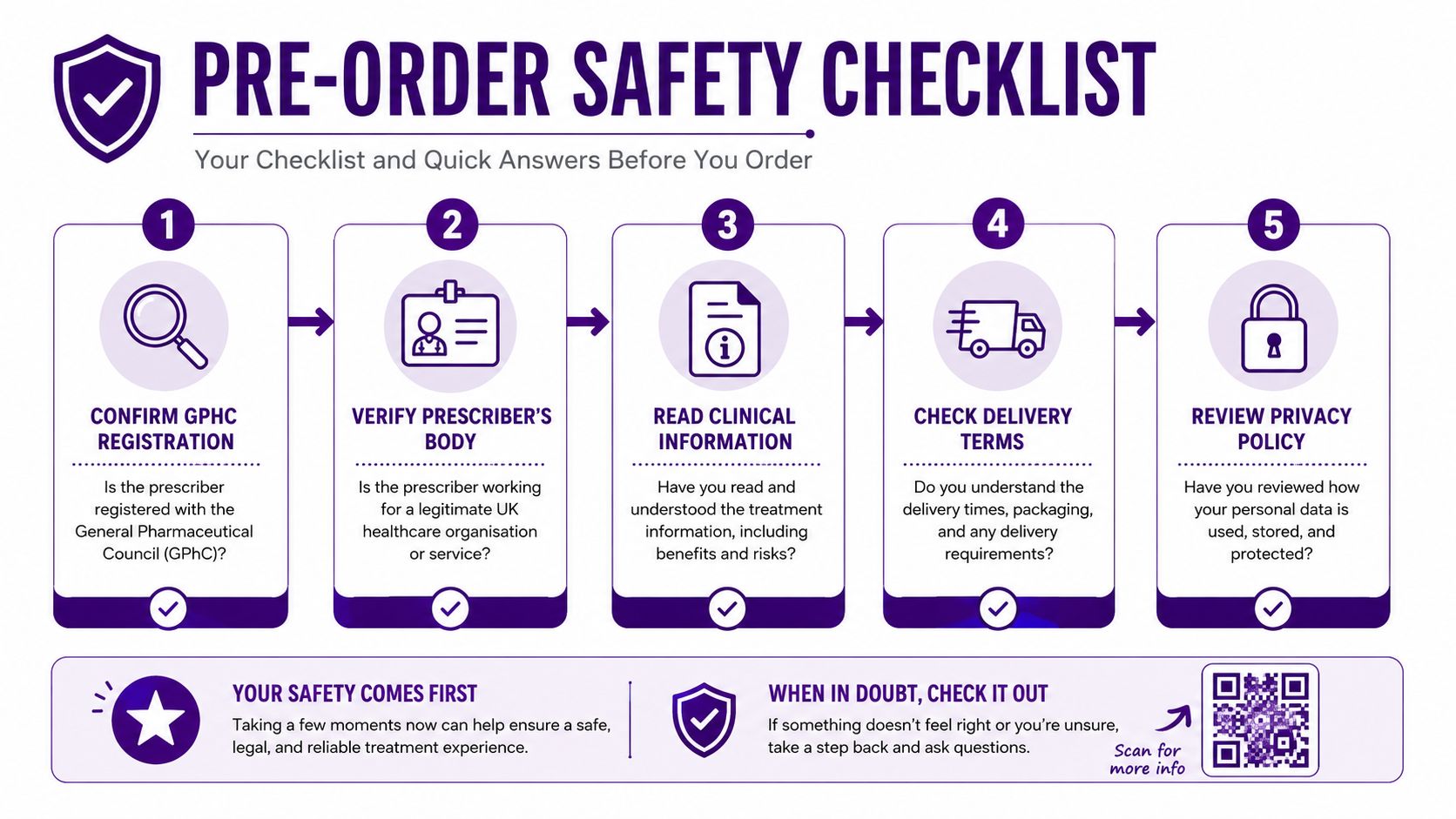
Save this checklist in your notes and use it for every provider:
- Confirm GPhC registration: Search the official register and match the business name and premises.
- Verify the prescriber: Check the clinician's professional registration and role.
- Read the consultation process: Make sure the questions cover medicines, conditions, allergies and relevant history.
- Identify the pharmacy: Record the dispensing address and superintendent pharmacist details.
- Check delivery terms: Look for approval cutoffs, tracking, cold-chain rules, remote-area exclusions and missed-delivery procedures.
- Review repeat billing: Confirm whether the order renews automatically and how cancellation works.
- Find complaints information: Make sure you know who handles clinical and delivery problems.
- Read the privacy policy: Check how health information is stored and shared.
Quick answers
What about antibiotics or an EpiPen? Don't use delivery promises as a substitute for urgent clinical care. Contact your GP, urgent treatment service or emergency service when timing or symptoms make waiting unsafe.
How should refrigerated medicines be delivered? Ask the pharmacy how it protects the medicine during transport and what you should do if the parcel arrives warm or delayed.
Can Mounjaro or Wegovy be ordered online? No. These are prescription medicines requiring an appropriate clinical assessment. NICE's eligibility conditions for semaglutide and tirzepatide apply as described earlier.
What if a parcel is late? Contact the dispensing pharmacy promptly, don't take compromised medicine and follow its complaints process.
How do repeat prescriptions work? The pharmacy should explain whether it receives an NHS repeat prescription, requests authorisation from your GP or issues a private prescription after a new clinical review.
When should you contact the GPhC? Escalate concerns about unsafe pharmacy practice, unverified registration, inappropriate supply or unresolved complaints through the regulator's published routes.
Trim provides a UK pharmacy and clinically supervised weight-management service, with clinician assessment, prescription review, discreet delivery and ongoing support rather than a delivery-only transaction. If you're comparing online pharmacy UK free delivery options for treatments such as Mounjaro or Wegovy, visit Trim to review the consultation and delivery information before deciding.