
Online Pharmacy UK Next Day Delivery: A Practical Guide

You've ordered a prescription online because you need it quickly, then reached the checkout page wondering what “next day” means. Does it include your postcode? Has a clinician assessed you, or has an automated form approved the medicine? And if the treatment needs refrigeration, how can it arrive safely in an ordinary parcel?
For UK online pharmacy next day delivery, the courier is only the final part of the process. A lawful order also depends on identity checks, clinical assessment, prescribing, dispensing, suitable packaging, and a delivery service that can reach your address within the stated timeframe. The fastest trustworthy service is therefore not necessarily the one with the boldest promise. It's the one that explains its limits clearly.
Table of Contents
- How a UK Online Pharmacy Order Actually Reaches You
- The Regulatory Framework Behind Next Day Dispensing
- The Ordering and Delivery Timeline Step by Step
- Weight Loss Medicines Available With Next Day Delivery
- How to Choose a Trusted UK Online Pharmacy
- Costs Shipping and Postcode Realities
- Common Questions UK Readers Still Ask
- Red Flags and When Next Day Delivery Is the Wrong Choice
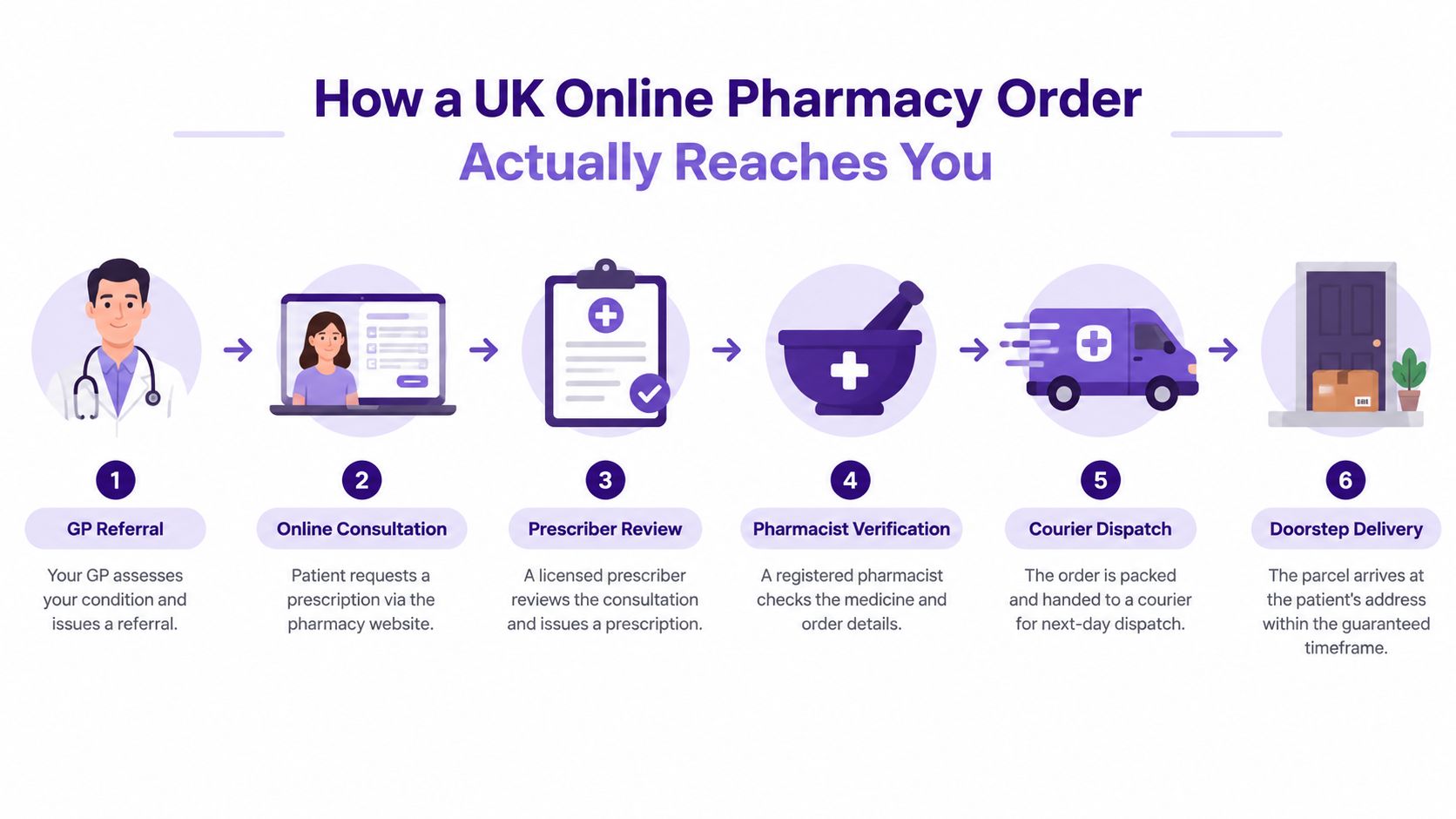
How a UK Online Pharmacy Order Actually Reaches You
Sarah is 38 and lives in Leeds. Her GP has discussed weight management with her, but an NHS referral has stalled on a waiting list. She decides to explore a GLP-1 prescription through a GPhC-registered online pharmacy, knowing that an online service still needs proper clinical oversight.
She begins with an online consultation. She provides her medical history, current medicines, relevant measurements, and information about previous treatment. If the service is connected to her GP, records may be transferred through an authorised clinical process. An online form doesn't replace professional judgement. A prescriber reviews the information and decides whether treatment is clinically appropriate, whether more information is needed, or whether the request should be declined.
The prescriber sits between the consultation and the pharmacy. They're responsible for making a prescribing decision within their professional scope. Once a prescription exists, a registered pharmacist checks the medicine, directions, patient details, and any obvious safety concerns before the dispensary prepares the parcel.
Why the parcel comes from a dispensary
Sarah's medicine shouldn't leave an anonymous fulfilment warehouse. It should be dispensed from a licensed pharmacy premises, where the pharmacy team can select the correct product, label it legally, check the prescription, and document the supply.
Orders approved before 3pm on a working day may be dispatched that day at some UK online pharmacies. Orders approved after 3pm, or during a weekend, may wait until the next working day, as explained by MailMyMeds' delivery information. The courier then carries out the final leg, commonly using a tracked service.
Technology can help pharmacies plan routes and handovers, but it doesn't remove the clinical steps. Readers interested in the logistics side can explore AI for last mile delivery optimization, while those comparing services can review this guide to online pharmacy delivery.
Practical rule: Next-day delivery starts when the prescription has been clinically approved, not when you first submit a questionnaire.
The Regulatory Framework Behind Next Day Dispensing
An online pharmacy is still a pharmacy. Its website may resemble an online shop, but the medicine supply must sit within the UK's regulatory system.
The checks behind the website
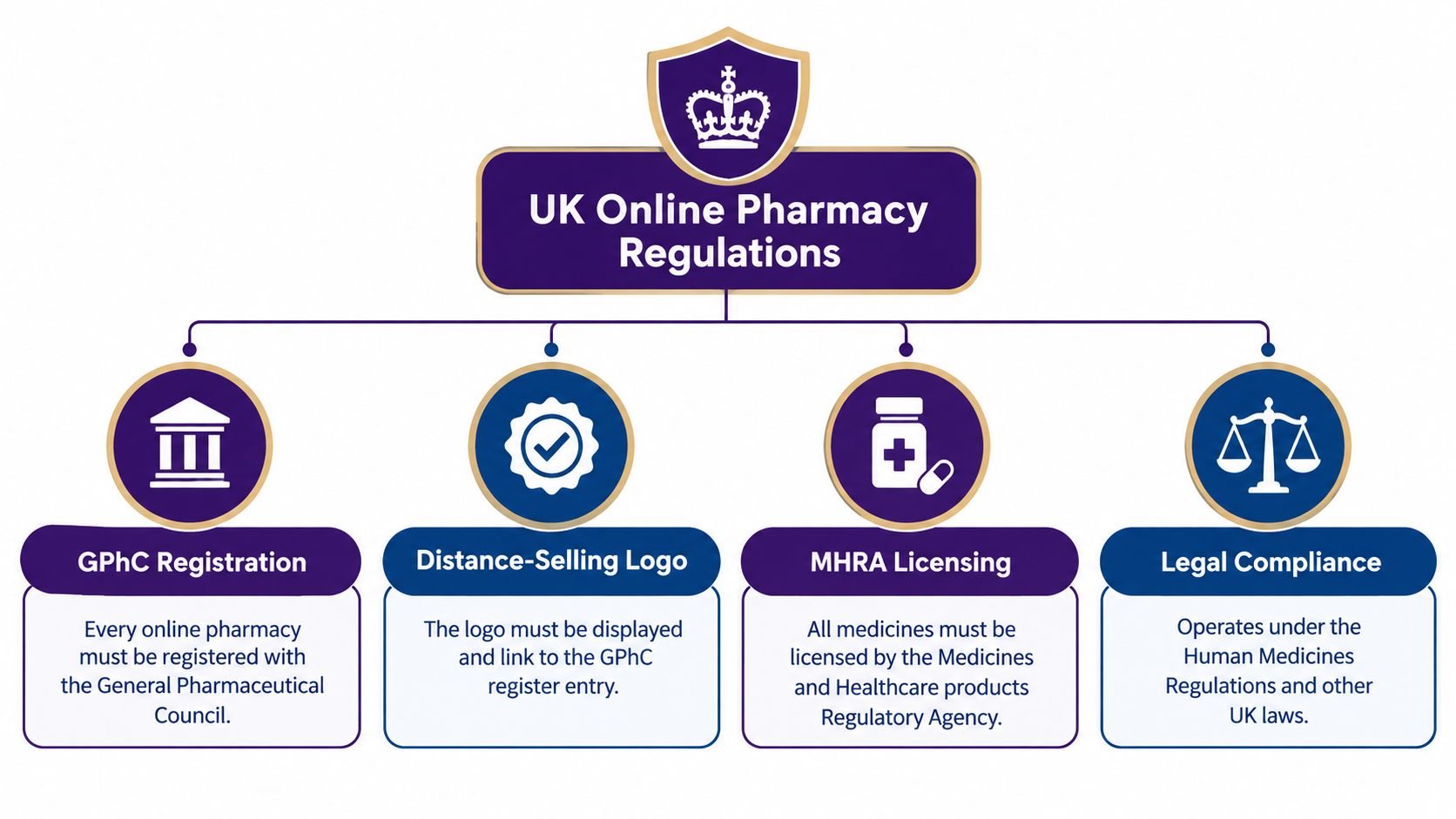
In Great Britain, pharmacies providing services online must be registered and meet pharmacy standards. The General Pharmaceutical Council, or GPhC, regulates pharmacy premises and professionals in Great Britain. Its guidance on providing pharmacy services online explains the importance of registration and online service requirements.
A legitimate website should make it possible to identify the pharmacy and verify its registration. The distance-selling logo should be visible and should link to the pharmacy's entry on the relevant register. That link matters because a logo displayed as a decorative image proves little if it doesn't lead to an official record.
Medicines themselves also need the correct legal authorisation. The Medicines and Healthcare products Regulatory Agency, or MHRA, has a role in the licensing and regulation of medicines, while pharmacies operate under the Human Medicines Regulations and other applicable UK laws.
Why prescribing is separate from dispensing
The clinician who assesses you may be a doctor, nurse prescriber, or pharmacist independent prescriber, depending on the service and the clinical arrangement. The pharmacy then dispenses against the prescription. Separating these responsibilities creates accountability, although one organisation may provide both the consultation and dispensing service.
The 2025 rules for distance-selling pharmacies in England introduced further change. New applications were restricted from 23 June 2025, and the rules changed what services could be delivered from distance-selling premises from 1 October 2025, according to the relevant regulatory information. For patients, the practical message is simple: a provider should be able to explain how it verifies identity, assesses suitability, manages safeguarding concerns, and arranges a consultation when an online questionnaire raises red flags.
Packaging is another quiet part of the safety chain. A useful introduction to tamper-evident pharmaceutical packaging explains why packaging security helps identify interference before a patient uses a medicine.
The Ordering and Delivery Timeline Step by Step
The clock usually begins with account creation and the eligibility questionnaire, not with the courier notification. You may need to provide photo identification, confirm your address, list current medicines, and answer health questions. A prescriber then reviews the information. If the answers are incomplete or clinically concerning, the service may request clarification or arrange a synchronous consultation.
For a working-day order, the important cut-off is often 3pm. Approval before that time may allow same-day dispatch. Approval after it can move dispatch to the next working day. Weekend submissions may also wait until Monday, depending on the provider and bank-holiday arrangements.
A practical delivery clock
| Order placed | Prescriber cut-off | Dispensed | Arrives |
|---|---|---|---|
| Monday morning | Approved before 3pm Monday | Monday | Tuesday, where the postcode and service qualify |
| Monday after the cut-off | Review completed Tuesday | Tuesday | Wednesday |
| Friday morning | Approved before the provider's Friday cut-off | Friday | Next working day, subject to the courier service |
| Saturday or Sunday | No weekend approval or dispatch | Monday or the next working day | Tuesday or later |
These are illustrations of the workflow, not guarantees. A provider may use Royal Mail or DPD, and the promise can differ by postcode. Saturday delivery may involve an additional charge or may not be available.
Where weight-management orders need extra care
GLP-1 medicines such as injectable weight-loss treatments may require temperature-controlled packaging. One UK pharmacy describes pharmacy-grade Woolcool packaging and ice packs for temperature-sensitive products, including weight-loss injectables, while a pharmaceutical logistics provider describes chilled delivery and next-day mainland services. The important question is whether the provider has a validated process for storage, packing, transport, and receipt.
Repeat patients also need to allow for dose titration, clinical reviews, prescription renewal, and stock availability. A repeat order isn't always a simple copy of the previous parcel. If the dose changes, the prescriber may need fresh information before the dispensary can release it.
Weight Loss Medicines Available With Next Day Delivery
Next-day availability doesn't make a medicine suitable for every patient. The clinical decision comes first, and NICE states that medicines for weight management should be used alongside a reduced-calorie diet and increased physical activity, not as a stand-alone replacement for broader care. NICE's medicine options for weight management in adults sets out that multicomponent approach.
Semaglutide, marketed as Wegovy for weight management, is a GLP-1 medicine given by injection. NICE's recommendation refers to evidence from the STEP 1 randomised double-blind trial, in which participants taking semaglutide lost an average of 12% more body weight than those taking placebo. NICE says it can be offered to adults with at least one weight-related comorbidity and a BMI of at least 35 kg/m², or exceptionally at a BMI of 30.0 to 34.9 kg/m² when referred to tier 3 services. These criteria come from NICE's recommendation for semaglutide.
Tirzepatide, marketed as Mounjaro, also requires clinical assessment and follow-up. NICE guidance says treatment should be reconsidered if the patient has lost less than 5% of initial body weight after 6 months. The same NICE prescribing summary says lower BMI thresholds are usually reduced by 2.5 kg/m² for people from South Asian, Chinese, other Asian, Middle Eastern, Black African, or Black African-Caribbean backgrounds. See the NICE prescribing summary for GLP-1 receptor agonists and tirzepatide.
| Medicine | Brand examples | Route | Typical NICE eligibility | Licensing | Next-day dispatch notes |
|---|---|---|---|---|---|
| Semaglutide | Wegovy | Injection | BMI and weight-related health criteria apply | Use a licensed product supplied through a lawful pharmacy | Cold-chain packaging and approval cut-offs matter |
| Tirzepatide | Mounjaro | Injection | Clinical eligibility and continuation review apply | Use a licensed product supplied through a lawful pharmacy | Chilled handling may affect dispatch timing |
| Liraglutide | Saxenda | Injection | Eligibility depends on clinical assessment and applicable guidance | Check the product and prescriber route | Refrigerated transport may be required |
| Orlistat | Orlistat brands | Capsule | Suitability depends on clinical assessment | Dispensed against the appropriate supply route | Ordinary parcel handling may be possible, but dispatch still depends on approval |
For children and young people, NICE says orlistat should be prescribed as a 6- to 12-month trial with regular review of effectiveness, adverse effects, and adherence. NICE also states that a weight loss of 0.5 kg to 1 kg per week is generally considered safe in its prescribing guidance. These figures are educational benchmarks, not a promise of what any individual will achieve. A broader, non-prescribing discussion of obesity drug peptides shouldn't be treated as a substitute for a UK clinical assessment.
Patients with type 2 diabetes, or those who meet relevant BMI and comorbidity criteria, may already have a route through NHS care. An online private consultation can't tell you whether NHS-funded treatment is available in your area, so discuss that possibility with your GP or local weight-management service.
How to Choose a Trusted UK Online Pharmacy
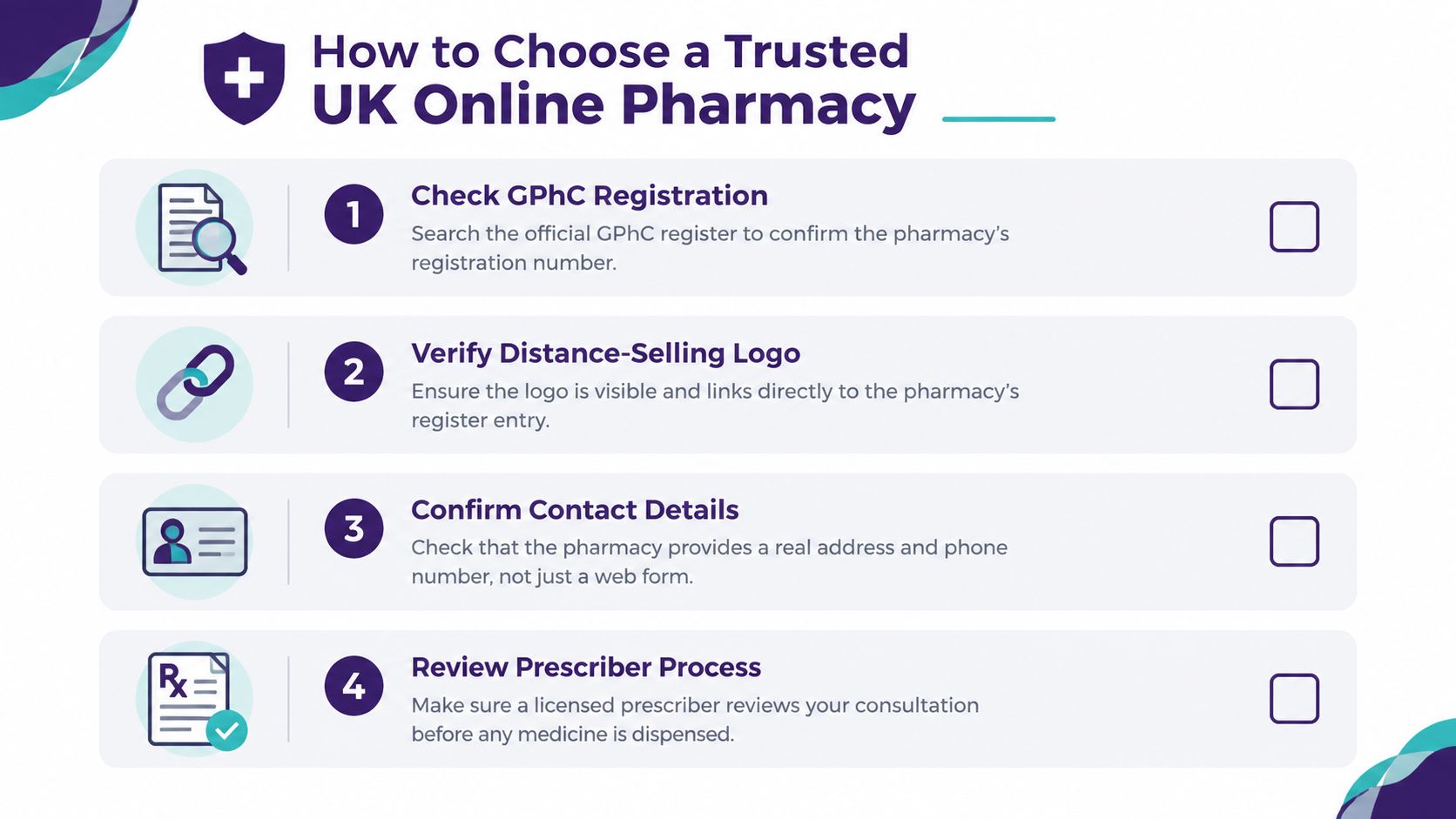
Start with the pharmacy, not the advertised medicine. Search the organisation on the official GPhC register and check that the registration details match the website, premises, and service you're considering. The distance-selling logo should link directly to that official entry, rather than to a generic regulator homepage.
A reliable consultation has friction
A compliant consultation may ask about your medical history, previous weight-management attempts, current medicines, allergies, pregnancy or breastfeeding, and relevant health measurements. For some treatments, the clinician may need evidence of BMI, blood pressure, blood tests, or other information. A service that offers a pre-selected medicine with no meaningful clinical review is not giving you informed care.
The prescriber's registration also matters. Check whether the clinician is a GMC-registered doctor, an NMC-registered nurse prescriber, or a GPhC-registered pharmacist independent prescriber, as appropriate. The provider should explain who prescribes, who dispenses, how follow-up works, and who you contact if you develop side effects.
Apply this check before payment
- Check registration: Find the pharmacy's registration number and confirm it on the official register.
- Inspect the logo: Follow the distance-selling logo to the correct register entry.
- Confirm contact details: Look for a real UK address, telephone number, superintendent pharmacist name, complaints process, and clear cancellation and refund terms.
- Question the consultation: Make sure a licensed prescriber reviews your answers before medicine is dispensed.
The 2025 distance-selling changes make identity checks, safeguarding questions, and escalation to a synchronous consultation more important when a patient's answers raise concerns. A provider shouldn't pressure you to select a treatment before a clinician has assessed whether it's appropriate. You can also compare how a prescription online pharmacy works, but retain responsibility for checking the specific pharmacy and prescriber details.
Costs Shipping and Postcode Realities
The advertised monthly figure rarely tells the whole financial story. A private next-day weight-management order may involve a consultation or membership charge, the medicine itself, delivery, temperature-controlled packaging, follow-up reviews, and any cost associated with dose changes.
Ask for the total payable at checkout and then ask what happens at renewal. A low initial price may not include later clinical reviews or higher doses. To compare providers fairly, write down the expected medicine cost, recurring service charge, delivery charge, and any cold-chain fee. Then check whether the service charges again when a prescription is changed or a repeat is clinically reviewed.
| Cost item | Typical range | What affects it | Postcode or delivery impact |
|---|---|---|---|
| Consultation or subscription | Varies by provider | Clinical support, review frequency, app or membership features | Usually unrelated to postcode, but cancellation terms matter |
| Medicine | Varies by medicine and dose | Product, dose, prescribing route, and titration | Stock may be held at a particular dispensary |
| Standard delivery | Varies by courier and service | Tracking, speed, signature, and parcel type | Remote destinations may need a different service |
| Chilled packaging | Varies by handling method | Insulated packaging, ice packs, and temperature controls | A suitable delivery window becomes more important |
| Follow-up review | Varies by provider | Dose change, side-effect review, and continuation decision | Delays can postpone dispatch even when stock is available |
Mainland UK next-day delivery is commonly the clearest promise, but it isn't universal. Northern Ireland, the Isle of Man, Scottish Highlands, Channel Islands, and other offshore or remote destinations may need an additional 24 to 48 hours, as set out in LloydsPharmacy Online Doctor's delivery information. A signature may also be required for some prescription medicines.
For a broader explanation of delivery models, see UK online pharmacy free delivery, then compare the final checkout total rather than relying on a headline price.
Common Questions UK Readers Still Ask
Will I need to sign for the parcel?
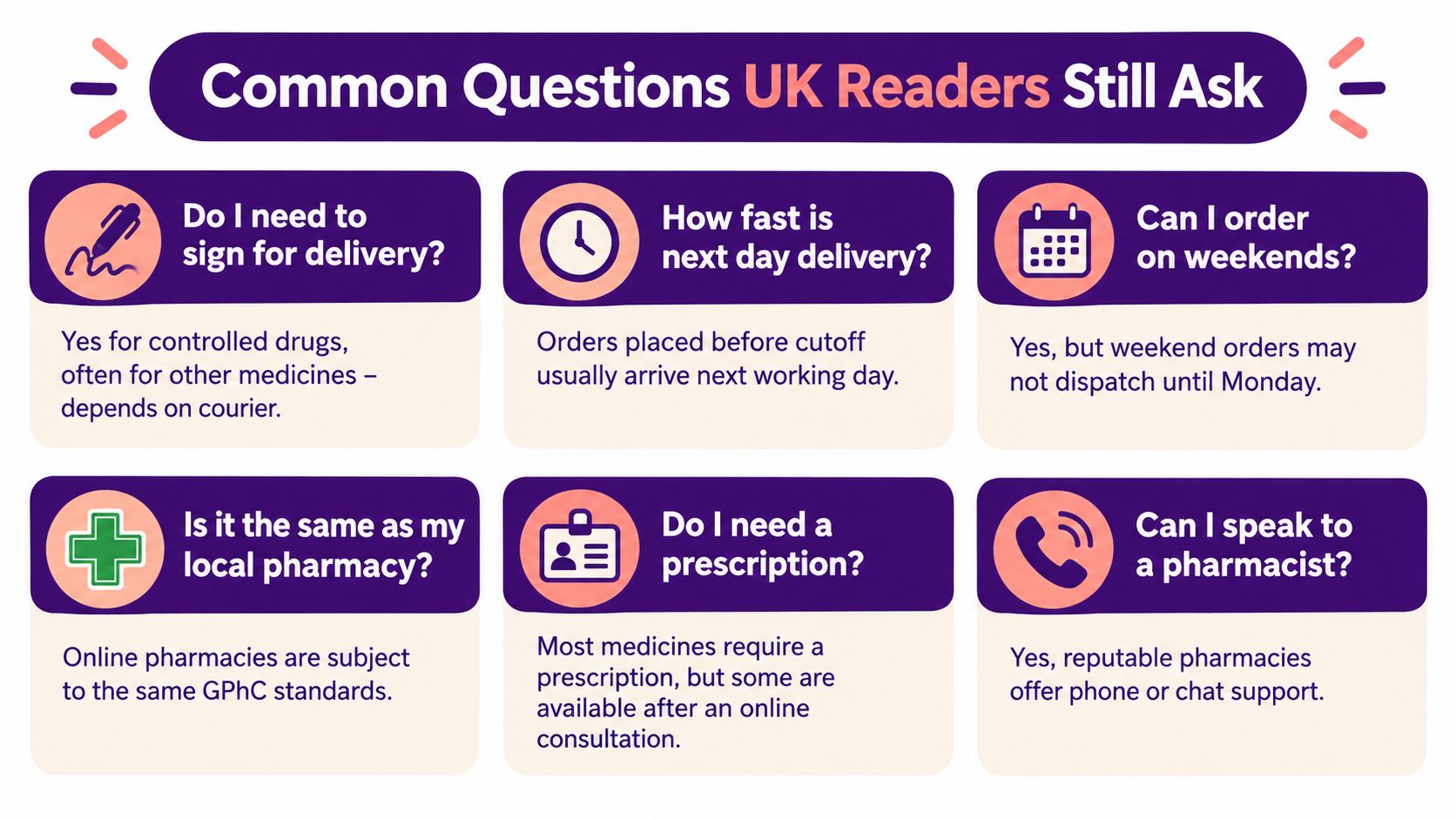
Sometimes. Controlled drugs and some higher-risk medicines may require a signature, while ordinary prescription deliveries may depend on the pharmacy's policy and courier service. Check before ordering, particularly if you work away from home.
Which addresses may miss next day?
Scottish Highlands, Northern Ireland, the Channel Islands, the Isle of Man, and some rural or offshore postcodes can fall outside the standard mainland promise. A trustworthy service should let you enter your postcode or read the exclusions before payment.
How are refrigerated GLP-1 medicines packed?
Temperature-sensitive medicines may be placed in insulated pharmacy-grade packaging with cool packs. The pharmacy should explain storage on arrival, including what to do if the parcel arrives warm, damaged, or later than expected. Don't use a medicine if you're concerned that its storage conditions have been compromised. Contact the supplying pharmacy for advice.
What did the 2025 rule change mean?
Distance-selling pharmacies in England faced tighter requirements around identity verification, safeguarding, prescriber oversight, and when a consultation must happen in real time. Pre-selected treatments shouldn't replace a proper clinical assessment. The pharmacy should also explain how it handles red flags and protects patient information.
Can I order repeat prescriptions?
Usually, repeat supply still depends on clinical suitability, prescription validity, stock, and any required review. A repeat order may be delayed if the prescriber needs to reassess your dose or side effects.
Can I return prescription medicine?
Medicines generally can't be put back into stock once they've left the pharmacy, because the pharmacy can't guarantee how they were stored. Contact the provider before posting anything back, especially if the product is damaged or incorrect.
Overseas websites shouldn't be assumed to have permission to supply medicines to a UK address. Check that the service operates through the appropriate UK-registered pharmacy and follows UK prescribing and dispensing requirements.
Red Flags and When Next Day Delivery Is the Wrong Choice
Speed becomes dangerous when it pushes clinical judgement out of the process. Walk away from a provider that doesn't display a verifiable GPhC registration number, uses prescribers registered abroad without explaining the UK legal arrangement, or asks for payment before collecting a meaningful medical history.
Other warning signs include:
- No identity check: The service supplies prescription medicine without confirming who you are or where you live.
- No clinical history: The questionnaire ignores current medicines, allergies, pregnancy, existing conditions, or previous treatment.
- Unusually low prices: The offer seems implausibly cheap and doesn't explain the product, pharmacy, or follow-up arrangements.
- Unsolicited social-media selling: Prescription-only weight-loss medicines are promoted through casual direct messages or informal adverts.
- Pressure tactics: Countdown timers, forced medicine selection, or claims that you must order immediately discourage informed decisions.
Next-day delivery can be useful for a stable repeat prescription, a time-sensitive antibiotic course after a clinician has assessed you, or continuity of an established GLP-1 treatment plan. It isn't the right response to acute chest pain, a suspected serious adverse reaction, or a mental-health crisis. Those situations need urgent clinical help, not a parcel ordered online.
It's also a poor substitute for deciding whether weight-management treatment is appropriate. Medicines work best within a plan that includes nutrition, physical activity, sleep, monitoring, and follow-up. NICE's guidance treats weight-management medicines as part of that wider approach, rather than a shortcut around it.
A pharmacist's view: The useful question isn't “Can this arrive tomorrow?” It's “Has the right medicine been prescribed for me, through the right pharmacy, with the right follow-up?”
Trim offers a UK-based, GPhC-registered online weight-management service with a digital consultation, UK-registered clinician review, pharmacy dispensing, discreet next-day delivery, and ongoing support. If you want to compare a medically supervised option with the checks described above, visit Trim and review the consultation and delivery information before deciding.