
GLP-1 Weight Loss Program: The UK Clinical Guide

A Food Foundation briefing estimates that around 29 million people in England could be eligible for GLP-1 treatment under NICE and MHRA guidance, while the NHS currently aims to reach 220,000 people over three years. That contrast explains why a GLP-1 weight loss program in the UK can't be understood as a simple prescription decision. It sits inside a wider care pathway shaped by clinical eligibility, NHS capacity, regional access, private provision, nutrition, physical activity and long-term follow-up, as the Food Foundation's UK briefing explains.
These medicines can reduce appetite and support clinically meaningful weight loss, but they aren't miracle treatments or substitutes for medical care. A safe programme uses medication as one tool within a structured plan, with clinicians checking suitability, adjusting treatment, managing side effects and helping the patient build habits that can continue after treatment.
Table of Contents
- The Rising Demand for GLP-1 Weight Loss Programs in the UK
- How GLP-1 Medications Regulate Appetite and Metabolism
- Navigating UK Eligibility and the Two-Tier Care Pathway
- Clinical Outcomes and Real-World Sustainability
- Managing Side Effects and the Titration Process
- The Necessity of Multidisciplinary Lifestyle Support
- Evaluating Clinic Safety and Preparing for Consultation
The Rising Demand for GLP-1 Weight Loss Programs in the UK
The UK conversation about GLP-1 medicines has moved well beyond a specialist discussion. The same Food Foundation briefing reported that 7% of the UK population had already used a GLP-1 medicine, while a further 8% of adults had considered using one, equivalent to roughly 8.25 million people. It also stated that 66% of the UK population is living with obesity and overweight, showing why demand for effective weight-management support is so substantial.
Those figures don't mean every person is clinically suitable for treatment, nor that every eligible person can receive medication immediately. They show the size of the population seeking help, compared with the much smaller number the NHS can currently treat. This difference has helped create a two-tier system in which NHS pathways remain tightly defined, while medically supervised private services provide another route for some adults who meet clinical requirements and can pay for care.
The treatment environment has also gained formal regulatory and clinical recognition. On 11 June 2026, the Medicines and Healthcare products Regulatory Agency approved the UK's first GLP-1 tablet for weight loss and weight management, semaglutide, marketed as Wegovy, for adults with obesity or overweight and a related comorbidity when used with a reduced-calorie diet and increased physical activity. Earlier in 2026, NHS England announced that Wegovy would be available to 1.2 million people with cardiovascular disease who are overweight, following NICE approval for people with previous heart attack, stroke or peripheral arterial disease and a BMI of 27 or higher, as reported in the Food Foundation's GLP-1 briefing.
Demand doesn't remove the need for assessment
A large eligible population doesn't turn GLP-1 treatment into a suitable option for everyone. A proper assessment still needs to consider medical history, current medicines, weight-related conditions, eating patterns, pregnancy or breastfeeding status where relevant, previous treatment, and the person's ability to follow up safely.
It also helps to understand why appetite-regulating medication has attracted such attention. Diets dominated by highly processed, energy-dense foods can influence appetite, routine and food choice in ways that make weight management difficult. For broader context on the health effects of a Western diet, readers may find it useful to consider how the wider food environment interacts with individual biology and behaviour.
The central question isn't just whether a medicine can reduce weight. It's whether the programme can give a patient appropriate access, clinical supervision, nutrition support, physical activity guidance and a realistic maintenance plan. Without those elements, the gap between initial treatment and durable health improvement remains unresolved.
How GLP-1 Medications Regulate Appetite and Metabolism
GLP-1 medicines work by mimicking the effects of a naturally occurring hormone called glucagon-like peptide-1. The body's natural GLP-1 signal is involved in appetite, digestion and blood-glucose regulation. Medicines that activate this pathway strengthen or extend that signal, helping some people feel satisfied with less food.
A useful analogy is a communication system with several connected controls:
- Brain signalling: GLP-1 activity influences appetite pathways involved in hunger and satiety. Many patients describe this as less persistent food preoccupation, sometimes called reduced “food noise”.
- Stomach emptying: Food can leave the stomach more slowly, so fullness may last longer. This isn't the same as blocking digestion, but it can make a normal-sized meal feel uncomfortable if eaten too quickly or in a large portion.
- Insulin response: When blood glucose rises, GLP-1 activity can support an appropriate insulin response. This helps explain why these medicines have an important role in metabolic care, not just weight reduction.
- Energy intake: Reduced hunger and earlier fullness can lower how much a person eats. The resulting weight change depends on treatment, food quality, activity, health status and how consistently the person can follow the care plan.
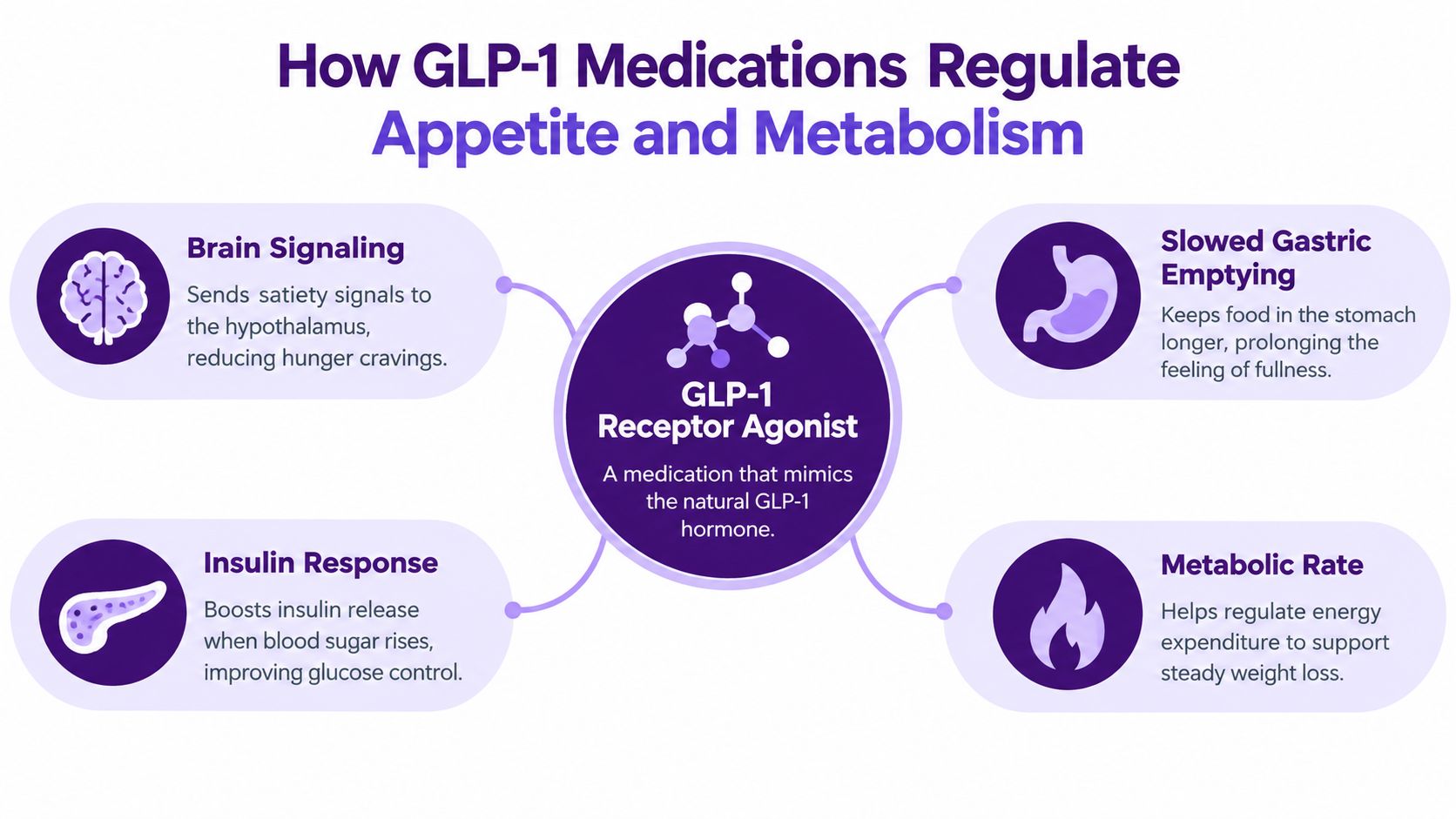
GLP-1 medicines aren't simple fat burners
Semaglutide medicines act primarily through the GLP-1 receptor. Tirzepatide, marketed as Mounjaro, acts on GLP-1 and GIP pathways, so it's often described as a dual agonist. The distinction matters pharmacologically, but patients still need the same practical safeguards: appropriate screening, gradual dose changes, attention to nutrition and regular review.
Slower gastric emptying also explains why the early treatment period can feel unfamiliar. A meal that was previously comfortable may cause nausea, reflux, bloating or vomiting if the person eats rapidly, chooses a rich meal or increases the dose before the body has adapted. These symptoms need to be discussed with the prescribing team rather than ignored.
People looking at treatment in the context of hormonal change may also want to read a clinically focused discussion of tirzepatide results in menopause. Menopause can affect weight, appetite, sleep, muscle and metabolic health, so medication decisions should be made in the context of the whole patient rather than a single symptom.
For a plain-language introduction to the hormone pathway, what GLP-1 means in weight management can provide useful background. The key point is simple: these medicines change appetite and metabolic signalling. They don't remove the need to eat adequately, move regularly or monitor health.
The following video provides another visual explanation of the underlying treatment concept:
Navigating UK Eligibility and the Two-Tier Care Pathway
Eligibility depends on which route a patient is using. NHS access is governed by NICE recommendations, local commissioning and service capacity. Private care can offer a different route, but it still requires a legitimate clinical assessment and isn't an exemption from prescribing responsibilities.
For semaglutide, NICE recommends treatment only as an addition to a reduced-calorie diet and increased physical activity, within a specialist multidisciplinary weight-management service. Eligibility is generally based on a BMI of at least 35 kg/m² with at least one weight-related comorbidity, or a BMI between 30.0 and 34.9 kg/m² where specialist referral criteria apply. NICE also advises stopping treatment if the patient loses less than 5% of initial body weight after six months, or continuing for no more than two years, according to the NHS Medicines Resources summary of NICE guidance.
Tirzepatide has its own NHS access rules. NHS England states that, in primary care, it is recommended alongside a reduced-calorie diet and increased physical activity for adults with a BMI of 35 or more, adjusted for ethnicity, plus four specified weight-related health problems. Specialist services can prescribe it under separate criteria, as set out in the NHS England guidance on weight-management injections.
UK GLP-1 access pathways compared
| Criteria | NHS Specialist Services | GPhC-Registered Private Clinics |
|---|---|---|
| Route into care | Referral and acceptance through NHS services, subject to NICE guidance, local arrangements and capacity | Direct clinical consultation with a regulated private provider |
| Eligibility | Defined by the relevant NICE recommendation and service criteria | Assessed by a UK-registered prescriber against clinical suitability and prescribing rules |
| Lifestyle support | Reduced-calorie diet and increased physical activity are required parts of the treatment approach | A responsible programme should also include nutrition and activity guidance |
| Availability | Phased and capacity-limited, with access varying by pathway and area | Availability depends on clinical suitability, pharmacy supply and the provider's service |
| Follow-up | Delivered through the relevant NHS service | Should include ongoing reviews, dose decisions and side-effect monitoring |
| Treatment review | NICE response criteria can determine whether treatment continues | The prescriber should use response, safety and tolerability to guide continuation |
The table describes routes, not guarantees. A private clinic shouldn't dispense medication solely because a patient requests it, and an NHS referral doesn't guarantee immediate treatment. The practical question is always, “Who assesses me, what criteria apply, and what happens if the treatment isn't tolerated or doesn't work?”
Patients researching semaglutide should also understand that obtaining Wegovy involves more than finding a product. A guide to how to get Wegovy through an appropriate UK route is useful only when read alongside the need for a full consultation and continuing supervision.
Clinical Outcomes and Real-World Sustainability
Clinical trial evidence shows that GLP-1 medicines can produce substantial weight reduction when combined with structured lifestyle support. NICE supporting documents cite the STEP 1 trial, in which semaglutide produced 14.9% mean body-weight reduction, approximately 15.3 kg over 68 weeks, compared with lifestyle support alone, as summarised in this NICE semaglutide briefing for integrated care systems.
Comparisons between medicines need careful interpretation because trials can differ in dose, duration, participants and study design. A 2026 comparative review reported mean weight reduction across individual studies ranging from minus 22.1% to minus 5.3% with tirzepatide, and from minus 17.1% to minus 2.7% with semaglutide, as reported in the comparative review of tirzepatide and semaglutide. These ranges describe study results, not a personal forecast.
A result isn't the same as a maintenance plan
NICE's response threshold at six months gives clinicians a practical decision point, but the number on the scales is only one part of the assessment. A care team should also consider side effects, nutritional adequacy, physical function, blood-glucose status, cardiovascular risk and whether the patient can continue safely.
NICE advises continued support after treatment ends and follow-up for at least a year after completion. That recommendation reflects a central reality of obesity medicine: appetite regulation may change again when treatment stops, so patients need a plan for maintaining meals, activity, sleep routines and responses to hunger.
Household behaviour can change quickly when appetite falls. A 2026 UK consumer study found that GLP-1-using households spent £780 million less on groceries than expected, with annual household grocery bills down by more than £418 on average, as reported in the PubMed record for the study. The practical lesson isn't that eating less automatically means eating well. Smaller food shops can also mean missed protein, inadequate fibre, insufficient fluids or fewer nutrient-dense foods unless the programme actively addresses those risks.
A sustainable programme therefore measures more than short-term weight loss. It helps the patient learn how to organise meals when appetite is low, maintain strength, recognise inadequate intake and prepare for treatment changes. Further reading on GLP-1 weight-loss results should be used to support realistic expectations, not to promise an identical outcome for every patient.
Managing Side Effects and the Titration Process
A patient may tolerate the starting dose well and still experience symptoms after an increase. That doesn't automatically mean the treatment has failed. It often means the prescribing team needs to assess whether the dose should remain unchanged for longer, whether food and fluid intake need attention, or whether another medical explanation needs investigation.
Titration means increasing the dose gradually rather than moving immediately to a higher amount. The purpose is to give the gastrointestinal system and appetite pathways time to adapt. A clinician may delay an increase, reduce the dose or review the medicine altogether if nausea, vomiting, diarrhoea, constipation, reflux or abdominal discomfort becomes difficult to manage.
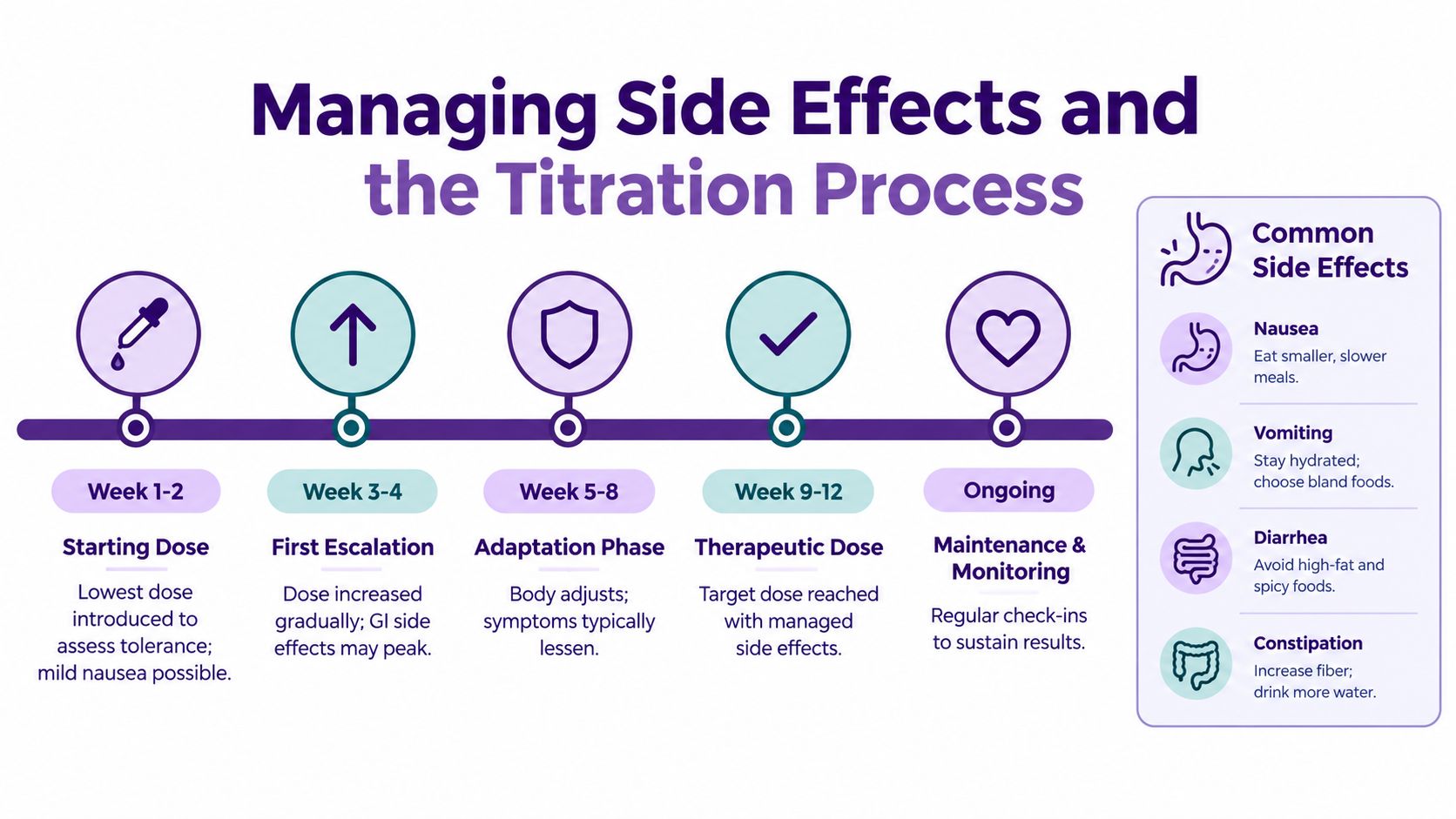
What a supervised adjustment looks like
Consider a patient who feels full after a few bites during the first dose increase. The safest response isn't to force a normal-sized meal or to increase again on schedule. The patient should contact the clinical team, describe the symptoms, review hydration and nutrition, and follow the prescriber's decision about the next dose.
Small, slower meals may be easier to tolerate than large portions. A patient should also avoid treating persistent vomiting or severe abdominal symptoms as an expected inconvenience. Ongoing symptoms can affect hydration and nutrient intake, and they deserve prompt clinical advice.
Practical rule: A dose increase is a clinical decision, not a target to reach regardless of how you feel.
Regular check-ins give the prescriber information that a questionnaire completed only once can't provide. Useful monitoring includes the pattern and severity of symptoms, changes in appetite, bowel function, food and fluid intake, current medicines, weight response and any new health concerns. This is why a GLP-1 weight loss program should include access to a clinician after the prescription is issued, not end at dispatch.
The Necessity of Multidisciplinary Lifestyle Support
Medication can reduce appetite, but it can't decide whether the food a patient eats contains enough protein, whether resistance training is safe, or how the person will respond when treatment changes. Those decisions require a wider programme.
Rapid weight reduction can involve loss of lean mass as well as fat. That makes strength-focused physical activity important, particularly for adults who already have low muscle strength, limited mobility or a history of repeated dieting. A clinician or qualified professional should adapt activity to the person's starting point rather than prescribing an unrealistic routine.
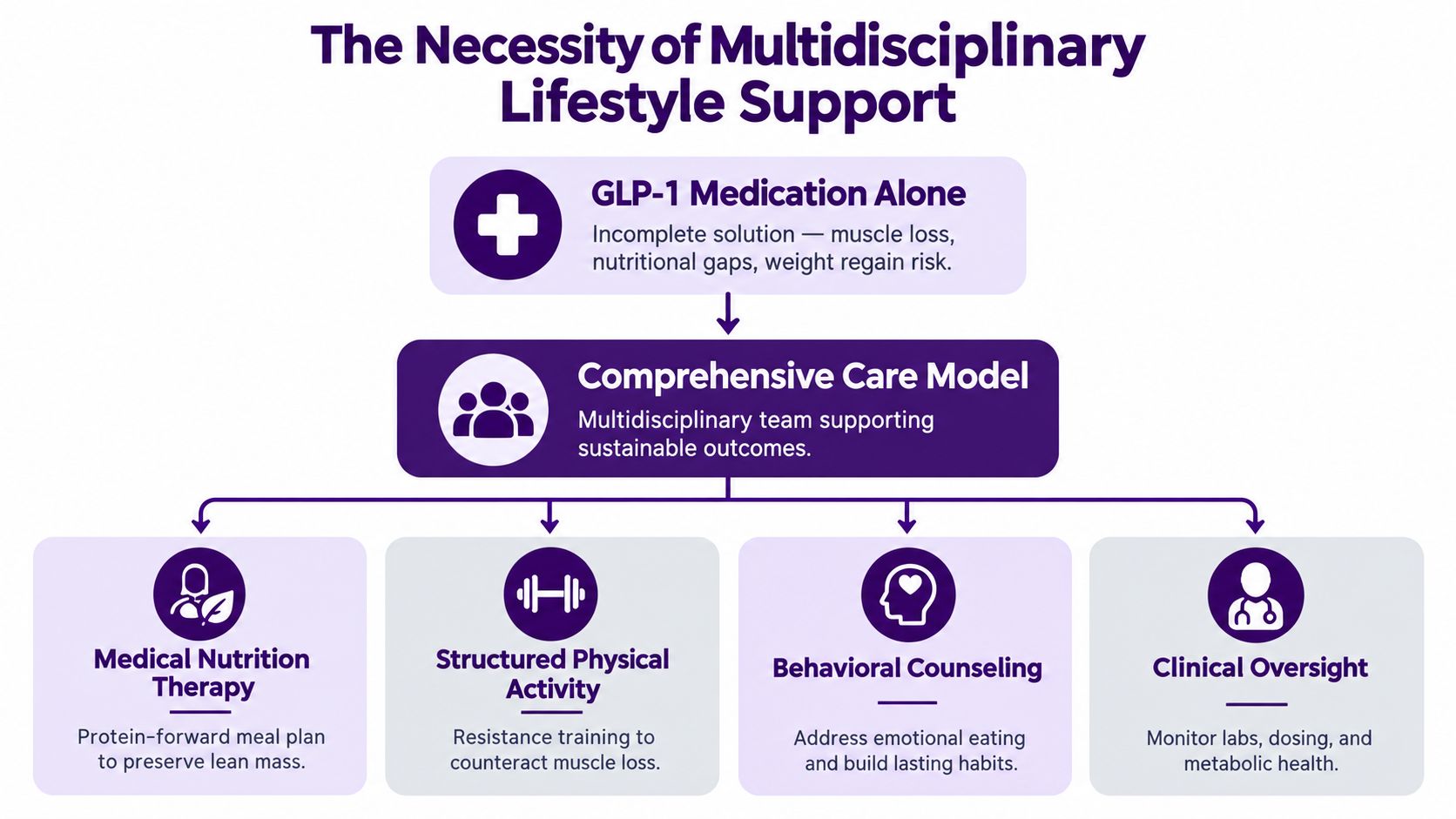
Four pillars of a safer programme
Evidence-based medicine comes first when medication is clinically appropriate. The prescriber should select a treatment based on the person's health, contraindications, goals, response and tolerability, rather than choosing solely on perceived potency.
Clinical guidance keeps the programme responsive. A doctor or prescribing clinician needs to review symptoms, medicines, relevant health conditions and treatment response. That oversight also helps identify when continuing, pausing or stopping treatment is more appropriate.
Personalized nutrition matters because appetite suppression can make under-eating easy. Meals should prioritise nutrient-dense foods, adequate protein and fibre, with adjustments for nausea, constipation, food preferences, cultural habits and other medical needs. A person shouldn't start supplements automatically, since requirements depend on health history and, where appropriate, clinical assessment.
Physical activity should include strength work where suitable, alongside activities that support cardiovascular health and daily function. The aim isn't to punish the body for eating less. It's to preserve capability, support muscle and make healthy routines practical beyond the medication period.
Psychological support can add another layer of protection. Emotional eating, stress, poor sleep and habitual food cues don't disappear just because hunger falls. Behavioural coaching can help patients recognise these patterns and build alternatives before appetite returns or treatment ends.
The medication may open a window for change. Nutrition, movement and behavioural support determine what the patient builds during that window.
This model also makes success more meaningful. A patient who loses weight but becomes weak, nutritionally depleted or unable to maintain daily routines hasn't achieved the full clinical goal. Sustainable care protects metabolic health, function and quality of life alongside weight reduction.
Evaluating Clinic Safety and Preparing for Consultation
Private access can be useful, but convenience shouldn't replace clinical standards. Before choosing an online provider, check who prescribes, which pharmacy dispenses the medicine, how the service handles side effects and what follow-up is included. A short form that produces an immediate prescription without meaningful medical review is not the same as a supervised programme.
Look for a GPhC-registered pharmacy and UK-registered clinicians who assess suitability before prescribing. The provider should explain the medicine, expected effects, possible adverse reactions, dose changes, storage or administration requirements where relevant, and the process for contacting the team.
Questions to ask before treatment starts
- Who makes the prescribing decision? Confirm that a qualified, registered clinician reviews your information and authorises treatment where appropriate.
- What assessment is required? Expect questions about your weight history, diagnoses, current medicines, allergies, previous treatments and relevant reproductive or gastrointestinal health.
- How will follow-up work? Ask how often reviews happen, who responds to side-effect concerns and how dose changes are decided.
- Where does the medicine come from? The provider should identify the licensed pharmacy supplying the medicine and give clear instructions for receiving and using it.
- What happens if treatment isn't suitable? A responsible clinic should be willing to decline prescribing, recommend another option or advise you to speak with your NHS team.
- What is the maintenance plan? Ask how the service supports nutrition, physical activity, treatment transition and follow-up after the active weight-loss phase.
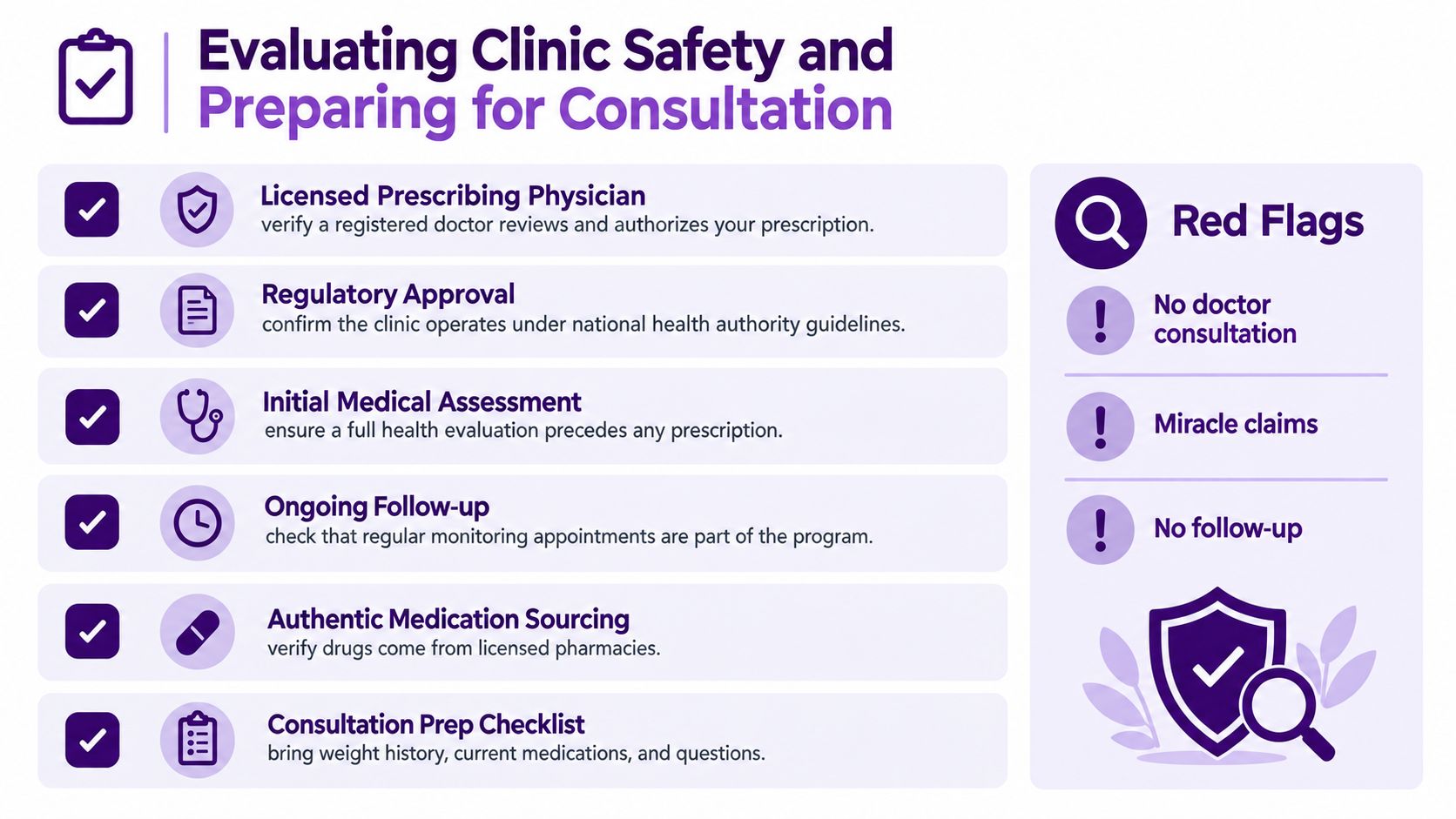
Prepare for a useful digital consultation
Have an accurate list of your current medicines, relevant diagnoses, allergies and previous weight-management attempts. Write down the symptoms or outcomes that matter most to you, such as mobility, blood pressure, appetite control, glucose management or confidence with physical activity.
Be honest about eating patterns and previous side effects. The clinician isn't assessing your worth or willpower. They need reliable information to decide whether a GLP-1 medicine is appropriate, whether another treatment deserves consideration, and what monitoring you may need.
Treat miracle claims, no doctor consultation and no follow-up as red flags. Prescription treatment should involve shared decisions and a route back to professional support when something changes.
Trim offers a UK-based, GPhC-registered online clinic and pharmacy with a digital consultation, UK-registered clinician assessment, medically supervised options including Mounjaro and Wegovy, nutrition and activity support, and ongoing one-to-one help. If that type of structured pathway fits your needs, visit Trim to review the service and begin with an informed consultation.