
Best GLP 1 Patches: Evidence, Safety and UK Alternatives

There are currently no MHRA-approved GLP-1 patches for weight loss in the UK, and no patch-based product has completed Phase 3 trials proving non-inferior efficacy versus licensed injectable GLP-1 therapies. The most accurate answer to “best GLP-1 patches” is therefore that no consumer patch can currently be recommended as an evidence-backed GLP-1 treatment.
That conclusion may sound counterintuitive because adhesive patches look familiar, simple and medical. But appearance isn't regulatory approval, and a product that mentions GLP-1 in its name isn't necessarily delivering a GLP-1 medicine. For UK adults, the useful question is whether a product has a licence, human pharmacokinetic data, controlled clinical trials and a legitimate prescribing pathway.
The distinction matters for safety as well as effectiveness. Licensed medicines are assessed for a defined ingredient, dose, route of administration, intended use and patient population. A patch marketed online may instead be a cosmetic or supplement product using language associated with prescription treatment, without demonstrating that it contains or delivers a GLP-1 receptor agonist.
Table of Contents
- What GLP-1 Patches Claim to Do
- UK Regulatory Status and Clinical Evidence
- Approved GLP-1 Medicines Versus Unlicensed Patch Products
- Why Transdermal GLP-1 Delivery Remains Unproven
- How to Evaluate GLP-1 Patch Product Claims
- Medically Supervised GLP-1 Alternatives in the UK
What GLP-1 Patches Claim to Do
The phrase GLP-1 patch suggests a simple version of a prescription medicine: apply an adhesive product to the skin and receive appetite control without an injection. That assumption isn't supported by the current UK evidence base.
GLP-1, or glucagon-like peptide-1, is a naturally occurring hormone involved in appetite signalling, insulin release and the movement of food through the stomach. Prescription GLP-1 receptor agonists are medicines designed to produce predictable activity at the relevant receptor. Their effects can include stronger fullness signals, slower gastric emptying and changes in post-meal glucose regulation. The clinical effect depends on enough active medicine reaching the body in a controlled way.
A patch product may borrow this biology in its marketing, but “GLP-1 support” isn't the same as delivering a GLP-1 receptor agonist. Products sold under patch terminology may contain botanical extracts, vitamins or other supplement ingredients. Unless a product contains a licensed GLP-1 medicine and has demonstrated delivery through the skin, the name alone tells you very little about its pharmacology.
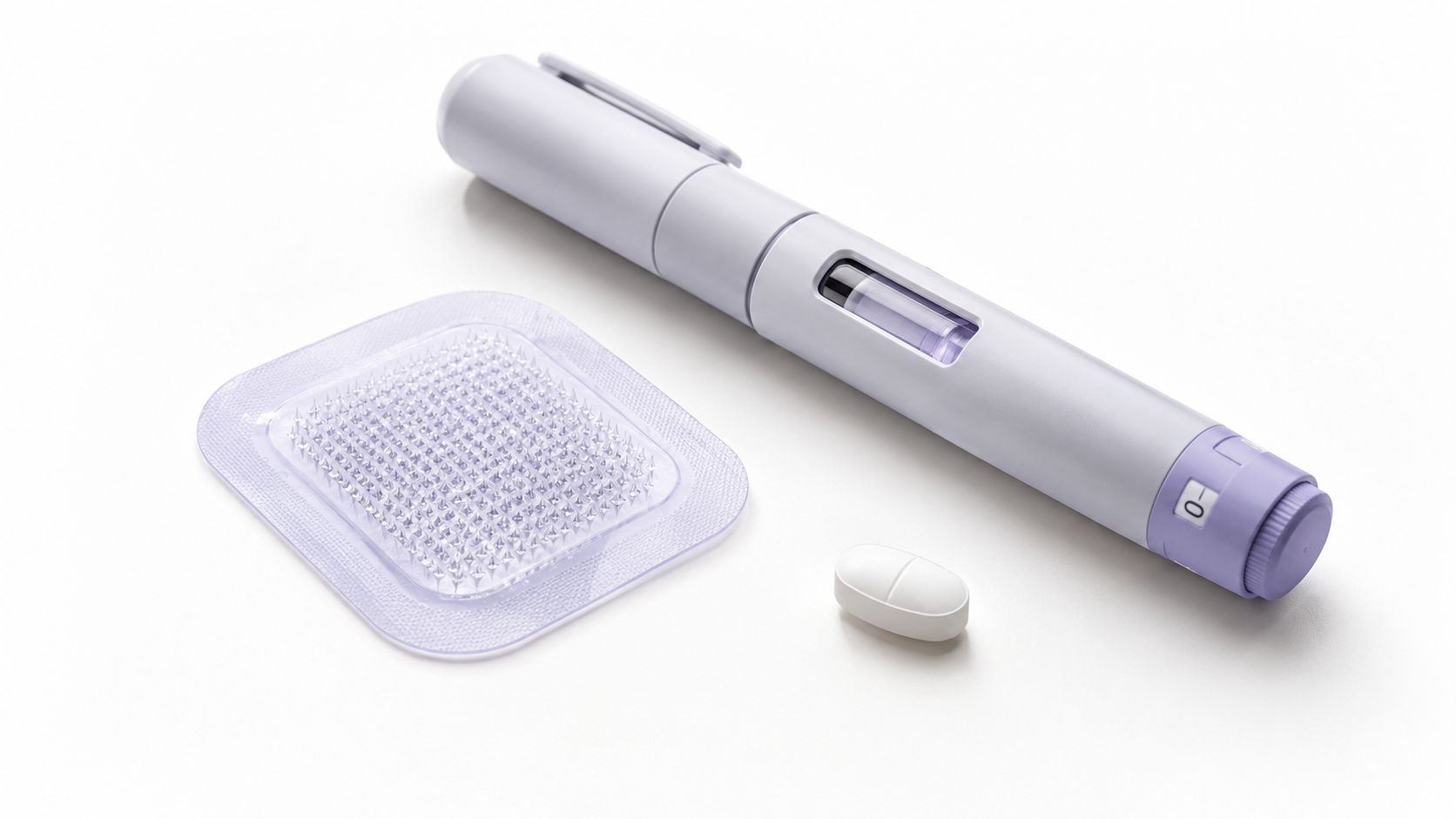
Why the format changes the question
Licensed GLP-1 medicines use routes that have been developed to deliver a defined dose. Injectable treatments place the medicine into tissue, while oral products require specialised formulation to protect the active ingredient and support absorption. A conventional adhesive patch has to overcome the skin's outer barrier before its contents can reach the bloodstream.
That makes the delivery method central, not a minor convenience issue. A seller might claim that a patch helps appetite, metabolism or natural GLP-1 activity, but those claims don't establish that the product produces the receptor-level effects seen with prescription medicines. A practical introduction to the medicines themselves is available in this guide to GLP-1 medicines.
Practical rule: Treat a patch's name as a marketing description until the manufacturer shows its active ingredient, delivered dose, human absorption data and regulatory status.
The counterintuitive point is that a patch can look more accessible while offering less information about what enters the body. For those searching for the best GLP-1 patches, the first filter should therefore be clinical identity, not adhesive comfort, customer reviews or the number of ingredients on the label.
UK Regulatory Status and Clinical Evidence
The UK regulatory position is clear. There are no MHRA-approved GLP-1 patches for clinical use in the United Kingdom, and current UK guidance doesn't recognise a patch-based GLP-1 format as an authorised weight-loss treatment. The MHRA has licensed semaglutide products such as Wegovy, tirzepatide as Mounjaro and liraglutide products for specific uses, but those licences don't extend to consumer transdermal patches. The GOV.UK guidance on GLP-1 medicines explains that these medicines are prescription-only and should be used only when clinically appropriate.
That distinction also applies to advertising. UK government and MHRA communications updated during 2025 and 2026 warn that GLP-1 products used outside their licence haven't been assessed for safety and effectiveness in that setting. Advertising prescription-only weight-loss medicines to the public is prohibited, so language that implies a patch is equivalent to Wegovy or Mounjaro deserves careful scrutiny.
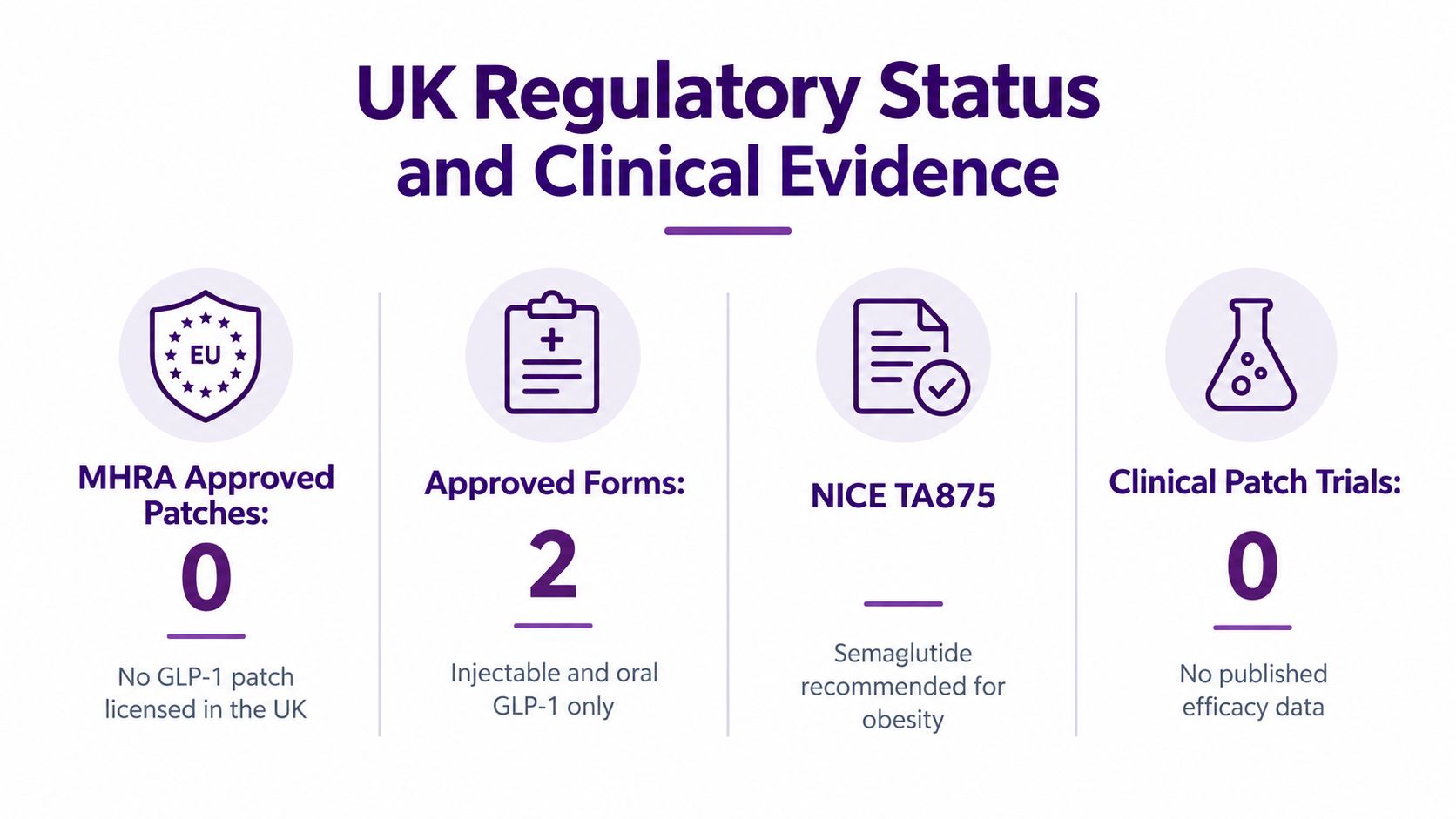
What the clinical gap means
Independent UK coverage reports that no product marketed as a GLP-1 patch has completed Phase 3 trials or demonstrated non-inferior efficacy against standard injectable GLP-1 therapies, as described in this UK review of GLP-1 patches. That doesn't mean every patch seller makes the same claim or that every ingredient is automatically dangerous. It means the category lacks the evidence normally needed to support a clinical treatment claim.
The ASA has also upheld complaints involving slimming patch products that made medicinal claims without the required licensing. A product can be sold as a wellness or cosmetic item, but its wording still matters. Claims about treating obesity, reproducing prescription-drug effects or causing clinically meaningful weight loss may move the product into a regulated medicines context.
The regulatory pathway protects more than a brand name. It connects the product to manufacturing standards, dose consistency, pharmacokinetic testing, clinical outcomes, contraindications, side-effect monitoring and professional oversight. A patch without that pathway doesn't offer an equivalent level of assurance, even if its packaging looks clinical.
A useful distinction
A licensed GLP-1 medicine has a defined active substance and approved uses. An unlicensed patch may be a supplement sticker, a cosmetic product or an item making claims that exceed its legal status. Those categories shouldn't be blended together only because they share the term GLP-1.
The video format can help explain the broader subject, but it doesn't replace checking the MHRA status of a specific product. For a UK consumer, no approval means no authorised GLP-1 patch treatment pathway.
Approved GLP-1 Medicines Versus Unlicensed Patch Products
The fairest comparison isn't injection versus patch. It is validated medicine versus unverified delivery product. Approved treatments have a defined substance, a standardised dose and an access route involving a prescriber or regulated service. Patch products marketed for GLP-1 effects don't have a comparable UK prescribing standard.
The UK has approved GLP-1 receptor agonists in medicinal forms, including dulaglutide, exenatide, liraglutide, lixisenatide and semaglutide. For weight management, the recognised pathways discussed in UK guidance include semaglutide, liraglutide and tirzepatide for specified patients and indications. The UK overview of weight-loss injections can help explain how those treatment categories differ, but suitability still requires clinical assessment.
GLP-1 Treatment Options Comparison
| Treatment Type | Regulatory Status | Clinical Evidence | Access Pathway |
|---|---|---|---|
| Semaglutide | Licensed for specific uses, including Wegovy for weight management under defined criteria | NICE describes trial evidence showing greater weight loss with semaglutide plus supervised weight-management support than with support alone | Prescription through an appropriate NHS or private clinical pathway |
| Tirzepatide | Licensed as Mounjaro for specific uses and eligibility conditions | Evaluated within regulated clinical development and prescribing frameworks | Prescription with clinical assessment and monitoring |
| Liraglutide | Licensed products include Saxenda and related preparations for specified uses | Supported by clinical evidence within its authorised indication | Prescription and structured weight-management care |
| Consumer GLP-1 patch | No MHRA approval or NICE recommendation for weight loss in the UK | No completed Phase 3 evidence demonstrating non-inferior efficacy to licensed injectable GLP-1 therapies | Usually purchased directly as a consumer product, without a comparable prescribing standard |
The table shows why convenience alone isn't enough. A licensed medicine provides a known exposure target, while a patch seller may not demonstrate that its claimed active compound crosses the skin or reaches a therapeutically relevant concentration.
Why “natural” doesn't close the gap
A patch containing botanical ingredients isn't automatically equivalent to a prescription medicine, even if one ingredient has been studied when taken orally. Evidence belongs to a specific product, dose, formulation and route. Oral research can't be transferred to a skin patch without showing that the patch produces comparable exposure.
The same principle applies to testimonials. A person may report less snacking after buying a patch, but that observation doesn't identify the cause. Changes in food choices, expectations and routine can occur at the same time. A controlled trial is designed to separate those factors from a medicine's pharmacological effect.
A familiar format can reduce anxiety, but it can't replace evidence that the active ingredient reaches the intended target.
For UK adults, the practical conclusion is straightforward. If you want a GLP-1 medicine, look for a licensed product and a legitimate clinical pathway. If you're considering a patch, assess it as an unlicensed consumer product rather than assuming it belongs to the same treatment class.
Why Transdermal GLP-1 Delivery Remains Unproven
The skin is designed to keep substances out. Its outer layer, the stratum corneum, provides a selective barrier that helps limit the movement of chemicals into the body. Small, suitably formulated medicines can sometimes cross it, but a large peptide requires a much more complex delivery system than a standard adhesive sticker.
GLP-1 receptor agonists are peptide-based medicines. Their size, structure, water solubility and sensitivity to degradation create several obstacles at once. Even if a patch contains a peptide, the manufacturer must show that the molecule remains intact, passes through the skin, enters circulation and reaches a predictable exposure level.

Absorption is more than contact
Putting a substance against the skin doesn't mean the substance has entered the bloodstream. A genuine transdermal medicine needs a controlled relationship between the patch, the skin and systemic exposure. Formulation, molecular properties, skin condition, application time and manufacturing consistency can all affect delivery.
That is why pharmacokinetic data matters. Researchers need to measure how much medicine appears in the blood, how quickly it appears, how long it remains there and whether exposure is consistent between users. UK guidance from NICE on GLP-1 receptor agonists and tirzepatide places treatment within regulated pathways, while patch products have no comparable prescribing standard, validated pharmacokinetic benchmark or published human dose-delivery data showing therapeutic GLP-1 exposure through the skin.
Why microneedles are a different category
A future microneedle system would not be equivalent to a conventional patch. Microneedles use a physical structure to pass through the outer barrier and release medicine in controlled conditions. That approach may be scientifically plausible, but it still needs clinical development, manufacturing controls and regulatory approval.
This distinction prevents two opposite mistakes. It would be premature to say that every possible transdermal GLP-1 technology is impossible. It is equally misleading to treat an ordinary adhesive supplement sticker as if it already uses advanced pharmaceutical delivery technology.
Injectable GLP-1 medicines have quantified clinical outcomes because their delivery and dosing have been studied in defined populations. Patch products don't have an equivalent human evidence base. Until they demonstrate measurable absorption and reproducible clinical effects, their claims remain unverified.
How to Evaluate GLP-1 Patch Product Claims
A calm evaluation starts with the label, not the advert. Ask what the product contains, what route it uses and which regulator has authorised it for the claim being made. If the seller can't answer clearly, you don't have enough information to treat the patch as a serious medical option.
Use these checks before buying:
- Identify the active medicine: Does the label name semaglutide, tirzepatide or another GLP-1 receptor agonist, or does it list only supplements and botanical extracts? A product borrowing the GLP-1 name isn't necessarily a GLP-1 medicine.
- Look for UK authorisation: Can the seller provide evidence of MHRA marketing authorisation for the patch itself? Approval of an injectable or oral medicine doesn't authorise a different patch formulation.
- Ask for human pharmacokinetics: Has the finished patch been tested in people with blood-level measurements? A study of an ingredient taken orally doesn't prove skin delivery.
- Check the trial phase: Does the evidence involve the exact finished product, rather than a different medicine, dose or route? Testimonials and laboratory experiments can't substitute for controlled human trials.
- Read the dose: Is the amount of each active ingredient disclosed, or hidden inside a proprietary blend? Without a defined dose, it becomes difficult to judge plausibility or compare the product with research.
- Examine the wording: Claims such as “same as Wegovy”, “Ozempic alternative” or “prescription results without a prescription” imply equivalence that requires strong evidence and appropriate authorisation.
Cosmetic claims versus medicinal claims
A cosmetic patch can make a limited appearance or skincare claim. A product that says it treats obesity, controls appetite through GLP-1 receptors or replaces a prescription medicine is making a much more serious medicinal claim. UK advertising rules restrict the public promotion of prescription-only medicines, so the language used by a seller deserves as much attention as the ingredient list.
Be cautious with evidence that sounds impressive but doesn't match the product. A study involving an injectable GLP-1 medicine can't validate a patch. Research on an oral supplement can't validate a transdermal formulation. The relevant question is always: was this exact product tested in humans at this exact dose and by this exact route?
If a seller provides a mechanism but no delivered dose, you have a theory, not a treatment.
Skin irritation is another practical consideration. Adhesives and botanical ingredients can cause redness, itching or contact reactions, particularly when used repeatedly or applied to already irritated skin. Stop using a product and seek advice from a pharmacist or clinician if a reaction is persistent, spreading or severe.
Medically Supervised GLP-1 Alternatives in the UK
The evidence-backed alternative to an unlicensed patch is a clinical assessment, not a promise of effortless weight loss. A clinician reviews your health, eligibility, goals, current medicines, nutrition and ability to attend follow-up. NICE recommends semaglutide for weight management alongside a reduced-calorie diet and increased physical activity, and only for adults who meet defined criteria, including a BMI of at least 35.0 kg/m², or 30.0 kg/m² in exceptional circumstances, as set out in NICE guidance on semaglutide.
These criteria show why prescription treatment is medical care rather than a cosmetic shortcut. The medicine forms one part of a wider programme. NICE's evidence review reports greater weight loss with semaglutide plus supervised weight-management support than with support alone, and greater weight loss with semaglutide than with liraglutide. The NICE evidence recommendations explain how that evidence informs the guidance.
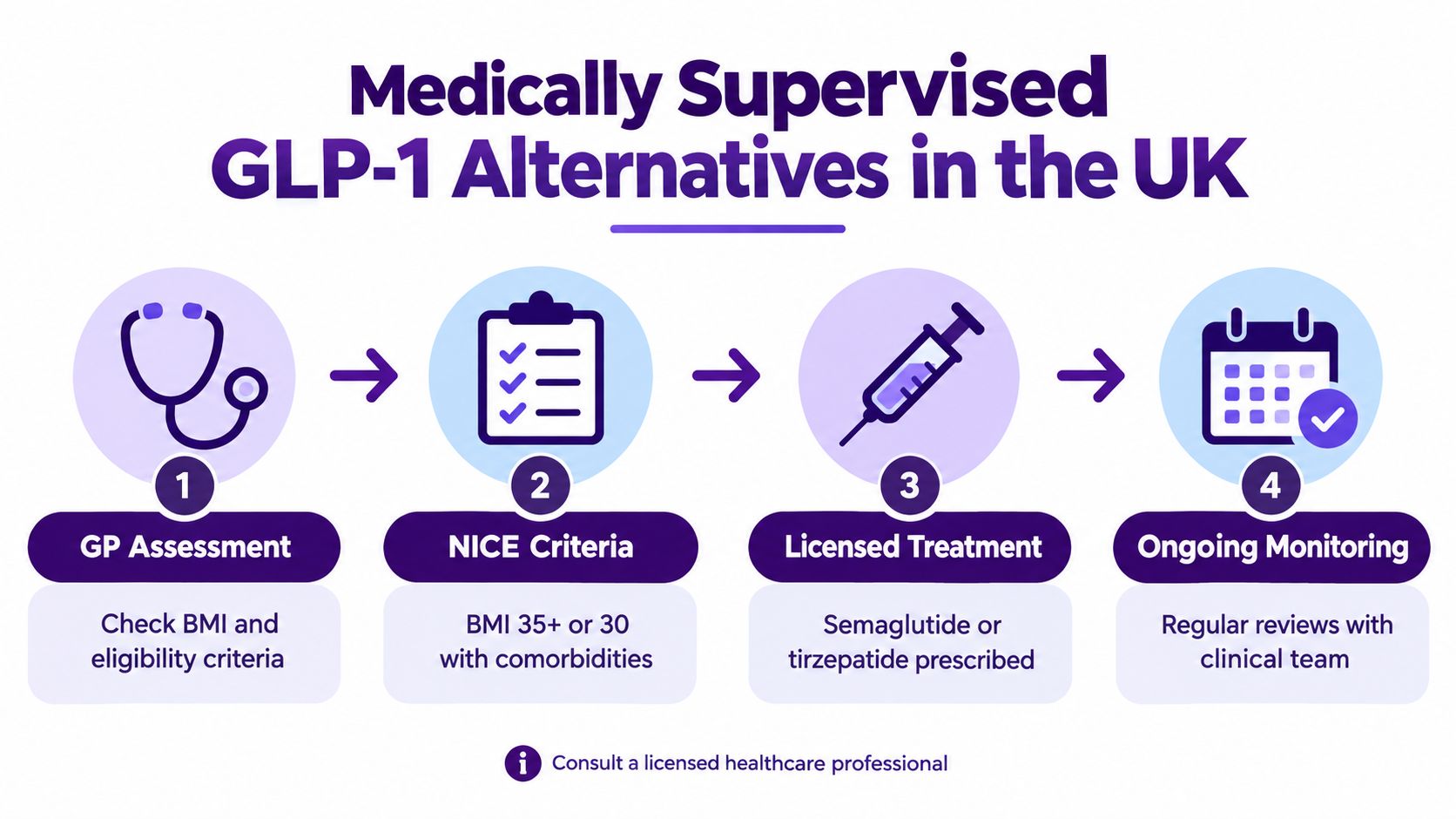
What supervised care adds
A clinician checks whether a GLP-1 medicine is appropriate, explains likely effects, and reviews problems such as gastrointestinal symptoms, interactions or inadequate nutrition. A regulated pharmacy supplies the prescribed product through the appropriate route. Follow-up then checks response, tolerability and whether treatment should continue.
Semaglutide or tirzepatide may be considered for people who meet the relevant criteria. Liraglutide is another licensed option for specified uses. Other weight-management approaches may also be discussed. NICE notes that it has no technology appraisal guidance on orlistat, so orlistat should be treated as a separate pathway, not as a GLP-1 equivalent.
A practical UK pathway
- Start with assessment. Speak with a GP or UK-registered clinical service about your health history, current medicines and weight-management goals.
- Confirm eligibility. The clinician assesses BMI and other relevant criteria instead of relying on a patch advertisement.
- Discuss treatment choices. If suitable, options may include licensed medicines such as semaglutide, tirzepatide or liraglutide, alongside diet and activity support.
- Plan follow-up. Reviews monitor response, side effects, nutrition and whether treatment remains appropriate.
A service such as Trim offers a clinician-led UK pathway with an online assessment, access to prescription weight-management treatments when clinically suitable, nutrition and activity guidance, and ongoing support. Learn more about medically supervised weight loss options and eligibility criteria. Trim is one service option, not a replacement for independent clinical judgement.
If you are deciding what to do next, record the patch's product name, ingredient list and claims, then discuss them with a pharmacist or clinician. For a UK adult seeking genuine GLP-1 treatment, that discussion provides a sounder basis for action than comparing unlicensed patches by branding or reviews.
Trim can help assess whether medically supervised weight management is appropriate, including licensed treatments such as Wegovy or Mounjaro when prescribed by a clinician. Visit Trim at gettrim.co.uk to complete the online assessment and review support covering clinical guidance, nutrition advice and progress monitoring.