
GLP-1 Weight Loss Results: What to Expect

A single headline number can mislead. In the STEP 1 trial, people taking semaglutide 2.4 mg lost an average of 14.9% of body weight, or 15.3 kg, over 68 weeks, while NICE's discussion reported a 12.4 percentage-point difference versus placebo at the same stage (NICE evidence briefing). That result is clinically important, but it isn't a promise for every person taking Wegovy.
The most useful way to interpret GLP-1 weight loss results is to separate three questions: how much weight might come off, how quickly it may happen, and how likely the result is to continue. Clinical trials show what can happen under carefully organised conditions. NHS data shows what treatment may look like in routine care, where dose changes, follow-up, availability, health conditions and adherence vary.
The answer also includes trade-offs. Appetite reduction can make eating easier, but nausea and other digestive symptoms are common, and stopping treatment can lead to substantial regain. A measured view treats GLP-1 medicines as one part of medical weight management, not as a guaranteed shortcut.
Table of Contents
- What Readers Actually Want to Know About GLP-1 Weight Loss Results
- How GLP-1 Medicines Change Appetite and Digestion
- Trial Results for Wegovy and Mounjaro Over Time
- Real-World UK Results Versus the Headline Trial Figures
- Factors That Shape Your Individual Response
- Side Effects Worth Knowing Before You Start
- What Happens When You Stop and How Maintenance Looks
- Putting It All Together for UK Adults Considering GLP-1 Therapy
What Readers Actually Want to Know About GLP-1 Weight Loss Results
How much weight could you lose
The headline results are usually in the double-digit percentage range. In STEP 1, semaglutide produced an average 14.9% reduction in body weight. NICE's review of SURMOUNT-1 found that tirzepatide 15 mg produced a mean body-weight change 20.1 percentage points greater than placebo at 72 weeks (NICE tirzepatide committee discussion).
These are study averages, not personal targets. Individual results vary, and some people stop because side effects or other medical problems make treatment unsuitable. Percentages also need translating into real terms. At a starting weight of 100 kg, a 10% reduction is roughly 10 kg. That calculation does not show how much muscle was retained, which health markers improved, how appetite changed, or whether the loss continued.
How fast does it happen
Weight loss usually develops along a gradual curve. Treatment often starts at a lower dose, followed by cautious increases while the body adjusts. Early changes may therefore appear modest even when a longer-term response is taking shape.
Routine NHS data shows the same pattern. In a dataset of 1,666 people treated with semaglutide, mean weight loss among patients with available follow-up was 4.39% at three months and 8.53% at six months (UK NHS real-world evidence).
How reliable is the result
The medicine is only part of the outcome. Trial participants followed a defined protocol, received structured support and had close monitoring. Routine care may involve missed doses, slower dose increases, supply problems, other medicines, difficult symptoms or less behavioural support.
Practical rule: Use the trial average to understand the medicine's potential, not to set a personal deadline.
A large loss is useful only if treatment remains tolerable and the result can be maintained. A slower response may suit someone better when it fits their health needs and daily routine.
How GLP-1 Medicines Change Appetite and Digestion
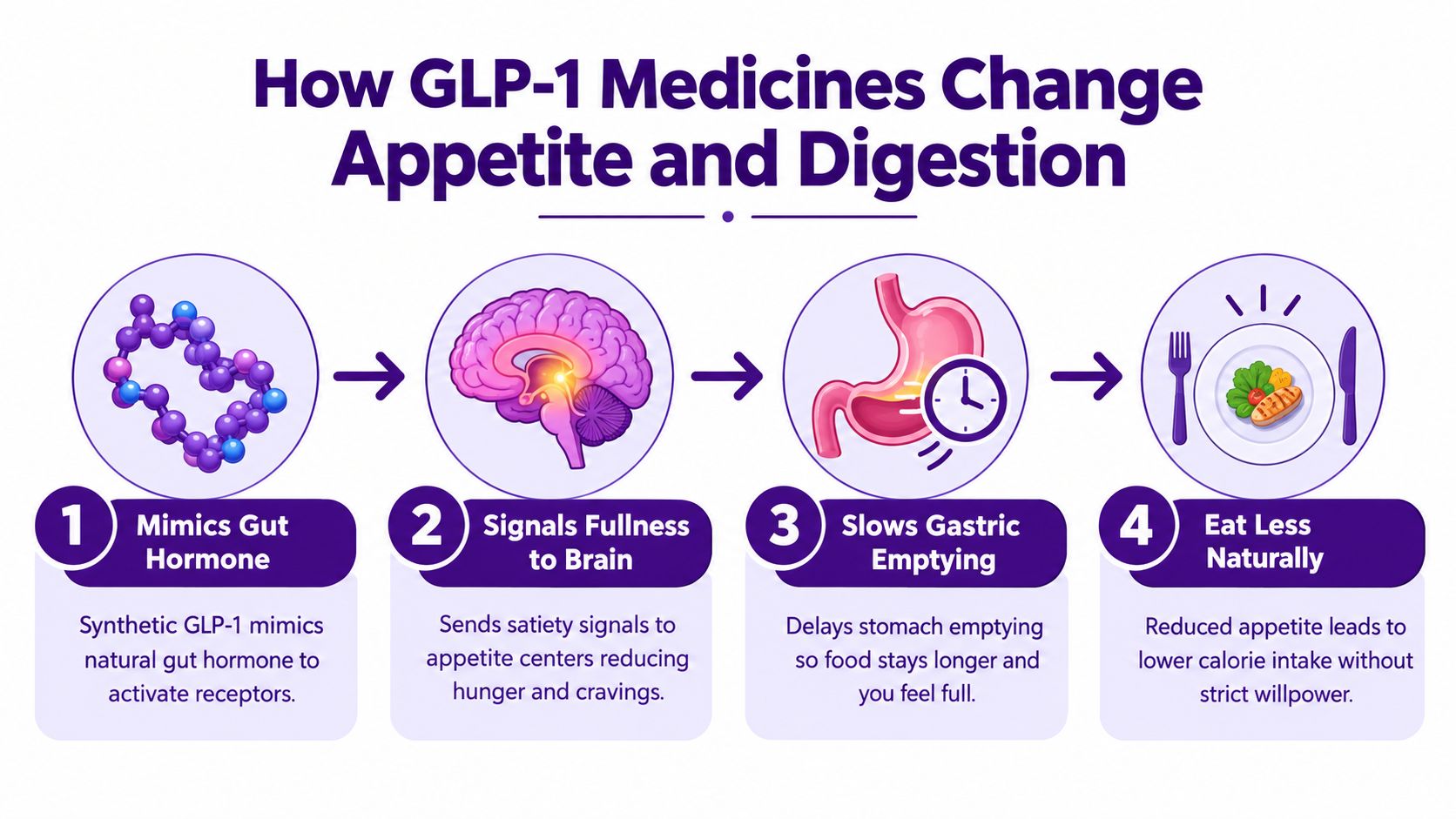
GLP-1 medicines imitate a hormone your gut naturally releases after eating. The hormone helps coordinate blood sugar, digestion and appetite. A useful analogy is a meal-management system with several linked controls: it tells the brain that food has arrived, slows the movement of food through the stomach, and helps the pancreas respond when blood sugar rises.
Appetite becomes easier to manage
Semaglutide activates GLP-1 receptors involved in fullness and appetite signalling. Many people find that portions feel more satisfying and that cravings occupy less mental space. The medicine isn't a stimulant that forces hunger away. Instead, it changes several signals involved in appetite, which can make a sustained reduction in food intake more achievable.
That mechanism is explained in more detail in what GLP-1 means for appetite and weight management. The practical result is lower energy intake over time, not direct fat burning.
Digestion slows down
GLP-1 treatment can slow gastric emptying, meaning food leaves the stomach more gradually. This can extend fullness after a meal, but it also helps explain why nausea, bloating, constipation or vomiting may occur, especially while the dose is increasing.
Tirzepatide, sold as Mounjaro in the UK, acts on GLP-1 and GIP receptors. GIP is another gut-related hormone involved in insulin regulation and nutrient handling. The combined action appears to produce larger average losses in some trials, although the result still depends on dose, duration, tolerance and the person receiving treatment.
Blood sugar is part of the picture
These medicines were developed in the context of type 2 diabetes because they help the pancreas release insulin when glucose is high and reduce signals that encourage the liver to release more glucose. The weight-loss effect became prominent because appetite, digestion and food intake changed alongside blood-sugar regulation.
A short educational overview can help visualise the mechanism:
Trial Results for Wegovy and Mounjaro Over Time
The headline trial averages were 14.9% weight loss for Wegovy after 68 weeks and a 20.1 percentage-point advantage for 15 mg Mounjaro over placebo after 72 weeks. These figures describe controlled studies, not guaranteed individual outcomes.
STEP 1 studied semaglutide 2.4 mg, marketed as Wegovy, while SURMOUNT-1 assessed tirzepatide, marketed as Mounjaro in the UK. Participants were mainly adults with obesity who did not have diabetes, and both trials included dietary and physical-activity support alongside medication.
Reading the curve rather than chasing the endpoint
Weight loss usually accumulates during dose escalation, becomes clearer through the middle of treatment and then slows as participants approach a plateau. A trial endpoint cannot show an exact week-by-week path for every patient, so the table uses only the verified study results available.
| Time point | Wegovy, STEP 1 | Mounjaro, SURMOUNT-1 | Placebo |
|---|---|---|---|
| 68 weeks | 14.9% average reduction, 15.3 kg (NICE evidence briefing) | Not stated in the verified data | Not stated in the verified data |
| 72 weeks | Not stated in the verified data | 20.1 percentage points greater mean weight change than placebo at 15 mg | 27.9% achieved at least 5% loss in the tirzepatide comparison |
The tirzepatide comparison also found that 96.3% of participants taking 15 mg lost at least 5% of body weight, compared with 27.9% receiving placebo. This shows a substantial treatment effect within the study, while leaving two practical questions open: whether someone can tolerate the highest dose and whether their result will match the average.
Why the endpoint needs context
A 68-week or 72-week result reflects sustained treatment, dose adjustments and regular monitoring. It should not be treated as a prediction for someone using a starting dose for a few weeks. Trial participants also received lifestyle guidance, so the medicine was assessed as part of a treatment programme rather than in isolation.
The Mounjaro result should also be compared with Wegovy on matching outcomes, doses and time points. The comparison of Mounjaro and Wegovy weight-loss outcomes explains why brand-level comparisons can be misleading. For general information about prescription injection services, see Ideal Face & Body injection options. Any treatment choice still requires an appropriate clinical assessment.
Real-World UK Results Versus the Headline Trial Figures
Routine NHS care produces a more variable picture than a clinical trial. In UK NHS data involving 1,666 patients treated with semaglutide, mean weight loss among those with follow-up was 4.39% at three months and 8.53% at six months, as noted in the UK NHS real-world evidence. That six-month result is lower than the STEP 1 endpoint, but the two figures describe different stages and settings.
The UK six-month checkpoint
NICE gives clinicians a practical response rule. In England, semaglutide should be stopped if a patient has lost less than 5% of initial body weight after six months. Tirzepatide should continue only if the patient has lost at least 5% after six months, according to the NICE GLP-1 and tirzepatide summary.
This threshold is a decision point, not a promise that everyone will match a trial average. Someone who reaches 5% may still have a meaningful clinical response, even if their eventual result remains below the headline figure.
Why routine care can look different
Trial participants follow a tightly managed schedule. NHS patients may experience delayed dose increases, missed injections, supply interruptions, less frequent behavioural support or medical conditions that affect response. The routine-care population can also be broader than the carefully selected trial group.
| Setting | Drug | Six-month loss | Twelve-month loss |
|---|---|---|---|
| UK NHS real-world dataset | Semaglutide | 4.39% mean loss at three months, 8.53% at six months | Not stated in the verified data |
| Main trial | Semaglutide 2.4 mg | Not stated at six months in the verified data | 14.9% average loss at 68 weeks |
| Main trial | Tirzepatide 15 mg | Not stated at six months in the verified data | 20.1 percentage points greater mean change than placebo at 72 weeks |
The table is a comparison aid, not a like-for-like forecast. Trial results reflect sustained treatment, dose adjustments and monitoring, whereas routine-care figures capture how treatment performs amid ordinary NHS constraints.
People comparing personal photographs or timelines should remember that before-and-after weight-loss results cannot show the dose history, treatment duration, muscle change, side effects or medical supervision behind the image. They also say little about whether weight was maintained after treatment changed or stopped.
Factors That Shape Your Individual Response
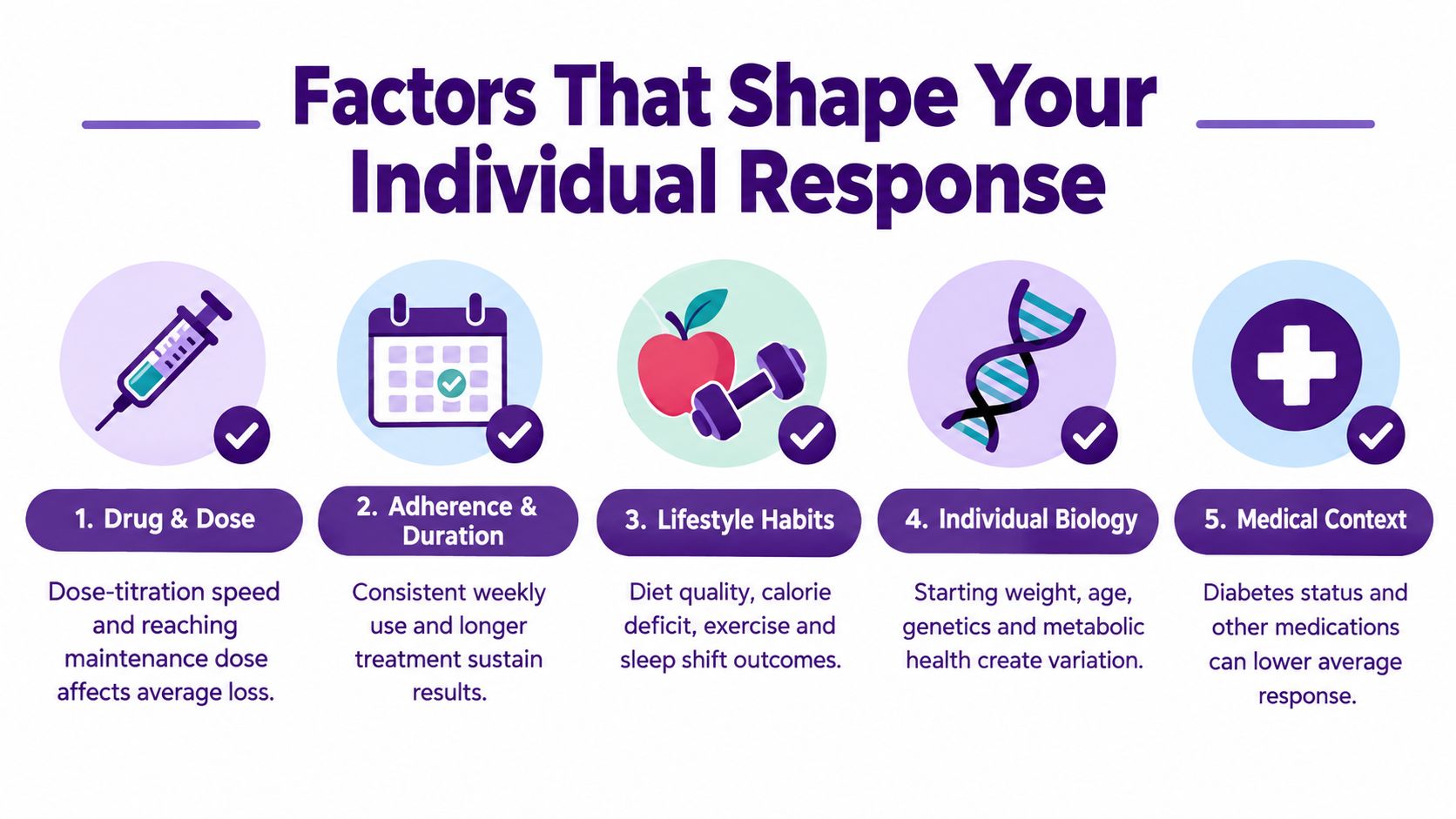
Population averages hide several layers of variation. The medicine, the dose you can tolerate, your health and your habits all influence the result, but no single factor determines it.
Treatment variables
Dose escalation is usually gradual. Reaching the intended maintenance dose of semaglutide 2.4 mg or tirzepatide 15 mg may support a larger response, but only if the person can tolerate it and a prescriber considers it appropriate. Weekly adherence matters too. Missed injections or prolonged pauses can interrupt appetite control and delay progress.
Personal biology
Starting weight often affects the number of kilograms lost, while the percentage change may be more comparable between people. Type 2 diabetes, age, sex-hormone context, genetics and other medicines can all alter the response. These factors should shape a conversation with a prescriber, not become reasons to blame yourself for a slower result.
Habits that protect the result
Protein-rich meals can help support lean tissue during weight loss. Resistance training gives muscles a reason to stay active, while regular sleep and stress-management routines can make hunger easier to manage. These habits don't override biology, and they can't guarantee a particular percentage loss.
For readers interested in a broader assessment beyond medication alone, a Shawnee KS functional medicine approach illustrates how some services organise discussions around nutrition, lifestyle and medical context. UK patients should still use a UK-authorised prescriber for their own treatment.
Side Effects Worth Knowing Before You Start
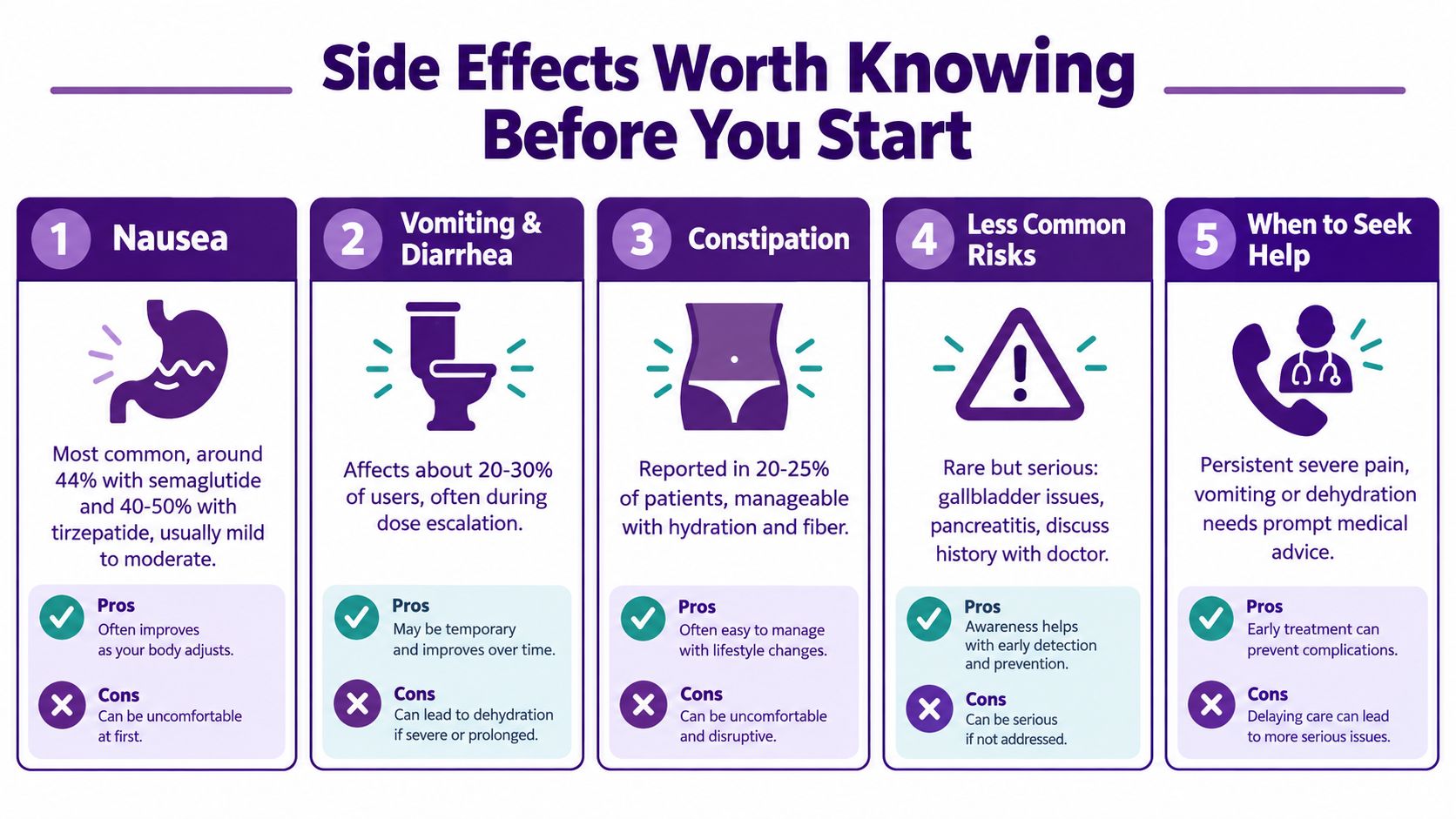
Digestive symptoms are the most familiar trade-off. Product information and trial safety data commonly describe nausea, vomiting, diarrhoea, constipation and abdominal discomfort, with symptoms often more noticeable during dose escalation. Exact rates vary by medicine and dose, so a symptom's presence doesn't automatically mean treatment is unsafe.
What early symptoms can mean
Nausea may appear when the appetite and digestion signals change faster than your body adapts. Smaller meals, avoiding foods that worsen symptoms and maintaining fluid intake can help, but patients shouldn't change the dose independently. A prescriber may pause an increase, extend the titration period or review whether another option is safer.
Constipation and diarrhoea can both create dehydration risk. Vomiting adds to that risk, particularly if the person can't keep fluids down. Fatigue, headache and injection-site reactions can also occur, though the severity and duration differ between individuals.
Symptoms that need medical advice
Persistent or severe abdominal pain should be assessed, particularly if it is accompanied by vomiting or pain that spreads to the back. Gallbladder problems and pancreatitis are uncommon but important risks to discuss, especially if you have relevant medical history.
People using insulin or sulfonylureas need specific advice because combining glucose-lowering treatments can increase the risk of hypoglycaemia. Seek prompt clinical help for severe pain, ongoing vomiting, signs of dehydration or concerning blood-sugar symptoms.
Safety comes before the scale. A slower dose increase or a treatment change may be more appropriate than pushing through symptoms.
UK prescribing involves clinician review, hydration advice and dose management rather than treating side effects as something patients must endure.
What Happens When You Stop and How Maintenance Looks
Weight loss and weight maintenance answer different clinical questions. GLP-1 medicines can reduce appetite during treatment, while the biological drive to eat may return after stopping. The practical question is therefore not only how much weight someone loses, but how much they are likely to retain.
A 2026 model estimated that people could regain around 60% of lost weight within a year of stopping GLP-1 treatment, with regain eventually levelling off near 75% of the original loss (Diabetes.co.uk report on post-treatment regain). This is a modelled estimate, not a prediction for every patient. It works like a warning light: stopping treatment deserves a plan rather than an assumption that the result will hold automatically.
Why regain can occur
Several factors may operate together. Appetite can increase as the medicine's effects fade, and the body may use less energy after weight loss. Eating habits that were manageable with lower hunger can become harder to maintain when hunger returns. For someone with diabetes, stopping treatment may also affect blood-glucose control, so clinician supervision matters.
NICE's six-month response rule is a checkpoint, not necessarily the end of treatment. If the medicine is helping and remains suitable, obesity management may continue as ongoing care. Anyone considering a finite self-pay course should discuss stopping, follow-up, nutrition and activity before starting, rather than waiting until the final dose.
A large change in body weight can also leave loose skin, which the scales do not record. This account of dramatic weight loss and excess skin shows why physical outcomes include more than a percentage change.
Maintenance requires active planning
Adequate protein, resistance training, regular sleep and scheduled clinical reviews may support weight retention. They do not fully reproduce the appetite effect of medication, and no lifestyle plan can guarantee that regain will not happen. Maintenance is better understood as continuing care than as a final stage completed once a target weight is reached.
The UK context is also changing. A 2026 population study estimated that 2.9% of UK adults, about 1.6 million people, reported using a GLP-1 or GLP-1/GIP medicine for weight loss in the previous year (UK population study). As use expands, long-term follow-up and fair access become more important, particularly for people deciding whether treatment can be sustained.
Putting It All Together for UK Adults Considering GLP-1 Therapy
A useful summary has four parts. Clinical trials reported large average reductions, including 14.9% with semaglutide 2.4 mg over 68 weeks and a 20.1 percentage-point advantage over placebo at 72 weeks for tirzepatide. These figures come from controlled studies, where follow-up and treatment conditions are closely managed, so they are benchmarks rather than promises (NICE semaglutide briefing, NICE tirzepatide discussion).
Routine NHS care may show a slower early pattern. In the available UK dataset, semaglutide users recorded 8.53% mean loss at six months (NHS real-world evidence). The comparison is useful because a trial average describes a study group, while routine results include missed doses, treatment changes, different starting points and everyday pressures.
Treatment also has practical costs. Nausea, constipation, diarrhoea, vomiting and abdominal discomfort can affect eating and daily life, especially during dose escalation. Stopping is not the same as completing a short course. Appetite can return, and substantial regain is possible, as the 2026 modelling evidence illustrates (post-treatment regain model).
A sensible decision framework
Ask a prescriber to work through:
- Eligibility: NICE recommendations and NHS access depend on clinical criteria, local commissioning and the medicine involved.
- Expected response: In England, the relevant benchmark is at least 5% loss after six months for continuing semaglutide or tirzepatide under the cited NICE guidance (NICE treatment summary).
- Safety: Review your medical history, other medicines, diabetes treatment, pregnancy plans and any digestive or pancreatic problems.
- Maintenance: Agree how progress will be monitored if treatment works, falls short or causes side effects.
- Support: Nutrition, strength training, sleep and behavioural support can help turn reduced appetite into a routine you can sustain.
In June 2026, the UK approved oral semaglutide, Wegovy tablets, for adults with obesity or overweight with a weight-related comorbidity. The government notice said it was not yet available on the NHS while NICE reviewed it (UK government approval notice). Tirzepatide access in primary care was introduced on a phased basis from 23 June 2025, with an eligible cohort planned around 220,000 people over the first three years (NHS England interim commissioning guidance).
Use a regulated pathway, confirm that the clinician is appropriately registered, and report persistent or severe symptoms rather than changing treatment alone. The practical target is a medically appropriate response that you can tolerate, monitor and maintain.
Trim offers medically supervised weight-management treatment in the UK, including clinician assessment, suitable prescription options such as Mounjaro and Wegovy, nutrition guidance, progress tracking and ongoing support. Visit Trim to complete a consultation for clinical assessment.
- glp-1, Mounjaro, UK, Wegovy, weight loss