
How Long Does Orlistat Stay in Your System Explained

Very little orlistat reaches the blood, and intact orlistat is non-measurable within 8 hours, with a 1 to 2 hour half-life for the small absorbed fraction. Complete elimination through faecal and urinary routes takes about 3 to 5 days, so functional gut effects can outlast measurable blood levels.
You may be asking this after missing a capsule, stopping treatment, or preparing to change to another weight-management medicine. The practical answer depends on what you mean by “in your system”. The blood clock moves quickly, while the gut clock can continue through several days of bowel transit and recent dietary fat.
That distinction matters because orlistat works locally inside the intestine rather than by circulating widely through the body. This article focuses on clinical trial data and UK regulatory information, not promotional claims, so you can understand the pharmacokinetics and discuss your situation sensibly with a clinician. Broader support, including a holistic weight loss treatment, may also address nutrition, behaviour and health conditions alongside medication.
Table of Contents
- Introduction to How Long Orlistat Stays in Your System
- How Orlistat Works Inside Your Gut
- Absorption Half Life and Elimination Timeline
- What Affects How Quickly Orlistat Clears
- How Long Effects and Side Effects Last After Stopping
- Treatment Planning and Monitoring in a Supervised Programme
- Common Misconceptions About Orlistat Persistence
Introduction to How Long Orlistat Stays in Your System
You take your last capsule on Monday and wonder on Tuesday whether orlistat has left your body, whether a missed dose still matters, or whether bowel symptoms mean it is accumulating. These questions sound alike, but they involve different processes.
The answer depends on which clock you mean. The blood clock runs in hours. The gut clock, involving undigested fat, bowel transit and related effects, can run for days.
UK product information reports that orlistat is minimally absorbed, with less than 2% entering the bloodstream. In the UK Xenical information, intact drug concentrations were non-measurable, below 5 ng/mL, by 8 hours after an oral dose (UK Xenical SmPC). The small absorbed fraction has a half-life of about 1 to 2 hours, while complete faecal and urinary elimination takes about 3 to 5 days, as described in the UK orlistat SmPC.
The useful distinction: blood levels can fall quickly, while undigested dietary fat and gastrointestinal effects may take longer to pass through the bowel.
Orlistat's local action explains the difference. It works on fat-digesting enzymes inside the gut, rather than requiring substantial circulation through the body. In practical terms, very little may remain measurable in the blood after hours, while faecal contents and functional effects may continue for days.
Treatment context matters too. NICE guidance states that orlistat can be prescribed in primary care when relevant criteria are met. It should sit within clinical care, nutrition advice and monitoring, rather than being treated as an isolated product. For a practical overview, see orlistat and weight loss. Additional support, including a holistic weight loss treatment, may address nutrition, behaviour and health conditions alongside medication.
How Orlistat Works Inside Your Gut
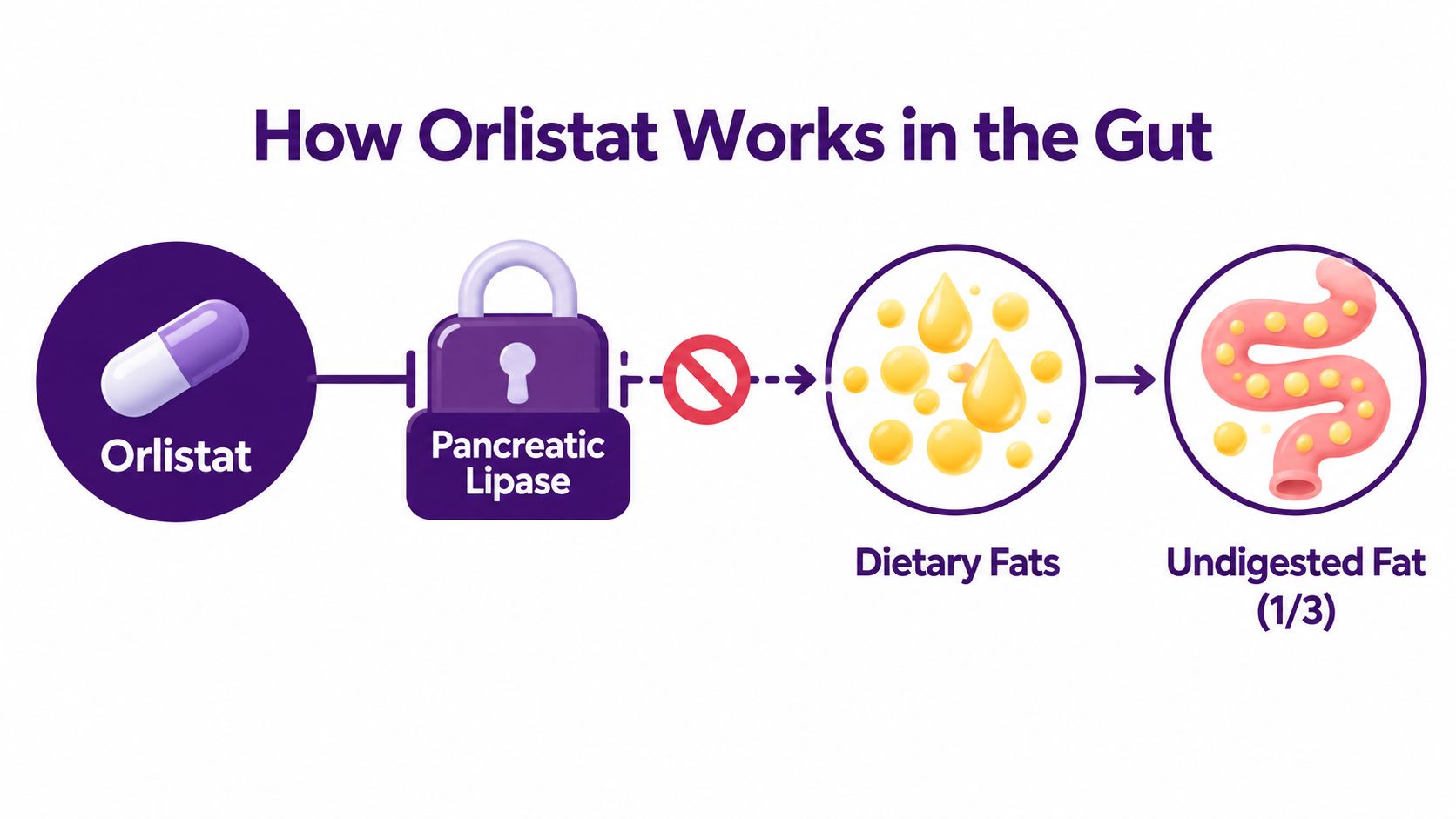
Start with the meal, not the bloodstream. Dietary fat is too large and complex for the intestine to absorb directly, so digestive enzymes called lipases break it into smaller components. Orlistat interferes with that process by inhibiting gastric and pancreatic lipases.
A simple analogy is a locked gate. Pancreatic lipase is the gatekeeper that normally prepares dietary fat for absorption. Orlistat sits at that gate and prevents the enzyme from doing its job efficiently. The fat remains undigested and continues through the intestine into the stool.
UK-facing information describes orlistat as passing about a third of dietary fat into the stool as a consequence of this local action (Teva UK product information). The important point isn't that the medicine needs to travel around the body. Its target is already in the gut, alongside the food and digestive enzymes.
Local action versus systemic action
A locally acting medicine produces its main effect at the place where it is administered or delivered. A systemic medicine, by contrast, needs to enter the circulation and reach tissues elsewhere in the body. Orlistat sits much closer to the first category, which is why its measurable plasma exposure is so limited.
That also explains why bowel changes can be more noticeable than whole-body effects. Oily stools, loose stools, urgency or wind with oily discharge are linked to undigested fat moving through the intestine. They don't prove that a large amount of orlistat remains in your blood.
Meal composition still matters. A meal with little or no fat gives the medicine less fat digestion to block, while a higher-fat meal can leave more unabsorbed fat in the bowel. Practical food choices can therefore influence symptoms even when the bloodstream contains very little drug. Guidance on what to eat when taking orlistat can help translate the mechanism into everyday meals.
Absorption Half Life and Elimination Timeline
A person may ask, “How long does orlistat stay in my system?” That question has two answers. One clock measures intact medicine in the blood, while the other follows the dose through the gut and out of the body. They overlap, but they do not run at the same speed.
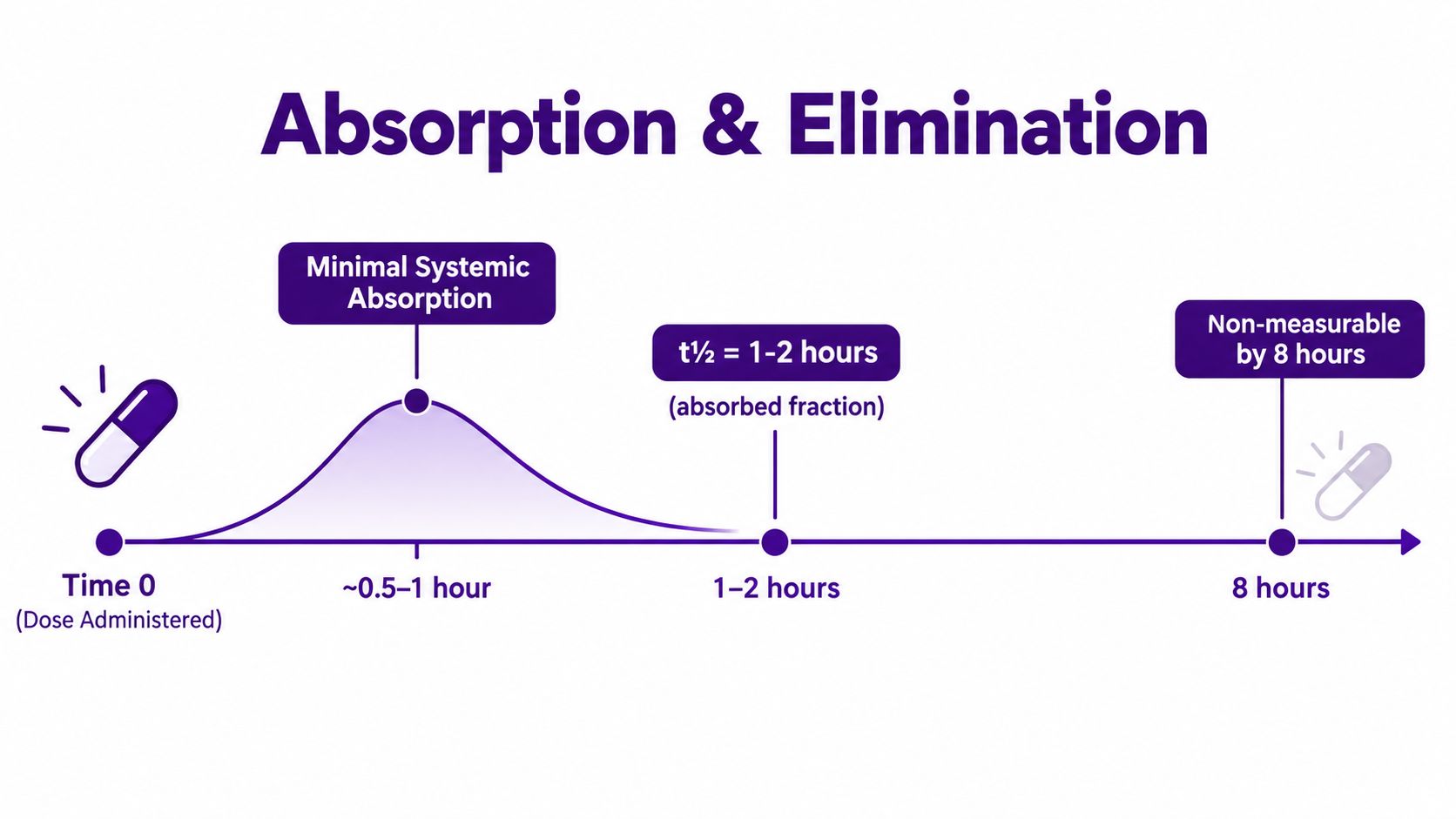
The UK Xenical SmPC reports that plasma concentrations of intact orlistat were non-measurable, below 5 ng/mL, by 8 hours after dosing. At therapeutic doses, detection in plasma was sporadic and extremely low, below 10 ng/mL, with no evidence of accumulation (UK Xenical SmPC). Repeated doses therefore do not appear to build a progressively larger reservoir in the bloodstream.
The reported half-life of 1 to 2 hours applies to the small fraction that is absorbed. It does not describe the larger amount remaining in the intestine. A half-life measures how quickly the quantity in one compartment falls. It does not mean that every trace throughout the body has disappeared by the same time.
The two clocks in plain English
The fast clock is the blood clock. Very little intact orlistat enters the circulation, and that absorbed fraction clears quickly. Plasma levels become non-measurable within the timeframe described above. The product information also states that no defined systemic pharmacokinetic profile can be established because absorption is minimal.
The slower clock follows the dose as a whole. About 97% of an administered dose is recovered in faeces, with 83% recovered unchanged. Cumulative renal excretion is less than 2%. Complete elimination through faecal and urinary routes takes about 3 to 5 days (UK orlistat SmPC).
That longer timeframe describes movement through the gut and excretion, not several days of high blood concentrations. It helps explain why bowel effects may outlast the period in which measurable intact medicine is present in plasma.
The SmPC says the volume of distribution cannot be determined because orlistat has no defined systemic pharmacokinetics. Clinicians therefore cannot describe it like a conventional medicine that spreads through a measurable body compartment. More than 99% protein binding further limits free circulating drug, while the practical conclusion remains simple: most of the dose stays in the gut and leaves in faeces.
What Affects How Quickly Orlistat Clears
Two processes can feel like one. The amount of intact orlistat in the blood falls quickly, while unabsorbed fat and stool may take longer to pass through the bowel. Variation after the final capsule usually reflects what remains in the intestine and when it is passed, rather than a major change in blood clearance.
Meal timing sets the scene for local activity. Taking orlistat with food containing fat gives it something to act on in the intestine. If a meal is missed or contains little fat, less undigested fat is associated with that dose. This can reduce the chance of gastrointestinal effects, but a missed dose does not cause the medicine to build up in the body.
Bowel transit then affects how long the functional effects are noticed. Faster transit may move unabsorbed material through sooner. Constipation can delay passage, while diarrhoea may make urgency or loose stools feel more immediate. These changes describe movement through the gut, not a higher amount of orlistat in the bloodstream.
| Factor | Effect on Clearance | Why It Matters |
|---|---|---|
| Meal timing | Changes when local activity occurs | Orlistat's effect is linked to food reaching the intestine, especially dietary fat. |
| Dietary fat | May increase or reduce unabsorbed fat in stool | More undigested fat can mean more noticeable oily stools or urgency. |
| Bowel transit | Faster transit may shorten functional persistence | Material leaves the gut sooner, although symptoms can feel sharper. |
| Constipation | May prolong passage through the bowel | Residual stool and associated effects can take longer to clear. |
| Diarrhoea | Can make gastrointestinal effects more prominent | Rapid transit changes the experience without proving systemic accumulation. |
| Missed or irregular doses | Reduces consistent local exposure | The effect relates to the specific meal and dose, not a stored body supply. |
| Kidney function | Usually has limited influence on the main route | Renal excretion makes up only a small part of the dose, so the kidneys are not the main clearance route. |
| Liver function | Doesn't change the gut-dominant principle | Most of the dose is recovered through faeces rather than urine. |
Use the table to organise questions, not as a personal clearance calculator. Severe, persistent, or unusual bowel symptoms need clinical assessment rather than an assumption that they represent normal orlistat transit. The same applies to conditions affecting digestion or absorption, where the usual timeline may not describe the individual situation accurately.
How Long Effects and Side Effects Last After Stopping
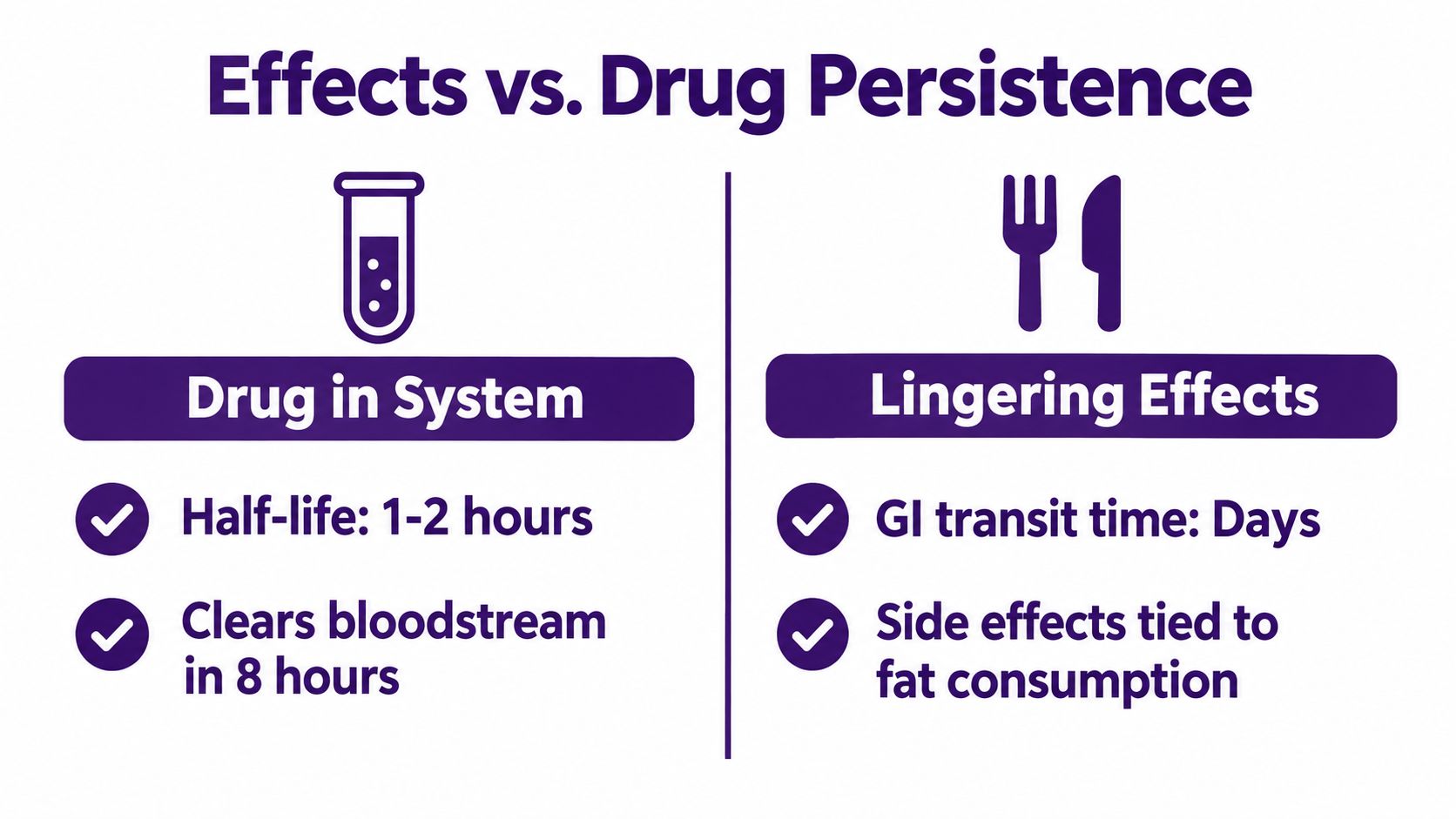
Stopping orlistat starts two separate clocks. The blood clock usually runs for hours, because only a small amount is absorbed and that absorbed fraction leaves the bloodstream quickly. The gut clock can run for days, because the last affected meals still contain unabsorbed fat moving through the bowel.
That explains why oily stools, faecal urgency, or changes in stool consistency may continue after intact orlistat is no longer measurable in plasma. The symptoms reflect the movement of unabsorbed fat and stool through the intestine, rather than a store of medicine building up in the body.
Recent meals can make this difference easier to notice. If the final doses were taken with food containing fat, undigested material may still need to pass through the bowel. Gastrointestinal effects should generally settle as that material clears over the following days, in keeping with the 3 to 5 day complete faecal and urinary elimination timeframe described earlier in UK product information.
A practical way to read the next few days
- Blood phase: Measurable exposure falls quickly after stopping, reflecting orlistat's limited absorption and short half-life.
- Bowel phase: Unabsorbed fat and stool continue along the intestine, so urgency or oily stools may not stop at once.
- Settling phase: Symptoms should gradually move back towards your usual pattern as the affected meal contents pass.
This sequence is a guide, not a promise that every person will feel the same. New, severe, worsening, or persistent symptoms need medical advice. Seek prompt guidance for significant dehydration, ongoing diarrhoea, severe abdominal pain, blood in the stool, or effects that feel unlike your usual response to orlistat.
The distinction helps resolve a common misunderstanding. Clear blood does not mean the bowel has finished processing the last meal affected by orlistat. Continued oily stool does not, by itself, show that the medicine is accumulating in the body.
The following video offers another visual explanation of drug persistence and lingering effects:
Treatment Planning and Monitoring in a Supervised Programme
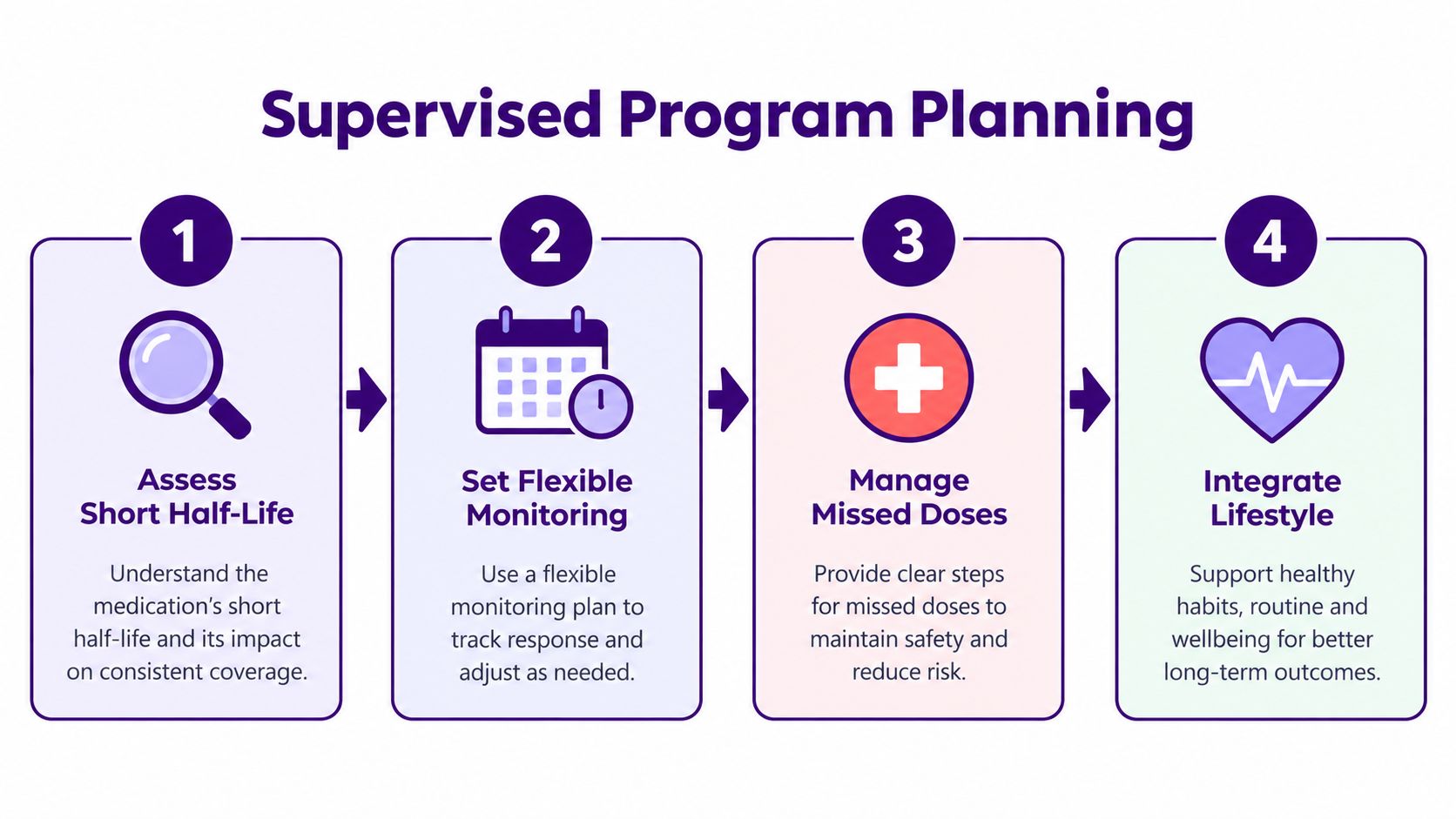
Clearance information becomes most useful when it supports a treatment conversation. A clinician may need to know when you took your last dose, whether you missed doses, what your recent meals were like, and whether bowel symptoms are improving or changing. Those details describe the gut clock more accurately than a simple yes-or-no question about whether the drug is “still there”.
UK guidance places orlistat within an evidence-based prescribing pathway. NICE says it can be prescribed in primary care when the relevant criteria are met, so suitability, monitoring and follow-up belong with an appropriate healthcare professional rather than an informal washout rule (NICE prescribing guidance).
Four practical planning questions
- What was the last dose? Record the date and approximate time, especially if you're changing treatment.
- What happened in the gut afterwards? Note urgency, oily stool, diarrhoea, constipation and abdominal discomfort.
- Are you considering pregnancy or contraception? Don't rely on a generic “washout” answer. Discuss pregnancy planning, contraception and any medication concerns with your clinician.
- Is another medicine being started? Switching isn't determined solely by how quickly plasma levels fall. A South Yorkshire NHS document advises clinicians to stop orlistat when starting tirzepatide, illustrating why the transition should be coordinated clinically.
A supervised programme can also help separate a missed dose from a treatment problem. Tracking meals, bowel symptoms, weight trends and other medicines in an app or written log gives the clinical team a clearer picture. It also avoids the assumption that a single symptom proves toxicity or that a single missed capsule requires an improvised catch-up dose.
For questions about eligibility and whether this medicine fits your circumstances, the information on who can take orlistat can help you prepare for a clinical discussion. It shouldn't replace an individual assessment, particularly if you're pregnant, planning pregnancy, breastfeeding, taking interacting medicines, or changing to a newer weight-management treatment.
Common Misconceptions About Orlistat Persistence
迷思一:orlistat 會在體內累積數週。 UK Xenical information cited earlier reports no evidence of accumulation. At treatment doses, orlistat is only detected sporadically in plasma and at extremely low levels. Because it acts mainly inside the gut, repeated capsules do not create the same pattern as a medicine that steadily stores in body tissues.
Clarification: A short blood half-life does not mean bowel effects stop at that exact moment.
迷思二:orlistat 會像某些長效減重藥物一樣留在體內數週。 This comparison overlooks differences in absorption, distribution and elimination. As the UK product information cited earlier reports, intact orlistat in plasma is non-measurable by 8 hours, while complete elimination through faeces and urine takes about 3 至 5 天. These are two different clocks: blood presence is brief, while gut transit and related effects can continue for days.
迷思三:討論下一項治療前一定需要長時間洗脫。 A clinician may still coordinate a switch carefully if contraception, pregnancy planning, side effects or another weight-loss medicine is involved. The decision considers the person's circumstances, the next medicine, ongoing bowel effects and the wider care plan, rather than relying only on a presumed residual blood concentration.
The practical model is 血液中以小時計算,腸道內以天計算. If symptoms or the timing of your last dose are unclear, raise those details at a clinical review instead of relying on a generic online estimate.
If you're considering medically supervised weight management, Trim offers clinician-led assessment, ongoing support and options that include orlistat alongside other regulated treatments. Visit Trim to discuss your current medicine, missed doses, gut symptoms or a possible switch with a UK clinical team.