
Weight Loss and Joint Pain: The Clinical Evidence

Each additional pound of body weight can transmit approximately four to six pounds of pressure through each knee during activity, so weight loss can reduce a major physical demand on painful joints. It can help, but the most useful approach combines gradual fat loss with strength, mobility work, and appropriate clinical assessment.
Joint pain changes how people move. A sore knee may shorten a walk, reduce stair use, or make resistance training feel impossible. That creates a difficult cycle: less movement can reduce muscle support and physical capacity, while excess body mass continues to load the joint.
The practical question isn't just whether losing weight helps. It's how to reduce body weight while preserving the muscle and function that keep a joint stable. The evidence is strongest for knee osteoarthritis, and it supports weight management as one part of care, not as a universal cure or replacement for diagnosis.
Table of Contents
- Why Weight Loss Matters for Joint Pain
- How Excess Weight Affects Joints
- What the Clinical Evidence Shows
- Diet, Exercise, and Combined Approaches
- Practical Strategies to Lose Weight Safely with Joint Pain
- Monitoring Progress and When to Seek Care
- Key Takeaways for Sustainable Joint Health
Why Weight Loss Matters for Joint Pain
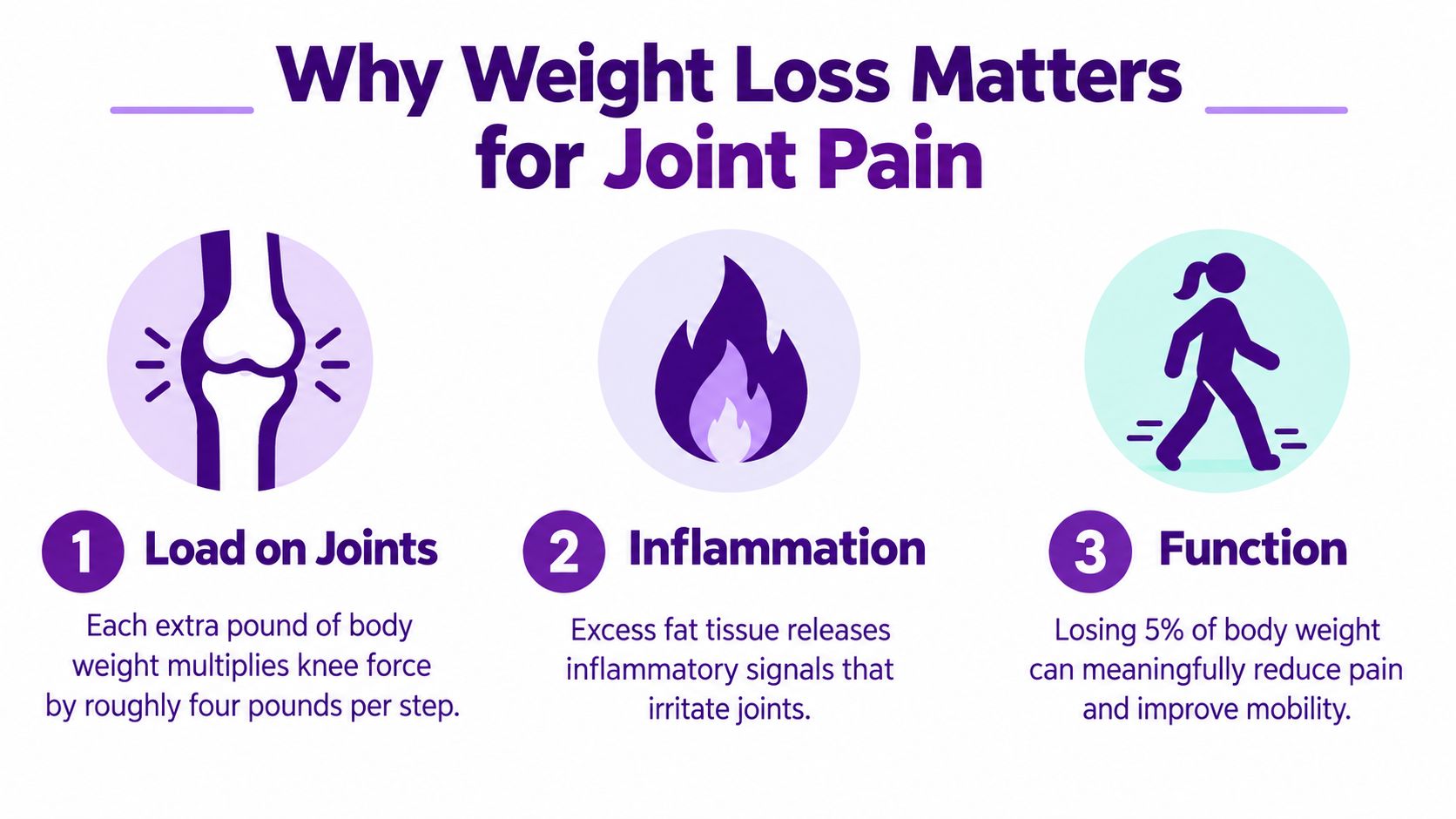
The mechanical case is straightforward. A UK NHS musculoskeletal resource explains that each additional pound of body weight can transmit approximately four to six pounds of pressure through each knee during activity (Dorset County Hospital NHS information). Walking, climbing stairs, and rising from a chair repeat that loading throughout the day.
That doesn't mean every painful joint is caused by weight, or that losing weight will reverse established osteoarthritis. It does explain why even a modest reduction can be clinically relevant for weight-bearing joints. Less mass means less repetitive demand during ordinary movement, particularly when pain is already limiting activity.
Load is only part of the picture
Clinicians treat excess weight as a modifiable risk factor, not a moral judgement. Weight is one factor among age, previous injury, genetics, muscle strength, alignment, occupation, and other health conditions. A person can have severe pain at a lower body weight, while someone living with obesity may have little joint pain.
The benefit of weight reduction is therefore functional. It may make walking more comfortable, reduce the effort required for daily tasks, and create room for exercises that were previously too difficult. Guidance on walking for health can be useful, but walking should be adapted to symptoms rather than treated as a test of willpower.
Practical rule: Choose movement you can repeat consistently without provoking a prolonged flare. Consistency matters more than forcing intensity.
Weight loss should complement assessment when pain persists, worsens, or affects sleep and mobility. A clinician or physiotherapist can help distinguish osteoarthritis from injury, inflammatory arthritis, nerve-related pain, or another condition requiring different treatment.
How Excess Weight Affects Joints
Excess weight affects joints through two connected pathways. The first is mechanical loading. Weight-bearing joints such as the knees and hips absorb greater forces as body mass rises, and the effect is repeated every time a person walks, stands, climbs, or changes direction.
The second pathway is biological. Fat tissue is metabolically active and can contribute to inflammatory signalling throughout the body. That doesn't prove that weight alone causes joint deterioration, but it helps explain why the relationship between obesity and osteoarthritis isn't purely a matter of force through cartilage.
The UK context
The scale of the issue makes this a population-health concern rather than an individual failure. Government estimates for 2023–2024 found that 64.5% of adults aged 18 and over in England were overweight or living with obesity, including 26.5% living with obesity (UK government obesity profile). The same source recognises obesity as a major modifiable risk factor for osteoarthritis, particularly in weight-bearing joints such as the knees.
That context matters because people with painful joints often receive the instruction to “lose weight” without a plan for doing so safely. Pain may prevent brisk walking, floor exercises, or conventional gym sessions. A useful programme must account for the joint, the person's existing strength, their confidence with movement, and any medical conditions affecting weight or pain.
Why diagnosis still matters
Mechanical strain and metabolic inflammation can coexist with other causes of pain. A hot, markedly swollen joint, sudden inability to bear weight, or rapidly worsening symptoms shouldn't be managed through weight loss alone. Those signs warrant clinical review.
People looking for broader explanations may also benefit from a resource on how to find relief from joint pain, provided they use general information as a prompt for appropriate assessment rather than a substitute for it. The right treatment depends on whether the problem is osteoarthritis, an acute injury, inflammatory disease, or another diagnosis.
What the Clinical Evidence Shows
The most useful evidence connects the amount of weight lost with changes in symptoms, rather than treating the scale as the only outcome. A UK-hosted systematic review and network meta-analysis included 30 trials involving 4,651 adults with knee osteoarthritis and found a dose-response relationship between weight loss and combined WOMAC pain, function, and stiffness scores (NHS osteoarthritis treatment evidence).
The analysis associated each 1% reduction in body weight with approximately a 2% improvement in the combined WOMAC scores. This is an average relationship across trials, not a promise for an individual patient. It also doesn't mean symptoms improve in a perfectly linear way week by week.
Meaningful improvement can require sustained loss
The same analysis estimated that roughly 25% weight reduction would be needed to achieve a 50% reduction in each WOMAC domain. That finding is clinically important because it counters the idea that a short-term fluctuation on the scales will automatically restore function.
It also shows why outcome expectations should be realistic. Someone may experience easier movement before pain changes substantially, or notice better pain control without being able to return immediately to every activity. Weight loss can reduce joint loading, but strength, balance, range of movement, sleep, confidence, and the condition of the joint still influence function.
The analysis found the largest pain reduction with bariatric surgery, followed by low-calorie diet plus exercise and intensive weight loss plus exercise. Reported pain-effect estimates were approximately −62.7, −34.4, and −27.1 points, respectively, with Bayesian 95% credible intervals reported in the review. These comparisons describe evaluated interventions. They aren't a reason to pursue surgery or medication without an individual assessment of benefits, risks, suitability, and long-term support.
Weight loss isn't the same as rehabilitation
A lower body weight may reduce demand on the knee, but it doesn't automatically rebuild muscle or restore movement confidence. People who lose weight rapidly without adequate protein, resistance exercise, or clinical monitoring may become weaker, particularly if pain already limits activity.
For readers considering medication-assisted treatment, educational information about weight loss injections in the UK should be read alongside advice from a registered clinician. The central clinical question isn't only how much weight a treatment removes. It's whether the programme also protects function.
Diet, Exercise, and Combined Approaches
Diet and exercise solve different parts of the problem. Dietary changes can create the energy deficit needed for weight loss, while exercise helps maintain strength, mobility, cardiovascular fitness, and confidence. For painful joints, separating the two can make the programme less effective.
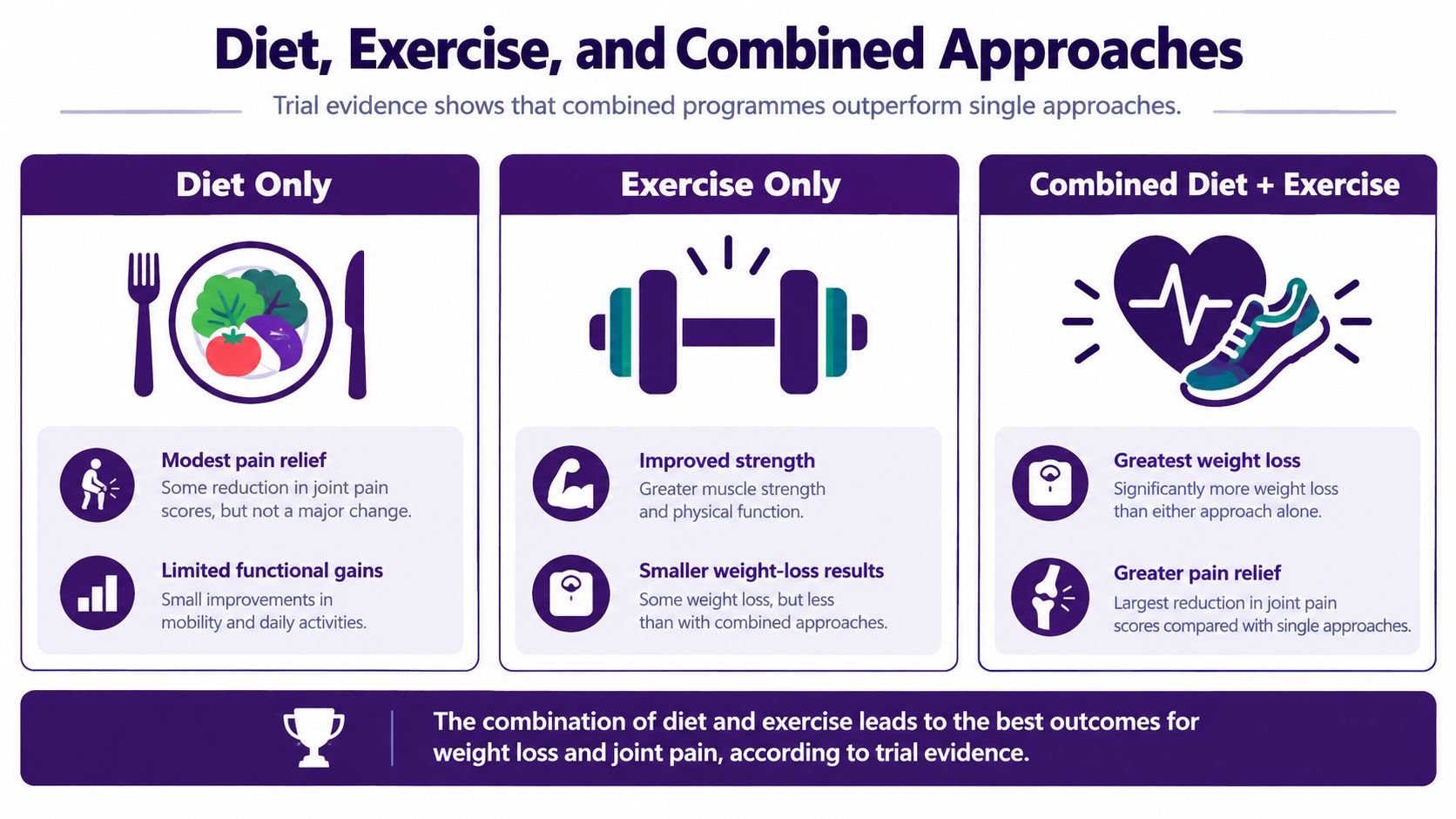
A UK evidence summary for knee osteoarthritis found that weight-loss interventions alone didn't significantly reduce pain over 8 to 18 weeks compared with no weight-loss intervention. In contrast, combined diet-and-exercise programmes significantly reduced pain, with a standardised mean difference of −0.37 (Arthritis UK evidence summary).
What the comparison means in practice
Diet-only programmes may reduce weight, but they don't directly train the muscles that stabilise and move a painful joint. Exercise-only programmes may improve strength and function, yet the scale may change more slowly than a person expects. A combined approach gives each element a distinct job.
The same evidence summary found a significant improvement in self-reported disability for weight-loss interventions, based on four randomised controlled trials involving 417 participants, with an effect size of 0.23 and a 95% confidence interval from 0.04 to 0.42. That result supports tracking daily function, not just pain intensity.
A practical combination might include:
- Nutrition: A sustainable calorie reduction using meals the person can maintain.
- Strength: Progressive exercises for the thighs, hips, trunk, and upper body.
- Low-impact conditioning: Swimming, aqua aerobics, cycling, or tolerable walking.
- Mobility: Controlled range-of-motion work that doesn't provoke a sustained flare.
Early pain results can be modest. That isn't evidence that the programme has failed, particularly when walking tolerance, chair transfers, sleep, or confidence are improving. Knee osteoarthritis evidence shouldn't automatically be applied to hip pain, hand pain, back pain, or undiagnosed symptoms.
Practical Strategies to Lose Weight Safely with Joint Pain
A function-preserving plan starts with a clinical baseline. Record the activities that currently cause difficulty, such as stairs, shopping, standing from a chair, or walking outdoors. A GP, physiotherapist, or suitably qualified clinician can then help adapt exercise around pain, swelling, balance, previous injury, and other health conditions.
NHS guidance recommends losing a small amount of weight, typically around 5% to 10% of body weight, to improve health in adults living with overweight or obesity. Arthritis UK identifies a 5% reduction in body weight as a recommended target in cited clinical evidence for knee osteoarthritis (NHS osteoarthritis treatment guidance). These are useful clinical reference points, not guarantees or compulsory targets.

Build the programme around preservation
Start with nutrition that creates a manageable reduction in energy intake without making meals so restrictive that adherence collapses. Include a reliable protein source in meals, plenty of fibre-rich foods, and enough variety to support general health. A dietitian can help adjust intake where kidney disease, diabetes, gastrointestinal symptoms, or other conditions affect food choices.
Strength work should be gradual. Useful starting points may include supported sit-to-stand practice, wall-supported exercises, resistance bands, or supervised machines. The right choice depends on the joint and the person's control. A painful knee may tolerate a partial movement well but react badly to deep bending or high-impact activity.
Low-impact conditioning can maintain fitness while reducing compressive stress. Swimming and aqua aerobics are often practical options, while cycling may suit people who tolerate a bent-knee position. Footwear can influence comfort and confidence, so guidance on arthritis-friendly running shoes from Swift Running may help people compare features, though shoes can't correct every biomechanical problem.
Manage flares instead of abandoning movement
Reduce the intensity, range, or duration of an exercise during a flare rather than stopping all activity. If pain remains worse beyond the expected recovery period, seek advice and adjust the programme. A physiotherapist can identify whether the problem is load, technique, progression speed, or an underlying diagnosis.
People considering medication-assisted weight management should treat it as one component of supervised care. A clinician can review suitability, side effects, nutrition, and strength training. Trim offers a UK medically supervised programme combining clinical assessment with nutrition, activity, progress tracking, and strength-focused support. Its approach can be considered alongside other regulated services, GP care, dietetic support, and physiotherapy. Practical nutrition guidance is available through nutrition tips for weight loss, but individual medical advice should come from the prescribing team.
Monitoring Progress and When to Seek Care
The scales provide one measure, not the whole clinical picture. Track whether you can walk farther, stand more comfortably, use stairs with greater control, sleep with fewer interruptions, or complete exercises with less hesitation. These changes may appear before a clear reduction in pain.
Pain and weight are related but separate endpoints. NHS advice about the health benefits of losing weight doesn't guarantee a specific improvement in osteoarthritis symptoms, and trial findings describe group averages rather than individual outcomes. Record pain alongside function, stiffness, swelling, activity tolerance, and strength so that you and your clinician can see what is changing.
Use a simple progress record
A weekly record can include:
- Function: One daily activity that has become easier or remains difficult.
- Symptoms: Pain, stiffness, swelling, and whether symptoms settle after exercise.
- Capacity: Repetitions, walking tolerance, or resistance used safely.
- Recovery: How long a flare lasts and whether it affects sleep or routine.
- Nutrition: Hunger, meal consistency, hydration, and any medication-related effects.
A temporary increase in soreness can occur when activity changes, but worsening symptoms need interpretation. A hot or markedly swollen joint, sudden inability to bear weight, or symptoms suggesting another diagnosis require clinical review rather than persistence.
Emerging medication evidence
Researchers are beginning to test joint outcomes directly. A UK Health Research Authority-listed Phase 3 randomised, double-blind, placebo-controlled trial is evaluating whether once-weekly LY3437943 can reduce knee pain in adults with overweight or obesity and knee osteoarthritis without diabetes (TRIUMPH-4 trial summary). The trial highlights an important distinction: researchers shouldn't assume that weight reduction automatically produces pain relief or preserved function.
A careful programme therefore monitors muscle quality, strength, mobility, pain, and adverse effects, not just body weight.
Key Takeaways for Sustainable Joint Health
Weight loss can help joint pain because it reduces the repeated mechanical demand placed on weight-bearing joints. The benefit is most relevant when excess weight contributes to knee osteoarthritis, but pain has multiple causes and doesn't disappear just because the scale moves.
The strongest practical message is to combine gradual weight reduction with structured exercise. Diet can drive the change in body mass. Strength work helps preserve the muscle needed for stability and daily function. Low-impact conditioning supports fitness without demanding high-impact loads, and mobility work helps people maintain usable range of movement.
A sustainable plan should also respect the person's starting point. Someone who can already walk comfortably may need a different progression from someone who avoids stairs because of pain. Someone with swelling, instability, or a previous injury may need assessment before increasing activity. Treating every painful knee with the same exercise prescription is neither precise nor safe.
The clinical priorities
- Reduce load without chasing extremes. General NHS guidance supports a small amount of weight loss for health, while knee osteoarthritis evidence cited by Arthritis UK supports a 5% reduction as a relevant target. Neither figure promises the same pain response for every person.
- Protect lean mass. Include resistance training where safe, maintain adequate nutrition, and monitor strength. Losing weight while becoming less able to rise from a chair or walk outdoors is not a successful functional outcome.
- Measure what matters. Pain is important, but so are walking tolerance, stairs, sleep, balance, confidence, and participation in daily activities.
- Use professional support early. A GP can assess diagnosis and medical risks. A physiotherapist can adapt loading and technique. A registered dietitian or supervised weight-management team can help make nutrition practical.
- Keep expectations honest. Weight loss may reduce symptoms, but it won't restore damaged cartilage or guarantee avoidance of future treatment. It can, however, create a better foundation for exercise, rehabilitation, and any later intervention.
Function is the target. A lower number on the scales matters most when it helps you move, strengthen, sleep, and participate in ordinary life.
The emerging research on medication-assisted weight loss reinforces this principle. Future treatments need to show not only that people lose weight, but that they experience meaningful pain relief without unacceptable weakness or loss of function. Until that evidence is established, the safest approach is a coordinated programme that combines clinical supervision, nutrition, progressive strength, low-impact movement, and regular review.
If joint pain is persistent, worsening, associated with swelling, or limiting your ability to bear weight, arrange an assessment rather than trying to solve it through weight loss alone. Start with a realistic nutritional change, choose one tolerable strengthening exercise, and track function for several weeks so your next clinical conversation is based on useful information.
Trim provides medically supervised weight management in the UK, combining clinician assessment with nutrition, activity guidance, progress tracking, and strength-focused support. If you want a structured plan that treats muscle preservation and joint-friendly movement as part of weight loss, visit Trim to learn how the service works.