
10 Evidence-Based Ways to Lose Body Fat Fast in 2026

The phrase 'ways to lose body fat fast' can evoke images of extreme diets and punishing exercise regimes that rarely deliver lasting success. This guide offers a modern, evidence-backed alternative. We move beyond generic advice to provide a comprehensive roundup of clinically validated methods designed for rapid, yet sustainable, fat loss. Our focus is on the science, ensuring you understand the 'how' and 'why' behind each effective strategy.
This article details a range of powerful options, from the role of groundbreaking GLP-1 medications like Mounjaro and Wegovy, supported by extensive clinical trial data, to structured nutrition planning that creates a manageable caloric deficit. We will explore how strength training can reshape your body composition and why optimising sleep and stress is fundamental to your success. The information is presented from an educational standpoint, prioritising safety and long-term health over quick fixes.
You will learn about specific, actionable approaches tailored to different life stages and goals, including postpartum recovery, navigating menopausal metabolic changes, and programmes designed for men seeking to lose fat while building muscle. Whether you are considering a medically supervised programme or looking to refine your current lifestyle, this guide provides the clear, science-led answers you need. We will unpack the most effective ways to lose body fat fast, grounded in a framework that prioritises your well-being for sustainable, long-term results.
1. GLP-1 Receptor Agonist Medications (Mounjaro & Wegovy)
For individuals who have struggled to achieve significant weight loss through diet and exercise alone, GLP-1 (glucagon-like peptide-1) receptor agonist medications represent a major clinical advancement. These prescription-only treatments, including Mounjaro (tirzepatide) and Wegovy (semaglutide), are administered via a simple weekly self-injection. They function by mimicking natural gut hormones that regulate appetite and blood sugar, making them one of the most effective medical ways to lose body fat fast when used under clinical supervision.

The primary mechanisms involve slowing down gastric emptying, which helps promote satiety, and acting on the brain’s hunger centres to reduce appetite and cravings. This biological support can help patients adhere to a calorie-controlled diet more easily, leading to substantial and sustained fat loss.
The Evidence for GLP-1s
The efficacy of these medications is supported by extensive clinical research. For example, landmark clinical trials for tirzepatide (Mounjaro) demonstrated that participants achieved up to a 22.5% reduction in body weight over 72 weeks when combined with lifestyle interventions. Similarly, trials for semaglutide (Wegovy) showed an average weight loss of around 15% over 68 weeks. These results highlight their role as powerful tools for significant body composition change. If you're interested in the science, you can learn more about how Mounjaro works and its dual-action mechanism.
How to Approach This Method
This is a medical treatment and should only be undertaken with professional guidance.
- Consult a Clinician: The first step is a thorough medical consultation to determine if you are a suitable candidate based on your BMI and medical history.
- Start Low, Go Slow: Treatment begins with the lowest dose, which is gradually increased over several weeks to minimise potential side effects like nausea.
- Combine with Lifestyle Changes: For optimal results and to preserve lean muscle mass, it is crucial to pair the medication with a balanced, protein-rich diet and regular physical activity.
- Stay Consistent: Adhering to the weekly injection schedule is essential for maintaining stable hormone levels and achieving the best outcomes.
2. Orlistat (Lipase Inhibitor Alternative)
For individuals seeking a medically supervised, non-injectable option for weight management, Orlistat offers a different mechanism of action. Available as a prescription (Xenical) or in a lower dose over-the-counter (Alli), Orlistat is an oral capsule that works locally in the digestive system. It functions as a lipase inhibitor, blocking approximately 25-30% of dietary fat from being absorbed by the gut, which in turn reduces overall calorie intake.
This approach doesn't alter appetite hormones or act on the brain’s hunger centres like GLP-1s. Instead, it provides a practical way to lower caloric uptake directly from food, making it a valuable alternative for those who may be unsuitable for or prefer to avoid injectable treatments. When used correctly under clinical guidance, it is another effective tool among the medical ways to lose body fat fast.
The Evidence for Orlistat
Orlistat's effectiveness is well-documented in clinical studies. Research has consistently shown that when combined with a calorie-controlled diet, participants using Orlistat can achieve an average body weight loss of around 5-8% over a six-month period. While more modest than the results seen with GLP-1 medications, this level of weight loss is clinically significant and can lead to notable improvements in health markers like blood pressure and cholesterol levels. For those weighing the pros and cons, you can explore a detailed comparison in this guide on weight loss injections vs Orlistat.
How to Approach This Method
Success with Orlistat is closely tied to dietary choices and consistent use.
- Seek Professional Guidance: A consultation with a clinician is essential to confirm your suitability and receive a safe, structured treatment plan.
- Take with Meals: Orlistat should be taken with meals that contain fat to be effective. If a meal has no fat, a dose can be skipped.
- Adopt a Low-Fat Diet: To minimise gastrointestinal side effects (like oily stools or urgency), it is crucial to adhere to a low-fat diet, with no more than 30% of calories coming from fat.
- Supplement Wisely: As Orlistat can reduce the absorption of fat-soluble vitamins (A, D, E, and K), your clinician may recommend taking a multivitamin supplement at bedtime.
3. Structured Nutrition Planning & Caloric Deficit
The foundation of any successful fat loss journey is a sustained caloric deficit, meaning you consume fewer calories than your body expends. Structured nutrition planning transforms this simple principle into a powerful, actionable strategy. It involves calculating your specific energy needs and creating a meal plan that reduces daily intake by 500-750 kcal, which scientifically supports a safe and steady fat loss of approximately 1-1.5 pounds per week. This methodical approach is one of the most reliable ways to lose body fat fast because it prioritises consistency and control.
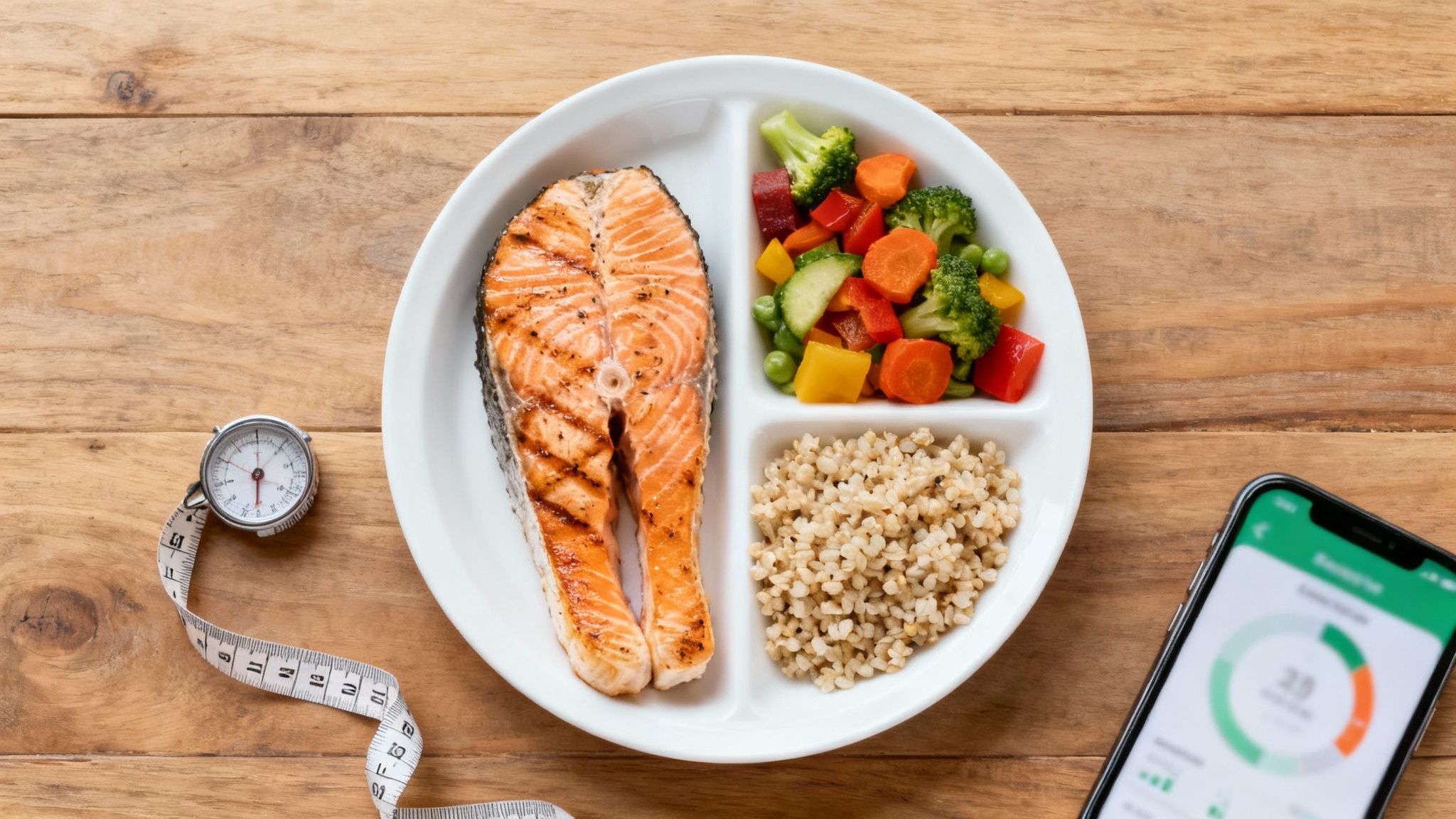
This isn't about extreme restriction; it's about smart choices. An effective plan centres on whole, nutrient-dense foods, with a strong emphasis on adequate protein (around 0.7–1g per lb of body weight) to preserve lean muscle mass during weight loss. When combined with appetite-suppressing medications, this structured approach becomes even more manageable, as the biological urge to overeat is significantly reduced, helping you adhere to your nutritional goals with greater ease.
The Evidence for a Caloric Deficit
The link between a caloric deficit and weight loss is a fundamental concept in nutritional science, supported by countless studies. Research consistently shows that regardless of the specific diet followed (e.g., low-carb, low-fat, Mediterranean), fat loss is primarily driven by a negative energy balance. Studies published in journals like the New England Journal of Medicine have compared various popular diets and found that long-term adherence to a reduced-calorie plan, rather than the specific macronutrient composition, is the key determinant of success. This evidence underscores the importance of finding a sustainable, structured plan that fits your lifestyle.
How to Approach This Method
A well-designed nutrition plan provides clarity and removes the guesswork from eating for fat loss.
- Calculate Your Needs: Use a Basal Metabolic Rate (BMR) and Total Daily Energy Expenditure (TDEE) calculator to estimate your maintenance calories, then subtract 500-750 to find your target.
- Prioritise Protein and Fibre: Aim for 0.7-1g of protein per pound of your target body weight and include plenty of high-fibre vegetables to enhance satiety and preserve muscle.
- Plan and Track: Plan your meals in advance to avoid impulsive, high-calorie choices. Use an app to track your intake for accountability.
- Focus on Nutrient Density: Choose foods that offer maximum nutritional value for their calories, such as lean meats, fish, vegetables, and whole grains.
- Adjust as Needed: As you lose weight, your metabolic rate will change. Recalculate your calorie needs every few weeks to prevent hitting a plateau.
4. Strength Training & Resistance Exercise
While calorie management is essential for fat loss, strength training is the crucial component that determines the quality of your weight loss. Focusing solely on diet often leads to the loss of both fat and valuable muscle tissue. Resistance exercise preserves and builds lean muscle, which increases your resting metabolic rate and enhances your body composition, making it one of the most effective ways to lose body fat fast and keep it off.

The primary mechanism is stimulating muscle protein synthesis. By challenging your muscles through lifting weights, using resistance bands, or performing bodyweight exercises, you create microscopic tears in the muscle fibres. The body then repairs and rebuilds these fibres stronger and denser, a process that requires significant energy (calories) and helps sculpt a leaner, more defined physique.
The Evidence for Resistance Training
Clinical evidence robustly supports the role of strength training in improving body composition during weight loss. Studies consistently show that individuals who combine a calorie-controlled diet with resistance exercise retain significantly more lean muscle mass than those who rely on diet alone. This is particularly relevant for those using GLP-1 medications; research indicates that combining the treatment with exercise can result in up to 30% better muscle preservation, leading to superior, more sustainable long-term outcomes.
How to Approach This Method
Integrating strength training is a non-negotiable for high-quality, lasting fat loss.
- Focus on Compound Lifts: Prioritise exercises that work multiple muscle groups at once, such as squats, deadlifts, bench presses, and rows, for maximum efficiency.
- Apply Progressive Overload: To continue stimulating muscle growth, you must consistently increase the challenge. Aim to increase the weight, repetitions, or sets every one to two weeks.
- Be Consistent: Schedule two to four sessions per week, allowing at least 48 hours of recovery for each muscle group.
- Prioritise Form: Proper technique is more important than lifting heavy weight. Consider working with a trainer initially to master the fundamentals and prevent injury.
- Fuel Your Muscles: Combine your training with adequate protein intake (aiming for 1.6-2.2 grams per kilogram of body weight) to support muscle repair and growth. As you integrate strength training into your routine, you might explore supplements to enhance your body composition goals, such as finding the best creatine for weight loss.
5. Intermittent Fasting & Time-Restricted Eating
Intermittent fasting (IF) is not a diet but an eating pattern that cycles between periods of eating and voluntary fasting. Rather than focusing on what you eat, it concentrates on when you eat. By shortening the eating window each day or week, IF can naturally lead to a reduction in overall calorie intake, which is fundamental to fat loss. This structured approach is one of the more popular ways to lose body fat fast because it simplifies meal timing and can enhance metabolic health.
The core mechanism behind IF is its ability to create a consistent calorie deficit without constant calorie counting. When you are in a fasted state, your body depletes its glucose stores and begins to burn fat for energy. This process may also improve insulin sensitivity, making your body more efficient at managing blood sugar and storing less fat. For individuals on GLP-1 medications, IF can be particularly effective as the appetite-suppressing effects of the treatment make it easier to adhere to longer fasting periods.
The Evidence for Intermittent Fasting
Research has consistently shown that IF is an effective strategy for weight loss. A 2022 meta-analysis published in JAMA Network Open found that various intermittent fasting protocols, including time-restricted eating and the 5:2 diet, led to significant weight loss comparable to traditional continuous calorie restriction. Some studies have noted weight loss of up to 8% of initial body weight over 12-24 weeks, with a significant portion of that loss coming from fat mass. The key takeaway is its efficacy in creating a sustainable energy deficit.
How to Approach This Method
Integrating IF requires a gradual and mindful approach to find what works for your body and lifestyle.
- Start Gradually: If you are new to fasting, begin with a shorter fasting window, such as a 14:10 schedule (14 hours fasting, 10 hours eating). You can slowly extend this to the more common 16:8 protocol as you adapt.
- Focus on Nutrient Density: Your eating window is not a licence to overeat or consume unhealthy foods. Prioritise whole foods, lean protein, and healthy fats to ensure you meet your nutritional needs and support muscle maintenance.
- Stay Hydrated: During fasting periods, drink plenty of water, black coffee, or herbal tea to stay hydrated and manage hunger pangs.
- Listen to Your Body: Pay attention to your energy levels, sleep, and overall well-being. Adjust your fasting schedule based on your individual tolerance, especially on training days or days with higher demands.
6. Personalised Clinical Monitoring & Digital App Tracking
Combining professional medical supervision with the power of digital tracking offers a modern, data-driven approach to fat loss. This integrated method ensures that a weight loss programme is not only effective but also safe, personalised, and adaptable to your unique physiology and lifestyle. It leverages technology to create a constant feedback loop between you and a clinical team, making it one of the most accountable ways to lose body fat fast.
This system typically involves a comprehensive app for logging meals, tracking physical activity, monitoring body measurements, and recording medication adherence. This data is then accessible to a clinical team who can provide rapid digital consultations, manage prescriptions like GLP-1s, and offer tailored guidance. This synergy between personal effort and professional oversight helps to optimise the journey and troubleshoot challenges in real time.
The Evidence for Integrated Tracking
The effectiveness of self-monitoring in weight management is well-documented. Studies consistently show that individuals who regularly track their food intake, activity, and weight achieve more significant and sustainable weight loss than those who do not. When this self-monitoring is paired with professional guidance, the results are amplified. A clinical team can interpret the tracked data to make informed adjustments to medication dosages or lifestyle recommendations, preventing plateaus and improving overall outcomes. This model allows UK-registered clinicians to use member-provided data to make precise, evidence-based decisions, enhancing both safety and success.
How to Approach This Method
To maximise the benefits of a clinically monitored programme, active participation is key.
- Be Thorough and Honest: Provide a complete medical history during your initial consultation and log your daily activities and food intake with accuracy. The more precise your data, the better the guidance you will receive.
- Stay Consistent with Tracking: Make logging a daily habit. Use app reminders for medication and take progress photos weekly, in the same conditions, to visually track changes.
- Engage with Your Clinical Team: Actively share your data and communicate any challenges or side effects you experience. This allows your clinicians to provide timely support and make necessary adjustments to your plan.
- Review Your Progress: Use the weekly summaries and data visualisations within the app to identify your own patterns. Recognising what works for you is a powerful tool for long-term success.
7. Postpartum-Specific Weight Management & Hormone-Aware Nutrition
For new mothers, the postpartum period presents a unique set of challenges for fat loss, involving significant hormonal shifts, the physical demands of recovery, and the lifestyle constraints of caring for a newborn. A specialised, hormone-aware approach is essential for safely and effectively managing weight during this time, prioritising the mother's health and recovery above all else. This method focuses on gentle, sustainable strategies rather than aggressive dieting or intense exercise.
The core principle is to work with the body's natural recovery processes. This involves supporting hormonal rebalancing through nutrient-dense foods, managing the sleep deprivation and stress that can elevate fat-storing hormones like cortisol, and gradually reintroducing physical activity. GLP-1 medications are contraindicated during pregnancy and breastfeeding, making these lifestyle-focused strategies the primary and safest route until a later stage.
The Evidence for a Specialised Approach
Research into postpartum metabolism highlights the importance of tailored nutritional support, especially for breastfeeding mothers who have increased energy demands. A moderate calorie intake (typically a minimum of 1,800 kcal daily) is crucial to maintain milk supply while still allowing for a gradual, safe reduction in body fat. Studies show that a combination of balanced nutrition and appropriate physical activity can lead to a healthy 10-15% reduction in retained body fat by 6-12 months postpartum without compromising maternal health or lactation.
How to Approach This Method
Patience and self-compassion are key, as postpartum recovery and weight management is a marathon, not a sprint.
- Obtain Medical Clearance: Always consult your GP or a women's health physiotherapist before starting any weight loss or exercise programme, usually around your 6-8 week postnatal check.
- Prioritise Nutrient Density: Focus on a diet rich in whole foods, lean protein, healthy fats, and complex carbohydrates to support energy levels and milk production if breastfeeding.
- Start with Gentle Movement: Begin with foundational movements that support healing. For new mothers, focusing on postpartum core strengthening exercises is vital not only for recovery but also for building a strong foundation for overall weight management.
- Manage Sleep and Stress: While challenging, prioritising sleep and using stress-reduction techniques can have a more significant impact on fat loss in the early postpartum months than intense exercise.
- Consider Medical Support Later: Clinically-supervised options can be explored once you have finished breastfeeding and your body has had ample time to recover. You can learn more about medication options and postpartum weight management to understand the appropriate timeline.
8. Menopausal & Perimenopausal Weight Management with Hormone-Aware Strategies
For women in perimenopause and menopause, losing body fat fast requires a specialised approach that accounts for significant hormonal shifts. Declining oestrogen levels slow metabolism, accelerate muscle loss (sarcopenia), and alter fat distribution, often leading to an increase in visceral fat around the abdomen. A hormone-aware strategy addresses these unique physiological changes directly, combining targeted nutrition, specific training protocols, and, where appropriate, medical support for effective and sustainable results.
This approach acknowledges that standard diet and exercise advice often falls short during this life stage. Instead, it prioritises methods that counteract hormonal effects, such as increasing protein intake to preserve lean muscle, implementing strength training to boost metabolic rate, and managing stress to control cortisol levels. This integrated method provides a more effective framework for body composition change.
The Evidence for a Targeted Approach
Research highlights why a specific strategy is necessary. Studies show that the metabolic slowdown during menopause is compounded by a loss of muscle mass, a key driver of your resting metabolic rate. Furthermore, clinical data on GLP-1 medications shows significant efficacy in this demographic, with trials demonstrating weight loss of 15-20% in perimenopausal and menopausal women. Combining these medications with strength training has been shown to produce superior outcomes, preserving lean mass while targeting stubborn fat stores.
How to Approach This Method
A successful menopausal weight management plan is multi-faceted and best guided by health professionals.
- Prioritise Protein and Strength: Consume 1.6-2.2 grams of protein per kilogram of body weight daily to support muscle maintenance. Combine this with 3-4 strength training sessions per week to build metabolically active tissue.
- Consider Medical Support: Consult a clinician to discuss if GLP-1 medications are a suitable option to manage appetite and improve metabolic health. Coordination with your GP regarding Hormone Replacement Therapy (HRT) is also crucial.
- Focus on Micronutrients: Ensure adequate intake of bone-supporting nutrients. Aim for 1,200 mg of calcium and at least 2,000 IU of vitamin D daily to mitigate the increased risk of osteoporosis.
- Track Key Health Markers: Go beyond the scales. Monitor visceral fat levels, blood pressure, and cholesterol, as these are critical indicators of metabolic health during menopause.
9. Men's-Specific Weight Loss & Muscle-Building Integration
For men, effective and fast body fat loss often requires a tailored approach that prioritises the preservation and building of lean muscle mass. Due to higher baseline metabolic rates and different hormonal profiles, men's programmes can successfully integrate aggressive strength training and higher protein targets to achieve significant body composition changes, focusing on performance metrics alongside scale weight. This strategy aims to reduce fat while enhancing strength and muscular definition for a more athletic physique.
The core principle involves creating a calorie deficit to drive fat loss while simultaneously providing the stimulus (strength training) and building blocks (protein) for muscle maintenance and growth. When combined with clinically supervised treatments like GLP-1 medications, this dual-focus approach can yield remarkable results, as the medication helps manage appetite, making it easier to sustain the necessary dietary structure without sacrificing energy for training.
The Evidence for a Muscle-Centric Approach
Research consistently shows that combining resistance training with a high-protein diet is superior for improving body composition compared to diet or cardio alone. Strength training not only burns calories but also boosts resting metabolic rate by increasing lean muscle mass. For men, this is a powerful combination for long-term fat management. Men's health-specific pathways that are designed around this evidence can integrate medical support with a muscle-preservation focus. Evidence from clinical settings often shows individuals losing 20-25% of their body fat while gaining 2-4.5 kg (5-10 lbs) of muscle over a six-month period.
How to Approach This Method
This integrated strategy requires consistency in both diet and exercise for optimal outcomes.
- Prioritise Strength Training: Aim for 4-5 sessions per week, focusing on compound movements like squats, deadlifts, bench presses, and rows that engage multiple muscle groups.
- Target High Protein Intake: Consume 1.6-2.2 grams of protein per kilogram of body weight daily to support muscle repair and growth.
- Implement a Modest Calorie Deficit: A daily deficit of 500-750 kcal is effective for fat loss without being so aggressive that it compromises muscle mass or training performance.
- Use Progressive Overload: Continuously challenge your muscles by gradually increasing the weight, reps, or sets over time.
- Track More Than Just Weight: Monitor progress using body composition scans, body measurements, progress photos, and strength gains, as the scale alone doesn't reflect muscle gain.
10. Comprehensive Four-Pillar Integrated Approach (Evidence-Based Synergy)
For those seeking the most effective and sustainable way to lose body fat fast, a comprehensive, integrated approach often yields superior results compared to focusing on a single method. This four-pillar model synergises evidence-based medicines, expert clinical guidance, tailored nutrition, and strength-focused training into a cohesive programme. By addressing the biological, behavioural, and physiological aspects of fat loss simultaneously, this strategy creates a powerful, mutually reinforcing system for profound and lasting body composition change.
The core principle is synergy. Potent medications like GLP-1s make adhering to a calorie deficit easier by reducing appetite. Expert clinical oversight ensures the treatment is safe, personalised, and adjusted as needed. A structured nutrition plan provides the essential nutrients to fuel the body and preserve muscle, while a progressive strength training routine signals the body to retain lean mass during weight loss, ensuring that the weight lost is primarily fat.
The Evidence for an Integrated Approach
The power of this multi-faceted strategy is demonstrated by clinical programme data and high user satisfaction. For example, some complete four-pillar programmes have shown average fat loss of 15-22% over six months among their members. Crucially, this is achieved with a focus on muscle preservation, leading to lean, defined physiques and sustainable outcomes, a testament to the effectiveness of combining clinical and lifestyle interventions. High user satisfaction ratings often reflect the success of this integrated model in practice.
How to Approach This Method
Adopting a comprehensive system requires commitment but offers a clear, structured path to success.
- Engage Consistently: Success depends on consistent application across all four pillars: medication adherence, nutrition tracking, completing workouts, and regular check-ins with your clinical team.
- Leverage Data and Feedback: Use app data and feedback from your clinician to make informed adjustments. This could involve modifying your prescription, tweaking macronutrient targets, or altering your training plan.
- Prioritise Protein and Progressive Overload: Pay close attention to your protein intake to support muscle preservation and ensure your strength training programme is progressively challenging.
- Invest in Long-Term Sustainability: View this as a long-term investment in your health. Commit the necessary time and resources to build habits that will support you long after the initial fat loss phase.
Fast Fat-Loss: 10-Method Comparison
| Item | 🔄 Implementation complexity | ⚡ Resource requirements & efficiency | ⭐ Expected effectiveness | 📊 Typical outcomes / impact | 💡 Ideal use cases & key advantages |
|---|---|---|---|---|---|
| GLP-1 Receptor Agonist Medications (Mounjaro & Wegovy) | High — requires prescription, baseline assessment and ongoing monitoring | High cost; clinician visits/labs; weekly injections (efficient adherence) | ⭐⭐⭐⭐⭐ — highest pharmacologic fat-loss efficacy | ~15–22% body-weight reduction in trials; improved glycemic markers; appetite suppression | Best for adults with metabolic concerns seeking substantial, medically supervised fat loss; effective when paired with lifestyle changes |
| Orlistat (Lipase Inhibitor Alternative) | Low–moderate — simple dosing but requires diet adjustment and vitamin monitoring | Low–medium cost; oral, 3× daily with meals; minimal systemic monitoring | ⭐⭐ — modest pharmacologic effect | ~5–8% weight loss over 6 months; fat-malabsorption side effects; possible vitamin depletion | Suitable for those contraindicated for injectables or preferring oral therapy; cost-conscious patients willing to follow a low-fat diet |
| Structured Nutrition Planning & Caloric Deficit | Moderate — requires individualized plans, tracking and periodic adjustment | Low–medium cost; time for meal prep and consistent logging; no meds required | ⭐⭐⭐ — reliable long-term foundation when adhered to | Steady loss ≈1–1.5 lb/week with 500–750 kcal deficit; preserves muscle with adequate protein | Foundational strategy for all adults seeking sustainable fat loss; pairs well with meds or training |
| Strength Training & Resistance Exercise | Moderate — program design, technique coaching and progressive overload needed | Equipment/gym access or home gear; 2–4 sessions/week; possible trainer | ⭐⭐⭐⭐ — high for body-composition improvements | Preserves/builds lean mass, ↑ resting metabolic rate (~6–8%), superior aesthetic outcomes vs diet-only | Ideal for those prioritizing muscle preservation/appearance and metabolic health; essential alongside nutrition and meds |
| Intermittent Fasting & Time-Restricted Eating | Low — simple schedule but requires discipline and adaptation | Minimal cost; can simplify meal planning; may improve daily efficiency | ⭐⭐⭐ — variable; useful for some but not universally superior | Variable results; some report 8–12% weight change over 12 weeks; depends on caloric control | Good for people who prefer time-based structure or want simplified meal choices; synergizes with appetite-reducing meds |
| Personalized Clinical Monitoring & Digital App Tracking | Moderate–high — setup, clinician reviews and ongoing engagement required | Requires clinician access, app subscription/time logging; data-driven efficiency | ⭐⭐⭐⭐ — improves safety, adherence and optimization | Better adherence, safer medication adjustments, improved outcomes vs unguided care | Best for individuals needing medical oversight, data-driven personalization and accountability |
| Postpartum-Specific Weight Management & Hormone-Aware Nutrition | High — requires postpartum clearance, breastfeeding considerations and specialist knowledge | Medical supervision; tailored nutrition; pelvic-floor–safe exercise; flexible timing | ⭐⭐⭐ — safe and modest early results; meds contraindicated if breastfeeding | More modest early loss; examples show ~10–15% fat loss by 6–12 months with supervised care | Designed for new mothers (≥6–8 weeks) needing breastfeeding-compatible, hormone-aware, empathetic care |
| Menopausal & Perimenopausal Weight Management | Moderate–high — hormone-aware assessment and possible HRT coordination | Medical input, strength training, micronutrient monitoring; possible bone density checks | ⭐⭐⭐⭐ — effective when tailored; GLP‑1 enhances outcomes | Potential 15–20% weight loss with GLP‑1; visceral fat and metabolic marker improvements | Best for perimenopausal/menopausal women needing hormone-aware strategies and bone/metabolic monitoring |
| Men's-Specific Weight Loss & Muscle-Building Integration | Moderate — high-frequency strength focus and performance tracking | Gym access, higher-protein diet, possible supplementation; training time commitment | ⭐⭐⭐⭐ — strong for muscle retention and composition changes | Reported examples: substantial fat loss with 5–10 lb muscle gain over months; improved performance metrics | Suited to men prioritizing strength, muscle preservation and aesthetic/performance outcomes |
| Comprehensive Four-Pillar Integrated Approach (Evidence-Based Synergy) | Very high — coordinates meds, clinicians, tailored nutrition, strength training and tracking | Highest resource and time investment; multidisciplinary team and app engagement | ⭐⭐⭐⭐⭐ — synergistic; superior sustained outcomes | Examples: average 15–22% weight loss with muscle preservation; higher adherence and sustained results | Best for individuals wanting an all‑in‑one, medically supervised, long‑term solution with maximal support and outcomes |
Your Next Step Towards Evidence-Based Fat Loss
The journey to effective and sustainable fat loss can feel overwhelming, often cluttered with conflicting advice and temporary fixes. Throughout this guide, we have navigated through a landscape of evidence-based, clinically-backed strategies, moving far beyond generic tips to provide a clear roadmap for real, lasting change. The central theme is clear: the most effective ways to lose body fat fast are not found in a single, isolated method, but in a comprehensive, synergistic approach tailored to your individual biology and lifestyle.
We've explored how groundbreaking GLP-1 medications like Mounjaro and Wegovy can powerfully regulate appetite, making a consistent caloric deficit feel manageable rather than a constant battle of willpower. We have also seen how structured nutrition, prioritising protein and fibre, forms the non-negotiable foundation for any successful fat loss plan. This isn't just about eating less; it's about eating smarter to fuel your body correctly.
Weaving the Threads Together for Lasting Success
The true power of this knowledge lies in its integration. Simply taking a medication without addressing nutrition and exercise will not yield optimal results. Likewise, intense exercise without adequate protein or a sustainable energy deficit can lead to frustration and burnout. The key takeaways from our deep dive are:
- Medical support is a powerful tool, not a standalone cure. Medications like GLP-1s and Orlistat work best when combined with lifestyle modifications. They create a crucial window of opportunity by managing hunger and cravings, enabling you to build healthier, lasting habits.
- Muscle is your metabolic engine. Prioritising strength training is non-negotiable. It ensures that the weight you lose is primarily fat, not precious, metabolically active muscle tissue. This protects your metabolic rate and helps you achieve a leaner, stronger physique.
- Personalisation is paramount. Your journey is unique. Whether you are navigating postpartum recovery, managing the hormonal shifts of perimenopause, or aiming to build muscle while losing fat, your strategy must be adapted to your specific physiological needs. A one-size-fits-all approach is a recipe for failure.
- Consistency trumps intensity. The most powerful fat loss tool is a plan you can stick with. This is where structured clinical monitoring, digital tracking, and the support of a dedicated health team become invaluable. They provide the accountability and adjustments needed to turn short-term efforts into long-term success.
From Knowledge to Action: Your Personalised Pathway
You now have a comprehensive understanding of the science-backed pillars of effective fat loss. The next step is to translate this knowledge into a personalised action plan. This means moving away from guesswork and towards a structured, medically supervised programme that considers your unique health profile, goals, and challenges.
An integrated approach, like the four-pillar system we've discussed, provides the cohesive framework necessary to combine these powerful strategies safely and effectively. It ensures that your nutrition, exercise, medication (if appropriate), and lifestyle habits are all working in harmony towards a single goal: sustainable fat loss and improved metabolic health. By embracing this evidence-led path, you are not just aiming to change the number on the scale; you are investing in a healthier, more energised, and more confident future.
Ready to stop guessing and start a clinically-guided journey? The Trim programme integrates these evidence-based pillars, providing medical supervision, personalised nutrition, and the support you need to achieve your goals. Start your free 5-minute consultation with Trim today to discover the right path for you.