
Men's Weight Loss Pills: What the UK Evidence Shows

67% of adult men in England were overweight or living with obesity, yet only 38% reported trying to lose weight, according to the 2022 Health Survey for England. That gap reframes the search for men's weight loss pills: the question isn't which product to buy, but how to get appropriate support.
Medicines can be part of that support. Understanding the difference between capsules and injections, prescribing eligibility and actual trial evidence helps you make a decision based on health rather than advertising.
Table of Contents
- Prescription Weight Loss Pills Available in the UK
- How These Medicines Work in the Body
- BMI and Eligibility Thresholds
- Expected Weight Loss and What the Trials Show
- Side Effects and Warning Signs to Act On
- Why Men Avoid Care and How to Spot Unsafe Supply
- How to Get a Prescribed Option Safely in the UK
Prescription Weight Loss Pills Available in the UK
Orlistat is an established oral option, while several commonly discussed prescription alternatives are injections. Searching for men's weight loss pills can therefore bring up medicines that aren't pills at all.
UK weight-loss medicines by form and access route
| Medicine | Active ingredient | Form | How to access |
|---|---|---|---|
| Orlistat 120 mg | Orlistat | Capsule taken with main meals | Prescription |
| Orlistat 60 mg | Orlistat | Capsule taken with main meals | Pharmacy, over the counter |
| Wegovy | Semaglutide | Weekly injection | Prescription only |
| Mounjaro | Tirzepatide | Weekly injection | Prescription only |
| Saxenda | Liraglutide | Daily injection | Prescription only |
The newer injectable medicines act on appetite-hormone pathways, while orlistat has a long UK prescribing record and works inside the digestive system. Strictly speaking, orlistat is a capsule, although people often use pill or tablet as a general description.
There isn't a separate medicine for men
These medicines aren't selected because someone is male. A clinician considers the person's health, treatment history, other medicines and suitability for the particular product.
A male-focused service can make conversations about weight easier without implying that men need different pharmacology. Someone who feels uncomfortable discussing waist size, eating habits or previous dieting attempts still needs the same careful assessment.
Over-the-counter doesn't mean suitable for everyone. A pharmacist should check whether the pharmacy-strength capsule is appropriate, including potential interactions and relevant health conditions.
The table is a comparison of the options discussed here, not an exhaustive register of every specialist obesity treatment or a guarantee that a product is currently available through a particular service. Availability, licensing and NHS access aren't interchangeable.
A weight-loss pill is therefore one possible route, not automatically the best route. The eligibility assessment determines which options are reasonable to discuss.
How These Medicines Work in the Body
Think of fullness as a signal that helps your brain recognise you've eaten enough. Some weight-management medicines turn that signal up, making it easier to feel satisfied with smaller portions.
GLP-1 means glucagon-like peptide-1, a hormone involved in appetite and blood-sugar regulation. Semaglutide and liraglutide mimic its action, helping reduce hunger and slowing the movement of food out of the stomach.
The illustration shows the basic appetite-signalling pathway.
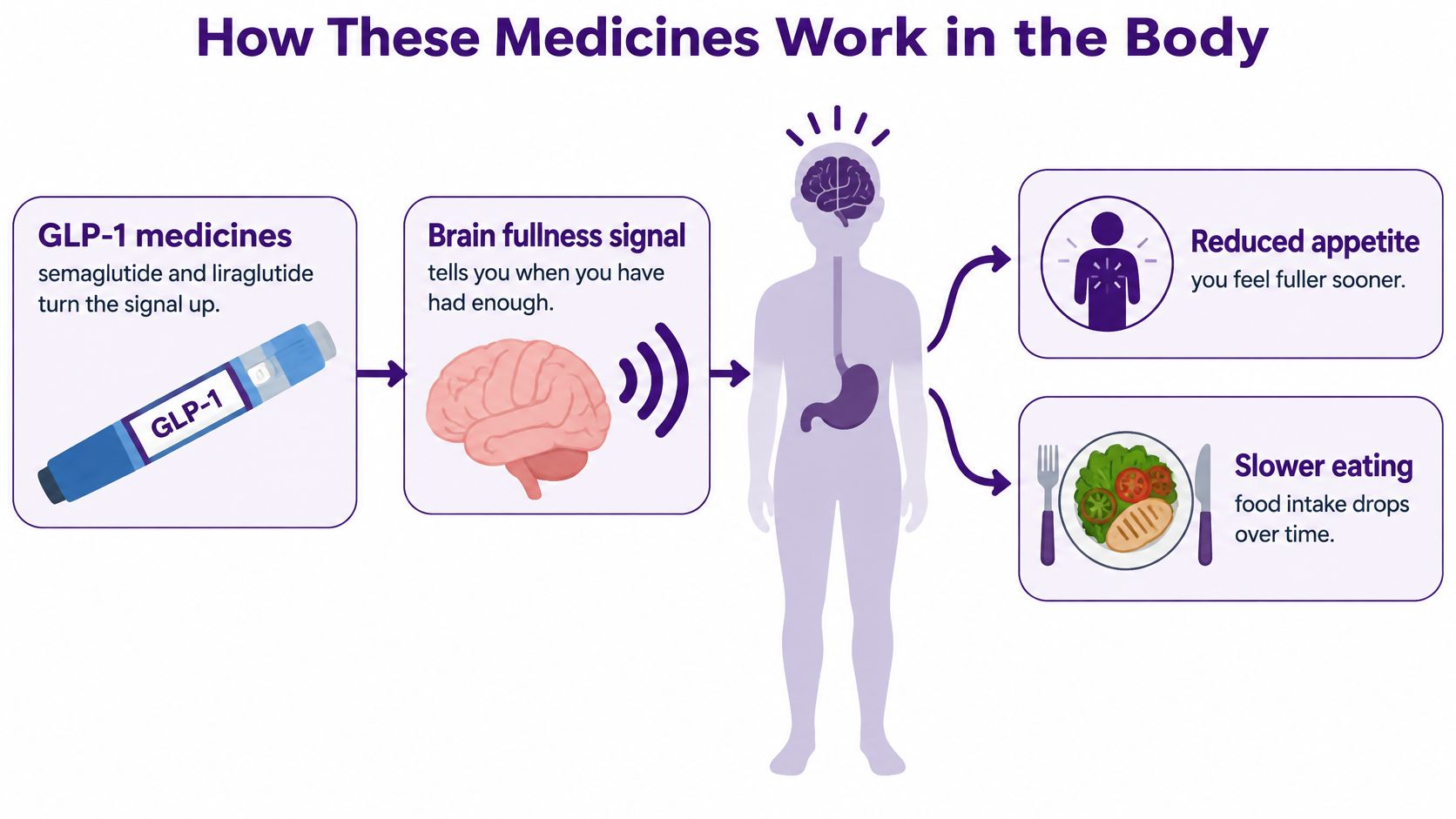
Say a man usually finishes dinner and immediately looks for something else to eat. With an appetite medicine, he may notice that a smaller dinner feels sufficient, rather than having to repeatedly resist hunger.
Tirzepatide acts on GLP-1 and another hormone pathway called GIP, short for glucose-dependent insulinotropic polypeptide. These pathways influence appetite and blood-sugar control; their involvement doesn't make the medicine a stimulant or a conventional fat-burning product.
Injections change how much you want to eat; orlistat changes how much fat you absorb.
Orlistat works in the gut
Orlistat is better understood as a partial barrier to fat digestion than an appetite switch. It inhibits lipases, digestive enzymes that break dietary fat into forms the body can absorb.
As NICE's practical guide to weight-management medicines explains, unabsorbed fat passes out in the stool, and higher-fat meals increase the likelihood of oily stools, urgency and diarrhoea. A lower-fat diet is therefore part of making treatment tolerable, not just background lifestyle advice.
For example, taking orlistat doesn't cancel out a large takeaway meal. The fat that isn't absorbed still has to leave the body, which can make a high-fat meal particularly uncomfortable.
Fat malabsorption can also affect fat-soluble vitamins, which need dietary fat for normal absorption. A prescriber or pharmacist should review nutritional needs and medicine interactions rather than leaving you to add supplements without guidance.
The mechanisms help explain the different side-effect patterns. Appetite medicines can produce nausea and prolonged fullness, whereas orlistat's characteristic effects involve greasy stools and bowel urgency.
BMI and Eligibility Thresholds
A man's BMI can help identify whether a weight-loss medicine may be suitable, but it is only one part of the assessment. The table summarises adult thresholds and conditions in NICE guidance on medicines and surgery for weight management.
Eligibility thresholds by weight-loss medicine
| Medicine | BMI threshold | Additional condition |
|---|---|---|
| Orlistat | 30 or above, or 28 or above | At the lower threshold, associated risk factors are required |
| Semaglutide (Wegovy) | 35 or above, or 30.0 to 34.9 | At least one weight-related condition; specialist referral criteria also apply in the lower range |
| Tirzepatide (Mounjaro) | 35 or above | At least one weight-related condition |
BMI, or body mass index, compares weight with height. It can support an eligibility decision, but it does not show how much of a person's weight is muscle or describe their overall health.
A comorbidity is a health condition that occurs alongside another condition. Examples relevant to weight management include high blood pressure, type 2 diabetes and obstructive sleep apnoea, which causes repeated interruptions to breathing during sleep.
A threshold isn't a prescription
For example, a man who is 1.80 m tall and weighs 98 kg has a BMI of about 30.2, calculated by dividing 98 by 1.80 squared. This meets the BMI criterion listed for orlistat, but not the listed threshold for tirzepatide. Other clinical checks still apply.
People with the same BMI may not be suitable for the same treatment. A prescriber also considers medical history, risks, preferences and the prescribing pathway.
A medicine's licence and NHS access rules are different. The MHRA's guide to GLP-1 medicines describes semaglutide and tirzepatide as treatments for adults with obesity, or overweight with a weight-related condition, alongside a reduced-calorie diet and increased physical activity.
NHS recommendations and local arrangements can be narrower than a medicine's licensed indication. Ethnicity-adjusted thresholds may also apply, so an online BMI calculator cannot make the final eligibility decision.
A clinical assessment should consider:
- BMI and health risks: Relevant conditions and any applicable ethnicity-adjusted criteria.
- Medication history: Prescription medicines, pharmacy products and supplements.
- Contraindications: Medical circumstances that could make a particular medicine unsafe.
- The product and prescribing pathway: Its formulation, approved indication and prescribing setting.
For oral treatments, check the criteria for the specific tablet rather than assuming they match those for injectable medicines. The UK guide to GLP-1 tablet eligibility explains why the distinction matters.
Expected Weight Loss and What the Trials Show
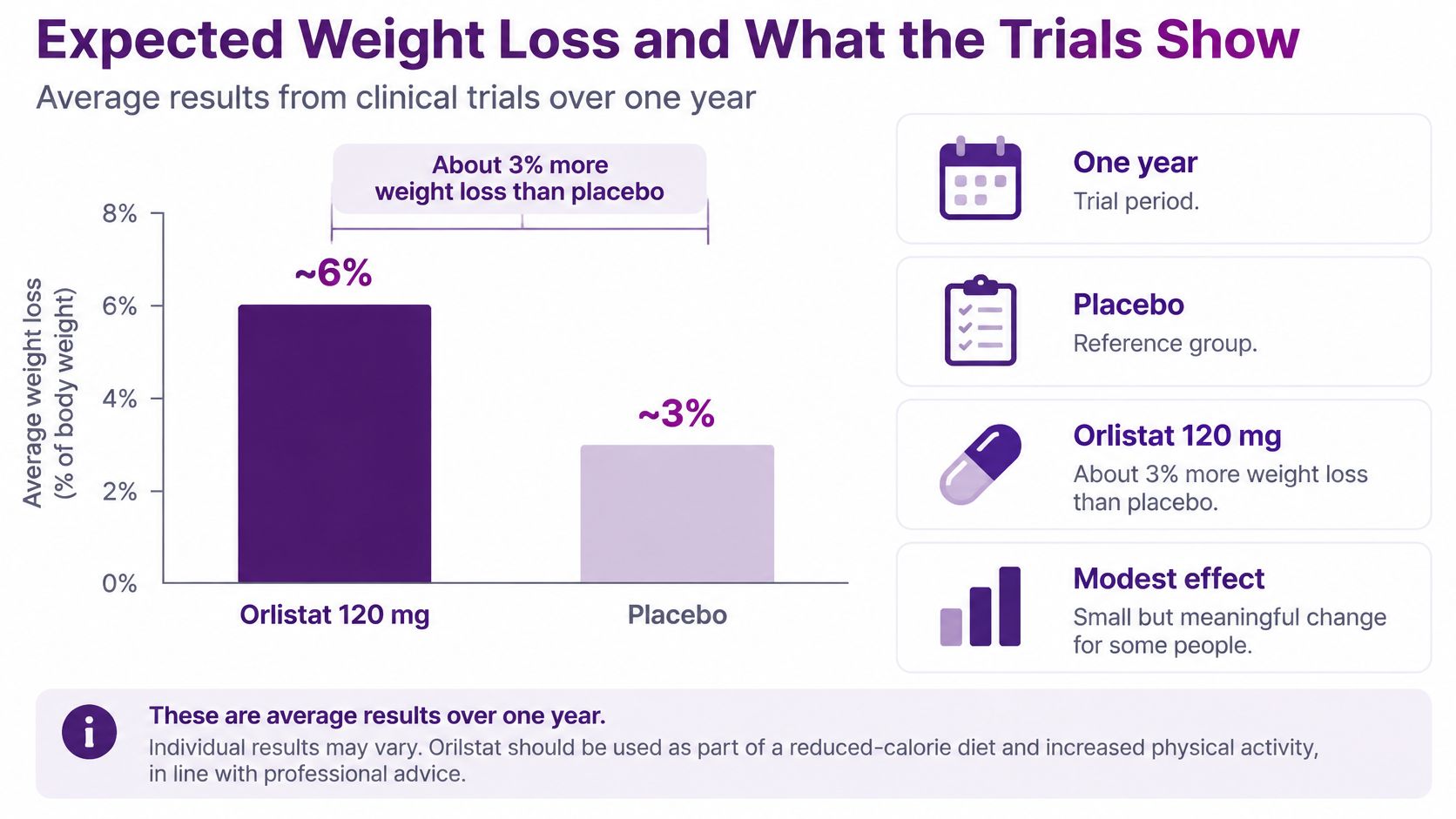
A trial average is a group result, not a personal forecast. To interpret a weight-loss figure, you need the medicine, dose, treatment duration, comparison group and the method used to analyse participants who stopped treatment early.
There is also a difference between total weight loss and additional loss compared with placebo. A placebo is a dummy treatment used for comparison, usually given alongside the same diet and activity support as the medicine.
The chart below shows that comparison for orlistat at prescription strength.
What a trustworthy trial comparison needs
Prescribing statistics show use, not effectiveness. NHS England's public-health prescription statistics recorded 370,000 orlistat prescription items in English primary care during 2022/23, but that figure says nothing about how much weight each person lost.
A prescription item counts a product supplied, not a person treated, so medicine supply cannot show adherence or treatment success. Only trial reports, which follow the same group over a fixed period, support reliable numerical comparisons.
How each medicine was studied in trials
| Medicine | Form and dosing | What the trials measured | Practical note |
|---|---|---|---|
| Orlistat, prescription strength | Capsule taken with each main meal | Weight change versus placebo after one year, alongside a reduced-fat diet | Results depend on dietary adherence, since the medicine acts on fat absorption |
| Liraglutide, weight-management dose (Saxenda) | Daily injection | Weight change versus placebo over about a year, with lifestyle support | A daily routine rather than a weekly pen |
| Semaglutide, weight-management dose (Wegovy) | Weekly injection, dose raised in steps | Percentage weight change versus placebo at the licensed dose | The full dose is reached gradually over several months |
| Tirzepatide, weight-management dose (Mounjaro) | Weekly injection, dose raised in steps | Percentage weight change versus placebo across the treatment period | Follows a similar weekly schedule to Wegovy |
Separate trials can enrol different populations, so ranking medicines by headline percentages alone can mislead. A proper comparison asks whether participants had diabetes, which lifestyle support they received and how missing measurements were handled.
For a purely hypothetical calculation, a 100 kg man losing 15% of his starting weight would lose 15 kg. That is arithmetic, not a prediction that a particular medicine will produce that result for him. Trim's weight projection tool applies the same logic: it draws on clinical trial data showing 22.5% average weight loss to sketch a possible trajectory, and individual results vary.
Men who shop around for the strongest headline figure are also the easiest targets for unsafe sellers, who quote a single percentage with no dose, duration or trial context. A number without that context should prompt questions, not confidence.
Evidence check: Ask whether a percentage describes total weight lost or the extra loss attributable to treatment compared with placebo.
Judge the trend, not a single weigh-in
Clinical reviews should assess weight trends, tolerability, eating patterns and whether continuing treatment remains worthwhile. Results develop over months, and a disappointing weigh-in is no reason to increase a dose yourself.
Our guide to interpreting GLP-1 weight-loss results explains how averages translate into individual variation.
This video offers additional discussion of weight-management treatment.
Side Effects and Warning Signs to Act On
Severe, persistent abdominal pain needs urgent assessment, particularly if it spreads to the back or comes with nausea or vomiting. Don't assume it's an ordinary adjustment to treatment.
The MHRA's updated guidance for prescribers and patients highlights possible pancreatitis, severe dehydration and low blood sugar as risks requiring attention. Pancreatitis means inflammation of the pancreas, an organ involved in digestion and blood-sugar regulation.
Warning signs, likely causes and what to do
| Symptom | Possible cause | What to do |
|---|---|---|
| Severe, persistent abdominal pain spreading to the back, with nausea or vomiting | Possible pancreatitis | Seek urgent medical attention |
| Vomiting or diarrhoea that won't settle | Dehydration | Seek medical advice promptly; go to hospital if severe |
| Sweating, shaking, weakness or confusion | Low blood sugar, or hypoglycaemia, which is possible without diabetes | Seek clinical advice and tell the prescriber about all medicines |
These symptoms don't prove a diagnosis. They tell you that professional assessment is more appropriate than waiting for a routine review or asking a seller what to do.
Common symptoms still deserve support
Nausea, constipation and uncomfortable fullness can occur with appetite medicines. They may ease as the body adjusts, and gradual dose increases can help tolerability, but you shouldn't be expected to endure symptoms that prevent normal eating or drinking.
Try smaller meals, eat slowly and stop when comfortably satisfied rather than finishing a familiar portion automatically. If nausea persists, speak to the prescribing team before the next planned dose increase.
Vomiting and diarrhoea deserve particular attention because they can cause fluid loss. Take regular small sips if you can, and seek prompt advice if you can't keep fluids down, pass very little urine or feel faint.
Tell the prescriber about diabetes medicines
Hypoglycaemia means blood sugar has fallen too low. It can occur in people without diabetes using some GLP-1 medicines, and combining treatment with insulin or sulfonylureas makes medication review especially important.
Sulfonylureas are diabetes medicines that stimulate insulin release. A prescriber may need to review the wider diabetes treatment plan rather than adding another medicine unchanged.
- Share the full list: Include medicine names and doses, not just a statement that you take diabetes tablets.
- Report symptoms early: Describe what happened, when it started and whether you could eat or drink.
- Follow an agreed plan: If you already have instructions for treating low blood sugar, use them and arrange medical advice.
- Don't improvise doses: Ask the prescribing team how symptoms affect your next dose or planned increase.
If someone becomes unconscious, has a seizure or cannot swallow safely, call emergency services. Don't give food or drink to someone who isn't fully alert.
Why Men Avoid Care and How to Spot Unsafe Supply
In a nationally representative survey of 5,260 adults in England, Wales and Scotland, only 5.1% of men said they would likely consider weight-loss medication in the following year, according to UCL's report on weight-loss medicine use. Some people who use GLP-1 medicines obtain them from unverified or illegal sellers, which turns a private decision into a safety risk.
Reluctance to discuss treatment doesn't necessarily mean reluctance to obtain it. Stigma, privacy worries and discomfort talking about body weight can make an anonymous online purchase feel easier than a clinical conversation. A confidential service can still be clinically supervised: privacy describes how your information is handled, not whether anyone checks your health first.
Men need appropriate access to the same licensed medicines
A helpful consultation addresses health goals without treating body weight as a character judgement. It explains how your information is stored and shared, and it gives you room to ask about side effects, cost and follow-up before deciding anything.
Privacy shouldn't cost you safety: A discreet service still asks detailed medical questions and tells you who takes responsibility for prescribing.
Use this checklist before paying:
- Verify the pharmacy independently: Check its name and address against the General Pharmaceutical Council register in Great Britain, or the relevant Northern Ireland regulator.
- Expect a clinical assessment: A genuine prescription-only medicine should not be sold just because you've selected a product.
- Identify the prescriber: You should know who authorises treatment and how to contact the clinical team.
- Reject assessment-free offers: "No consultation needed" is a warning sign, not a convenience.
- Question implausible prices: A very low price, a social-media-only seller, or pressure to pay immediately should prompt further checks.
The difference between a regulated online assessment and an unregulated sale is explained in our guide to using an online pharmacy with a prescription.
Keep cosmetic treatment separate
Localised body contouring and medical weight management address different goals. If you're comparing those categories, the 3D Aesthetics Leamington Spa treatment guide describes non-surgical fat-removal treatments; it isn't evidence that they replace obesity care.
A familiar brand name or convincing packaging doesn't establish legitimate supply. If you've already bought from an unverified seller, tell a pharmacist or clinician what you obtained rather than continuing because you're embarrassed to ask.
How to Get a Prescribed Option Safely in the UK
Start with a consultation, not a shopping basket. You don't need to choose a medicine before asking whether treatment could help.
The process should leave you knowing who has assessed you, what the treatment is intended to achieve and how to obtain help if something changes. A prescription without accessible follow-up isn't a complete care plan.
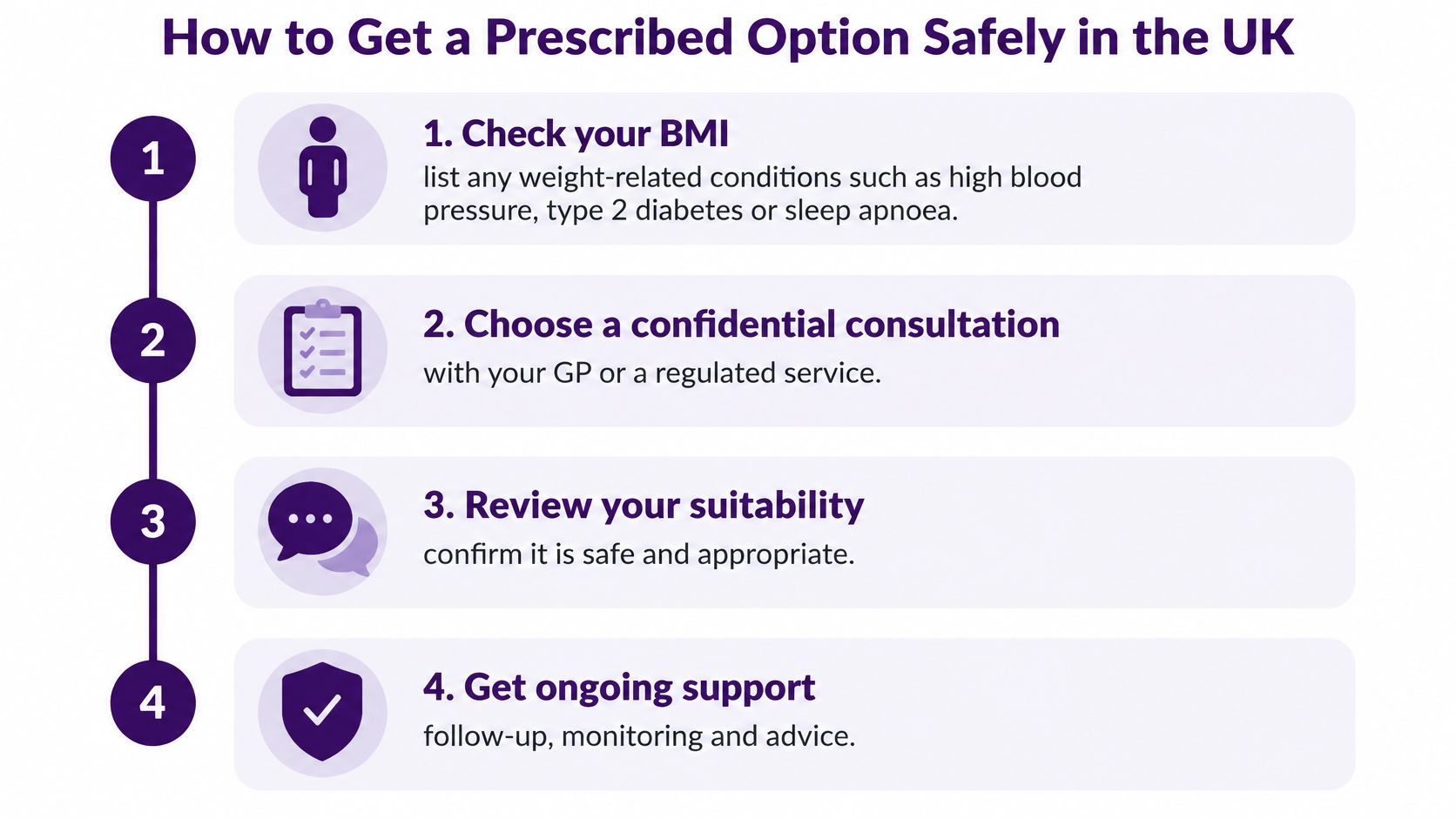
This overview summarises the main stages.
Prepare for an individual assessment
- Record your starting information. Measure your height and weight, and list conditions such as high blood pressure, type 2 diabetes or sleep apnoea. Bring previous weight-management attempts too, including what helped and what made continuing difficult.
- Choose a confidential clinical route. Arrange a GP appointment or use a regulated service, checking the dispensing pharmacy's registration before submitting sensitive details. Ask your GP surgery which NHS options are available locally.
- Give a complete medical history. Include current medicines, supplements, allergies, previous significant abdominal problems and any treatment bought elsewhere. Accurate information allows the clinician to assess contraindications and interactions.
- Wait for prescribing approval. An automated eligibility message isn't a substitute for the clinician's decision. At Trim, customers who complete the medical questions and are eligible see “You're eligible for the Trim weight loss programme.”, but that message shouldn't be read as permission to start treatment independently.
Agree the practical details
- Make the eating and activity plan workable. Discuss a reduced-calorie diet that still provides adequate nutrition, alongside activity suited to your health and ability. Include strength or resistance exercise where appropriate to help maintain muscle during weight loss.
- Follow the medicine-specific instructions. For medicines requiring dose escalation, start at the prescribed starting dose and increase only as directed. Orlistat follows a different regimen, so don't assume that every treatment uses an injection-style escalation schedule.
- Set review points before starting. Agree how response, tolerability and ongoing suitability will be assessed, including the product-specific stopping rule. If meaningful benefit isn't achieved, the clinician should reconsider treatment rather than continuing automatically.
- Know how to obtain help. Keep the clinical contact details and medicine leaflet accessible, and report concerning symptoms promptly. Urgent warning signs require urgent care rather than waiting for an online message to be answered.
We are a pharmacy-led weight management service. Our independent prescriber, Mohammed Aazim Imran, GPhC number 2220165, has expertise in weight management and male hair loss treatments.
NHS and private routes can differ in access arrangements and cost. Before committing, establish what you'll pay for consultations, medicine and follow-up, and how care will continue if treatment needs to change.
Book a confidential assessment this week rather than buying an unverified product. The useful outcome is an informed decision, which may be medication, another form of support or further medical assessment.
At Trim, we offer pharmacy-led weight management with clinical assessment, prescription treatment when appropriate, and dietary and lifestyle support. If you're considering men's weight loss pills or injections, visit us to begin a confidential assessment and discuss which options may be suitable for your health.