
Men's Weight Loss Before and After: 6 Evidence-Based Cases

In the STEP 1 trial reviewed in NICE's semaglutide appraisal, 1,961 adults with obesity or overweight plus at least one weight-related comorbidity were studied, and people on semaglutide lost about 14.9% of body weight over 68 weeks, compared with about 2.4% on placebo. That is the number that becomes a photo. The trial record is more useful. It shows the starting point, dose, timeline, control group and spread of results.
The need is not abstract. The 2022 Health Survey for England found 28% of men were living with obesity and 67% were overweight or living with obesity overall. Men's weight loss before and after claims should be judged against that baseline, not against a selected image.
Six trials follow. Each is read the same way. Who entered, what changed, over what period, and what a man can replicate. Speed, muscle retention and maintenance do not move together.
Table of Contents
- 1. Semaglutide 2.4 mg STEP 1 Trial Before-and-After Weight Change
- 2. Tirzepatide SURMOUNT-1 Trial Before-and-After Weight Change
- 3. Orlistat XENDOS Trial Long-Term Weight Management Evidence
- 4. Intensive Lifestyle Intervention Diabetes Prevention Program Before-and-After Evidence Without Medicines
- 5. Total Diet Replacement DiRECT Trial Before-and-After Weight Loss and Remission
- 6. Resistance Training With Calorie Restriction Villareal et al 2017 Preserving Muscle During Weight Loss
- How the six trial-based before-and-after results compare
- Turning Trial Evidence Into Your Own Plan
1. Semaglutide 2.4 mg STEP 1 Trial Before-and-After Weight Change
STEP 1 compared weekly semaglutide 2.4 mg with placebo over 68 weeks. In the trial published by Wilding et al. in 2021, adults with obesity or overweight and a weight-related condition received lifestyle support alongside their assigned treatment. The Wilding et al. trial results show mean body-weight losses of about 14.9% with semaglutide and 2.4% with placebo. Around 86% of participants taking semaglutide lost at least 5% of their body weight.
For a man starting at 110 kg, a loss of 14.9% would be about 16 kg. That calculation illustrates the trial average; it does not predict an individual result. The useful comparison is the measured change over the full study period, not a selected before-and-after image.
What the before-and-after pattern actually shows
Weight loss accumulated over months and later slowed. A plateau can therefore occur within a longer downward trend. Comparing measurements across clinical reviews gives a clearer picture than interpreting daily scale changes.
NICE advises clinicians to consider stopping semaglutide if a person has lost less than 5% of their initial weight after six months on the maintenance dose. The NICE semaglutide appraisal sets out this stopping threshold. For someone starting at 100 kg, 5% is 5 kg. It is a clinical review point, not a target to pursue without medical guidance.
Three practical lessons follow:
- Measure over time: Compare progress at planned reviews rather than reading too much into short-term changes.
- Track more than weight: Waist measurements, strength and clothing fit add context to the scale.
- Include strength work: Resistance training can support muscle during weight loss.
Semaglutide is sold as Wegovy and requires a prescription. A UK-registered prescriber assesses suitability, side effects and contraindications. For a comparison of how injection progress is presented, see weight loss injections before and after. The lesson men can take from STEP 1 is to assess progress across months, with clinical follow-up, rather than judge it by a single photograph.
2. Tirzepatide SURMOUNT-1 Trial Before-and-After Weight Change
SURMOUNT-1 asked a different question. What happens when one medicine targets two pathways?
Jastreboff et al., New England Journal of Medicine, 2022, randomised adults with obesity without diabetes for 72 weeks. Groups received once-weekly tirzepatide 5 mg, 10 mg or 15 mg, or placebo, alongside lifestyle advice. Tirzepatide is a dual GIP and GLP-1 receptor agonist. It's sold in the UK as Mounjaro and is prescription only.
Numbers by dose
Mean loss at 72 weeks was about 15.0% at 5 mg, about 15.7% at 10 mg, about 20.9% at 15 mg, and about 3.1% with placebo. The 15 mg group had the largest mean reduction. Individual results still varied, and dose escalation took time. Nobody started at the top dose.
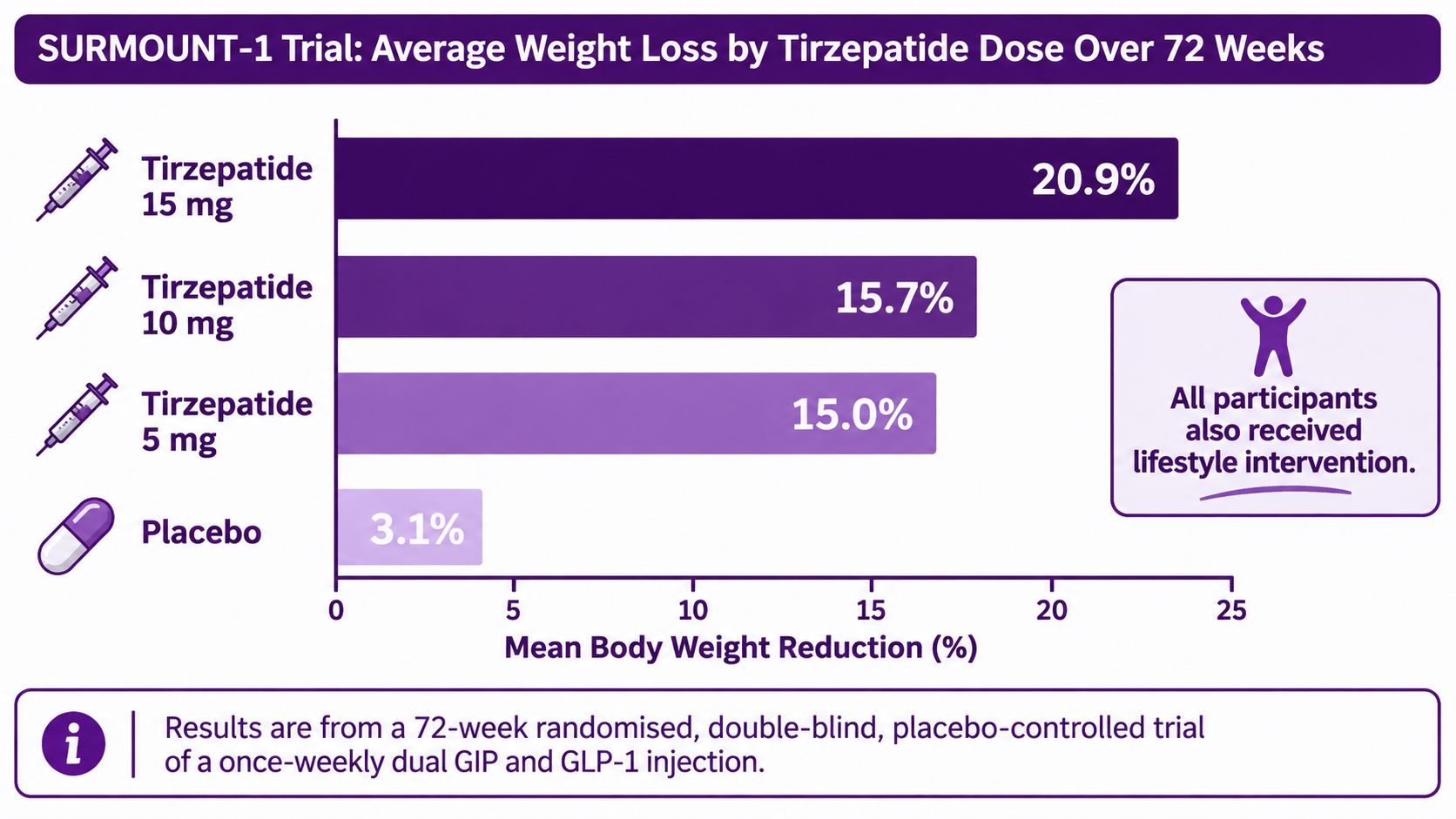
Say a man starts at 120 kg. A 20% loss would be 24 kg. That's the arithmetic of the group mean, not a forecast for him. Starting weight, adherence, side effects and other health conditions change the outcome. Trial volunteers also receive structured contact that routine life doesn't provide.
Dose is not a shortcut: Escalation exists to balance effect against gastrointestinal tolerability. Faster isn't the trial method.
- Ask about escalation: Know what the first weeks involve and when reviews happen.
- Eat smaller, protein-first meals: This helps many men manage nausea and fullness.
- Log food and training: A simple record shows whether a stall is intake, activity or a normal plateau.
The lesson is comparative. SURMOUNT-1 produced larger mean losses than STEP 1, over a similar long timeline. It didn't remove the need for diet, activity or muscle protection. Bigger mean loss raises the stakes for preserving strength, it doesn't lower them.
3. Orlistat XENDOS Trial Long-Term Weight Management Evidence
Four years is the longest follow-up of any trial here.
Torgerson et al., Diabetes Care, 2004, assigned adults with obesity to orlistat or placebo. Both groups received a reduced-calorie diet and exercise advice. The treatment arm took orlistat three times daily with meals. The drug acts in the gut, partially blocking the absorption of dietary fat. It never reaches appetite pathways in the brain.
By year four, the orlistat group had kept off more weight than the placebo group, though the gap was small. Newer medicines produce far larger mean losses over shorter timelines. Type 2 diabetes incidence was also lower on orlistat, most clearly in participants who entered with impaired glucose tolerance. Duration, not effect size, is what this trial adds to the evidence.
Why maintenance changes the verdict
Early loss doesn't prove durable success. NICE's evidence summary notes that several lifestyle studies found benefits were not sustained beyond 12 months, while one cited trial still showed 3.4 kg greater loss at 48 months for diet and physical activity versus health education. A men's weight loss before and after claim at month three tells you little about year four. XENDOS ran long enough to answer the question most trials leave open: does the loss hold?
- Take it with food: Orlistat is taken with meals containing some fat, while overall fat stays low to limit bowel effects.
- Separate vitamins: A daily multivitamin with fat-soluble vitamins is usually taken a few hours apart.
- Plan lower-fat, high-fibre meals: This reduces symptoms and makes the method sustainable.
In the UK, orlistat is available on prescription and, at a lower dose, over the counter. Because it works locally in the gut, it offers a non-systemic route for men who cannot or do not want to use an appetite-targeting medicine. Nothing in the method protects lean mass, so diet and resistance training carry that job. The replicable lesson is tolerance for a smaller, steadier result. A method a man can sustain for years beats a larger loss he abandons.
4. Intensive Lifestyle Intervention Diabetes Prevention Program Before-and-After Evidence Without Medicines
Start here if you want the baseline. No medicine. Structured behaviour change.
The US Diabetes Prevention Program, Knowler et al., New England Journal of Medicine, 2002, randomised over 3,200 adults with prediabetes to intensive lifestyle, metformin or placebo. The lifestyle group aimed for at least 7% weight loss and 150 minutes of physical activity per week, with coaching and follow-up.
Over about three years, diabetes risk was 58% lower in the lifestyle group than with placebo. Participants who met the 7% goal saw the largest risk reductions. Men and women were included. This wasn't advice to eat less and move more. It was a programme with targets, contact and accountability.
UK men respond to the same structure when it's designed for them. In the Football Fans in Training trial covered by NIHR Evidence, 747 men were randomised and, after one year, the intervention group had lost nearly 5 kg more than the waiting-list control.

A worked first target
A man at 105 kg aiming for 5 to 7% needs to lose about 5 to 7 kg. That's specific enough to plan meals and walking around. Vague goals don't survive a busy week.
- Build activity gradually: Walking plus two strength sessions is a practical route toward the weekly target.
- Use a food log briefly: Two weeks of recording usually exposes the high-calorie habit worth changing first.
- Don't train alone by default: A partner or group improves attendance when motivation drops.
The lesson is not that lifestyle beats medicine for everyone. It's that lifestyle is the comparator every other method must beat, and the foundation each one still requires.
5. Total Diet Replacement DiRECT Trial Before-and-After Weight Loss and Remission
DiRECT produced a large change without weight-loss medicines. It also shows why supervision matters.
Lean et al., The Lancet, 2018, tested a structured total diet replacement in adults with type 2 diabetes in primary care. Participants used low-calorie formulated meals for roughly 3 to 5 months, then stepped food reintroduction, then maintenance support. The control group received usual care.
At 12 months, the intervention group had lost a mean of about 10 kg. About 46% of participants achieved diabetes remission, with the best outcomes in those whose diabetes history was six years or less. Shorter duration mattered. So did amount lost.

This isn't a licence for a crash diet bought online. NICE's prescribing guidance evidence defines a very-low-calorie diet as no more than 800 calories per day and treats it as a specialised intervention. Early change can include water and glycogen, not only fat. The reintroduction phase decides whether the loss holds.
The replacement phase creates the deficit. The reintroduction phase decides whether you keep the result.
- Start only with clinical supervision: Blood pressure and glucose medicines may need adjustment as weight falls.
- Plan reintroduction before you start: Protein, vegetables and portion structure need to be decided in advance.
- Monitor health markers: Regular glucose and blood pressure checks are part of the method, not optional extras.
For a man with recent type 2 diabetes, DiRECT offers a defined, time-limited route with a maintenance plan attached. For a man without that diagnosis, the transferable lesson is structure. Meals were decided, monitored and then rebuilt. Willpower wasn't the intervention.
6. Resistance Training With Calorie Restriction Villareal et al 2017 Preserving Muscle During Weight Loss
Two men can lose the same weight and finish with different bodies. Villareal et al. show why the difference sits under the scales.
The trial put older adults with obesity on calorie restriction, with groups adding aerobic exercise, resistance training, both, or neither. Total weight loss was similar across the groups. What changed was composition. Participants who trained with weights kept more of their muscle through the deficit.
That is the before-and-after this trial measures, and it is routinely missing from transformation content. Research discussed in a Sheffield Hallam University paper.pdf) notes UK services have often felt female-dominated to men, with self-consciousness, shame and stigma reported as barriers to staying engaged. A strength-based setting can remove that barrier for some men. It also gives a performance measure that sits outside the scales.

What to track instead of weight alone
Waist circumference, strength on key lifts, and body composition trends tell you whether fat is falling while muscle holds. If weight stalls for two weeks but waist drops and squat load rises, that's progress. If weight falls fast and strength collapses, that's a warning.
- Train each major muscle group twice weekly: Use progressive overload you can record.
- Eat enough protein daily: Agree a target with a dietitian or clinician rather than guessing during a deficit.
- Start training during the deficit: Don't wait until after loss to rebuild what you've lost.
For session structure, see this men's health weight loss workout plan, and for principles behind strength training during a calorie deficit. The lesson applies to every case above. Whatever creates the deficit, resistance training decides what you keep.
How the six trial-based before-and-after results compare
| Item | Primary method | Study duration | Reported weight change | Prescription needed |
|---|---|---|---|---|
| Semaglutide 2.4 mg (STEP 1 Trial) | Weekly GLP-1 injection plus lifestyle support | 68 weeks | Mean loss of about 14.9% | Yes |
| Tirzepatide (SURMOUNT-1 Trial) | Weekly dual GIP/GLP-1 injection plus lifestyle support | 72 weeks | Mean loss of 15.0%–20.9%, depending on dose | Yes |
| Orlistat (XENDOS Trial) | Fat-absorption inhibitor plus diet and exercise advice | 4 years | About 3 kg more loss than placebo | Prescription or lower-dose over-the-counter option |
| Intensive Lifestyle Intervention (Diabetes Prevention Program) | Structured diet and physical activity programme | About 3 years | 7% weight-loss goal; mean change not stated | No |
| Total Diet Replacement (DiRECT Trial) | Low-calorie meal replacement, followed by food reintroduction and maintenance | 12 months | Mean loss of about 10 kg | No; clinical supervision recommended |
| Resistance Training with Calorie Restriction (Villareal et al., 2017) | Calorie restriction with or without exercise, including resistance training | Not specified | Similar weight loss across groups; resistance training preserved more lean mass | No |
Turning Trial Evidence Into Your Own Plan
Read the six cases together and a pattern emerges that no single before-and-after photo shows. Medicines produced the largest mean losses over 68 to 72 weeks. Total diet replacement produced a large loss faster, in a selected group, under supervision. Lifestyle intervention produced a smaller loss with a major reduction in diabetes risk. Orlistat produced the smallest additional loss, sustained over the longest period. Resistance training changed what the loss was made of rather than how much was lost.
Pace also needs context. NICE guidance on weight management states programmes should generally aim for approximately 0.5 to 1 kg per week. That benchmark makes many dramatic six-month claims look less credible, and it protects muscle better than aggressive restriction. A man losing at that rate over 68 weeks would land close to the STEP 1 result. Speed is rarely the variable that matters.
Completion matters more. In the NHS Digital Weight Management Programme evaluation in Obesity, men who completed the programme lost an average of 4.27 kg from a baseline of 112.84 kg, compared with 2.25 kg across the wider eligible group. Starting is not the intervention. Finishing, then maintaining, is.
Stigma interferes with both. The Numan State of Obesity report found 51% of men viewed obesity as a personal choice, compared with 37% of women, and four in ten people feared judgement when asking for help. That framing gives men a reason to delay effective support. Clinically supervised treatment is medical care, not an admission of failure.
Build your own record accordingly. Photograph if you wish, but record waist, strength, blood pressure, fitness and weight at fixed intervals. Note plateaus and side effects. Plan maintenance before you reach your lowest weight, including protein intake, resistance training and practical food routines such as dietary guidance for Thermomix cooking if batch cooking helps you stay consistent. Discuss any medicine-based option with a UK-registered prescriber who reviews your history.
Trim runs a dedicated men's weight loss treatment page, alongside separate pages for postpartum and menopause needs. The programme includes medical, dietary and lifestyle coaching alongside medicine where prescribed, and if a client does not lose at least 10% of body weight within six months, Trim guarantees a refund. Judge that, and any service, by follow-up and muscle preservation rather than by the largest loss advertised.
If you want a medically supervised route built around clinician review, nutrition and strength-focused activity rather than a photo promise, Trim offers prescription weight management for eligible UK adults following assessment. Complete the medical questions to check eligibility, and use the trial timelines above to set expectations you can measure.