
Men's Health Weight Loss Workout Plan That Builds Muscle

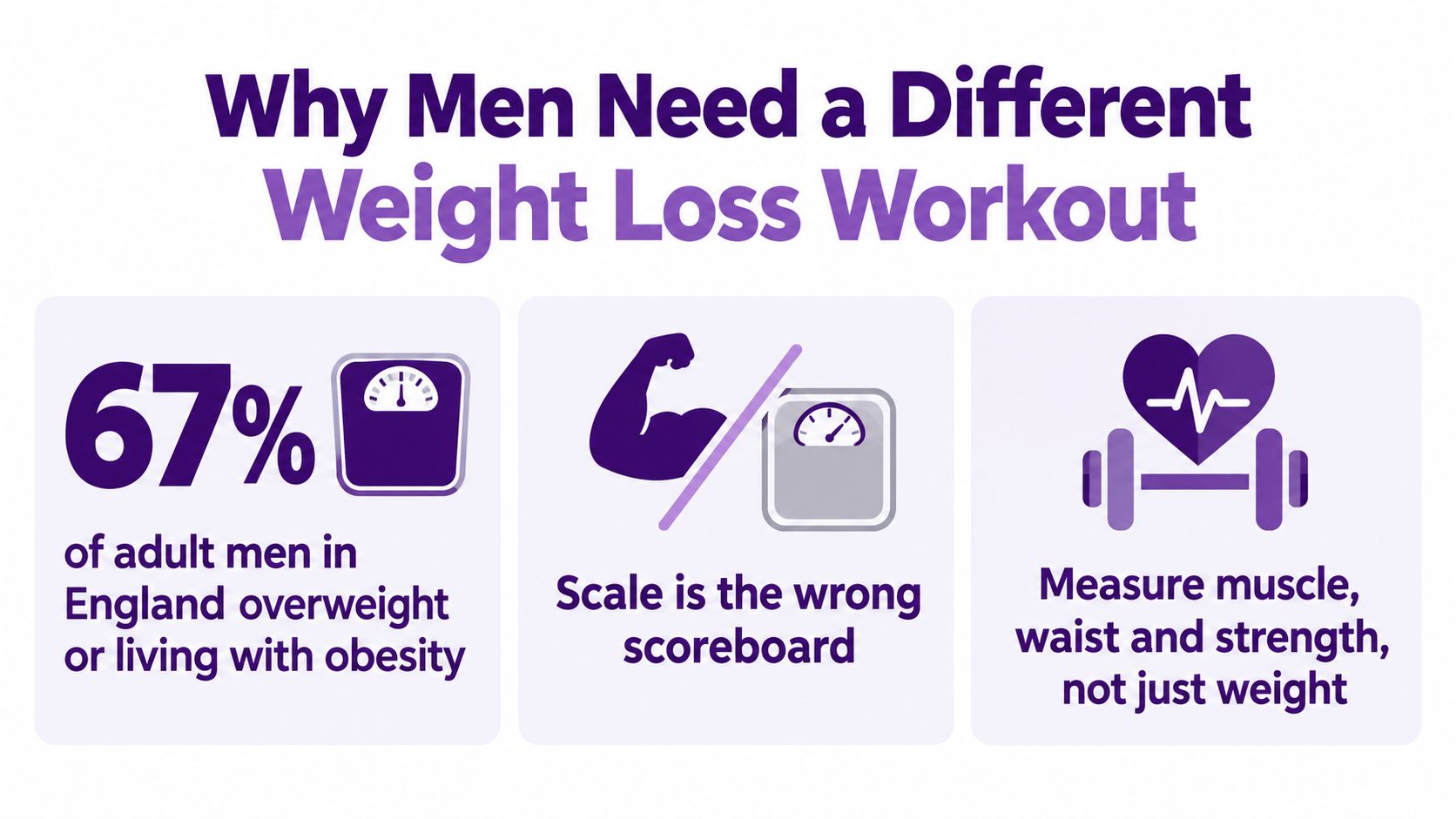
In England, 67% of adult men were overweight or living with obesity in 2022, while 28% were living with obesity, according to the Health Survey for England 2022. A useful men's health weight loss workout plan therefore shouldn't chase the fastest possible drop on the scales. It should reduce body fat while protecting strength, muscle and the ability to keep moving consistently.
The approach below combines resistance training, manageable cardio, daily movement and sensible progress checks. It isn't a prescription for everyone, particularly if you have cardiovascular disease, diabetes, joint problems, significant deconditioning or exercise symptoms. In those situations, get appropriate clinical advice before increasing training load.
Table of Contents
- Why Men Need a Different Weight Loss Workout
- Weekly Structure Built on UK Activity Guidelines
- Resistance Training Template for Fat Loss
- Cardio and Daily Movement Around the Strength Sessions
- Why the Scale Can Stall and What to Measure Instead
- A Minimum-Effective-Dose Plan for Time-Poor Men
- Putting It Together with Nutrition and Clinical Support
Why Men Need a Different Weight Loss Workout
England's Health Survey for 2022 found that 61% of adult women were overweight or living with obesity, while 28% of men were living with obesity, broadly similar to the 26–27% recorded annually from 2016 to 2019 (Health Survey for England 2022). These figures show the scale of the problem, not whether weight loss is preserving muscle needed for strength and daily function.
BMI helps compare health across populations, but it cannot separate muscle from fat or show fat distribution. Use waist circumference, body weight, strength, fitness and energy together. The scale is one dashboard light, not the whole vehicle. This men's weight-loss guide applies a fat-loss approach that treats muscle retention and adherence as outcomes. Resistance training gives lean tissue a reason to stay, while manageable progress supports consistency.
Weekly Structure Built on UK Activity Guidelines
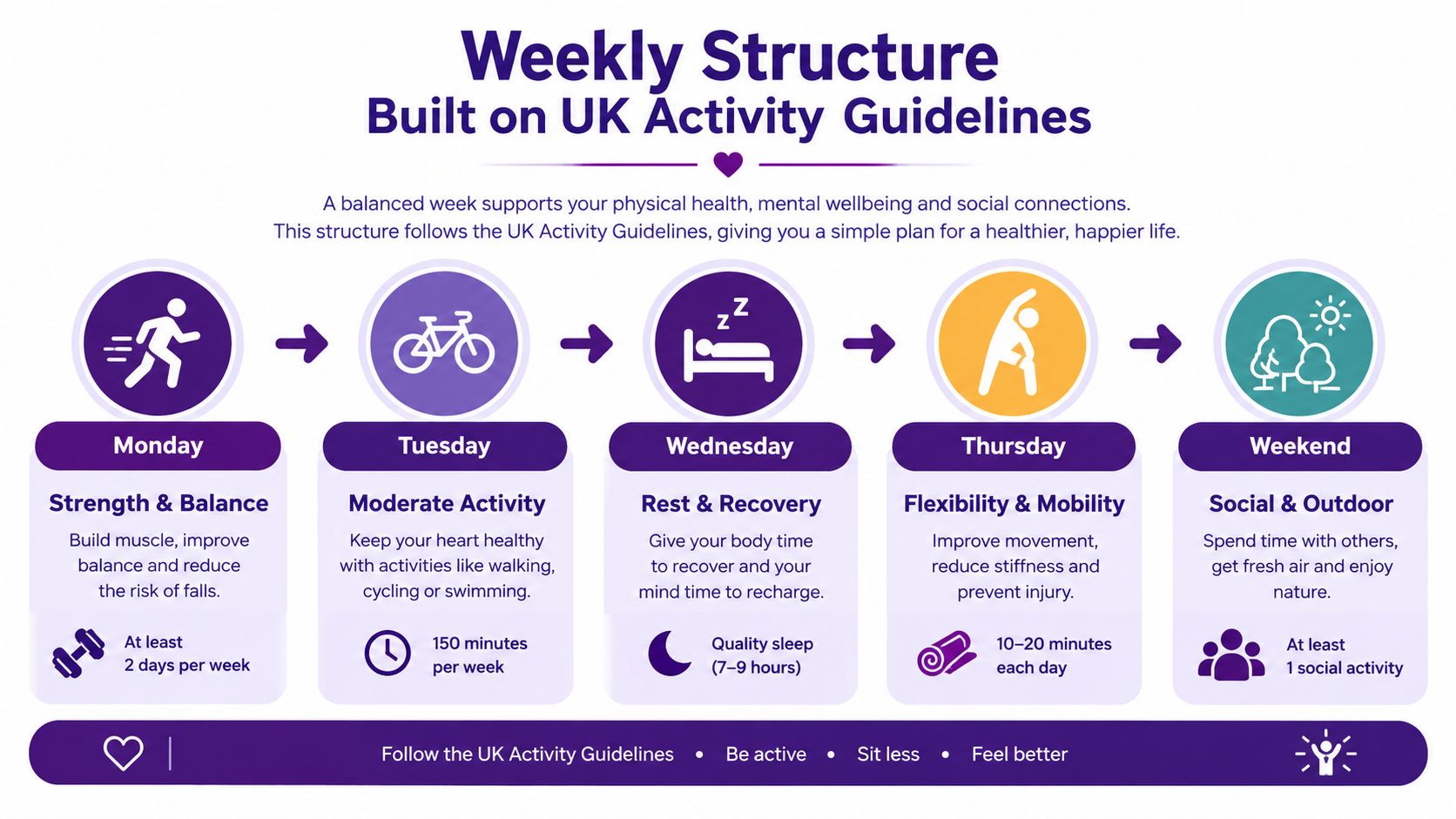
A week that protects muscle needs both resistance training and regular movement. UK guidance recommends at least 150 minutes of moderate activity or 75 minutes of vigorous activity, alongside muscle-strengthening work for all major muscle groups on at least two days (UK physical-activity guidance). Treat that target as the frame of the week, then fit sessions around work, sleep and recovery.
The gap between aerobic and strengthening activity matters. In England's Health Survey 2021, 70% of men aged 16 and over met the aerobic guideline, compared with 36% who met the muscle-strengthening guideline, while 34% met both recommendations (Health Survey for England 2021, physical activity). Preserving lean mass depends on giving muscles a repeated training signal, not merely accumulating steps.
| Day | Training |
|---|---|
| Monday | Full-body strength |
| Tuesday | Brisk walk or cycling |
| Wednesday | Easy movement and reduced sitting |
| Thursday | Full-body strength |
| Friday | Brisk walk, cycling or swimming |
| Saturday | Optional strength session or longer walk |
| Sunday | Recovery and gentle movement |
Place strength sessions on non-consecutive days where possible. Break up long sitting periods with brief movement. This keeps the week practical, supports adherence and builds function without making scale speed the only measure of progress.
Rehearse technique with a short demonstration before adding load:
Resistance Training Template for Fat Loss
Use one full-body session twice weekly to start. Add a third session only when recovery, sleep and schedule are stable. Each workout should cover a squat or leg press, hip hinge, horizontal push, horizontal pull and loaded carry.
The NHS recommends at least two sets, with three sets offering additional benefit. Suitable options include weights, resistance bands, push-ups, sit-ups, heavy shopping and demanding gardening, provided the work is challenging enough to require a short rest before repeating it (NHS strength and flexibility guidance).
| Movement pattern | Sample exercise | Sets x reps | RIR target |
|---|---|---|---|
| Squat | Goblet squat or leg press | 2–4 x 6–12 | 1–3 |
| Hip hinge | Romanian deadlift or hip hinge | 2–4 x 6–12 | 1–3 |
| Horizontal push | Dumbbell press or push-up | 2–4 x 6–12 | 1–3 |
| Horizontal pull | Cable row or resistance-band row | 2–4 x 6–12 | 1–3 |
| Loaded carry | Farmer's carry | 2–4 controlled walks | 1–3 |
RIR means repetitions in reserve. Stop most sets while you could still perform one to three technically sound repetitions. When every set reaches the top of its rep range with good form, add a small amount of load or increase the challenge. At home, use bands, push-ups and split squats. In a gym, machines and cables can make loading easier to control. Outdoors, a bench, sturdy backpack or pull-up bar can provide useful alternatives.
If dieting leaves you unusually fatigued, reduce a set from each exercise rather than abandoning the week. Reassess your main movements every four weeks in a logbook. This strength-training guide for fat loss can provide further exercise ideas, but the central rule remains simple: train consistently and progress gradually.
Cardio and Daily Movement Around the Strength Sessions
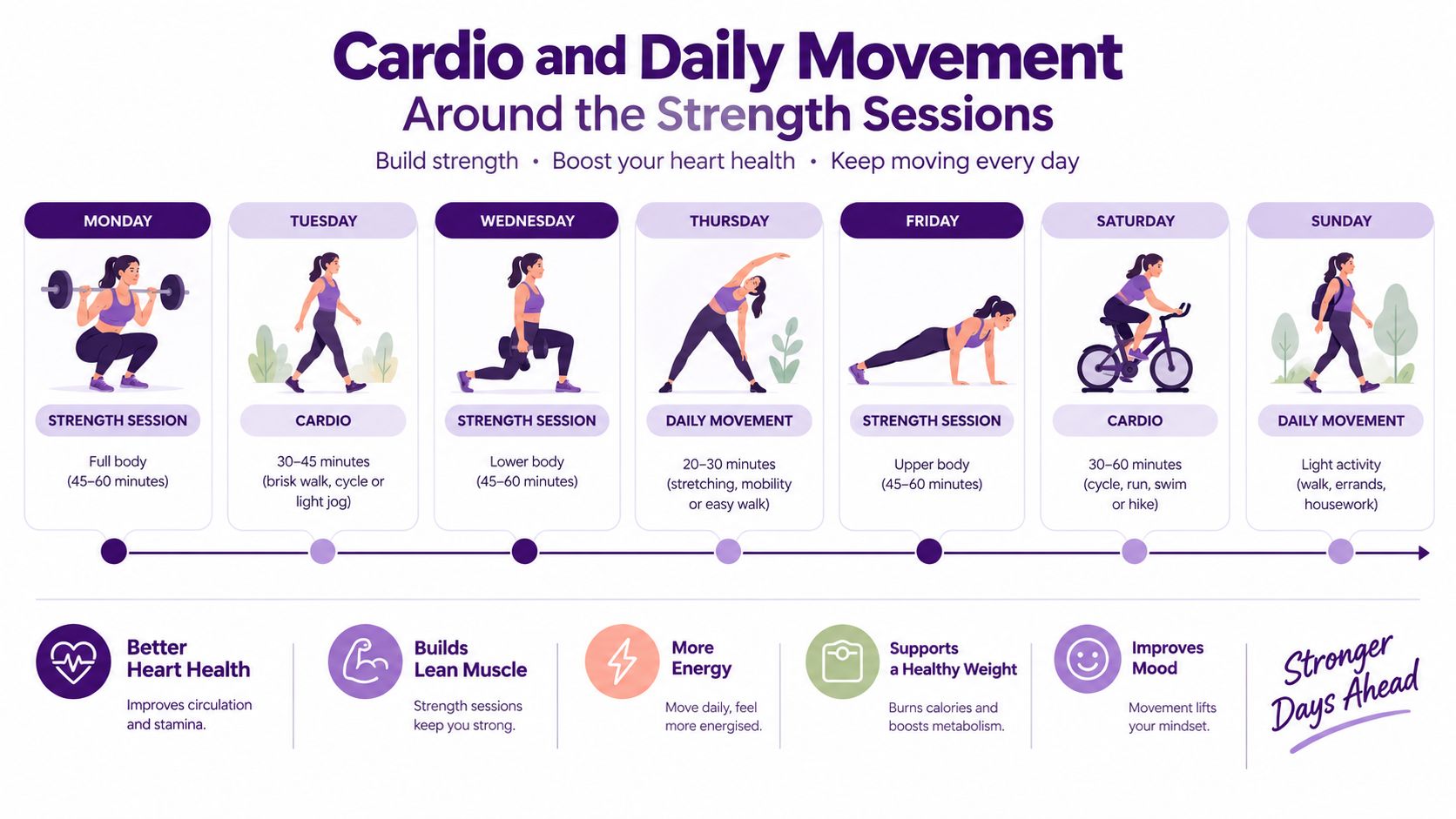
Cardio supports the resistance work. Choose brisk walking, cycling, swimming or rowing, then distribute it across three to five days so it doesn't compete with every strength session.
A walk-heavy week might use brisk walking for most sessions, divided between commuting, lunch breaks and evening movement. A mixed week could combine two longer brisk walks with shorter bike or rowing intervals. Start below your eventual target if you're currently inactive, then add time gradually rather than making every session hard.
NICE advises that adults may need around 45–60 minutes of moderate-intensity activity daily to help prevent obesity when calorie intake isn't reduced. For people who have lived with obesity and lost weight, 60–90 minutes daily may be needed to reduce regain risk (NICE physical activity and diet guidance). Treat those as progression targets, not a demand for your first week.
For timed intervals or focused walking blocks, a simple timer can remove decisions from the session. Kohru's guide to focus sessions offers a practical way to structure timed bouts while you build a repeatable routine. Stand up and move regularly during desk work, even when that movement isn't recorded as formal exercise.
Why the Scale Can Stall and What to Measure Instead
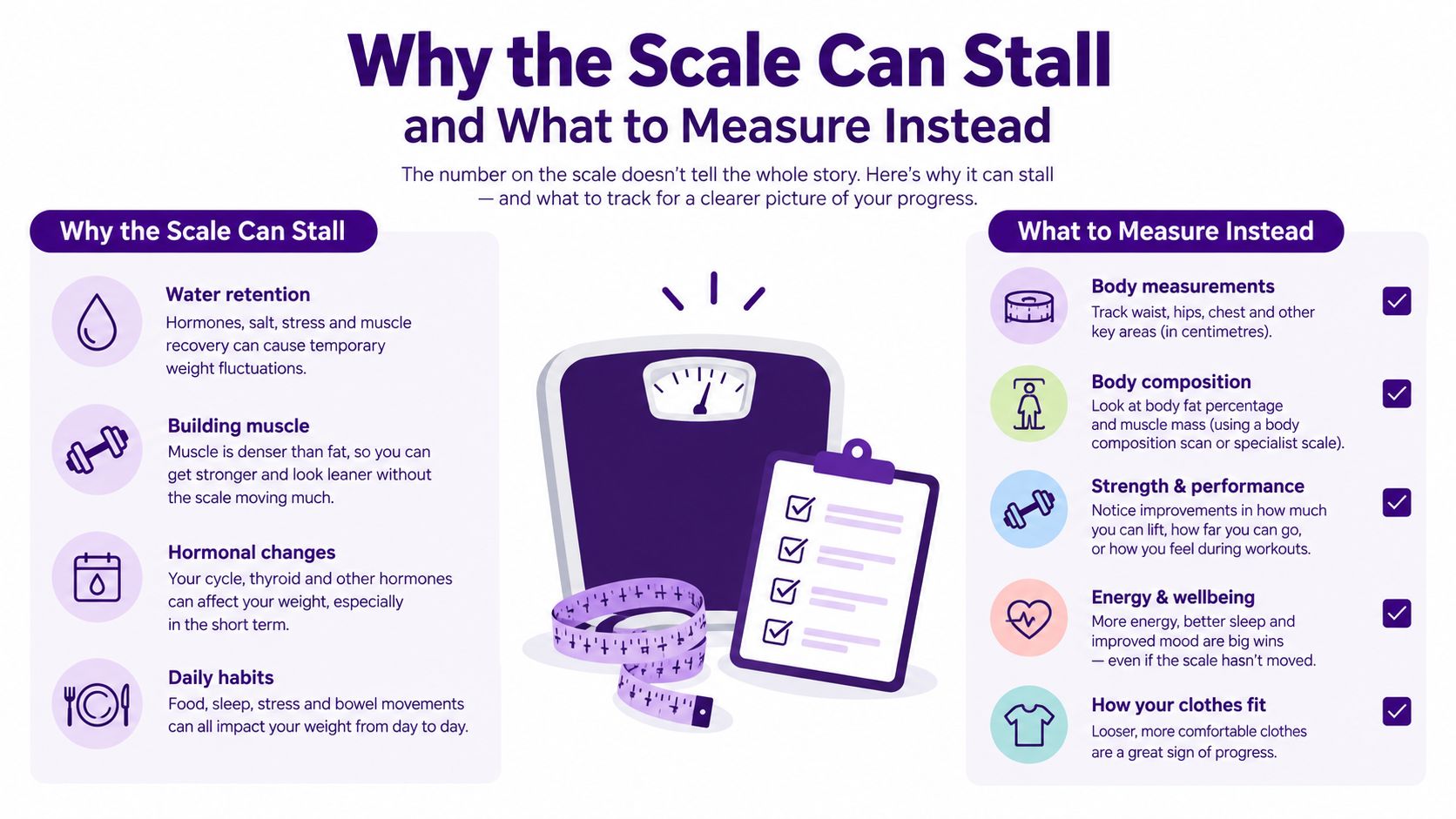
A Glasgow randomised pilot trial followed 48 adults with overweight or obesity through dietary weight loss, comparing diet alone with diet plus home-based resistance training. The added training didn't significantly change body weight, BMI, fat mass, fat-free mass or muscle thickness, but grip strength improved by approximately 2.65 units, compared with a 0.26-unit decrease with diet alone, with p=0.046 (Glasgow resistance-training trial).
Maximal voluntary contraction also rose by 23.61 units with resistance training, compared with an 11.95-unit decrease with diet alone, with p=0.019. That doesn't mean every person will gain strength during dieting. It does show why a flat scale isn't automatically evidence that training has failed.
Practical rule: measure the outcome you want to protect, not only the outcome that's easiest to see.
Use a simple log:
- Body weight: record regularly and assess the pattern rather than one reading.
- Waist circumference: measure at the navel under consistent conditions.
- Strength: repeat one safe movement at a fixed load every four weeks.
- Function: note walking comfort, stair ability, energy and technique.
For a clearer explanation of why body measurements can disagree, see this body composition analysis guide. A successful men's health weight loss workout plan may produce slower scale changes while waist, strength or daily function improves.
A Minimum-Effective-Dose Plan for Time-Poor Men
The barrier often isn't a lack of willingness to work hard. A 2025 local physical-activity assessment identified lack of time as the most frequently reported barrier at 45.0%, followed by insufficient energy at 29.4% and affordability at 22.9%. National UK figures for 2025 showed 61% of men met recommended activity levels (Cheshire West and Chester assessment).
Start with a minimum viable week:
- Strength: complete two short full-body sessions, using the template above.
- Walking: split activity into two or three brief bouts across the day.
- Workday movement: stand, walk or climb stairs during regular breaks from sitting.
- Substitutions: use bands or bodyweight at home, benches outdoors and machines in a gym.
If you miss a session, don't double the next workout. Complete the next planned session and resume the sequence. Symptoms, medication side effects, chest discomfort, unusual breathlessness or an existing medical condition require clinical advice, not a harder workout.
Putting It Together with Nutrition and Clinical Support
Exercise works inside a wider energy and behaviour plan. Use calorie-controlled nutrition that supplies adequate protein and fibre, and avoid treating cardio as permission to ignore food intake. If a UK-registered clinician prescribes a GLP-1 medicine such as Wegovy or Mounjaro, reduced appetite makes structured meals and resistance training especially relevant for protecting function and lean tissue. This is educational guidance, not a recommendation to start prescription treatment.
A medically supervised programme can combine prescribed treatment where appropriate, clinical monitoring, personalised nutrition and strength-focused exercise. If you're comparing protein products or planning convenient meals around training, you can browse best weight loss powders as one source of general product information, while remembering that supplements don't replace a balanced diet.
Use this first-month schedule:
- Week one: establish your current walking and sitting pattern.
- Week two: add one full-body resistance session.
- Week three: add the second strength session and keep cardio comfortable.
- Week four: review weight, waist, function and your selected strength test.
For UK adults aged 19–64, NHS guidance recommends 150 minutes of moderate aerobic activity or 75 minutes of vigorous activity each week, plus strengthening work on at least two days, covering all major muscle groups (NHS adult physical-activity guidance). Men with obesity, cardiovascular disease, diabetes, joint problems or other medical conditions should adapt the plan with appropriate clinical advice. Stop exercise and seek assessment for new chest pain, severe breathlessness or unusual symptoms.
Trim provides medically supervised UK weight management through clinician assessment, personalized nutrition guidance, activity tracking and strength-focused support. If you want this workout approach considered alongside clinically appropriate treatment options, visit Trim and complete the consultation.