
Men's Weight Loss Programme: What Works and How to Choose

67.2% of men in England were overweight or living with obesity in 2022, according to the Department of Health and Social Care's Men's Health Strategy for England. That makes weight management a mainstream men's health issue, not a test of individual willpower. A credible programme should help you reduce health risks while protecting the strength you use at work, in the gym and in everyday life.
The useful question isn't how quickly you can become lighter. It's whether you can lose fat, eat adequately, maintain muscle and keep making progress with appropriate clinical support.
Table of Contents
- Why Men's Weight Loss Needs a Structured Programme
- What a Complete Men's Weight Loss Programme Includes
- How to Assess Your Starting Risk Before Treatment
- Who Qualifies for Prescription Weight-Loss Medicines
- Protecting Muscle With Strength Training and Protein
- What Results to Expect and How to Track Them
- Choosing a Programme and Confirming Your Next Step
Why Men's Weight Loss Needs a Structured Programme
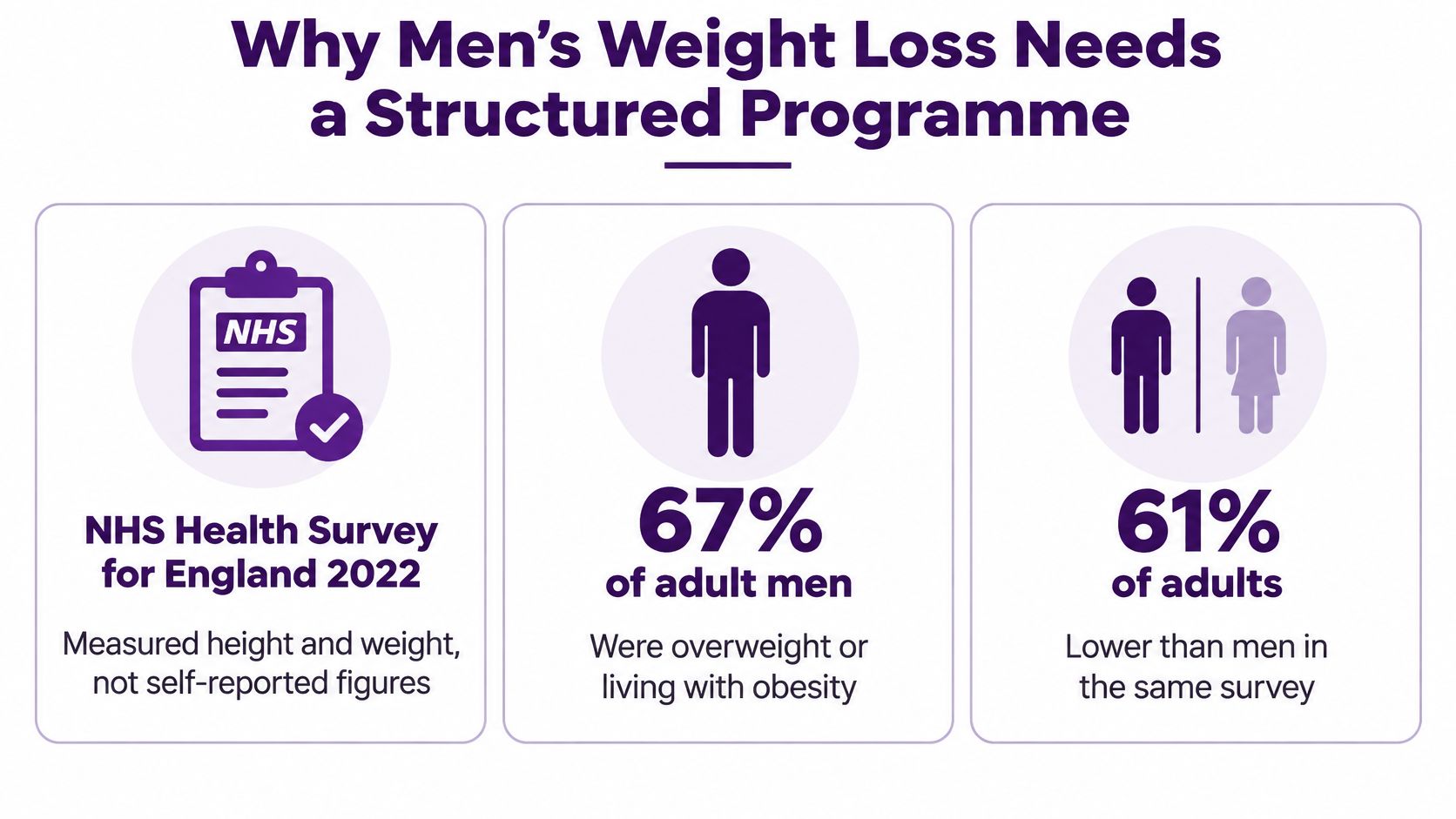
The NHS Health Survey for England 2022 measured height and weight, finding that 67% of adult men were overweight or living with obesity, compared with 61% of women. It also found that 28% of men were living with obesity and 39% were overweight without obesity, according to the survey's adult overweight and obesity findings. Among men, the figures ranged from 80% for those aged 55 to 64 to 35% for those aged 16 to 24. The survey comparison is between men and women, not all adults. It generally defines overweight as a BMI of at least 25 kg/m² and obesity as at least 30 kg/m².
Changing lunch habits may have limited effect if a man also works unpredictable shifts, sleeps poorly and drinks regularly after work. Treating weight in isolation is like mopping a wet patch beneath a leaking roof: lasting progress means addressing the conditions that keep bringing the problem back.
A structured programme should account for what happens beyond the first few kilograms lost. That includes planning for maintenance, eating adequately, choosing activity that fits a person's fitness and circumstances, and reviewing health risks as they change with age or medication. The scale records weight, but it cannot show by itself whether a man is maintaining strength or managing health risks well.
What a Complete Men's Weight Loss Programme Includes
Components of a complete men's weight-loss programme
| Component | What it covers | What to check |
|---|---|---|
| Clinical assessment | Baseline risk measures, detailed in the risk check section | A named clinician reviews results before treatment |
| Prescription medicine, where eligible | Licensed medicine used alongside diet and activity | Eligibility criteria and monitoring plan are written down |
| Nutrition plan | An energy target informed by baseline needs, with protein included | The plan adjusts when appetite falls |
| Resistance training | Major muscle groups trained regularly | Loads and repetitions are logged each session |
| Aerobic and daily activity | Moderate cardio and walking, built up towards an agreed maintenance goal | Weekly activity volume is tracked |
| Monitoring and review | Weight trend, waist, strength and symptoms | Scheduled reviews, not isolated weigh-ins |
| Ongoing support | A maintenance plan after the active phase | A clear route to a clinician for side effects |
These components work together. A food plan can establish an energy deficit, but it won't teach lifting technique or identify why someone feels dizzy. An exercise programme can improve fitness, but it can't replace a prescribing assessment.
The underlying approach is multicomponent management: combine changes in behaviour, food quality, energy intake and activity rather than treating any single tactic as the whole solution. For medicines, dietary and physical-activity support remain part of treatment, not optional extras.
Make the nutrition plan usable
A calorie estimate is a starting point, not a verdict on your metabolism. The Wallaby Wellness calorie deficit calculator can help you understand how an estimated energy budget is constructed, but it doesn't assess medical suitability or replace an individual nutrition review.
A usable plan translates that estimate into meals you can prepare. For a shift worker, that might mean a packed meal, a protein-containing snack and a planned breakfast after work, rather than a rigid timetable built around office hours.
It should also explain what to do when circumstances change. If appetite falls, the answer shouldn't automatically be to skip more meals. The clinician or dietitian needs to check whether you're still getting adequate nourishment.
A programme is judged by its weakest component, not its strongest.
Consider a man who starts appetite-suppressing treatment without any strength work or food planning. His weight may fall, but that alone won't establish whether he's preserving muscle or eating adequately. Monitoring should detect declining function and trigger a review rather than celebrate every lower reading.
Look beyond the treatment itself
Medically supervised weight loss should mean someone takes responsibility for assessment, follow-up and changes to the plan. It shouldn't mean a prescription followed by silence.
Support also needs to fit ordinary life. Social meals, alcohol, travel and busy weeks require practical decisions, not a demand for perfect adherence.
Warning signs include:
- Supply before assessment, without meaningful clinical review.
- No written nutrition or activity plan, leaving you to improvise.
- No scheduled follow-up, particularly when symptoms or eating difficulties arise.
How to Assess Your Starting Risk Before Treatment
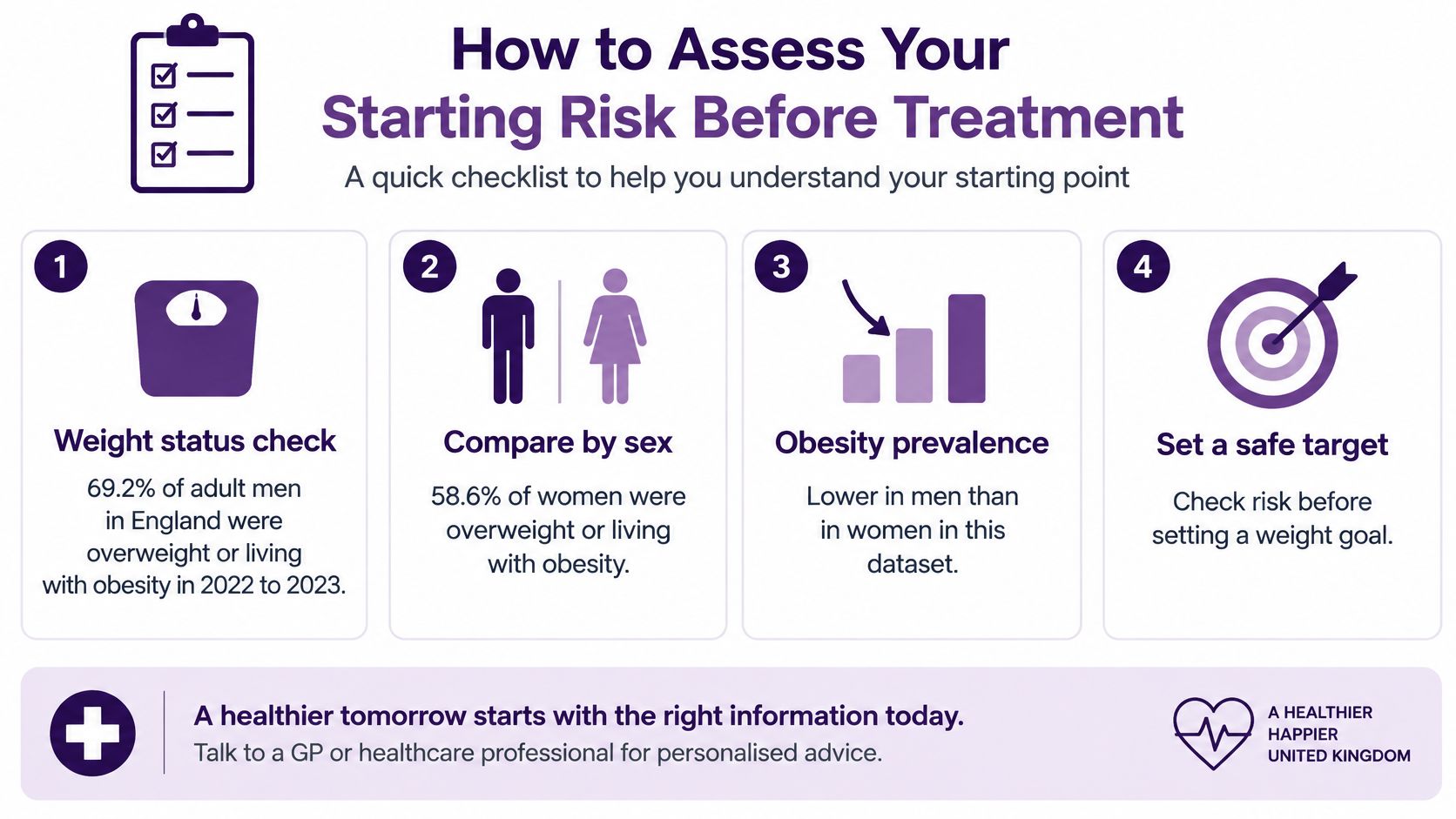
In England in 2022 to 2023, 69.2% of adult men were overweight or living with obesity, compared with 58.6% of women. Obesity prevalence was similar: 26.4% for men and 26.2% for women, according to the government's Obesity Profile commentary.
Many men are in the overweight range, where waist size, blood pressure and existing health conditions can add useful context to BMI.
Record a practical baseline
- Height and weight to calculate BMI. Measure height without shoes and weigh yourself on a firm, level surface.
- Waist circumference. Place a tape midway between the lowest rib and the top of the hip bone. Keep it level without pulling it tight.
- Blood pressure reading. Use a correctly sized upper-arm cuff while seated and rested, following the device instructions.
- Current medicines, including over-the-counter products. Make a complete list, including supplements and any weight-loss products.
- Sleep quality and possible signs of sleep apnoea. Note loud snoring, witnessed pauses in breathing or pronounced daytime sleepiness.
- Weekly alcohol intake. Record drink types and serving sizes rather than describing your consumption as occasional.
- Existing conditions, such as type 2 diabetes or high blood pressure. Include diagnoses, current treatment and recent results where available.
A waist measurement alone does not diagnose a health problem. Your clinician can interpret it alongside BMI, ethnicity and other findings.
Turn measurements into decisions
Your baseline helps a clinician decide whether further investigation is appropriate before treatment. Metabolic health testing may be relevant if your history or examination points to concerns that need closer assessment.
For home tracking, compare weekly averages from readings taken under similar conditions. Fluid shifts and changes associated with resistance training can temporarily obscure fat loss, so a single weigh-in may give a misleading impression.
Safety first: Chest pain, significant breathlessness or fainting need urgent medical assessment, not a smaller calorie target or a revised workout.
Severe or sudden symptoms warrant emergency help. Do not wait for a routine programme review.
Who Qualifies for Prescription Weight-Loss Medicines
Eligibility thresholds for semaglutide (Wegovy) under NHS guidance
The following thresholds come from NHS England's guidance on weight-management injections.
| Group | BMI threshold | Additional requirement |
|---|---|---|
| Adults generally | BMI 35 or above | Weight-related health problems |
| Adults of Asian, Chinese, Middle Eastern, Black African or African-Caribbean origin | BMI 32.5 or above | Weight-related health problems |
| Adults generally | BMI 30 to 34.9 | Qualifies only when specialist criteria are met |
| Adults of Asian, Chinese, Middle Eastern, Black African or African-Caribbean origin | BMI 27.5 to 32.4 | Qualifies only when specialist criteria are met |
BMI alone doesn't decide eligibility. These NHS thresholds combine body size, ethnicity-adjusted risk, weight-related complications and the requirements for specialist care. They aren't a universal eligibility table for every medicine or every private service.
Wegovy is licensed by the MHRA for chronic weight management in adults with obesity, or overweight with at least one weight-related comorbidity. Licensing and NHS access are different questions: a medicine's authorised use doesn't automatically establish entitlement to NHS treatment.
Apply the criteria to the whole person
Consider a hypothetical man with a BMI of 33 and high blood pressure who doesn't fall within an ethnicity-adjusted group. He sits in the intermediate band and needs assessment against the additional specialist criteria, rather than automatic approval.
A man with the same hypothetical BMI but no related condition doesn't meet the stated NHS criteria on BMI alone. For someone in an ethnicity-adjusted group, the assessment may follow a different threshold, which is why a bare BMI number can mislead.
NHS guidance places semaglutide treatment within a specialist weight-management service, alongside dietary and lifestyle support. Medicine must be used with diet and lifestyle improvements, not as a substitute for them.
A questionnaire isn't the prescribing decision
An online form can collect history and identify potential eligibility. A registered prescriber must still assess suitability, including relevant conditions, current medicines and whether the proposed treatment is appropriate.
A higher dose or a particular medicine shouldn't be treated as a consumer upgrade. Treatment choices require a clinical reason, and changes need to account for tolerability as well as progress.
If you don't qualify, you still have useful options: a structured lifestyle programme, a GP review of weight-related risks and an appropriate referral route. Not meeting a prescribing threshold doesn't mean your concerns are unimportant.
Protecting Muscle With Strength Training and Protein
The UK Chief Medical Officers' physical activity guidance recommends muscle-strengthening activity involving major muscle groups on at least two days a week. During weight loss, strength work should be planned deliberately, not left until you reach your target.
The aim is to maintain useful capacity, including standing up, carrying shopping and handling everyday loads. Dumbbells, machines, resistance bands and bodyweight movements can all contribute.
Use the exercise and food examples below as prompts for a plan suited to your ability.

Build a repeatable training routine
A beginner's plan might look like this:
- Schedule full-body sessions. Leave recovery time between them and choose days you can sustain.
- Cover the main movement patterns. Include a squat, hinge, push, pull and carry, adapted to your joints and confidence.
- Practise controlled repetitions. As a hypothetical starting session, try two sets of eight repetitions with a load you could lift a few more times.
- Progress only when technique stays sound. Add repetitions or a small amount of resistance when the current work feels manageable.
- Keep moving outside the gym. Walk regularly and build moderate aerobic activity gradually towards an agreed maintenance goal.
A chair squat can precede a loaded squat. A supported row may suit someone who can't comfortably hold a bent-over position. Progress means doing appropriate work more confidently, not copying the hardest version of an exercise.
The calorie deficit supports fat loss, while resistance training provides a stimulus to retain muscle and strength. Aerobic activity serves a different purpose, supporting fitness and increasing overall movement.
This video can be used as an additional exercise resource; adapt any movements to your ability and clinical advice.
Plan protein before appetite becomes a problem
Include a protein-containing food across your meals, such as eggs, fish, lean meat, yoghurt, tofu, beans or lentils. The appropriate total should be agreed individually, particularly if you have kidney disease or another condition affecting dietary needs.
Reduced appetite can make adequate eating harder. Plan meals in advance rather than waiting until you're hungry, and use smaller, nourishing portions when large meals feel unmanageable.
For practical dinner ideas, Just Cook It's protein-packed weeknight meals can help turn an abstract nutrition aim into a shopping list. Recipes still need adjusting to your appetite, preferences and clinical plan.
Function matters: Becoming lighter shouldn't mean becoming progressively less capable.
That principle is particularly relevant during GLP-1 treatment, when appetite suppression may make under-eating easier to overlook. Lean mass isn't synonymous with muscle, so a body-composition reading needs interpretation rather than alarm.
A practical approach to losing weight while keeping muscle combines adequate food, progressive training and attention to recovery. Persistent deterioration in performance deserves review, not praise for faster weight loss.
What Results to Expect and How to Track Them
Average weight reduction in the SURMOUNT-1 trial
NICE's clinical-effectiveness summary reports the following results from SURMOUNT-1, involving 2,539 adults without diabetes, and separately identifies SURMOUNT-2, involving 938 adults with type 2 diabetes.
| Treatment arm | Average reduction | Reported range | Notes |
|---|---|---|---|
| Tirzepatide 5 mg | 15.0% | 14.2% to 15.9% | SURMOUNT-1, adults without diabetes |
| Tirzepatide 10 mg | 19.5% | 18.5% to 20.4% | Same trial |
| Tirzepatide 15 mg | 20.9% | 19.9% to 21.8% | Same trial |
| Placebo | 3.1% | 1.9% to 4.3% | Same trial, for comparison |
These are controlled-trial averages, not individual promises. The reported ranges shouldn't be read as the minimum and maximum that any patient could experience, and the participants weren't exclusively men.
The table concerns tirzepatide, whereas the NHS eligibility table concerns semaglutide. The medicines aren't interchangeable, and these results mustn't be presented as Wegovy outcomes.
Translate averages cautiously
As a hypothetical calculation, a man starting at 100 kg who lost 15% would lose 15 kg. That arithmetic explains a percentage; it doesn't predict his response or tell him how quickly it will happen.
Some people lose more and others less. Progress may also slow after an initially faster period, so a straight-line projection can create unrealistic expectations.
The MHRA distinguishes the weight-management studies from the separate diabetes-development programme in its tirzepatide regulatory summary. Results from different populations shouldn't be merged into a single personal forecast.
Use a small progress dashboard
Track enough information to guide decisions without making monitoring a second job:
- Weight trend: Keep a weekly average under consistent measuring conditions.
- Waist: Measure periodically with the same technique and tape position.
- Strength: Record exercises, resistance and repetitions.
- Activity: Log walking or other activity volume.
- Symptoms: Note sickness, dizziness, bowel changes and difficulty eating or drinking.
A falling waist with stable strength is more reassuring than rapid scale loss accompanied by weakness. Neither home scales nor a gym log can diagnose muscle loss, but together they can flag a need for assessment.
Contact the treating clinician about sustained strength loss, dizziness, persistent sickness or weight regain after a period of loss. These are reasons to review the plan, not to restrict food further or change a dose yourself.
Choosing a Programme and Confirming Your Next Step
Start with professional registration, not before-and-after photographs. Check doctors through the GMC and pharmacists or pharmacy services through the GPhC.
Use a short decision checklist:
- Verify who's responsible. Identify the prescriber and dispensing pharmacy.
- Confirm assessment precedes supply. A questionnaire result isn't a substitute for a prescribing decision.
- Review the written plan. Nutrition and activity guidance should include strength work.
- Understand follow-up. Know the review schedule and how to report side effects.
- Read the terms. Eligibility messages and refund policies explain processes, not guaranteed clinical outcomes.
At Trim, eligible customers who complete the medical questions see “You're eligible for the Trim weight loss programme.” That message shouldn't be interpreted as permission to bypass clinical assessment.
Our policy guarantees a refund if a client doesn't lose at least 10% of their body weight within six months. Read the full terms before relying on the guarantee; a financial policy isn't a medical prediction.
Seek help when lifestyle changes have stalled or measurements suggest raised risk. You can frame a GP appointment around blood pressure, waist size, sleep or diabetes concerns without identifying as someone who's dieting.
Book a GP review, discuss an NHS referral or arrange a regulated assessment. Bring your baseline measurements and complete medicine list. If you don't meet a clinical threshold, choose supported lifestyle care, not a shortcut.
Trim offers clinician-assessed prescription weight management alongside nutrition advice and strength-focused activity guidance. Visit Trim to explore the assessment process and consider whether its supervised approach fits your health needs and muscle-preservation goals.