
5 Minute Clinical Consult App Explained Clearly

The 5-Minute Clinical Consult is a point-of-care reference for clinicians, not an app that diagnoses or prescribes for a named patient; its online service offers targeted diagnostic information in less than 30 seconds. That speed helps someone find information, but it doesn't establish whether a treatment is suitable for you.
The familiar advice to choose a clinical app because it gives quick answers misses the important distinction. A reference can explain a condition. A personalised UK consultation needs someone accountable for checking your circumstances, making a decision and recording why.
Table of Contents
- What the 5 Minute Clinical Consult App Is
- How a Five-Minute UK Consultation Runs
- Safety Fields a Short Consult Must Hold
- Failures Inspectors Still Find Online
- Reading Evidence and Reference Limits for You
- Check a UK Provider Before You Book
What the 5 Minute Clinical Consult App Is
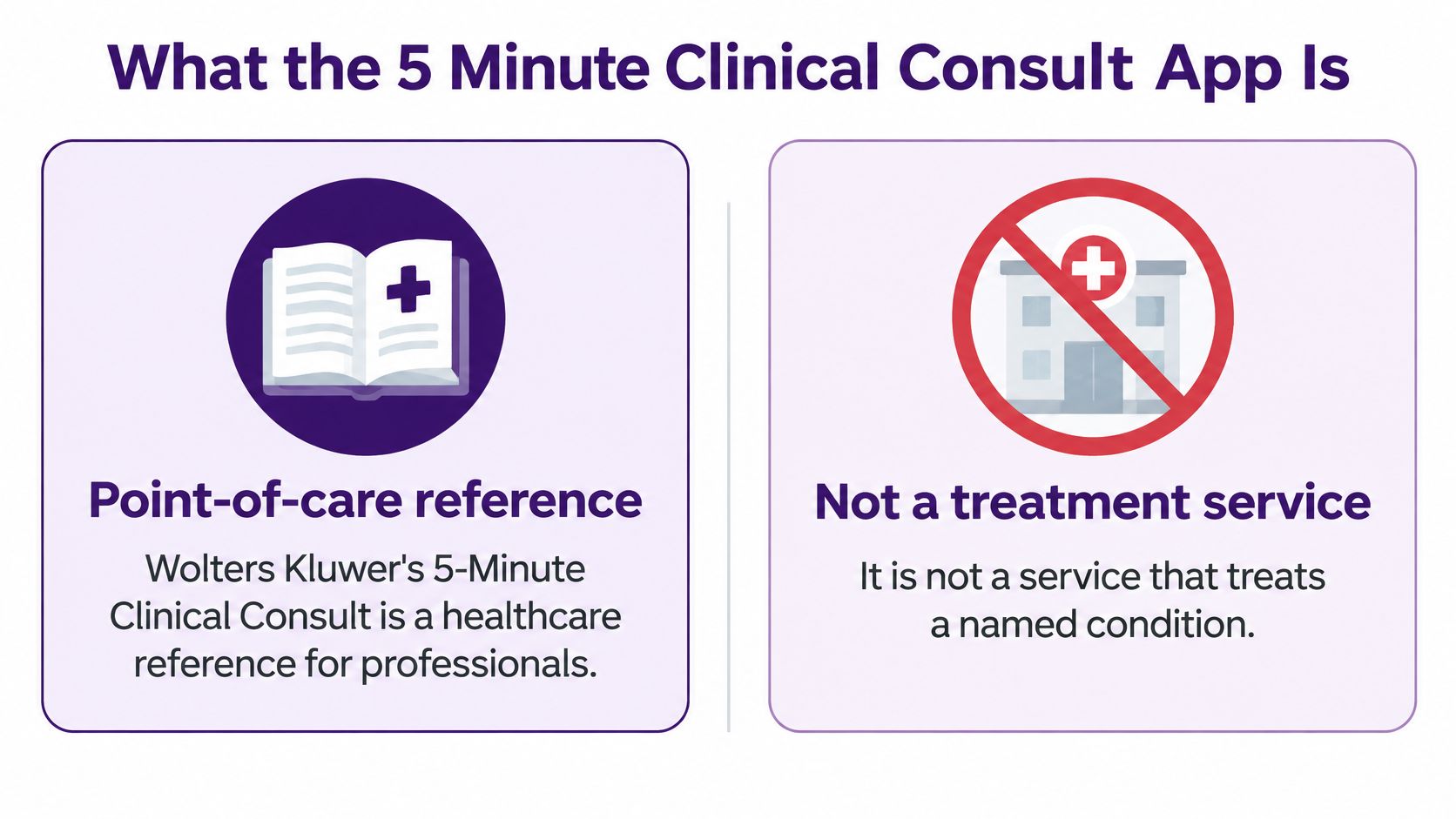
A clinical reference and a patient consultation are different products. The 5-Minute Clinical Consult supports healthcare professionals looking up diagnosis, treatment and follow-up information; a patient consultation assesses a particular person's health and next steps.
The publisher's platform description says the online service provides targeted diagnostic information in less than 30 seconds, with more than 180 evidence-based diagnostic and treatment algorithms. It also describes disease summaries, procedure and physical-therapy videos, clinical images, diagnostic-test information, drug information, interaction tools and calculators.
That combination makes it more than a searchable medical dictionary. A clinician can check a diagnostic pathway, review an examination technique and consult medication information within the same reference. None of those functions establishes that a particular patient has been examined or that their current medicines have been reconciled.
The distinction is illustrated below.
Reference app versus a UK patient consultation
| Question | 5-Minute Clinical Consult | UK five-minute patient consult |
|---|---|---|
| Primary user | Healthcare professional | Adult seeking care |
| Job | Rapid diagnosis, treatment and follow-up reference | Collect history and support a suitability decision |
| Who decides for you | The clinician using the reference | A suitably qualified UK prescriber |
| Typical content | Disease summaries, evidence-based algorithms, videos, images and drug tools | Identity, history, medicines, allergies and contraindications |
| Connection | Optimised for mobile; the mobile edition supports offline use | Needs a reviewable clinical record |
| What it cannot do | Replace judgement for one patient | Prescribe by software alone |
The product also has an established print-reference background. The UK catalogue identifies its 35th edition, describing more than 500 disease and condition topics in that edition, alongside a mobile version designed to work without an internet connection.
Those descriptions refer to different formats. Don't assume every book, app and online subscription has identical content or functionality. Before choosing access, check which edition you're considering, whether offline resources are included and how updates reach the device.
What the difference means during care
Say a clinician checks an algorithm for persistent nausea. The reference can organise possible explanations, but the clinician still needs your symptom history, medicines and relevant examination findings before deciding what to do.
A patient-facing GLP-1 app may instead help organise progress tracking and contact with a clinical team. Its usefulness should be judged against those tasks, not against the breadth of a professional reference library.
The practical test is simple: general disease summaries indicate a reference; a named clinical record and an accountable prescriber indicate a consultation.
How a Five-Minute UK Consultation Runs
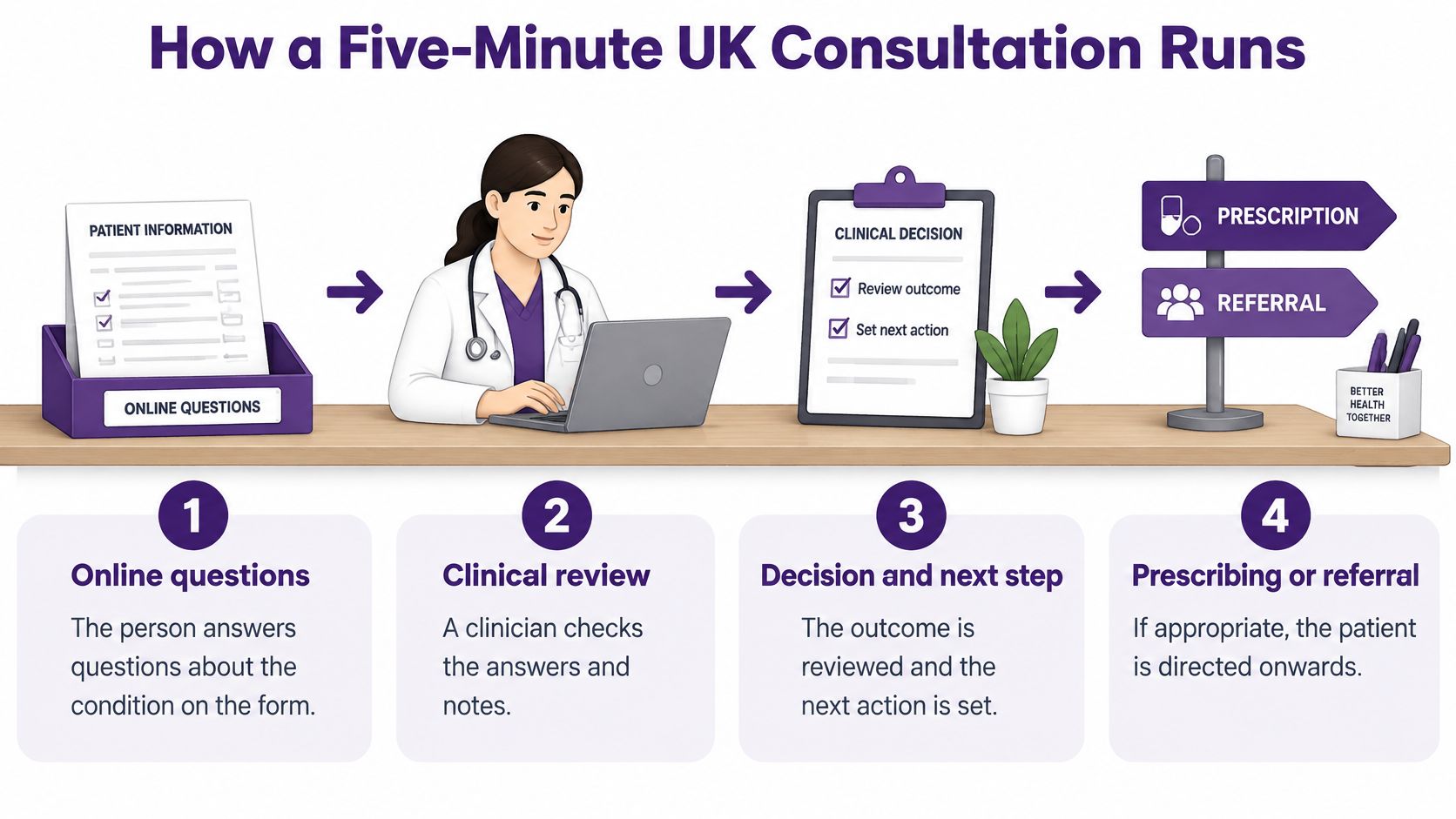
Think of the online form as the notes tray on a clinic desk, not the prescriber sitting behind it. It collects information so a clinician can assess the case. Submitting it isn't the same as receiving clinical approval.
At Trim, our first step is a five-minute consultation covering the condition and medical history. That describes the questionnaire, not a promise that every clinical question can be safely resolved within the same time.
The broad route from information gathering to a clinical outcome looks like this.
The path from answers to a decision
- Answer the health questions accurately. Include the condition you're seeking help with and your medical history. If you're unsure of a diagnosis or medicine name, identify the uncertainty rather than guessing; the case may need clarification before it can proceed.
- Provide dietary and health detail in the pre-qualification form. Our form gives an overview of treatments that may be recommended within licensed indications. A digital suggestion isn't prescribing authority, and an apparent match mustn't override information that makes treatment unsuitable.
- Allow the independent prescriber to review the case. Our second step is review by a qualified independent prescriber, with UK-registered clinicians checking safety and suitability. Missing or conflicting answers should prompt further questions, not an assumption that everything is acceptable.
- Receive a prescription only if treatment is appropriate. Our clinicians review medical information and issue prescriptions when suitable. A concerning symptom, uncertain history or unresolved risk should stop the routine route and lead to further assessment or referral.
- Receive confirmation after clinical approval. We send an order confirmation email with order details once the medical team has approved the order. Our clinical team remains available to discuss treatment and answer questions.
What you should have afterwards
The useful outcome isn't merely a completed form. You should understand what was decided, who made the decision and how to ask a follow-up question. If further information is needed, the service should make the next action clear rather than leave you interpreting a pending order.
Non-prescription purchases follow a different route. Our non-prescription product orders are confirmed by message and don't require an online consultation, so confirmation of a basket item doesn't necessarily mean a prescribing assessment has occurred.
Practical rule: Treat a request for more information as part of clinical care, not as an obstacle to checkout.
Keep a copy of the advice and decision you receive. If your circumstances change before starting treatment, tell the clinical team rather than relying on answers that are no longer accurate.
Safety Fields a Short Consult Must Hold
Safety record for a five-minute consult
| Field | Why it is recorded | If it is missing or unsafe |
|---|---|---|
| Identity | Confirms who is being assessed | Don't prescribe against an unverified account |
| Consent and GP sharing | Records agreement to assessment and relevant information sharing | Hold supply until the required consent is in place |
| Current medicines and allergies | Screens interactions and hypersensitivity | Escalate conflicting or unclear regimens |
| Diagnoses and red-flag symptoms | Checks indication and possible urgent illness | Clinician review or urgent signposting |
| Pregnancy or breastfeeding | Identifies circumstances needing specific suitability checks | Don't continue on an automated path |
| Rationale and prescriber identity | Shows who decided and why | No dispatch without a documented decision |
A short questionnaire still needs a substantial clinical record behind it. The Medicines and Healthcare products Regulatory Agency, or MHRA, explains in its software and apps guidance that software can qualify as a medical device when its intended purpose involves a medical function, with applicable duties for manufacturers.
That doesn't mean every health questionnaire is automatically a medical device. Classification follows what the software is intended to do, not whether it appears on a phone.
Branching must create a safe way out
Good branching logic changes the route when an answer creates uncertainty. If someone lists a medicine but can't identify its strength or purpose, the system should request clarification. If they describe a concerning symptom, it should move them away from routine supply towards appropriate clinical assessment.
Decision rules should be version-controlled, clinically approved and tested against representative UK scenarios. The record should preserve which information was available when the clinician decided, including any later corrections.
Our customers must consent to sharing consultation and prescription data with their GP before receiving treatment. Our clinician team also approves every medication before it's sent, and customers must tell us about medical-history changes that could affect treatment.
Communication and data need their own checks
A usable record needs clear language as well as complete fields. For teams designing clarification questions, patient communication insights from Recepta.ai offer a useful discussion point, but conversational fluency shouldn't be mistaken for clinical validation.
Patients should be able to understand the service's privacy information:
- Contents: Which assessment answers, clinical decisions and messages are retained.
- Access: Which clinicians, delivery partners or other authorised recipients can see relevant information.
- Retention: How the service explains its retention arrangements.
- Corrections: How to request access to information or flag an inaccurate entry.
Don't assume a consent checkbox explains all of this. Ask for clarification if the privacy information leaves a material question unanswered.
Post-launch safety also matters. Teams need a route for reporting software incidents, investigating errors and applying corrective action.
Completion time isn't the main safety measure. More useful checks are whether required fields are complete, escalations are appropriate, decisions have a written rationale and high-risk alerts are resolved.
Failures Inspectors Still Find Online
Questionnaire-only assessments, unverified BMI, unsafe injection advice and poor responses to clinical queries feature in the General Pharmaceutical Council's review of weight-management inspections and concerns. The regulator also identifies weaknesses in communication about medicine storage and delivery, and expects timely access to suitably trained staff.
The important questions therefore extend beyond the form itself.
Four aftercare questions that need concrete answers
- What happens when I report a side effect? You need a route to a trained person, with appropriate urgency, not a chatbot loop. Our terms tell customers to stop treatment and seek medical advice immediately if they experience sudden changes to mood, behaviour or thoughts.
- Who reviews a dose increase? A proposed change needs a prescriber's assessment of response, tolerability and current circumstances. A recurring payment or repeat order isn't evidence that a higher dose is appropriate.
- How are weight and height checked? The service should explain its verification method. Typing measurements into a form once doesn't independently establish BMI or resolve inconsistent information.
- What if delivery is delayed or the medicine becomes warm? Contact the dispensing team before using a potentially affected product. They need to assess the product-specific storage requirements and delivery circumstances, rather than offer a generic reassurance.
For context on our own service, the account of XO Medical's GPhC inspection can be considered alongside these practical questions. Inspection information doesn't replace a clear plan for your next clinical query.
The accompanying video provides another format for considering digital care.
Outcomes need follow-up, not just success stories
NHS England's National Obesity Audit benchmarks access, service activity and patient outcomes. A useful provider dashboard should retain baseline and follow-up measurements, their timestamps and whether they were reported at home or observed clinically.
It should also keep discontinuation and missing follow-up visible. Showing only people who finish treatment can make results appear more favourable while concealing who couldn't continue.
Next-day delivery tells you about delivery speed. It doesn't establish the quality of assessment, aftercare or medicines handling.
Reading Evidence and Reference Limits for You
Evidence-based information explains what was tested, against what and in whom. It doesn't turn a study average into a prediction for the person reading an app.
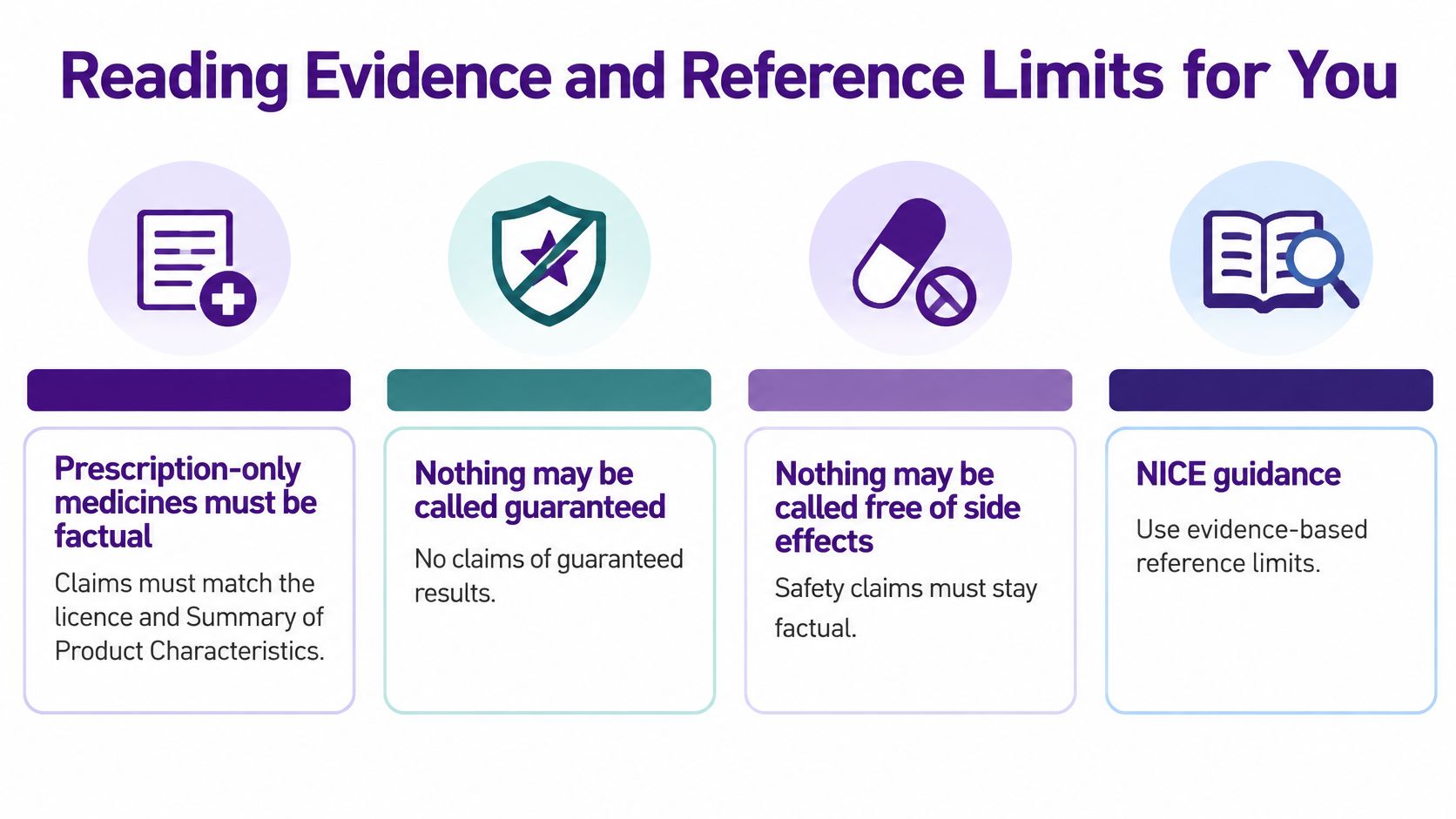
Prescription-medicine information must also stay educational. The MHRA's medicines advertising guidance states that prescription-only medicines cannot be advertised to the general public. Separately, the ASA's medicines guidance requires medicinal claims to conform to the licence and product information, and prohibits claims of guaranteed effects or absolute safety without side effects.
The evidence and communication limits belong together.
What the trial design actually tells you
NICE's tirzepatide appraisal describes SURMOUNT-1 as a randomised, double-blind trial comparing tirzepatide with placebo, and STEP-1 as a randomised controlled trial comparing semaglutide with placebo, with diet and exercise support in both groups in each trial. In the same appraisal, NICE reports that a network meta-analysis found tirzepatide 15 mg statistically significantly more effective than semaglutide 2.4 mg for weight loss, but found no statistically significant difference for total cholesterol or systolic blood-pressure improvement.
These are trial and evidence-synthesis findings in the populations studied, not personal treatment forecasts. Randomisation helps reduce systematic differences between groups. Double-blinding means participants and investigators don't know the assigned treatment during the blinded comparison, helping limit expectation-related bias.
A network meta-analysis combines evidence across a network of studies. It shouldn't be described as though the original placebo-controlled trials directly compared the medicines against each other.
The lifestyle support matters too. Describing those results as the effect of a medicine used without accompanying support would misrepresent the comparison.
Before accepting a percentage on a product page, examine:
- Population: Who entered the study, and who was excluded?
- Comparator: Was the comparison placebo, usual care or another active treatment?
- Duration: When was the outcome measured?
- Outcome: Was it body weight, a metabolic measure or something else?
- Missing information: How were discontinuation and absent measurements handled?
Statistical significance doesn't establish that every outcome improves, or that an individual will experience the average result. It also doesn't remove the need to discuss adverse effects and uncertainty.
Applying evidence to a particular person
The MHRA's GLP-1 patient guidance explains that these medicines are prescription-only, should be used for authorised medical indications and require discussion of benefits and risks with a prescriber before starting or changing treatment.
A disease summary doesn't necessarily include the current medicine list, an undisclosed eating-disorder history, or a change in pregnancy status. Even a well-written reference cannot determine suitability when those facts are missing.
Consider these conflicts:
- Pregnancy or breastfeeding: Someone reads a weight-management summary while their reproductive circumstances have changed. The conflict is between generic guidance and current personal information; pause the routine route and seek a prescriber assessment.
- Diabetes medicines: Someone reads about Wegovy or Mounjaro while already taking treatment for diabetes. The unresolved issue is the complete regimen, so a clinician needs to reconcile it before any treatment change.
- Eating-disorder history: A weight-based eligibility screen appears favourable, but the person's history raises a separate concern. That needs individual clinical assessment rather than approval from a numerical screen.
- Dose changes: Someone interprets a trial's maintenance dose as their next dose. The conflict is between a study regimen and their own tolerability and prescribing plan; contact the prescriber instead of copying it.
For UK prescribing, clinicians should check the current UK Summary of Product Characteristics and relevant local pathways rather than treating international reference text as authority to bypass them. An NHS access pathway and a medicine's marketing authorisation also answer different questions: service eligibility isn't interchangeable with clinical suitability.
A reliable reference helps a clinician ask better questions. It doesn't remove the need to ask them.
If reference information conflicts with your history, or you want to start, stop or change a prescription medicine, take the specific question to a prescriber. Don't resolve the disagreement by choosing whichever screen gives the quickest answer.
Check a UK Provider Before You Book
Choose a provider by the visibility of its clinical safeguards, not by how quickly its registration form loads. A regulator registration, a named prescriber and an accessible aftercare route each answer a different question.
Trim operates through XO Medical Ltd, with a GPhC-registered pharmacy in Wakefield and listed UK prescribers. The comparison below describes our published position, not a ranking against other services.
Checks before booking a UK consult
| Check | Why it matters | Trim's published position |
|---|---|---|
| GPhC-registered pharmacy and UK prescribers | Supply and prescribing are regulated | Lists UK prescribers and a GPhC-registered pharmacy |
| Clinician approves every prescription | Software must not self-prescribe | Clinicians approve medication before it's sent |
| Same-day prescription review | A short wait shouldn't skip review | Prescription reviews are offered same day |
| GP sharing consent | The usual GP should know | Consent required before treatment |
| Aftercare contact | Side effects need a person | Ongoing access to the support team |
| Published satisfaction | Context only, not efficacy | 4.9 out of 5 patient satisfaction rating |
Satisfaction isn't a clinical-trial outcome. It can describe patients' impressions of a service, but it doesn't establish treatment effectiveness, comparative safety or your likelihood of benefiting.
Our wider programme includes clinical guidance, nutrition advice and strength-focused activity alongside treatment where appropriate. Those elements describe the support offered, not a guarantee of weight loss.
Make the route and the record clear
When comparing an online weight-loss clinic, check whether the published information makes each responsibility understandable. A statement that care is personalised should be backed by an identifiable assessment, a documented decision and a contact route after supply.
For clinicians considering documentation workflows, PatientNotes for UK healthcare professionals is a relevant resource to review. Documentation software should be assessed separately from the provider's registration and prescribing arrangements; using a note-taking tool isn't evidence of clinical quality.
You can also arrange a GP appointment to discuss weight management and ask about an NHS weight-management service, subject to local access and eligibility. Your GP can review a medicine discussed by an online provider before or after supply.
Before proceeding, complete eligibility questions carefully, expect that the answer may be no, and confirm the GP-sharing arrangements. Book only when the provider's own pages make the safeguards visible and you know how to reach a person if something changes.
Trim offers an online health assessment, independent-prescriber review and ongoing support for medically supervised weight management. Visit Trim to review the consultation process and eligibility questions, remembering that a short form starts an assessment rather than guarantees a prescription.