
Maintain Muscle While Losing Fat: A 2026 Guide

Adding home-based resistance training produced a 2.65 kg increase in grip strength, compared with a 0.26 kg decline with dieting alone, even when body weight and measured lean mass looked similar. To maintain muscle while losing fat, track strength and waist measurements alongside the scales, then combine progressive resistance exercise with adequate protein and a sustainable calorie deficit.
You may recognise the situation. Your weekly weigh-in is moving in the right direction, your clothes fit more comfortably, yet the weights you used to lift feel heavier and everyday tasks seem more tiring. The number you wanted is falling, but you aren't sure whether the change represents fat loss, muscle loss, or both.
That uncertainty matters. Fat loss is a useful outcome, but total weight reduction doesn't tell you which tissues have changed. A sensible plan therefore protects physical function while reducing waist size, rather than treating the lowest possible scale reading as the only sign of success.
Table of Contents
- Why the Scale Can Mislead You During Fat Loss
- What Clinical Evidence Says About Preserving Lean Mass
- Setting Protein Targets That Actually Work
- Designing a Resistance Training Programme for Fat Loss
- Monitoring Your Progress Without Obsessing Over the Scale
- Building Your Weekly Action Plan
Why the Scale Can Mislead You During Fat Loss
A person starts dieting with a clear target. They reduce portions, add more walking and watch their weight fall over several weeks. At first, progress feels straightforward. Then their usual squats become difficult, they shorten their walks because of fatigue, and the scale continues to reward the strategy. Without another measure, they may assume everything is working.
That assumption can be wrong. A calorie deficit can reduce fat, water and lean tissue at the same time. A falling body weight can therefore conceal a less helpful change in body composition, particularly when someone eats too little, loses weight rapidly or provides little stimulus for their muscles.

The practical difference between weight and function
A 12-week Glasgow randomised pilot study of 48 adults with overweight or obesity compared dietary weight loss with dietary weight loss plus home-based resistance training. The groups didn't differ significantly in body weight, fat mass, fat-free mass or muscle thickness, but their functional results did differ: grip strength rose by 2.65 kg in the training group and declined by 0.26 kg in the diet-only group, as reported in the Glasgow randomised pilot study.
That finding is clinically useful because it shows why a single body-composition reading shouldn't dominate your interpretation. Short-term measurements may fail to capture meaningful changes in how well someone can use their muscles. Strength, movement quality and the ability to perform normal activities can provide an earlier and more actionable signal.
Practical rule: If your waist is falling but your performance is steadily deteriorating, don't automatically celebrate the deficit or add more exercise. Review food intake, recovery and training with a qualified professional.
Early warning signs worth taking seriously
Look for a pattern rather than one disappointing workout. Warning signs include:
- Repeated strength losses: The same movement feels harder across several sessions, despite reasonable technique and recovery.
- Reduced daily function: Stairs, carrying shopping or rising from a chair becomes noticeably more difficult.
- Persistent fatigue: Tiredness continues beyond the normal discomfort of starting a new programme.
- Poor dietary adequacy: Appetite, nausea or busy routines make it difficult to eat enough protein and other essential foods.
- Rapid change without improved function: The scale drops quickly, but waist measurements and training performance don't provide reassuring context.
A useful explanation of the underlying distinction appears in this guide to muscle weight versus fat weight. The key point isn't to distrust the scales. It is to stop asking them to answer a question they cannot answer alone: whether you are retaining useful muscle as fat decreases.
What Clinical Evidence Says About Preserving Lean Mass
Resistance exercise earns its place in a fat-loss plan because it changes what is lost, not necessarily how much total weight appears on the scales. A systematic review and meta-analysis of diet-induced weight-loss studies found that adding resistance exercise produced a between-group weight difference of -0.32 kg, which wasn't statistically significant at p = 0.35. In other words, resistance training didn't materially alter total scale weight compared with dieting alone.
The body-composition results were more important. Resistance exercise protected fat-free mass, with a standardised mean difference of 0.40 at p = 0.0003, and increased fat-mass loss, with a standardised mean difference of -0.36 at p < 0.00001. Participants also achieved substantially greater muscular strength, with a standardised mean difference of 2.36 at p = 0.00001, although certainty for that strength outcome was rated low in the systematic review and meta-analysis.
Why the trade-off matters
Dieting alone creates an energy shortage, but it doesn't tell the body which tissue it should retain. Progressive resistance training supplies that instruction through repeated mechanical loading. Protein then provides building material for repair and adaptation, while a moderate deficit reduces the pressure to use lean tissue as an energy source.
This doesn't mean every person will preserve every gram of lean mass. It means the strategy gives muscle a reason to stay and gives you a way to test whether function is being maintained. Someone who loses a similar amount of body weight with stronger lifts, a smaller waist and stable daily function may have achieved a more favourable result than someone whose scale changed more but whose capacity declined.
The same caution applies to GLP-1-based weight-loss treatments. Clinical responses aren't uniform, and the way researchers measure lean mass differs between trials. A 2024 review found lean-mass reductions ranging from approximately 15% or less of total weight lost in some studies to 40–60% in others, with variation linked to study design, medication, treatment duration, baseline characteristics, diet, physical activity and measurement methods, as summarised in the review of lean body mass changes with GLP-1-based treatments.
| Study or intervention | Lean mass loss as a proportion of weight lost |
|---|---|
| Some GLP-1 treatment studies | Approximately 15% or less |
| Other GLP-1 treatment studies | 40–60% |
The table shouldn't be used to predict an individual result. It demonstrates why a person shouldn't assume that all treatment-associated weight loss is fat, or that a single scale reading proves muscle has been preserved.
What works and what doesn't
What works: combine progressive loading, sufficient protein, a manageable energy deficit and regular monitoring of strength and function.
What doesn't work reliably: using body weight alone, replacing all resistance exercise with aerobic activity, or assuming appetite reduction automatically protects muscle. Recovery products may be relevant to a broader training routine, but they can't replace food, progressive loading or clinical assessment. If you're comparing options, use a neutral resource on recovery products after training and keep its role proportionate to the fundamentals.
Setting Protein Targets That Actually Work
The UK adult reference intake for protein is approximately 0.75 g/kg/day, but that figure isn't the same as a practical target for an exercising adult in an energy deficit. A recent evidence review identifies 1.2–1.6 g/kg/day as a useful range when exercise is included, with little additional benefit generally observed above 1.6 g/kg/day. For an 80 kg adult, that represents approximately 96–128 g per day, according to this UK-focused explanation of protein intake.
The distinction matters because dieting reduces the total amount of food available. If protein falls with calories, resistance training has less nutritional support. A UK-adapted protein screening study found that 40% of respondents in its validation sample reported consuming no more than 1.0 g/kg/day, so assuming that a normal diet provides enough can leave a substantial gap.
Set the target before planning meals
Start with body weight and choose a point within the practical range rather than chasing the highest number. An adult who weighs 80 kg might begin by planning around 96 g daily, then adjust towards 128 g if that fits their appetite, training demands and clinical circumstances.
Distribute the intake across three or four eating occasions. This approach is easier to manage than leaving nearly all protein until dinner, especially when appetite is reduced. Each meal can centre on a substantial serving of Greek yoghurt or cottage cheese, eggs, fish, lean meat, pulses, tofu or a fortified alternative.
Make small meals count
Reduced appetite, nausea and early fullness can turn a large plate into an unrealistic target. Use lower-volume options when necessary, such as yoghurt, eggs, soft tofu, fish, cottage cheese or a milk-based drink that fits your dietary and clinical needs. Eat the protein component first, then add vegetables, fruit, wholegrain carbohydrates and fats according to tolerance and the rest of your nutritional plan.
For plant-based choices, combine practical staples rather than relying on one expensive product. Beans, lentils, tofu, soya yoghurt, fortified plant drinks, peas and seeds can contribute to the daily total. This guide to high-protein vegan foods can help generate ideas, but check labels and portion sizes rather than assuming every plant-based food is protein-dense.
Protein alone won't preserve muscle if the muscles aren't loaded. Resistance exercise remains the mechanical signal, and adequate food cannot compensate for a programme that continually leaves you weaker.
Safety boundary: Anyone with kidney disease, significant gastrointestinal symptoms or another medical condition should discuss protein targets with a clinician or dietitian. Don't increase intake aggressively without considering kidney health, medication, hydration and the rest of your diet.
If appetite suppression is making meals difficult, use this practical guide to protein intake for weight loss as a starting point, then personalise the plan with professional support where needed.
Designing a Resistance Training Programme for Fat Loss
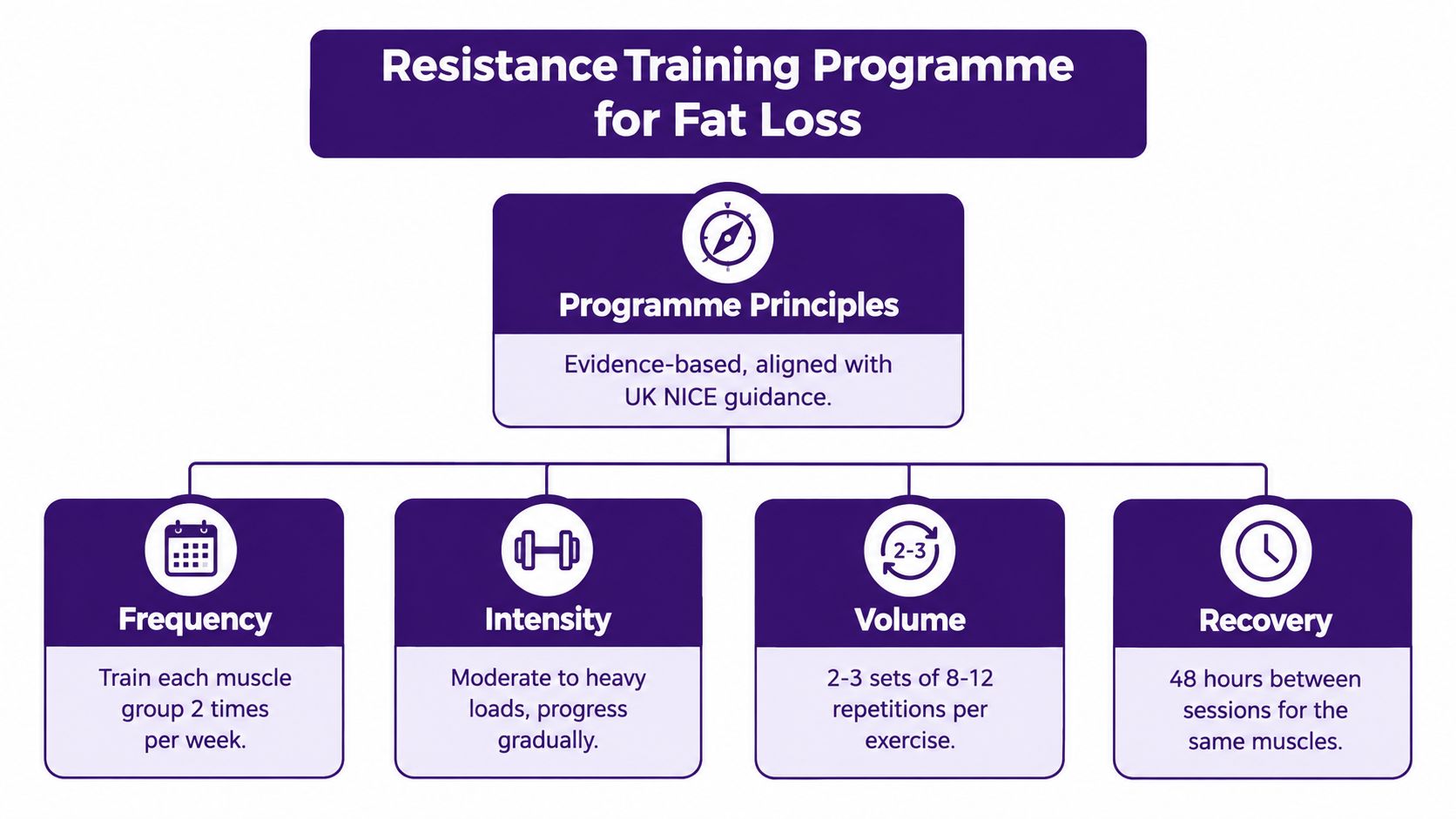
A useful starting point is two to three full-body sessions each week. An NHS clinical resource links adequate protein and strength exercise with maintaining muscle during weight loss and recommends strength training two to three times weekly, while UK guidance cautions against using restrictive diets as a long-term strategy. The aim is not to exhaust yourself. It is to give major muscle groups a repeatable reason to adapt while your calorie intake is reduced.
Build each session around movement patterns
A full-body session doesn't need a long list of exercises. Cover these patterns with movements you can perform safely:
- Squat or leg press: Choose a squat variation, sit-to-stand progression or leg press that allows controlled depth.
- Hip hinge: Use a Romanian deadlift, hip thrust or a coached hinge pattern.
- Horizontal push and pull: Pair a chest press or press-up with a cable, dumbbell or supported row.
- Vertical push and pull: Use an overhead press and a pulldown or assisted pull-up, adapting range to shoulder comfort.
- Carry or trunk work: Finish with a loaded carry, dead-bug variation, side plank or another exercise that challenges the trunk.
Start with loads that allow roughly 6–12 technically controlled repetitions, while keeping 1–3 repetitions in reserve. When you complete every prescribed set with good form and still have the planned reserve, add a small amount of load or perform another repetition within the range. If technique breaks down, reduce the load rather than treating discomfort as evidence of progress.
Someone returning after illness, pregnancy or a long period of inactivity may need easier versions and fewer exercises at first. The programme should progress from the person's current ability, not from an arbitrary standard.
Keep aerobic work in its proper role
Walking, cycling and other moderate aerobic activities support cardiovascular health and can help someone remain active. They shouldn't replace resistance training when retaining muscle is the priority. Excessive additional exercise can also worsen fatigue if food intake and recovery are already inadequate, so increase activity gradually and protect the quality of the strength sessions.
A practical week might place full-body sessions on non-consecutive days, with comfortable walks between them. Rest days aren't wasted time. They help you return to the next session able to produce force, practise technique and progress rather than merely survive the workout.
For readers interested in combining muscle development with useful movement, this introduction to bodybuilding with functional strength offers a relevant training concept. Keep the same clinical principles in view: controlled loading, progression, individual adjustment and recovery.
This strength training for fat loss resource can provide further exercise ideas, but a clinician, physiotherapist or qualified coach should adapt the plan if pain, disability or a medical condition affects movement.
A sustainable dietary approach matters too. UK NICE guidance recommends avoiding low-energy and very-low-energy diets as a long-term obesity-management strategy and identifies an energy deficit of about 600 kcal per day as one sustainable approach when combined with expert support and follow-up, as outlined in the NICE evidence on diet and energy deficits.
Monitoring Your Progress Without Obsessing Over the Scale
A good monitoring system answers four questions: Is fat likely decreasing? Is strength stable or improving? Is food intake adequate? Is the pace sustainable? No single measurement answers all four, so use a small set of signals collected consistently.
Use a simple dashboard
Record your body weight regularly, but judge the trend rather than reacting to one reading. Add waist circumference under similar conditions, noting whether it is falling over time. Track performance on a few repeatable exercises, such as a leg press, row, press or carry, and record the load, repetitions and perceived difficulty.
A falling waist alongside stable or improving performance is generally more reassuring than a large scale change accompanied by repeated strength losses. If weight is static while the waist reduces and training improves, don't assume the plan has failed. Body composition can change without a dramatic change in total mass.
Validated body-composition assessment can add useful information when it is clinically appropriate and available. In a STEP 1 DXA substudy, adults receiving semaglutide 2.4 mg for 68 weeks lost approximately 15% of body weight. Total fat mass fell by about 19.3%, visceral fat mass by 27.4% and lean body mass by 9.7%, while the proportion of lean body mass relative to total weight increased by approximately 3%, according to the DXA body-composition substudy.
These findings show that absolute lean-mass reduction can coexist with a favourable overall composition change. They don't remove the need for strength training or prove that every individual response will be similar.
Know when to adjust
Persistent performance deterioration, unusual fatigue, dizziness, inadequate eating, worsening nausea or difficulty completing normal activities deserves clinical or dietetic review. Don't respond automatically by adding more cardio or cutting food further. Review the deficit, protein intake, medication effects, sleep, training volume and any underlying health issue with an appropriate professional.
Building Your Weekly Action Plan
A practical plan should be repeatable on a busy UK week, not just on an ideal week. Use the checklist below as a framework and adjust exercise selection, food texture and session length to your health, appetite and experience.
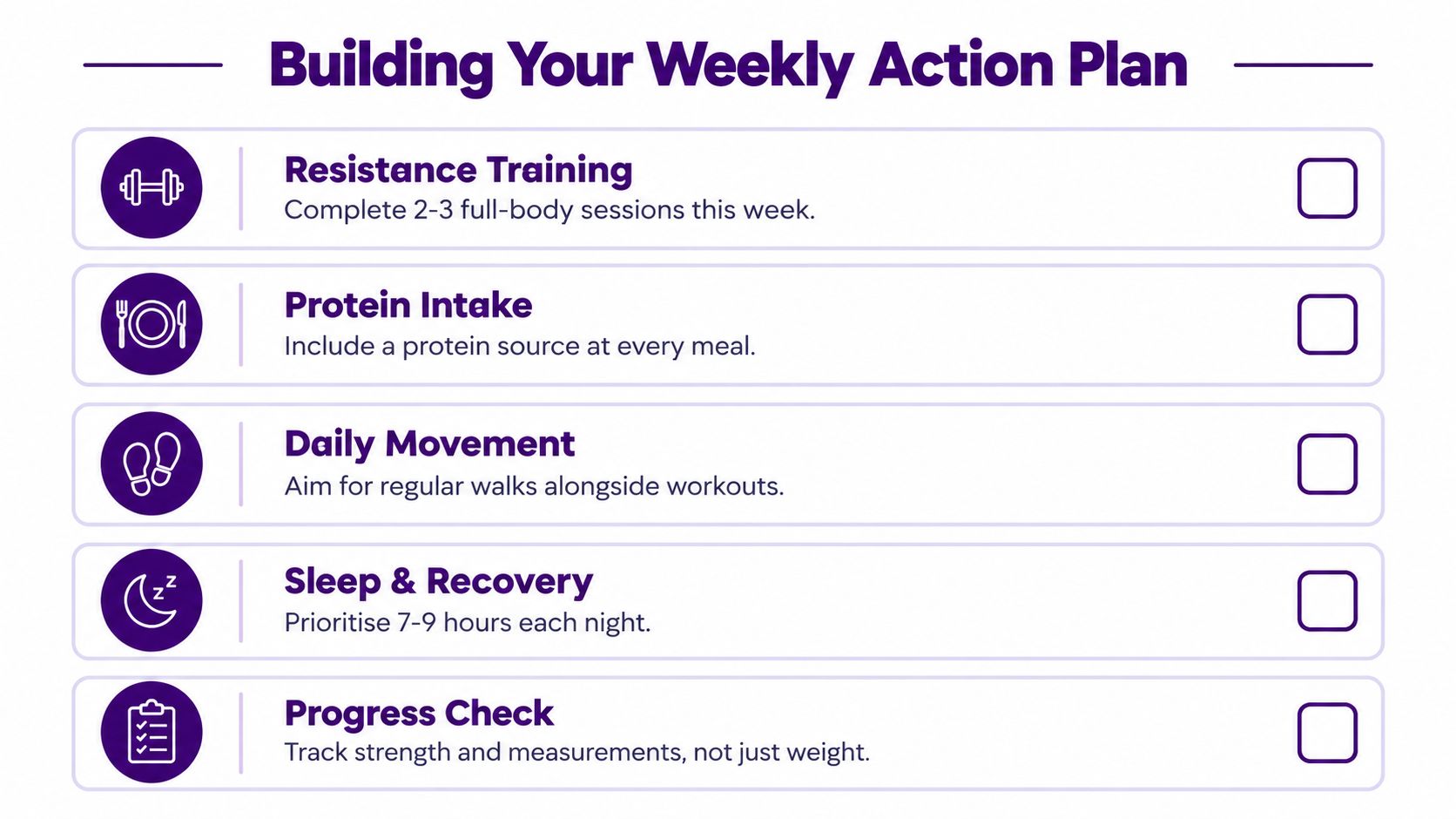
- Resistance training: Complete two or three full-body sessions, using controlled repetitions and gradual progression.
- Protein intake: Include a protein source at each meal and distribute the daily target rather than leaving it until the evening.
- Daily movement: Add regular walking or other comfortable activity without allowing it to undermine strength-session recovery.
- Progress check: Review waist measurement, selected exercise performance, appetite, fatigue and the weight trend at a consistent interval.
- Clinical review: Seek advice if strength keeps falling, fatigue persists, eating becomes difficult, or symptoms become concerning.
The Health Survey for England 2021 found that only 32% of adults aged 16 and over met the national muscle-strengthening guideline, with men at 36% and women at 29%. Only 30% met both the aerobic and muscle-strengthening guidelines, according to the Health Survey for England physical activity data. These figures support making strength work a deliberate appointment rather than assuming everyday activity will cover it.
If you're using a GLP-1 medicine, treat appetite suppression as a planning issue rather than a guarantee of muscle preservation. Choose smaller protein-rich meals, monitor symptoms and training performance, and involve your prescribing clinician or a dietitian when intake becomes inadequate. Trim offers medically supervised weight-loss treatment, clinical support, personalized nutrition guidance and strength-focused education for UK adults who want structured help with fat loss and muscle preservation. Visit Trim to learn how its programme could fit your health and weight-management needs.