
GLP-1 Weight Loss Cost: UK Pricing Guide

Private GLP-1 weight-loss treatment in the UK typically costs £100 to £350 per month, depending on dose and clinical support, while NHS access limits eligible patients to a standard £9.90 prescription charge in England. The NHS route can be far cheaper, but strict eligibility rules and significant waiting lists affect how quickly treatment becomes available.
That difference makes the GLP-1 weight loss cost question more complicated than comparing two monthly prices. The medicine is only one part of the bill. Dose increases, clinical reviews, nutrition support, monitoring, delivery, and the practical cost of waiting can all change what treatment costs over time.
A useful comparison should therefore answer three questions:
- What does the medicine itself cost at the dose you may eventually need?
- Which clinical services are included in the quoted price?
- Can you access appropriate care when you need it?
Table of Contents
- Understanding the Baseline GLP-1 Weight Loss Cost
- Navigating NHS Availability Versus Private Routes
- Analysing Medication Pricing and Dose Progression
- Factoring in Clinical Consultations and Ongoing Support
- Evaluating Cost-Effectiveness and Clinical Outcomes
- Strategic Budgeting for Long-Term Weight Management
- Making an Informed Decision on Your Treatment Pathway
Understanding the Baseline GLP-1 Weight Loss Cost
Private prices vary because clinics may charge for different medicines, doses, prescribing processes, and support packages. The BBC's UK coverage of weight-loss injections places typical private treatment between £100 and £350 a month, depending on the dose and the support provided. The same coverage reports that Wegovy starting doses are available from around £100, while the 2.4 mg maintenance dose is usually around £240.
That starting price can look attractive, but it may not represent the cost of continuing treatment. A patient who begins on a lower dose may later move to a higher maintenance dose, and the cost can rise at the same time. Some providers include consultations, follow-up messages, nutrition guidance, and delivery. Others show the medicine price separately and charge for additional services.
Practical rule: Treat the advertised monthly price as a starting point, not as a complete treatment budget.
What changes the monthly price
The medication is usually the most visible expense, but it isn't the only variable. Ask whether the quoted price covers:
- Prescribing and clinical review: Find out whether a clinician assesses suitability before treatment and reviews dose changes.
- Follow-up support: Check whether you can contact the clinical team if side effects or questions arise.
- Delivery and dispensing: Confirm whether delivery is included or added at checkout.
- Lifestyle guidance: Establish whether nutrition and activity support are part of the programme or sold separately.
- Ongoing treatment: Ask what happens to the price when you move from an initiation dose to a maintenance dose.
This is why two clinics can advertise apparently similar GLP-1 medicines at noticeably different prices without offering identical value. One may provide a prescription only, while another may bundle medical oversight and behavioural support into the monthly fee.
For a balanced discussion of the benefits, limitations, and responsible use of these medicines, readers may also find this resource on evaluating GLP-1 medication with Ashley Koff useful. It reinforces an important point: a prescription should sit within an appropriate health plan, rather than replace one.
The baseline is therefore straightforward. Private care usually requires substantial self-funding, and the final amount depends on the dose and the level of clinical involvement. NHS care can reduce the prescription cost sharply, but access is restricted and isn't available to everyone who wants treatment.
Navigating NHS Availability Versus Private Routes
The NHS and private healthcare don't offer the same treatment at different prices. They are different access pathways, with different eligibility rules, waiting experiences, and service structures.
For eligible patients in England, NICE-backed treatment can be dispensed at the standard NHS prescription charge of £9.90 per item. Prescriptions are free in Scotland, Wales, and Northern Ireland, according to the UK treatment access summary from Numan's guide to Mounjaro and NHS availability. Eligibility is restricted, typically focusing on people with obesity and weight-related health conditions who meet the relevant clinical requirements.
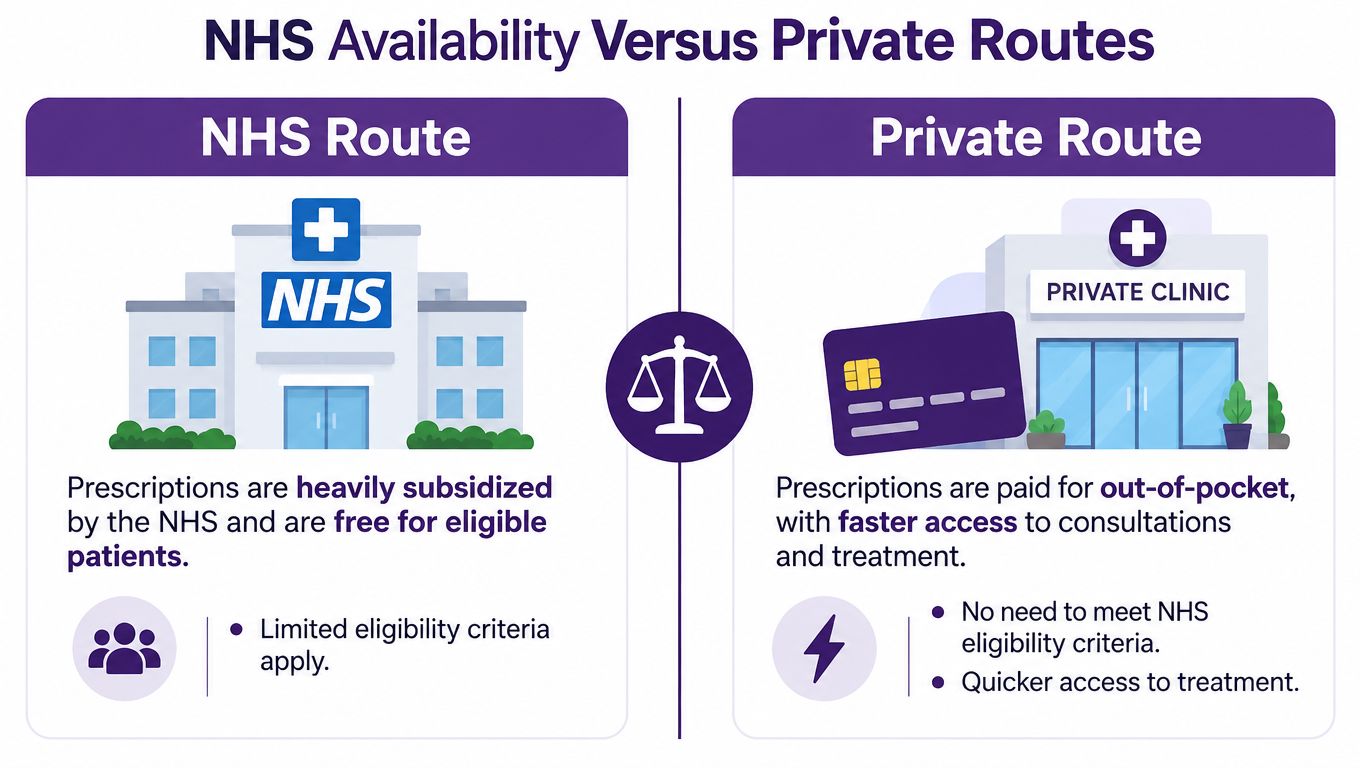
The NHS route
The NHS price is low for the patient who qualifies, but the financial saving doesn't remove other constraints. Local services have limited capacity, eligibility can be interpreted through local pathways, and patients may need to wait for assessment or specialist support.
NHS access also tends to focus resources on people with the greatest clinical need. That approach is understandable from a public-health perspective, but it means a person who wants treatment may not qualify just because they can pay privately. A lower prescription charge doesn't guarantee immediate access, a choice of provider, or a full wrap-around programme.
The Trim guide to whether Mounjaro is available on the NHS can help readers understand the distinction between a medicine being approved for NHS use and being available to every patient through primary care.
The private route
Private treatment shifts the main cost from the public system to the patient. In return, private clinics may offer a more direct assessment process, a wider choice of appointment arrangements, and support delivered through online services. The exact service differs by provider, so patients should check whether the clinic uses UK-registered prescribers and a pharmacy operating within the appropriate regulatory framework.
The financial comparison looks like this:
| Consideration | NHS route | Private route |
|---|---|---|
| Patient payment | Standard prescription charge in England for eligible patients, or free prescriptions in Scotland, Wales, and Northern Ireland | Monthly self-funded treatment |
| Eligibility | Restricted to people meeting clinical and local pathway requirements | Assessment still required, but access rules differ |
| Waiting experience | May involve referral, limited service capacity, or waiting lists | May provide a faster assessment, depending on the clinic |
| Support | Depends on the local service | Depends on the package purchased |
| Main risk | Assuming low prescription cost means easy access | Assuming the lowest advertised fee includes complete care |
The private route can be more accessible, but it isn't automatically more suitable. A quick prescription without proper assessment may offer poor value if the patient can't obtain timely advice about dose changes, side effects, or progress. Conversely, a higher monthly fee may include services that reduce the need to arrange separate appointments.
The cheapest route on paper isn't always the cheapest route in practice. Time, access, and included care have financial value too.
Analysing Medication Pricing and Dose Progression
GLP-1 treatment pricing doesn't stay flat across every dose. Patients commonly begin with a lower dose and may then move upwards under clinical supervision. That means a quote based on the first prescription can underestimate the cost of later treatment.
The clearest UK example comes from Mounjaro, also known as tirzepatide. The NHS Business Services Authority's September 2025 Drug Tariff redetermination recorded reimbursement prices rising by dose. The 2.5 mg KwikPen moved from £92 to £133, the 5 mg dose from £92 to £180, the 7.5 mg and 10 mg doses from £107 to £255, and the 12.5 mg and 15 mg doses from £122 to £330 per month's supply.
These are reimbursement figures, not a promise of what every private patient pays. They do, however, demonstrate the size of the dose-related price curve. The highest listed level reaches £330 for a month's supply, and maintaining the 15 mg dose at that tariff would annualise to about £3,960 before any additional service costs.
A simple forecasting table
The table below uses the published UK private price range and reported Wegovy examples as planning references. Actual prices depend on the provider, prescription, dose, and services included.
| Medication | Phase | Typical monthly cost |
|---|---|---|
| Wegovy | Starting dose | Around £100 |
| Wegovy | 2.4 mg maintenance dose | Usually around £240 |
| Mounjaro | Private treatment across doses | Typically within the broader £100 to £350 range |
| Mounjaro | Higher-dose tariff example | Up to £330 per month's supply at the listed reimbursement level |
The private Wegovy figures and broader injection range are reported in the UK pricing coverage cited earlier. The Mounjaro tariff figures should be treated as a separate reference point because reimbursement pricing and private patient pricing aren't identical.
How to calculate your likely medicine spend
Start by asking the provider for the expected price at every proposed stage, not only the first dose. Then ask whether the price changes if the clinician delays an increase, maintains the current dose, or recommends stopping.
A practical forecast should include:
- The initiation phase, when the prescribed dose may be lower.
- The escalation phase, if the clinician increases the dose.
- The maintenance phase, which may be more expensive.
- Any pause or review, including whether a new consultation fee applies.
For a separate explanation of the figures that affect Wegovy treatment, see this guide to the cost of Wegovy. The central budgeting lesson is simple: don't multiply the first monthly quote by the number of months you expect to continue unless the provider confirms that the price remains unchanged.
Factoring in Clinical Consultations and Ongoing Support
Medication is one component of weight-management care. A responsible programme also needs an assessment of suitability, review of relevant health information, decisions about dose changes, and a way to respond when treatment isn't tolerated or isn't producing the expected result.
That clinical work has a cost because it requires qualified professionals and time. It also has value. A lower medicine price may not be a saving if the patient must pay separately for every review or has no reliable route to ask about problems.
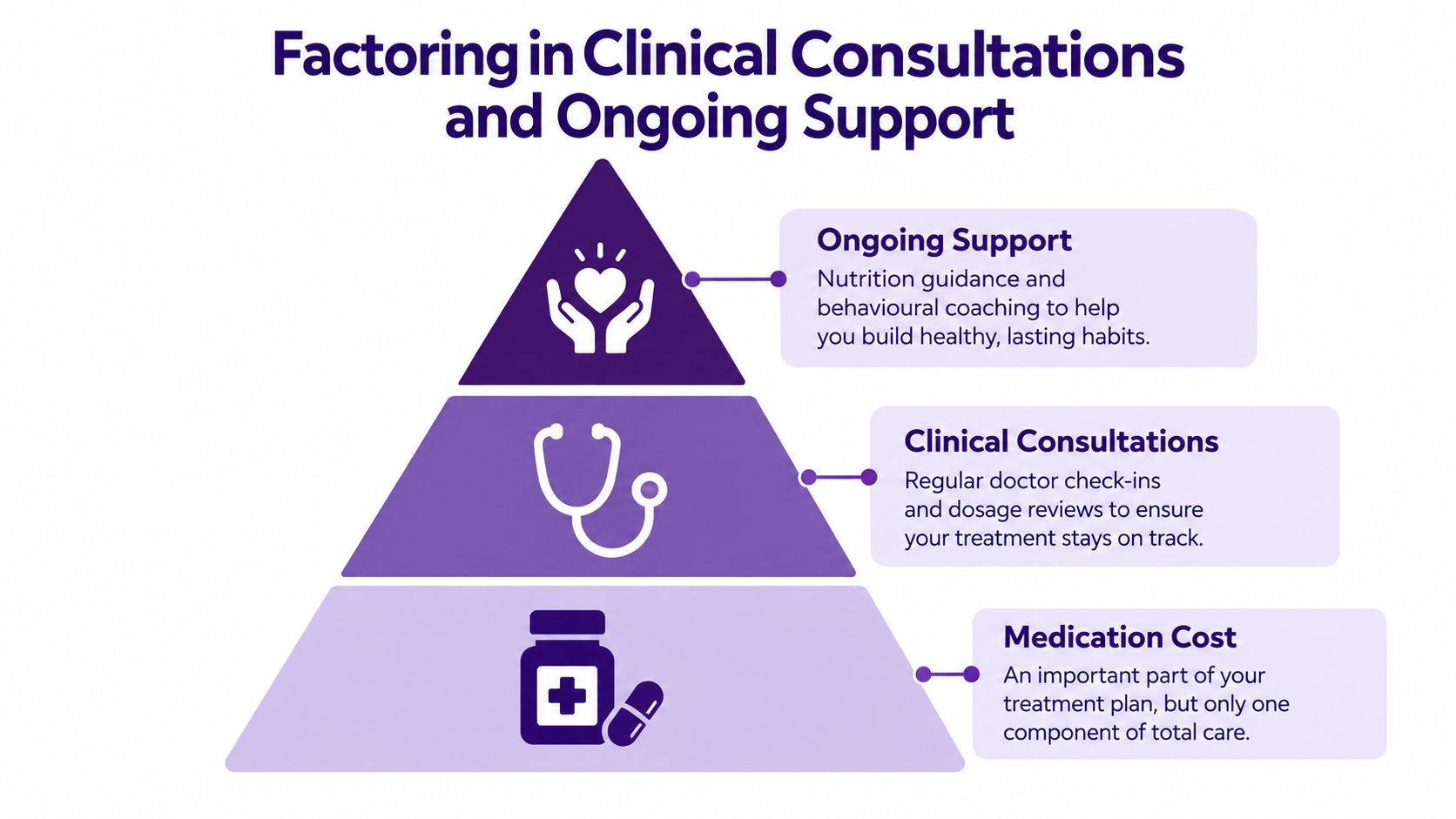
The three parts of total care
Medication provides the pharmacological treatment, but it doesn't create a complete plan by itself. The prescription should be matched to the patient's health circumstances and reviewed as treatment develops.
Clinical consultations allow the prescriber to assess progress, discuss tolerability, and decide whether a dose should change. Patients should know how often these reviews happen and whether they are included in the quoted fee.
Ongoing support can include nutrition guidance, activity planning, behavioural strategies, and help with maintaining changes. These services may be especially important when appetite changes make it easier to eat less but harder to meet nutritional needs consistently.
The Nesta analysis of weight-loss drugs and the UK obesity crisis highlights why the out-of-pocket gap deserves more attention. Comparing only the medicine price misses consultations, follow-up, support, and whether lifestyle services are bundled. Those extras can change the total annual spend by hundreds of pounds.
A safe programme should make clear who reviews your treatment, what support you receive, and what you pay if your circumstances change.
Strength-focused activity and appropriate nutrition advice also matter to the quality of weight loss. The aim isn't just to make the scale move. Patients need guidance that supports adequate nutrition and helps them build habits they can continue if treatment is changed or stopped.
This video provides another format for considering the relationship between medication and broader weight-management care:
Before choosing a clinic, compare the full package rather than the medicine line alone. A provider's online weight-loss clinic service should explain prescribing, pharmacy arrangements, clinical contact, support, and any charges that sit outside the monthly price.
Evaluating Cost-Effectiveness and Clinical Outcomes
Cost-effectiveness is the relationship between what treatment costs and the health benefit it delivers. A low monthly fee may offer poor value if the medicine is unsuitable, causes problems, receives little monitoring, or is difficult to continue. The total cost of care includes clinical reviews, practical support, travel or delivery, and the time spent waiting for access.
The NHS and private routes can produce different costs that do not appear on a medicine price list. NHS care may reduce direct spending, but eligibility rules, limited availability, and waiting can delay treatment and support. Private care may provide faster access and regular contact, while charging separately for consultations, follow-up, and broader weight-management guidance. Cost-effectiveness therefore includes both money paid and the consequences of delayed or unsupported care.
NICE recommends semaglutide for weight management alongside a reduced-calorie diet and increased physical activity. It also recommends stopping treatment if the patient has not lost at least 5% of initial body weight after six months, as set out in its semaglutide technology appraisal.
That stopping rule has a direct financial meaning. Continuing to pay for a treatment that is not producing an adequate response may waste money, even when the monthly charge seems manageable. A review can examine tolerability, adherence, dose, expectations, and whether another plan would be more appropriate.
What clinical trial evidence can and can't tell you
Clinical trials show outcomes under defined conditions. They do not promise that every patient will achieve the same result. Results may depend on dietary, activity, and behavioural support, as well as regular clinical oversight.
The UK government reports that trials found people could lose up to 15% of body weight after one year when weight-loss medicines were prescribed with diet, physical activity, and behavioural support, according to its announcement on the obesity treatment pilot. This describes a combined care pathway, not a medicine acting alone.
A useful value assessment asks:
- Is the treatment appropriate? A clinician should assess suitability before prescribing.
- Is progress reviewed? Poor response or tolerability should prompt a treatment change.
- Is support practical? Advice should fit the patient's health, work, family, and food environment.
- Can the plan continue financially? A treatment that becomes unaffordable may not be sustainable.
Weight change is one outcome. Improved mobility, confidence with food, or weight-related health may also matter. These possible benefits should be discussed with a clinician, not guaranteed by a provider. Good value means paying for care that is appropriate, monitored, and sustainable.
Strategic Budgeting for Long-Term Weight Management
Budgeting should begin before the first prescription. Patients need to know what they can afford during initiation, dose changes, and maintenance, rather than relying on a price that applies only to the opening stage.
UK pharmacy data place annual drug costs at roughly £956 for semaglutide 1 mg and £1,200 to £1,591 for tirzepatide doses, according to the Pharmaceutical Journal's review of GLP-1 medicines for weight loss. These figures show why a medicine-only budget can become substantial before consultations or support are added.
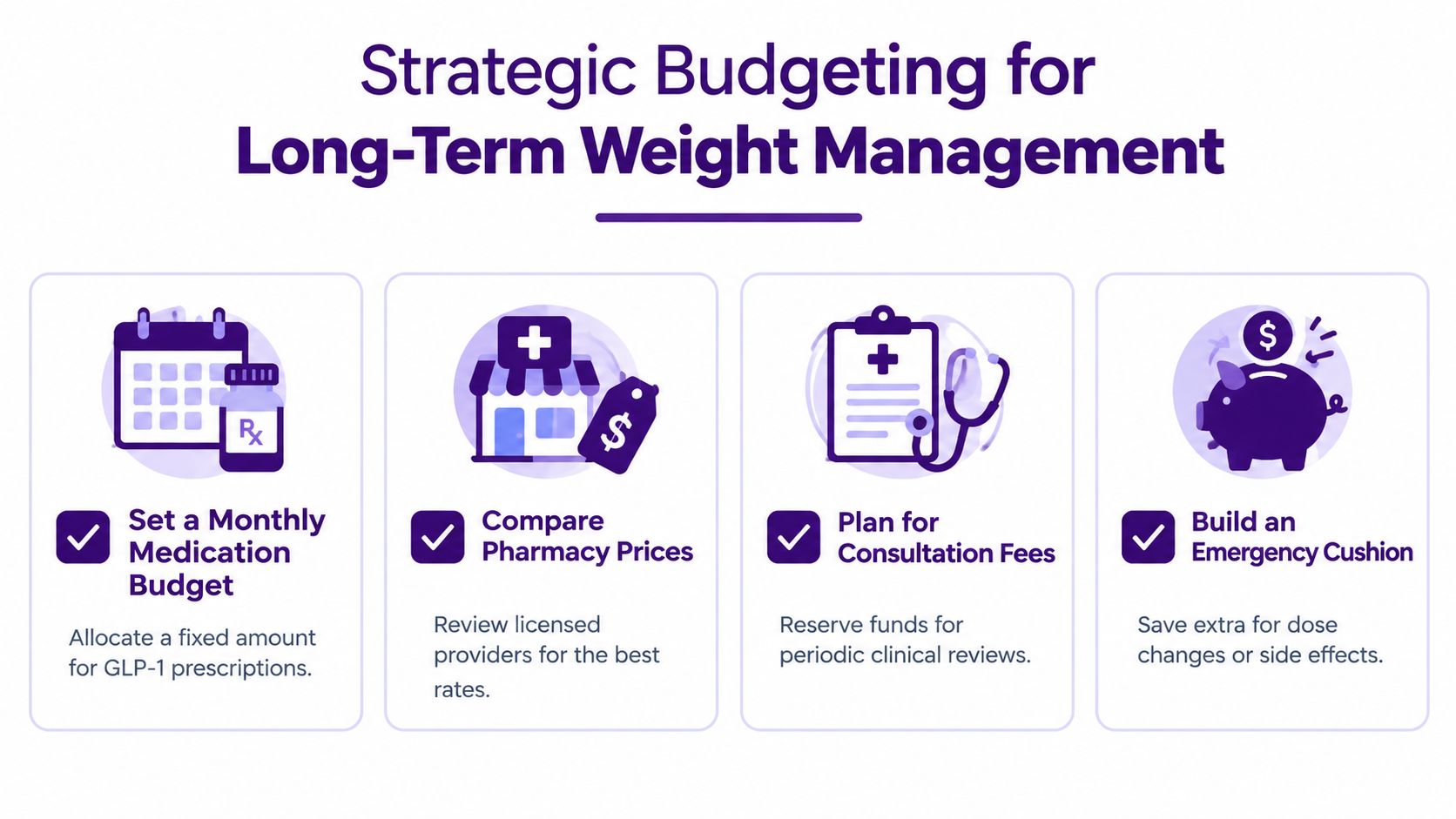
Build the budget around decisions, not promises
Set a monthly ceiling. Decide what you can sustain without compromising essential household spending. Include the possibility that your prescribed dose may change.
Request a full price schedule. Ask for initiation, higher-dose, maintenance, consultation, delivery, and cancellation costs in writing. A clear schedule is more useful than a single headline price.
Keep a clinical reserve. Set aside money for an unexpected review, a treatment adjustment, or a period when your care needs change. Don't use unregulated sources to compensate for a shortfall.
Compare included services. A clinic with a higher medicine price may include support that another provider charges separately. Compare the total package, not individual line items.
An employer benefit or health-related allowance may help in some circumstances, but availability varies. Check the terms directly rather than assuming that private weight-management treatment is covered.
Stopping or pausing also needs planning. Patients shouldn't abruptly change prescription treatment without speaking to the prescriber. A structured review can address what happens next, how to maintain nutritional and activity habits, and whether further clinical support is needed.
The most resilient budget has room for both treatment and the habits that make treatment useful. If all available money goes towards the medicine, there may be nothing left for nutritious food, practical activity support, or appropriate follow-up.
Making an Informed Decision on Your Treatment Pathway
Up to 15% of body weight after one year has been reported when medication is prescribed alongside diet, physical activity, and behavioural support, according to the UK government's clinical information on weight-loss medicines. This result is not a promise for any individual. It does show why a GLP-1 weight loss cost comparison should include the care around the medicine, rather than treating the prescription as the whole intervention.
NHS care may have the lowest direct prescription cost for eligible patients, yet local capacity and waiting lists can delay assessment and treatment. That delay can carry practical costs, such as time away from work, repeated appointments, or continued spending on other attempts to manage weight. Private care can shorten the route to assessment, but the patient usually pays for the medicine, prescribing, monitoring, delivery, and support. A lower waiting burden may therefore come with a higher visible bill, while a low direct NHS cost may involve limited access.
Before selecting a provider, ask:
- Who will assess me? Confirm that a qualified UK clinician reviews your information before prescribing.
- Which pharmacy dispenses the medicine? Check that it is properly registered and that the medicine follows a regulated supply process.
- What happens after the first prescription? Ask how dose reviews, side effects, treatment changes, and clinical contact are handled.
- What does the monthly price include? Clarify delivery, consultations, nutrition guidance, app access, and separate charges.
- What happens if treatment stops or needs review? The provider should explain how suitability and next steps will be assessed.
- How will progress be measured? Weight matters, but so do health, physical function, eating patterns, side effects, and whether changes can be maintained.
The most useful comparison is the total cost of care. Include the medicine and clinical appointments, then examine the support that may make treatment safer and more sustainable. Also consider what waiting for NHS access would mean for your health plans and household budget.
Trim is a UK-based, GPhC-registered online weight-loss clinic and pharmacy. It offers medically supervised treatment, clinical guidance, nutrition support, strength-focused training, and progress tools. Visit Trim to complete an assessment and review its available care pathway.