
Strength Training Bands for Fat Loss: A Complete Guide

A 15-minute resistance band session performed three days per week can improve physical function and adherence during a fat-loss phase, while helping you keep strength when calories are restricted. Strength training bands won't replace every heavy lower-body exercise, but they can provide a practical, evidence-based way to train consistently at home.
The counterintuitive point is that a short, structured routine may be more useful than an ambitious programme you can't recover from or repeat. For people eating less, experiencing reduced appetite, or managing weight under clinical supervision, the priority isn't just burning more calories. It's maintaining the muscle, strength and daily movement capacity that support a healthier reduction in body mass.
Table of Contents
- Why Brief Band Training Matters for Fat Loss and Muscle Preservation
- Understanding Strength Training Bands and Resistance Levels
- Core Technique Cues for Safer, More Effective Band Work
- Progressive Band Workouts for Beginners to Advanced
- Adapting Band Training for Postpartum and Menopause
- Safety and Programming Considerations with GLP-1 and Clinical Weight Loss
- Integrating Band Training with Trim's Four-Pillar Programme
Why Brief Band Training Matters for Fat Loss and Muscle Preservation
A UK randomised controlled trial found that a home-based resistance band programme delivered three times per week for four weeks, with sessions lasting about 15 minutes, improved lower- and upper-body physical function, alongside perceived stress, work engagement and productivity in the published trial report. That matters because physical function is a more useful starting point than the promise of dramatic visual change. If you can squat, push, pull and rise from a chair more confidently, you're better placed to remain active while losing fat.
The intervention was deliberately modest. The UK trial registry describes short strength tests before and after the programme, together with weekly training diaries, rather than an elaborate gym schedule in the registered study design. This is a clinically sensible model. A repeatable dose gives you something to monitor, and it reduces the temptation to compensate for a lower calorie intake with exhausting sessions that undermine recovery.
Why this supports lean-mass retention
Fat loss requires an energy deficit, but a deficit doesn't tell your body which tissue to retain. Resistance training supplies a reason to keep using muscle, while adequate nutrition and recovery provide the resources needed to respond. Bands are particularly useful when gym access, time, joint tolerance or motivation is limited.
A 2019 systematic review and meta-analysis of eight randomised controlled trials involving 224 participants found no statistically significant difference in strength gains between elastic resistance training and conventional resistance training. The reported effect sizes were SMD -0.11 for upper limbs and SMD 0.09 for lower limbs, supporting comparable strength improvements when bands and conventional resistance are programmed appropriately in the systematic review.
That doesn't mean every band exercise matches every barbell exercise. It means elastic resistance deserves to be treated as training, not as a consolation prize. For a person losing weight, the best programme is often the one that offers enough stimulus to maintain function and can be completed consistently.
For a broader nutrition and activity framework, this guide on how to lose fat without losing muscle provides useful context. Keep the expectation realistic: bands support fat loss by helping preserve training capacity and lean tissue, but the calorie deficit still drives the reduction in body fat.
Understanding Strength Training Bands and Resistance Levels
A band doesn't have one fixed weight in the way a dumbbell does. Its resistance changes as it stretches, so the hardest point in an exercise may occur near the end of the movement. That variable load can be helpful for rows, presses, lateral walks and controlled mobility work, but it also makes band selection less intuitive.
Resistance bands usually come as looped bands, long therapy bands, tube bands with handles, or smaller fabric bands for the hips and thighs. Colour coding isn't universal. One manufacturer's red band may feel entirely different from another's, so judge resistance by the exercise, your technique and the manufacturer's stated load or tension range rather than colour alone.
A practical selection guide
| Tension Category | Typical Use | Progression Signal |
|---|---|---|
| Light | Shoulder work, rehabilitation-style movements, warm-ups and technique practice | You can complete the movement with control, but the final repetitions feel challenging |
| Moderate | Rows, presses, squats, hinges and full-body sessions | You reach the planned repetitions without losing range or alignment |
| Heavy | Stronger rows, presses, split squats and advanced compound movements | The band no longer creates a meaningful challenge without shortened range or momentum |
| Extra heavy | Short sets for experienced users and movements with strong anchoring | You need more tension, a slower tempo or a harder variation to maintain effort |
These categories are practical descriptions, not universal measurements. Start with a band that lets you learn the movement. Progress by increasing tension, moving farther from the anchor, shortening the slack, adding a set, extending the range of motion or slowing the lowering phase. If your knees collapse, your shoulders shrug or the band snaps you back, the resistance is already too high for that exercise.
Where bands have a hard limit
The evidence supports bands as a legitimate resistance method, but it doesn't make them a universal substitute for weights. A 2024 UK article summarising a small study of 12 trained men reported that adding bands to hip thrusts and glute bridges didn't increase glute medius activation and reduced lifting capacity by roughly 20 kg in its discussion of the study. The authors concluded that bands may not produce the expected results in that setting.
Use that finding as a programming boundary, not a reason to discard bands. They're strong tools for upper-body work, controlled hip work, warm-ups, travel sessions and moderate lower-body training. If your main goal is maximal glute or lower-body strength, pair them with progressively heavier external loading where appropriate.
People with latex sensitivity should also check the material before buying. For recovery work or home use, latex-free bands for recovery can be a sensible option, particularly when skin tolerance or rehabilitation requirements influence equipment choice.
Core Technique Cues for Safer, More Effective Band Work
Athletes don't need more exercises. They need better control of the exercises they already perform. Strength training bands reward steady tension, accurate positioning and a deliberate return to the start, while rushed repetitions turn useful resistance into uncontrolled snap-back.
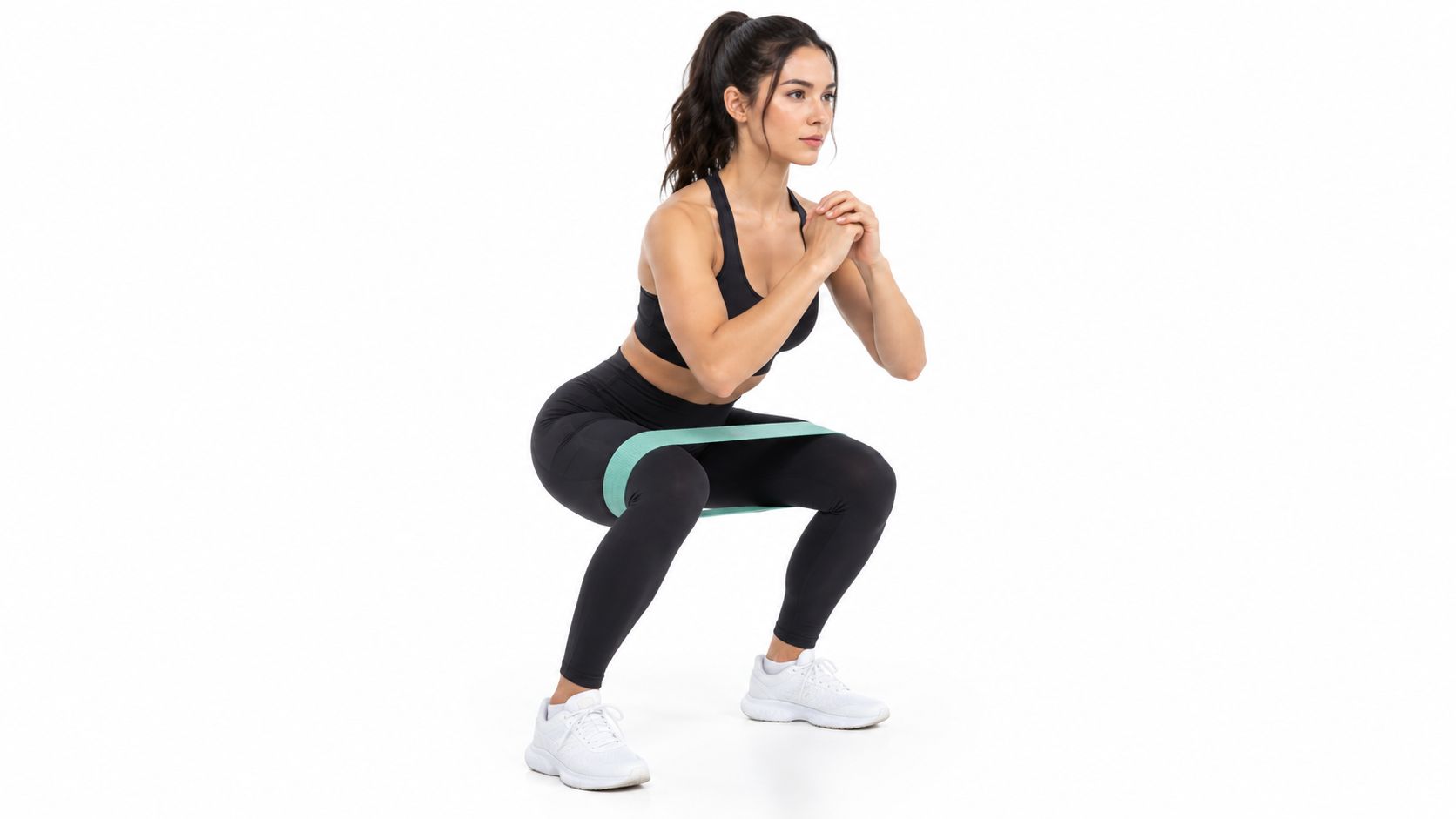
Four cues that change the result
- Control the eccentric phase. Take time to return from a row, press or squat. The band should remain under tension rather than going slack, and you should be able to stop the movement at any point.
- Use the available range. In a squat, keep the band positioned so it challenges the hips without forcing the knees inward. In a row, reach forward only as far as you can maintain a stable trunk, then pull the elbows back without shrugging.
- Anchor with purpose. A low anchor suits some rows and anti-rotation exercises, but it may pull your body into poor alignment for an upper-body movement. Check that the anchor is secure, the band is free from sharp edges and the line of pull matches the exercise.
- Keep joints stacked. A banded press shouldn't force the wrists into extension, and a lateral walk shouldn't become a series of wide, uncontrolled steps. Smaller movement with consistent tension is usually more productive than a larger movement powered by momentum.
The UK PROSPER breast-cancer rehabilitation protocol demonstrates why standardisation matters in clinical exercise. It used defined band loads, including tan at 1.1 kg, red at 1.7 kg and blue at 2.6 kg at 100 per cent elongation, showing that bands can be prescribed as a measurable training dose rather than selected by colour alone in the published protocol.
Practical rule: If you can't repeat the same setup, range and tempo, you can't reliably judge whether you've progressed.
For a squat, keep your feet planted and avoid allowing the band to pull the knees inward. For a press, brace gently and finish without thrusting the ribs forward. For core work, choose an anchor height that lets you resist rotation rather than twisting towards the band.
A short demonstration can help you check the basic setup and movement path before adding tension.
Stop if you feel sharp pain, numbness, unusual weakness or symptoms that don't settle when you reduce the load. During an energy-restricted phase, connective tissues and muscles may not tolerate careless volume, even when the equipment feels light.
Progressive Band Workouts for Beginners to Advanced
A useful programme starts with a routine you can repeat, not with the heaviest band you can stretch once. Begin with stable anchoring and uncomplicated patterns, then progress one variable at a time. That might mean more resistance, more range, an additional set or a slower tempo, but changing everything together makes it difficult to identify what helped or caused fatigue.
Beginner session
Perform a full-body session built around a band squat, standing row, chest press, hip hinge, supported split squat and anti-rotation hold. Use a light or moderate band, practise smooth repetitions and stop each set while your technique remains reliable. The first objective is to learn where the band should sit, how it should be anchored and how to keep tension through the full movement.
A beginner might use a simple progression across several sessions:
- First stage: Learn the setup and complete the movements without rushing.
- Next stage: Increase the range of motion while keeping the same band.
- Then: Add a set or move to the next tension category when the current load feels controlled.
Intermediate session
An intermediate routine can add a banded Romanian deadlift, standing shoulder press, lateral walk, one-arm row and reverse lunge. Use unilateral work to expose differences between sides, but don't allow the weaker side to be dragged through the movement by the stronger one. A slower lowering phase can increase difficulty without requiring a much heavier band.
The UK trial that used three weekly sessions for four weeks reported 89 per cent adherence, with measurable improvements in sit-to-stand and 30-second push-up performance in the trial report. The programming lesson is simple. A fixed, short routine with objective tests can be easier to sustain than a constantly changing plan.
Advanced session
Experienced users can combine a heavier band with split squats, single-arm presses, rows from a challenging stance, slow-tempo squats and anti-rotation work. Advanced doesn't mean reckless. It means the band creates enough challenge that you must maintain position, breathing and control throughout the set.
Progress when the final repetitions are technically sound and recovery remains normal. Reduce volume when fatigue affects your daily movement, your joints feel persistently irritated or your performance drops across repeated sessions. During fat loss, maintaining a manageable workload is often more valuable than forcing constant increases.
Adapting Band Training for Postpartum and Menopause
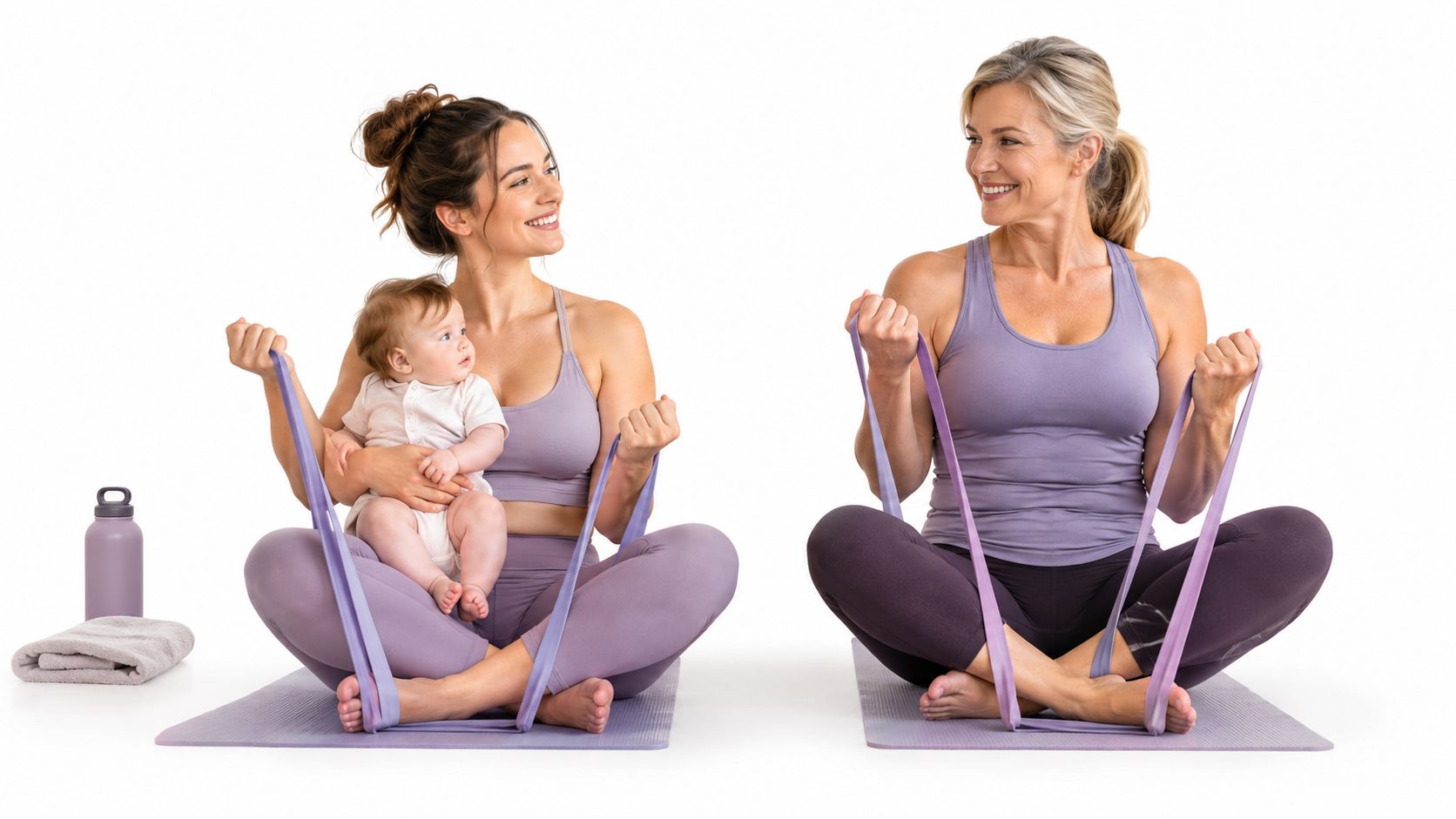
The same band can serve different purposes at different life stages. Postpartum training often needs a gradual return to loading, while perimenopause and menopause may bring changes in recovery, sleep, joint comfort, body composition and training tolerance. Neither situation calls for abandoning strength work. Both call for a more individual approach to dose and positioning.
Postpartum considerations
Return to training should follow appropriate clinical advice, especially after complications, significant pain, pelvic-floor symptoms or surgery. Start with positions that feel stable, such as supported standing work, gentle rows and controlled sit-to-stands. Keep the band light enough that you can breathe normally rather than bracing aggressively or bearing down through every repetition.
A practical postpartum sequence might begin with a supported squat, seated row, standing press with a short range and a hip hinge using a wall for feedback. If symptoms increase during or after training, reduce the range, tension or total work and seek assessment rather than pushing through.
A practical postpartum fitness guide can help organise the return-to-exercise conversation, but it can't replace individual assessment when symptoms are present.
Menopause considerations
For perimenopausal and menopausal women, bands provide a convenient way to practise strength movements without committing to a full gym setup. Choose resistance that allows a controlled range, and monitor how sleep, stress and joint symptoms affect recovery. Progress may be uneven, so use performance and consistency, not body weight alone, to judge whether training is working.
The aim is not to chase soreness. It's to provide a regular stimulus that supports muscle use, balance, confidence and daily function. A personalized plan such as strength training for menopause can sit alongside this approach.
A UK public-health programme shows how accessible this equipment can be. Worcestershire County Council reported distributing over 40,000 resistance bands since 2020 and training more than 43 organisations to deliver exercise sessions in its programme materials. The principle transfers well to individual training: use a simple tool, define the dose and adjust it to the person's current capacity.
Safety and Programming Considerations with GLP-1 and Clinical Weight Loss
Resistance bands can be useful during medically supervised weight loss, but they don't remove the need for medical judgement. This article is educational, not a recommendation to start, stop or change prescription treatment. Anyone taking medication or managing a health condition should coordinate exercise and nutrition decisions with their prescribing clinician.
Reduced appetite can make it harder to consume enough fluid, protein and overall energy to recover from training. A short band session may therefore be more appropriate than adding excessive volume, particularly when fatigue, nausea or dizziness affects the day. Train when you feel most capable, keep water available and avoid treating a missed meal as a reason to force a demanding workout.
Adjust the session to the day
Use a simple readiness check before starting:
- Energy: If you feel unusually weak, reduce resistance and remove the hardest movement.
- Symptoms: Stop for faintness, severe nausea, chest pain, unusual breathlessness or new neurological symptoms, and seek appropriate medical help.
- Recovery: Persistent soreness or falling performance suggests that the programme needs less volume, more recovery or clinical review.
- Technique: A lighter band is the correct choice when you can't control the return phase or maintain stable joints.
Bands may feel less intimidating than heavy free weights, but lower perceived load doesn't guarantee a risk-free workout. Poor anchoring, excessive stretch and rapid recoil can still irritate skin, joints or soft tissue. Inspect bands regularly and don't use damaged latex or fabric.
The useful question isn't whether a medication makes exercise unnecessary. It's whether your training dose matches your current appetite, recovery and clinical circumstances. Guidance on GLP-1 weight loss can help explain the broader treatment context, while your clinician should address individual medication and symptom questions.
Integrating Band Training with Trim's Four-Pillar Programme
Strength training bands work best as one part of a coordinated weight-management plan. A sensible weekly routine can provide the resistance stimulus, while nutrition planning supports recovery, clinical oversight addresses suitability and symptoms, and tracking helps you notice whether consistency is improving.
Trim's four-pillar programme combines evidence-based medicines, expert clinical guidance, personalised nutrition advice and strength-focused training. The service operates as a UK-based, GPhC-registered online weight-loss clinic and pharmacy, with clinician-led consultations, ongoing support and app-based tracking for progress, nutrition and activity. Those features can help a person connect an exercise habit with the wider decisions that influence fat loss and muscle preservation.
Make the band work measurable
Record the details that matter:
- The band or tension category used.
- The exercise variation and range of motion.
- The number of sets completed.
- Whether you maintained control and stable positioning.
- How your energy and recovery felt afterwards.
Simple functional markers, such as sit-to-stand quality, push-up performance or the ability to complete a full range without compensation, can show progress when scales are noisy. Body weight alone doesn't reveal whether you have retained strength or improved movement capacity.
Start with three manageable sessions each week if that fits your clinical guidance and recovery. Keep the sessions brief, repeat the same core movements long enough to assess them, and progress only when technique remains dependable. If appetite, symptoms or fatigue change, adjust the training dose rather than assuming more effort is always better.
The purpose of medical supervision is not to make exercise feel complicated. It is to help align treatment, nutrition, activity and safety with your circumstances. Band training can provide the practical exercise component, but the complete plan should remain flexible enough to respond to real changes in health and recovery.
Trim offers medically supervised weight management through UK-registered clinicians, personalised nutrition guidance, strength-focused support and app-based progress tracking. Visit Trim to learn how a structured clinical programme could fit alongside short, consistent strength training bands sessions.