
How to Combat Menopause Weight Gain: An Evidence-Based Guide

You've kept your food mostly the same, your job hasn't changed, and yet your jeans sit tighter at the waist every month. The number on the scale climbs by a kilo here, a kilo there, and it feels unfair because you haven't suddenly “let yourself go”. That pattern is common in midlife, and how to combat menopause weight gain starts with recognising that the answer isn't just eating less, it's changing the muscle, sleep, and activity habits that now matter more than they used to.
Table of Contents
- Why the Midlife Weight Gain Feels Different
- What Is Actually Driving the Change in Your Body
- Eating in a Way That Works With Perimenopause
- Strength Training as the Cornerstone of Your Plan
- Sleep, Stress, and Alcohol as Hidden Drivers
- Medical Options Including the GLP 1 Context
- Tracking Progress and Knowing When to See a Clinician
Why the Midlife Weight Gain Feels Different
A lot of women describe the same story. At 51, you're eating roughly what you've eaten for years, but the weight starts landing around your middle instead of staying steady. That doesn't mean menopause has magically switched on weight gain by itself, it means your old inputs no longer match your new output.
The body is less forgiving of unchanged habits
The main shift is usually less lean mass, lower energy expenditure, and more abdominal fat storage. British Menopause Society guidance says women gain about 1.5 kg per year on average during the perimenopause transition and that visceral fat can rise from 5 to 8% of total body weight to 10 to 15% as oestrogen falls, which is why the waist changes even when the overall routine looks the same (British Menopause Society clinician guidance).
That's also why “I'm not eating any differently” can be true and still not protect you. If appetite, sleep, steps, and strength work stay static while energy use declines, the maths changes in the background. A useful way to frame it is this:
Practical rule: if the waist is changing, don't assume willpower failed. First assume the body's fuel balance has changed.
A useful clinical resource on the broader hormonal side of this is The Axelrad Clinic weight loss guide, but the practical point for everyday care is simpler. Menopause weight gain is usually a muscle and behaviour problem first, and a hormone problem second.
What Is Actually Driving the Change in Your Body
A patient may report that her meals have barely changed, yet her waistline is expanding and her usual clothes no longer fit. The explanation is rarely oestrogen alone. Oestrogen decline changes where fat is stored and how the body responds to the same routine, but it does not switch weight gain on by itself.
Four drivers matter more than one hormone
| Driver | Main effect | Modifiable? |
|---|---|---|
| Oestrogen decline | More abdominal fat storage and a less favourable glucose response | Partly |
| Muscle loss and reduced activity | Lower resting metabolism and daily energy use | Yes |
| Poor sleep and stress | More hunger, cravings, and difficulty maintaining habits | Yes |
| Alcohol and evening eating | Fragmented sleep and additional energy intake | Yes |
NHS menopause guidance recognises that menopause can make the body store more fat and use calories less efficiently (NHS menopause exercise and lifestyle guidance). NICE also states that adult weight gain is not inevitable and should be discussed at times when risk may increase, including around menopause (NICE NG246).
The practical priority is preserving muscle. A calorie cut without resistance training or adequate protein can reduce body weight while also reducing lean tissue. That can leave daily energy expenditure lower and make regain more likely. Strength work, regular walking, and protein-containing meals address the mechanisms that calorie restriction alone misses.
Hormones set the context. Muscle loss and behaviour usually determine the result. Two women with similar menopausal symptoms can therefore have very different outcomes. One maintains resistance training, daily movement, and protein intake. The other moves less, sleeps poorly, drinks more in the evening, and keeps portions unchanged while gradually losing muscle.
Waist circumference is a useful practical marker because abdominal fat can increase even when total body weight changes little. Measure it under the same conditions, rather than relying on clothing fit alone.
For a broader consumer explanation, The Axelrad Clinic weight loss guide and Trim's menopause weight-loss medication guide provide additional context. Medication may have a role for some patients, but the first assessment remains whether current activity, muscle stimulus, protein intake, sleep, and alcohol use match present energy needs.
Eating in a Way That Works With Perimenopause
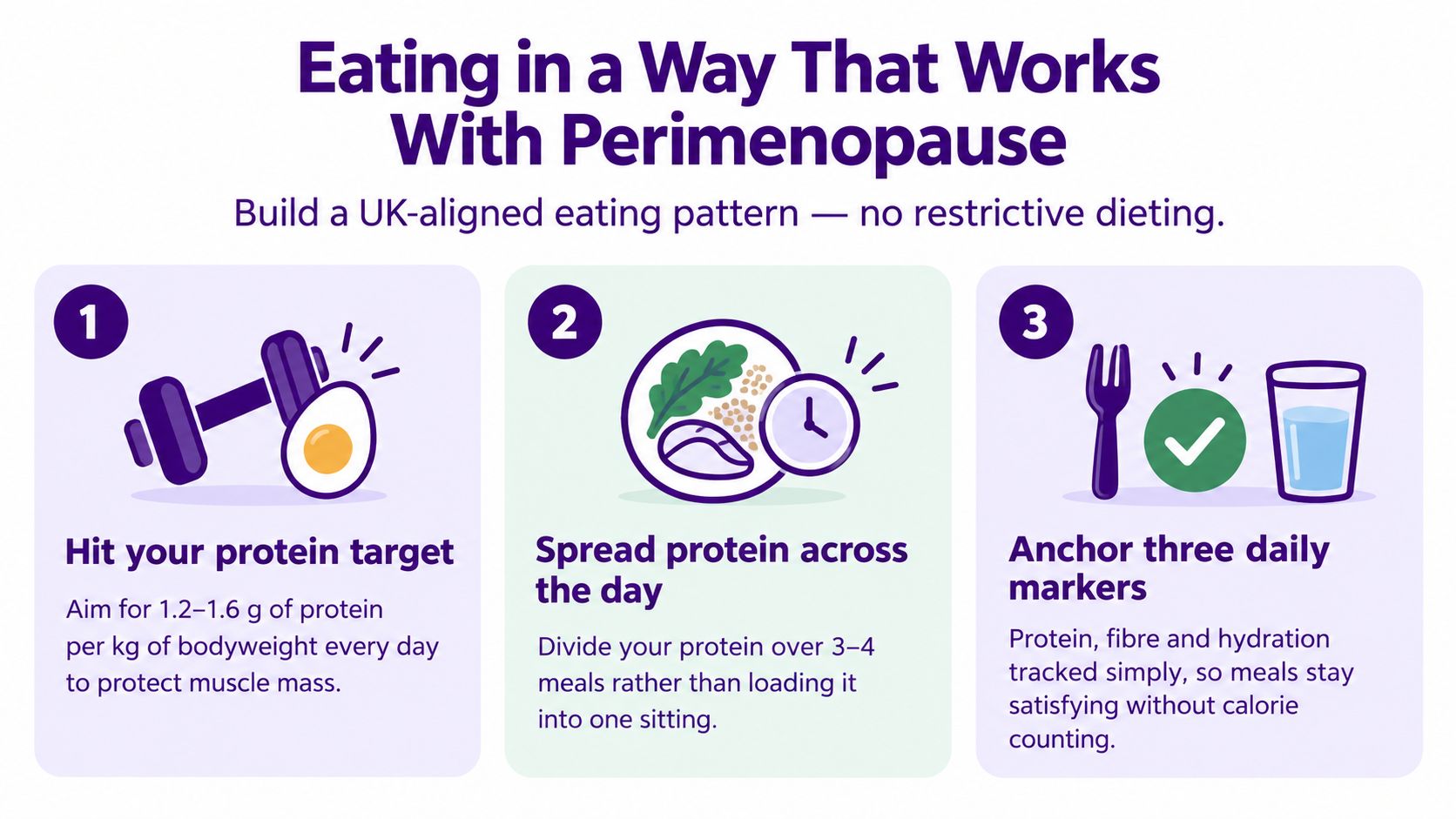
The best eating plan for midlife isn't a crash diet. It's a pattern that keeps you full, protects muscle, and makes a modest deficit possible without obsession. NHS menopause guidance leans towards a balanced diet with regular activity, while the British Menopause Society says sustainable loss usually needs a structured energy deficit alongside exercise (NHS menopause eating well guidance, British Menopause Society top tips).
Build the plate first, then adjust the deficit
The most practical target is protein at every meal, enough fibre to keep hunger stable, and a modest calorie shortfall rather than aggressive restriction. In real-world terms, that means a palm of protein, a fist of vegetables, a cupped hand of carbs, and a thumb of fats. If breakfast is usually toast, cereal, or a fruit-only bowl, that's the first place to change because protein at breakfast often blunts the larger post-meal glucose swing many midlife women notice.
A strong starting point is this:
- Protein: aim for a protein source at 3 to 4 meals, with meals built around Greek yoghurt, eggs, chicken, tinned fish, lentils, tofu, or whey-based options.
- Fibre: use vegetables, oats, beans, and wholegrains to keep the day anchored.
- Deficit: keep it modest enough that you can repeat it next week.
If you want a practical planning tool, the internal guide on the best diet for perimenopause is a useful companion to this approach.
Why consistency beats perfection
The mistake I see most often is women trying to “be good” Monday to Thursday and then collapsing by the weekend. That pattern usually backfires, because the body doesn't care about short bursts of perfection, it responds to the average across weeks. A protein-forward breakfast, a proper lunch, and a dinner built around vegetables and protein will do more than a rigid rule you can't live with.
Clinician's shortcut: if you're hungry by mid-morning, breakfast was probably too light on protein or too heavy on refined carbs.
For many women, the simplest win is not eating less overall, it's eating more strategically earlier in the day.
Strength Training as the Cornerstone of Your Plan
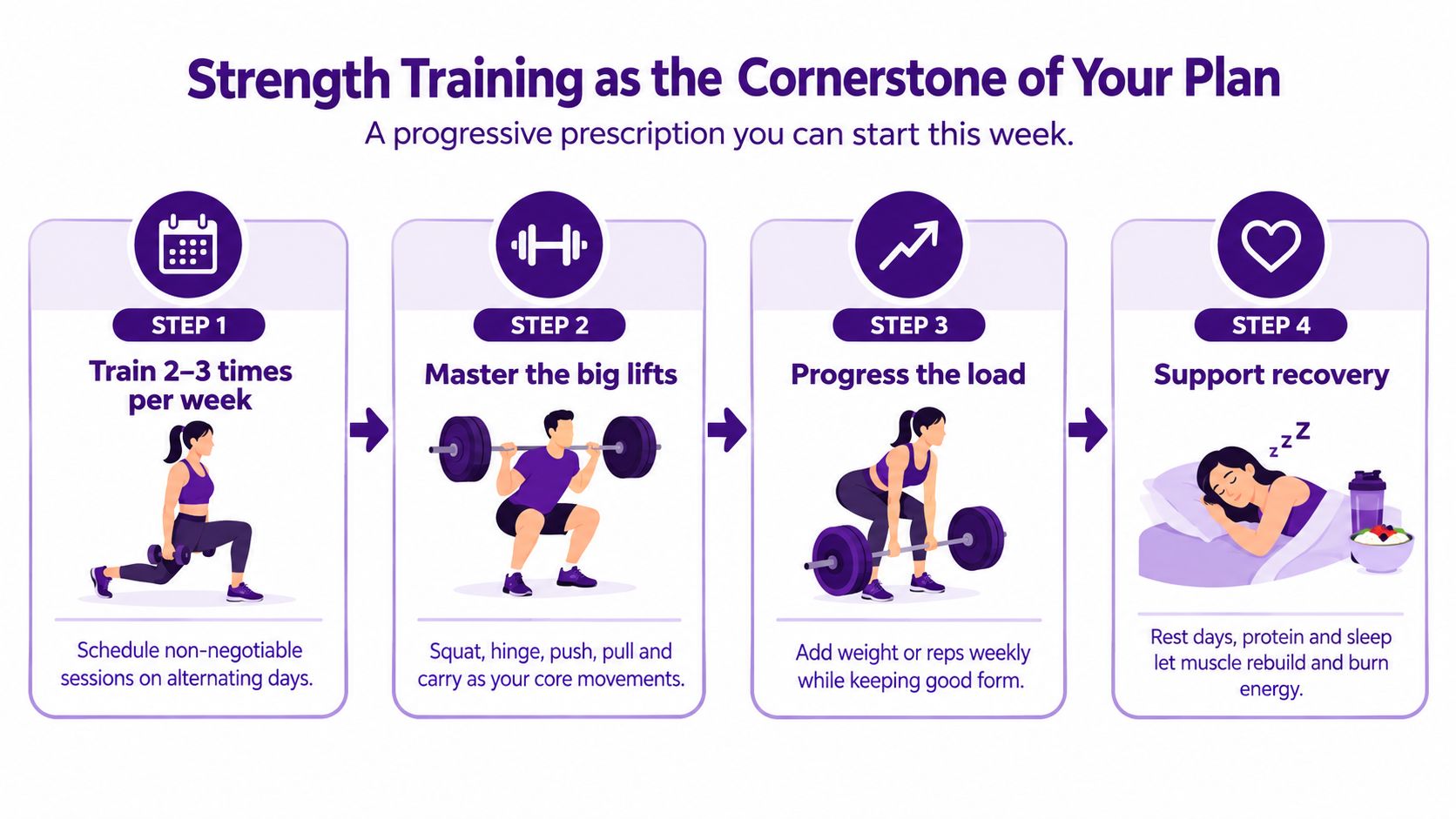
If there's one intervention that changes the midlife weight equation, it's resistance work. Cardio is useful, but it can't fully replace the metabolic effect of preserving and building muscle. The whole point is to give your body a reason to keep tissue that burns energy all day, not just during the workout.
Start with a repeatable weekly structure
A good starting prescription is two full-body sessions a week, each lasting about 45 to 60 minutes, with 3 to 4 working sets for the main movements. The core lifts are simple: goblet squat, Romanian deadlift, overhead press, bench-supported row, and loaded carry. If those are too ambitious at first, start with bodyweight or light dumbbells, then build.
Progression should be boring and measurable. Add load only when the top of your rep range feels like about a 7 out of 10 effort for two sessions in a row, not when you're chasing soreness. For compound lifts, work in the 6 to 12 rep range. For smaller isolation work, use 12 to 20 reps.
For a practical programme template, Strive Workout Log's perimenopause strength training guide is a useful adjunct, and the internal piece on strength training for menopause fits neatly beside it.
Remove the usual objections before they stop you
Gym anxiety is real. So is joint pain, limited time, and the feeling that you need perfect equipment before you start. You don't. The minimum effective dose for the time-poor is two sessions, four exercises, around 30 minutes. That's enough to begin shifting the muscle side of the equation.
If you've got new aches, prolapse symptoms, or known osteopenia, get a physiotherapy or coach-led assessment before pushing load. Technique matters more than variety here.
Bottom line: if you can only change one exercise habit, make it strength training, not extra cardio.
The point isn't to become a bodybuilder. It's to keep enough muscle that your metabolism doesn't keep slipping under your feet.
Sleep, Stress, and Alcohol as Hidden Drivers
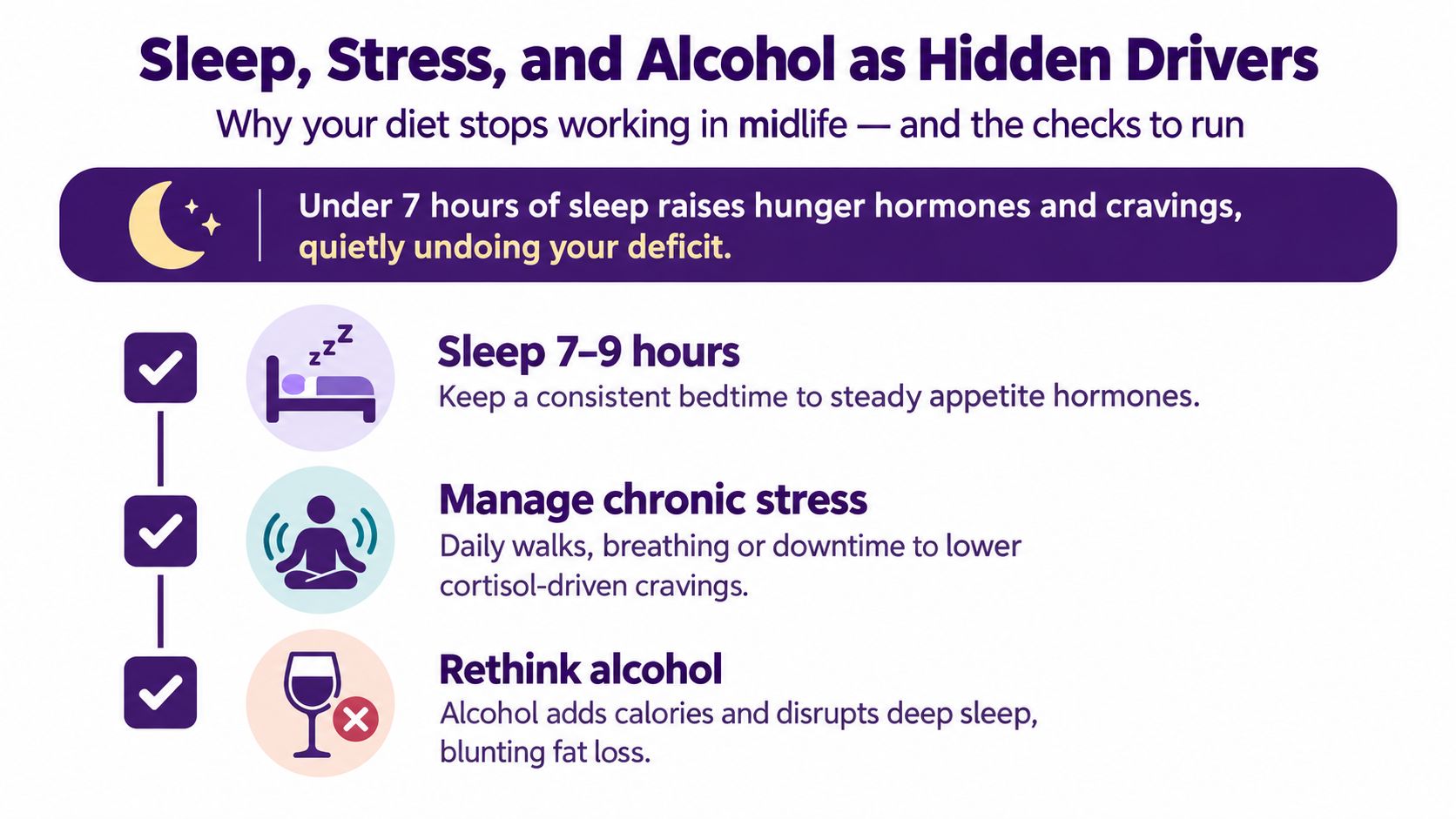
A lot of women blame food choices when the underlying problem is fatigue. Short sleep, evening alcohol, and chronic stress all make eating harder to regulate. If you're under 7 hours a night, hunger signalling gets louder, cravings get stronger, and your daytime willpower gets asked to do a job it can't reliably do.
Fix the sleep first, because appetite follows it
Menopause symptoms can fragment sleep, and alcohol makes that worse even when total hours look acceptable. That matters because broken sleep changes the next day's appetite, and the body often compensates by nudging you towards quick-energy foods. A fixed lights-out window, a 90-minute screen buffer, and morning daylight are simple, non-dramatic ways to anchor the rhythm.
NHS sleep-focused advice is often more useful than people expect. If you're trying to improve bedtime habits, this better sleep guide gives a straightforward consumer checklist, although the key clinical point is consistency rather than a perfect sleep routine.
Treat stress as a weight issue, not just a mood issue
Chronic stress pushes the body towards a visceral-fat pattern, which is exactly why midlife weight gain often sits around the abdomen. That doesn't mean you need a perfect stress-free life. It does mean daily habits that lower the load matter, including walking, breathing work, and clear boundaries around evenings.
Alcohol deserves a realistic conversation too. It's optional, not virtuous to eliminate, but it does add calories and can fragment deep sleep. If you drink, cap intake at 4 to 6 UK units a week, keep it away from late evenings, and review whether sleep and waist measurements change over four weeks.
If the plan only works on days you sleep well and don't drink, the plan is too fragile.
Midlife weight loss gets easier when you stop treating sleep, stress, and alcohol as side issues.
Medical Options Including the GLP 1 Context
Medical treatment can support a structured plan, but it does not replace adequate protein, resistance training, or sustainable eating habits. NICE-aligned access to prescription weight treatment is generally for people with BMI 30 or more, or BMI 27 with a weight-related condition, through an appropriate service. Assessment, prescribing, and follow-up still matter because the safest option depends on your health, symptoms, medications, and eating pattern.
What the main options do and don't do
| Option | Mechanism | Typical Weight Effect | UK Eligibility | Key Trade-offs |
|---|---|---|---|---|
| GLP-1 medicines, such as semaglutide and tirzepatide | Reduce appetite and food noise | Substantial weight loss over time, depending on the medicine and adherence | Usually BMI 30 or BMI 27 with a comorbidity in an appropriate service | Gastrointestinal side effects, private cost, and muscle-loss risk if protein and resistance work are neglected |
| Orlistat | Reduces fat absorption in the gut | Modest loss compared with GLP-1 medicines | Available through selected weight-management pathways | Gut side effects and lower tolerability for some people |
| HRT | Treats menopausal symptoms rather than weight directly | Neutral to favourable effects on body composition, without being a weight-loss treatment | Menopause symptom management based on clinical assessment | Not a weight-loss drug, though it may improve symptoms that make healthy behaviour easier |
GLP-1 medicines can reduce appetite substantially, which helps some women maintain a calorie deficit when dieting alone has repeatedly failed. The trade-off is reduced food intake without enough nutritional planning. If protein intake falls and strength training is absent, some of the weight lost may be lean tissue rather than fat. Discuss the practical benefits and limitations in this menopause weight-loss medication guide, then take individual suitability to a qualified prescriber.
The aim is fat loss while protecting muscle. That means building meals around protein, continuing resistance training, and reviewing progress beyond the scale. Medication can reduce appetite, but it cannot perform the training or provide the nutrients your body needs.
Safety matters more than hype
Avoid compounded peptides, unregulated online sellers, and providers that skip blood tests, blood pressure checks, or a full medical history. A responsible service should ask about current symptoms, cardiovascular risk, previous weight-management attempts, and your eating pattern before prescribing.
HRT has a different role. It is not a weight-loss drug, but British Menopause Society guidance describes neutral-to-favourable body-composition effects. Better control of hot flushes and improved sleep may also make regular meals, exercise, and other behaviour changes easier to sustain. The treatment addresses menopausal symptoms, while the weight-management plan still requires consistent nutrition and strength work.
Tracking Progress and Knowing When to See a Clinician
The scale can mislead during midlife. Fat loss, modest muscle gain, and changes in fluid balance may produce only a small shift in body weight. Track waist circumference, strength, and clothing fit alongside the scale, so improvements in body composition do not go unnoticed.
Use three measures, not one
Measure your waist at the navel under consistent conditions. NICE uses under 80 cm for South Asian women and under 88 cm for white European women as key thresholds in obesity prevention guidance (NICE NG246). Take a progress photo every fortnight and record loads or repetitions for your main resistance exercises.
Review the measures together rather than reacting to one reading. A 2 kg drop, a 3 cm waist reduction, and improving strength indicate meaningful progress, even if your weight chart changes slowly. Preserving muscle while reducing fat is the priority, particularly when dieting alone has previously led to repeated regain or reduced training capacity.
Know when to ask for medical input
After about three months of consistent nutrition and training, discuss relevant tests with your GP. Depending on your symptoms and history, these may include HbA1c, fasting insulin, lipids, TSH, and vitamin D. Testing should help identify other causes of weight change and highlight metabolic risk, rather than turn every result into another target.
Seek same-day GP advice for rapid unexplained gain, new severe night sweats, chest pain, breathlessness on exertion, or weight change that does not fit your routine. Thyroid conditions and other medical problems can overlap with menopause symptoms, so do not attribute every change to hormones.
Use a review rhythm that fits your life:
- Week 1: record baseline waist, photos, and strength
- Week 4: check whether the routine is realistic
- Week 8: adjust food or training if progress has stalled
- Week 12: review the measurements and discuss them with a clinician if needed
Judge the plan by its results and sustainability, not by the speed of weight loss.
Trim provides clinician-led weight management in the UK, with education covering menopause-related weight change, nutrition, and strength-focused habits. For a medically supervised option that includes muscle preservation and ongoing support, visit Trim to assess whether its regulated programme suits your circumstances.