
How to Start a Weight Loss Journey: An Evidence-Based UK Roadmap

When you're ready to start your weight loss journey, a crucial first step is a medically supervised consultation to build a personalised, evidence-based plan. This approach prioritises safety and efficacy, combining clinically proven treatments with lifestyle changes to ensure your path is built on robust health data and expert guidance.
Your First Step on the Path to Sustainable Weight Loss
Beginning a weight loss journey can feel overwhelming, but a structured, medically supervised programme replaces that uncertainty with a clear, actionable roadmap. Modern weight management in the UK increasingly involves blending clinically proven medicines with personalised lifestyle coaching—a combination demonstrated to be effective for long-term success.
It all starts with a simple but vital step: a brief digital consultation with a UK-registered clinician. This initial assessment is designed to safely determine if a medical programme is suitable for you and which treatments, such as GLP-1 receptor agonists, might be appropriate for your unique health profile.
Seeing the Bigger Picture
If you’re considering this path, it’s important to understand the broader health context. Weight management is a significant public health concern. In fact, an estimated 64.5% of adults in England are classified as overweight or living with obesity.
To put that in perspective, NHS data indicates that around 25% of UK adults are living with obesity, which means millions of people are facing similar challenges. These statistics underscore that seeking proper support is a proactive step towards better health outcomes.
This simple diagram breaks down the structured process of a medically guided programme.
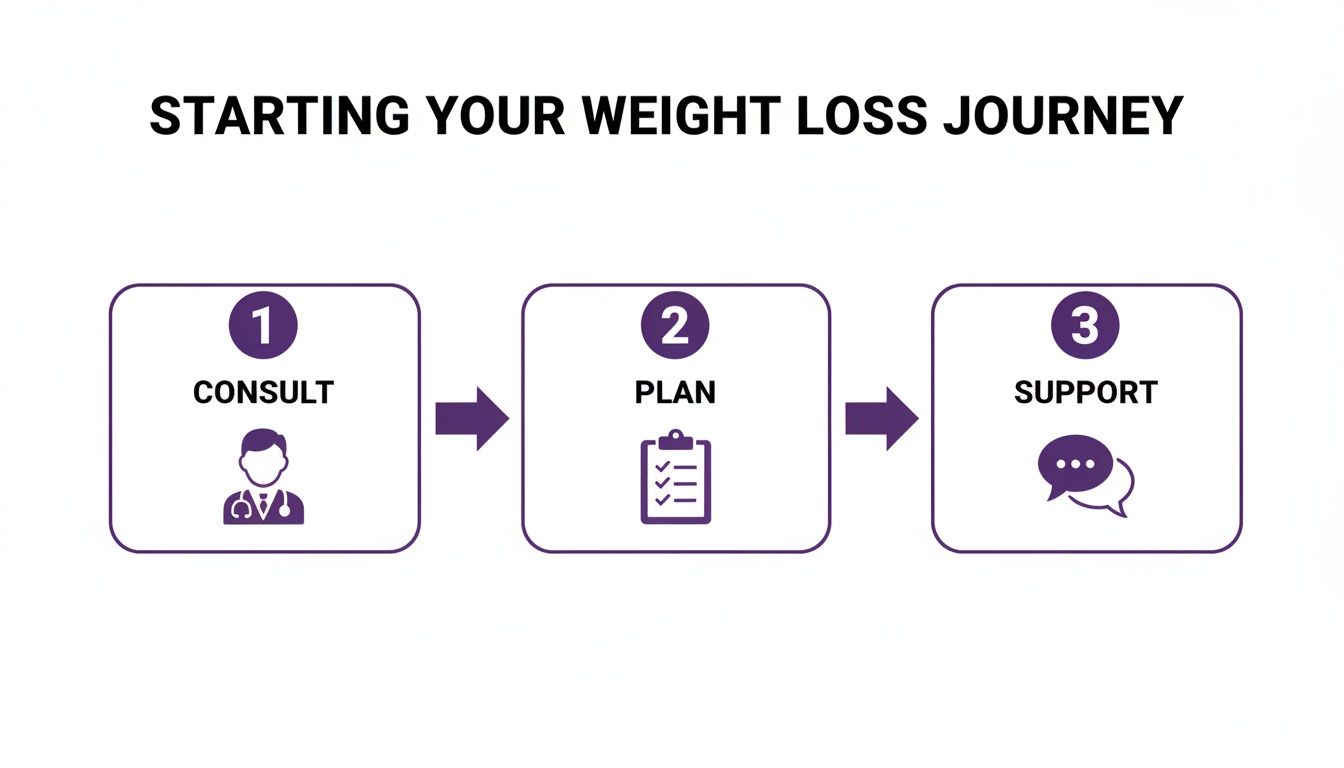
As you can see, the journey is simplified into three core phases: consultation, planning, and ongoing support. This highlights the collaborative nature of a modern weight loss programme.
The Four Pillars of an Effective Journey
A successful medically supervised plan isn’t just about medication; it's a comprehensive system designed to support your body and mind, built on four interconnected pillars.
- Evidence-Based Medicine: Utilising clinically proven treatments that help regulate biological factors like appetite and metabolism.
- Expert Clinical Guidance: Having continuous, one-to-one support from healthcare professionals to track your progress, manage potential side effects, and ensure safety.
- Tailored Nutrition: Developing a sustainable eating plan focused on nourishment and satiety, not severe restriction.
- Strength-Focused Exercise: Incorporating activity that preserves vital muscle mass during weight loss, which is crucial for maintaining a healthy metabolic rate.
The strength of this integrated approach lies in its focus on sustainability. The goal isn't just weight reduction, but also equipping you with the tools and habits necessary for long-term health maintenance.
A key part of personalising your plan involves finding the best app to track food for your goals, as technology can facilitate accurate monitoring of your nutritional intake. By combining these pillars, you move away from guesswork and towards a predictable, supportive, and safe plan.
Preparing for Your Clinical Consultation
Embarking on a medically supervised weight loss journey properly starts before you even speak to a clinician. Thorough preparation isn't just about efficiency; it's fundamental to your safety and ensuring the clinical team gets a complete, accurate picture of your health from the outset.
Think of it as laying the groundwork. With the right information on hand, you can have a more productive and transparent conversation, which allows your clinician to accurately assess if certain treatments are appropriate for you. Honesty here is absolutely non-negotiable, as your health history directly informs the safety and potential efficacy of any prescribed plan.

Your Essential Health Checklist
Before your digital consultation, it’s a good idea to spend a few minutes gathering some key pieces of information. Having these details ready will make the assessment process more efficient for everyone.
-
Your Body Mass Index (BMI): While BMI is just one metric, it’s a standard starting point for clinical assessments. Clinically proven medications are typically licensed for individuals with a BMI of 30 or higher, or 27 or higher if they also have a weight-related health condition like hypertension.
-
Existing Medical Conditions: This is arguably the most critical part of your preparation. Be ready to discuss any current or past health issues. Certain conditions are contraindications for specific treatments. For example, a personal or family history of medullary thyroid carcinoma or Multiple Endocrine Neoplasia syndrome type 2 (MEN 2) would make GLP-1 medications unsuitable. A history of pancreatitis also requires careful clinical consideration.
-
Current Medications and Supplements: Make a comprehensive list of everything you take. This includes prescription medicines, over-the-counter products, and any vitamins or herbal supplements. Some substances can interact with weight loss medications, so a full, transparent list is essential for a proper safety evaluation.
Understanding Key Health Factors
Your clinician needs to evaluate the full clinical picture, not just isolated numbers. This includes reviewing your personal and family medical history to identify any potential risks or predispositions.
For instance, a family history of heart disease or type 2 diabetes provides valuable information. It helps the clinician build a more protective and proactive plan tailored to your specific risk profile. This is all part of a holistic assessment designed to ensure any treatment supports your overall well-being.
A thorough health assessment isn't a barrier; it's a safety protocol. It ensures that the chosen therapeutic path is not only effective for weight loss but also fundamentally safe for your specific health profile.
This commitment to safety is a core principle, something you can learn more about when looking into what to expect from a reputable weight loss clinic in the UK. The goal is always to match the right individual with the right treatment based on clinical evidence.
Why Complete Transparency Is Crucial
It might be tempting to omit what seems like a minor health issue or an occasional medication, but every detail matters. The information you provide allows the clinical team to conduct a responsible risk assessment.
Consider this scenario: an individual with undiagnosed gallbladder issues starts a GLP-1 medication. Since this class of medicine can sometimes affect the gallbladder, non-disclosure of initial symptoms could lead to a serious complication. With full transparency, a clinician can make an informed decision, perhaps suggesting an alternative treatment or recommending further investigations first.
Being open and honest during your consultation isn’t just a formality; it’s the foundation of a safe and successful partnership with your healthcare provider. This collaboration ensures your weight loss journey begins on the strongest and most secure footing possible.
Navigating the Consultation and Setting Meaningful Goals
This first consultation is a pivotal moment. It’s the point where a general goal of ‘losing weight’ transforms into a specific, actionable plan, structured around your health and lifestyle. This is where the information you've gathered meets clinical expertise. A digital assessment with a UK-registered clinician isn't just a form; it's a structured conversation designed to understand you, your health history, and your objectives, ensuring any plan is safe and effective from day one.
The process is thorough but straightforward. You'll be asked a series of questions that explore the health data you’ve already provided, covering lifestyle, eating habits, and previous weight management attempts. This is a collaborative dialogue. The clinician uses this information to align your health profile with the most suitable, evidence-based treatments available.

Shifting Focus From the Scales
While having a target weight is a common starting point, a truly successful journey is measured by much more than kilograms. A key part of your consultation is setting meaningful, health-focused goals that reflect an improved quality of life. This is a crucial step in starting a weight loss journey that feels motivating and, most importantly, sustainable.
These goals are deeply personal and go beyond a number. Consider what success would feel like:
- Improved Mobility: Being able to engage in physical activities with family without shortness of breath or joint discomfort.
- Increased Energy Levels: Experiencing improved stamina throughout the day and waking up feeling more refreshed.
- Reduced ‘Food Noise’: A decrease in constant, intrusive thoughts about food, freeing up mental capacity.
- Better Health Markers: Seeing measurable improvements in clinical data such as blood pressure, cholesterol levels, or blood sugar control (HbA1c).
Focusing on these quality-of-life outcomes provides powerful, intrinsic motivation. It reframes the experience from one of restriction to one of empowerment and positive, tangible change.
Understanding Your Treatment Options
A significant part of this consultation is an educational overview of potential treatment paths. This is not a sales discussion. It’s an informative dialogue where your clinician explains the science behind different options, referencing data from clinical studies to illustrate how they work and what realistic outcomes might be.
For instance, if you are a suitable candidate for GLP-1 medications, the clinician will explain their mechanism of action—how they interact with the body's natural hormones to regulate appetite and slow gastric emptying. Understanding the underlying science helps demystify the process. It shows that these treatments address physiological factors, not a perceived lack of willpower.
The primary aim of this conversation is to establish a therapeutic partnership. You and your clinical team will work together to choose a path that aligns with your health needs, lifestyle, and the meaningful goals you’ve set.
This collaborative approach is fundamental. It ensures the plan feels appropriate for you from the outset. It’s about building a foundation of trust and understanding so you feel confident and supported as you move forward. The clinician provides the expert guidance; you provide the personal insight. Together, you create a realistic and motivating roadmap for the journey ahead.
What Are My Treatment Options?
https://www.youtube.com/embed/p8y-VE-VE7KdOk
Once your clinician has a clear picture of your health, you can explore evidence-based tools that can support your journey. A medically supervised programme provides access to clinically proven medications. These are not shortcuts, but scientific instruments designed to work with your body’s biology.
These treatments do not replace diet and exercise; they are intended to enhance their effectiveness. The conversation around weight loss in the UK has shifted, and seeking medical support is now a recognised and evidence-based approach. It's estimated that 1.6 million adults in England, Wales, and Scotland used medications like Wegovy and Mounjaro last year, with another 3.3 million considering it, indicating a move towards integrated medical care for weight management.
How GLP-1 Medications Rebalance Your Body
Medications like Wegovy (semaglutide) and Mounjaro (tirzepatide) are part of a class of treatments called GLP-1 receptor agonists. Originally developed for managing type 2 diabetes, their significant effect on weight regulation was identified during clinical trials.
Their mechanism of action involves mimicking a natural hormone your gut releases after eating, called GLP-1 (glucagon-like peptide-1). This triggers several physiological responses:
- Appetite Regulation: GLP-1s act on the hypothalamus in the brain, sending signals of satiety (fullness), which can help reduce overall calorie intake.
- Quiets ‘Food Noise’: Many patients report a significant reduction in persistent, intrusive thoughts about food, which can be a major barrier to weight management.
- Slows Gastric Emptying: By keeping food in the stomach for longer, these medications promote a prolonged feeling of fullness and help stabilise post-meal blood sugar levels.
Large-scale clinical trials support these effects. For instance, the STEP 1 trial showed that participants taking semaglutide 2.4mg, combined with lifestyle intervention, achieved an average weight loss of 14.9% from baseline over 68 weeks, compared to 2.4% with placebo and lifestyle intervention alone.
Exploring Other Clinically Proven Options
While GLP-1s have received significant attention, they are not the only available treatment. A comprehensive clinical programme will consider a range of options to find the most suitable one for an individual's health profile and preferences.
For instance, orlistat is another effective, long-established option. It functions via a different mechanism. As a lipase inhibitor, it works directly in the digestive system to prevent the absorption of approximately one-third of the dietary fat consumed. This unabsorbed fat is then excreted from the body. This illustrates how different medications can address weight management from various biological angles.
It is important to understand that there is no single 'best' medication for everyone. The appropriate choice depends on an individual's medical history, lifestyle, and physiological response. This decision is made collaboratively between you and your clinician.
This collaborative approach ensures you are an active participant in your care. For a deeper dive into the different options, our guide covers the full range of weight loss medication available in the UK.
To provide a clearer picture, here is a straightforward comparison of the main treatment types.
Comparing Medically Supervised Weight Loss Treatments
This table provides a simple, educational overview of how different clinically proven medications work. It is designed to help you understand the therapeutic landscape.
| Treatment Type | Mechanism of Action | How It Supports Weight Loss | Administration |
|---|---|---|---|
| GLP-1 Receptor Agonists | Mimics natural gut hormones to influence central appetite-regulating pathways. | Regulates appetite, increases feelings of fullness, and slows stomach emptying. | Typically a self-administered weekly injection. |
| Orlistat | A lipase inhibitor that acts locally in the gastrointestinal tract. | Blocks the absorption of a portion of dietary fat. | An oral capsule taken with meals containing fat. |
Ultimately, the goal is to find the right support for your individual needs. Medication can be an effective tool to initiate progress and build momentum. It can provide the physiological support needed to focus on establishing long-term health behaviours: personalised nutrition, regular physical activity, and healthier behavioural patterns.
Building Your Four-Pillar Support System for Lasting Success
Starting a medically supervised weight loss journey involves more than a prescription. While treatments are powerful tools for managing the biological aspects of weight, they are only one component of a larger, integrated strategy. Real, sustainable success is built on a foundation of four interconnected pillars, working synergistically to support your health.
This comprehensive framework is designed not just for weight reduction but also to equip you with the skills for long-term weight maintenance and improved overall health.
Pillar One: Personalised Nutrition
The first pillar is personalised nutrition, which moves away from the concept of restrictive dieting. The focus is on creating sustainable eating habits that nourish the body, particularly while in a calorie deficit. When using medications like GLP-1s that reduce appetite, it becomes even more critical that the food consumed is nutritionally dense.
Prioritising protein intake is a key component of this pillar. Adequate protein is essential for promoting satiety, which helps in managing hunger. More importantly, it plays a crucial role in preserving lean muscle mass during fat loss—a non-negotiable factor for maintaining a healthy metabolic rate.
A common error is simply reducing food quantity without improving food quality. The evidence-based approach is to focus on nutrient density, ensuring the body receives essential vitamins, minerals, and macronutrients to function optimally, even on a reduced calorie intake.
Building this dietary pillar involves learning to make food choices that support your goals. For instance, knowing how to select the best low sugar snacks for weight loss can make a significant difference. Our own guide offers more nutrition tips for weight loss to help you get started correctly.
Pillar Two: Strength-Focused Exercise
The second pillar is the integration of strength-focused exercise. While all physical activity is beneficial, resistance training is particularly important during a period of weight loss. As body weight decreases, there can be a corresponding loss of muscle mass along with fat, which can lead to a reduction in metabolic rate.
Strength training is an effective countermeasure. It signals the body to preserve—and even build—lean muscle tissue. The benefits are numerous:
- Maintains Metabolic Rate: More muscle helps the body burn more calories at rest.
- Improves Body Composition: It helps ensure that the weight lost is primarily from fat stores, not muscle.
- Increases Functional Strength: This makes everyday activities easier and improves overall quality of life.
This does not require intensive bodybuilding. Consistency is more important than intensity. Starting with two to three sessions per week, using bodyweight exercises or light resistance, is a fantastic starting point.
Pillar Three: Ongoing Clinical Guidance
Your journey does not end after receiving a prescription. The third pillar—ongoing clinical guidance—is your safety and optimisation framework. Regular check-ins with your clinical team are essential for several key reasons.
First, they allow for careful monitoring of your progress and any potential side effects. While most side effects from medications are mild and manageable, having direct access to a clinician provides reassurance and allows for prompt adjustments if necessary. Second, your treatment plan is dynamic. Your clinician can titrate your dosage or modify your treatment based on your body's response, ensuring your plan remains optimised for you.
Pillar Four: Behavioural Strategies and Tracking
The final pillar integrates behavioural strategies with modern digital tools for tracking progress. This is where you build the habits that make your new lifestyle sustainable. Using an app to monitor food intake, activity levels, and physical measurements provides valuable data. It helps you identify patterns, celebrate incremental successes, and remain accountable to your goals.
This tech-driven support is increasingly recognised as a valuable component of weight management. Research into how UK residents approach weight loss shows that while exercising more (46%) and eating healthier (42%) remain top strategies, there’s a significant rise in the use of digital tools. This demonstrates that combining traditional methods with modern tracking and professional medical guidance creates a powerful formula for success.
These four pillars—nutrition, exercise, clinical support, and behavioural tracking—form a complete, holistic system. They ensure you’re not just losing weight, but fundamentally improving your health for the long run.
Common Questions About Medically Guided Weight Loss
Deciding to start a medically guided weight loss journey is a significant step, and it’s natural to have questions. Obtaining clear, evidence-based answers is the best way to feel confident and prepared. This section addresses some of the most common queries.
The purpose of seeking clinical support is to replace uncertainty with clarity and evidence. Let's ensure you feel informed and supported from the start.

How Quickly Can I Expect to See Results?
This is a common question, and the answer depends on individual factors. Your starting weight, metabolic health, and adherence to the comprehensive plan all play a role. That said, clinical trial data for GLP-1 medications shows that many individuals begin to see noticeable weight loss within the first few weeks of treatment.
However, the most significant changes are typically observed over six months to a year. A healthy, sustainable rate of weight loss is generally considered to be around 1-2 pounds (0.5-1 kg) per week. Your clinical team will help you set realistic expectations, shifting the focus from rapid, short-term changes to lasting health improvements.
Are the Side Effects of GLP-1 Medications Severe?
For most people, the side effects associated with GLP-1s are mild and transient. They most commonly occur upon initiating the medication or when increasing the dose, and they typically diminish as the body acclimatises.
Commonly reported side effects are gastrointestinal in nature, such as:
- Nausea
- Constipation or diarrhoea
- A feeling of excessive fullness
This is where a medically supervised programme provides significant value. You have direct access to clinicians who can offer evidence-based strategies to manage these effects. Severe side effects are rare, largely because a thorough screening is conducted beforehand and patients are monitored closely throughout treatment.
The goal of ongoing clinical support is to ensure your treatment is both effective and well-tolerated. Your care team is there to help you navigate any issues, adjusting the plan as needed to keep you on track.
This proactive management is what makes a supervised programme a safer, more supportive approach to weight loss.
What Happens If I Stop Taking the Medication?
Weight loss medications are a therapeutic tool designed to support you while you establish new, healthier habits. Clinical evidence shows that if medication is discontinued before these new behaviours are firmly established, there is a high likelihood of weight regain as the pharmacological effects on appetite wear off.
This is precisely why a comprehensive, multi-pillar approach is so critical. The integration of medicine with personalised nutrition, strength-focused exercise, and behavioural coaching is designed to equip you with the skills and habits needed for long-term weight maintenance. The objective is that if and when you and your clinician decide to discontinue the medication, you have a robust foundation of lifestyle changes to sustain your results.
Is This Programme Suitable for My Specific Dietary Needs?
Yes, absolutely. Personalisation is a key strength of a medically guided programme. Your journey begins with a comprehensive assessment of your health profile, which includes any specific dietary requirements, allergies, or preferences.
Whether you follow a vegetarian, gluten-free, or other specific dietary pattern, the clinical and nutrition teams will develop a plan tailored to you. They ensure that the medication and the nutritional guidance are complementary and integrated into your lifestyle. This customised approach is essential for both safety and the long-term success of the programme.
Ready to take the first step with a plan built just for you? At Trim, our UK-registered clinicians are ready to help you start your weight loss journey safely and effectively. Begin your free 5-minute consultation today to see if a medically guided programme is right for you. Start your consultation.