
How to Lose Weight Sustainably: A Practical, Evidence-Based Guide

If you've ever stared at the bathroom scales in frustration after another diet has failed, you're not alone. It’s a dishearteningly common experience. To lose weight and keep it off for good, you need to break the cycle of quick fixes and the inevitable rebound. Lasting success isn't about sheer willpower; it's a science-backed process that brings together mindset, tailored nutrition, smart physical activity, and, when appropriate, clinical support.
The Reality of Weight Loss in the UK

The journey to sustainable weight management can feel isolating, but the statistics show it’s a shared struggle across the country. Many people find themselves trapped in a pattern of losing weight rapidly on restrictive diets, only to regain it all—and sometimes more—once normal eating habits resume. This yo-yo effect can be incredibly damaging, both physically and mentally.
This guide offers a different path. It's one grounded in evidence and designed for the realities of modern life. We're moving away from the idea of a "perfect" diet and focusing instead on building consistent, healthy habits that you can actually maintain for years to come. True change requires looking at the bigger picture.
A Growing National Challenge
The need for effective, long-term strategies has never been more urgent. Recent data paints a stark picture of the health landscape in the UK, highlighting a consistent upward trend in weight-related issues.
In England, during the 2023-2024 period, a staggering 64.5% of adults aged 18 and over were classified as overweight or living with obesity. This is a noticeable increase from 61.2% in 2015-2016, showing that conventional advice isn't sufficient for a growing number of people. Deprivation also plays a significant role; obesity prevalence is 35.3% in the most deprived areas compared to just 20.2% in the least deprived. You can explore the complete government statistics on obesity trends in the UK.
Sustainable weight management is less about a sprint to a target number on the scale and more about creating a lifestyle that supports your health for the long haul. It's about progress, not perfection.
Introducing a Multi-Pillar Framework
To tackle this challenge head-on, a structured, holistic approach is essential. This guide introduces an evidence-based, multi-pillar framework that provides a clear and actionable roadmap. It’s designed to help you understand how to lose weight sustainably by integrating several key areas of your life.
This framework is built on:
- Setting Realistic Goals: Moving beyond vague wishes to create motivating targets you can actually achieve.
- Evidence-Based Strategies: Combining tailored nutrition, strength-focused training, and, when clinically suitable, medical support. You might find our guide on the role of weight loss injections available in the UK useful.
- Lifestyle Management: Addressing the crucial, often-overlooked factors like sleep, stress, and daily movement.
- Long-Term Maintenance: Learning how to navigate plateaus and setbacks without letting them derail your progress.
By focusing on these interconnected pillars, you can build a foundation for success that lasts a lifetime and finally move beyond the frustration of temporary fixes.
Setting Goals That Actually Work
The first step on any successful weight loss journey isn't a dramatic diet overhaul or a punishing new exercise regime. It's something much simpler, yet far more powerful: setting the right kind of goals. A vague wish like "I want to lose 20 pounds" can feel overwhelming and offers no clear direction, often leading to frustration and burnout before you’ve even really started.
The key is to shift your focus from outcome-based goals—the number on the scale, which you can't directly control—to process-based goals. These are the small, consistent actions you can control every single day. This change in perspective is fundamental to building momentum and creating habits that last a lifetime.
From Vague Wishes to SMART Objectives
For your goals to be effective, they need structure. The SMART framework is a clinically-recognized method for turning ambiguous desires into concrete, actionable plans. Every goal you set should be:
- Specific: Clearly define what you want to do. Instead of "eat healthier," a better goal is "I will include two servings of vegetables with my lunch and dinner."
- Measurable: How will you track your progress? "Walk more" becomes "I will walk for 30 minutes, five days a week." You can easily see if you've done it.
- Achievable: Your goal must be realistic for your current lifestyle. If you haven't exercised in years, aiming for a daily 5k run is a recipe for failure. Starting with three 20-minute walks per week is far more attainable.
- Relevant: Does this goal genuinely support your long-term health? Prioritising seven hours of sleep a night, for instance, is highly relevant to successful weight management.
- Time-bound: Give yourself a deadline. "I will incorporate strength training twice a week for the next four weeks." This creates a clear timeframe for action and evaluation.
This structured approach transforms what feels like a daunting mountain climb into a series of manageable, confidence-boosting steps.
The real aim isn't just to lose weight; it's to build a set of behaviours and habits that naturally lead to and maintain a healthy weight. The weight loss itself becomes a positive side effect of your new lifestyle.
Small Wins Build Unstoppable Momentum
Focusing on small, achievable milestones is psychologically powerful. Each time you hit a process goal—like drinking two litres of water today or trying a new healthy recipe—your brain gets a small hit of dopamine, reinforcing that positive behaviour. This creates a feedback loop of motivation and self-belief that snowballs over time.
Think of it this way: clinical guidelines recommend a rate for sustainable weight loss of around 1 to 2 pounds per week. While that might not sound as exciting as a rapid drop, this steady pace is far more likely to come from fat loss—not just water or muscle—and it's infinitely more maintainable in the long run.
To truly understand the power of this approach, it helps to see how vague wishes can be transformed into actionable goals that set you up for success.
Example SMART Goals for Sustainable Weight Loss
| Vague Goal | SMART Goal Example | Why It Works |
|---|---|---|
| "I want to lose weight." | "I will lose 1-2 lbs per week for the next 12 weeks by maintaining a modest calorie deficit and strength training twice weekly." | This is Specific (1-2 lbs/week), Measurable (weekly weigh-ins), Achievable (sustainable rate), Relevant (directly targets weight loss), and Time-bound (12 weeks). |
| "I need to exercise more." | "I will attend two 45-minute strength training classes at my local gym every Tuesday and Thursday for the next month." | This goal defines the what, where, when, and for how long, making it easy to schedule and track. It removes ambiguity and makes the action concrete. |
| "I will cut out junk food." | "For the next two weeks, I will replace my daily afternoon chocolate bar with a piece of fruit or a protein yoghurt." | Instead of a drastic, unsustainable ban, this goal focuses on a specific, achievable swap. It's a small change that builds confidence for bigger adjustments later. |
By breaking down your journey into these clear, controllable actions, you reclaim control. You are no longer at the mercy of the scales; instead, you are actively building the foundation for lasting success, one smart goal at a time.
An Evidence-Based Framework for Lasting Fat Loss
If you've ever been told to just "eat less and move more," you know how frustrating that advice can be. While the sentiment isn't entirely wrong, the biological reality of managing your weight is far more complex than a simple calorie equation. Real, sustainable fat loss requires a smarter approach—one that addresses everything from your hormones to your metabolic health.
To see lasting change, you need a structured programme that integrates several critical components. It's about understanding weight loss: why gym visits alone may not be enough. Let’s break down the four pillars that form the foundation of our evidence-based framework.
Pillar 1: Rebalancing Biology with Medical Support
For many people, the struggle to lose weight isn't a lack of willpower; it's a battle against powerful biological signals. In 1993, 13% of men and 16% of women in England were living with obesity. By 2021, those figures had risen to 25% and 26% respectively. This dramatic shift highlights that our bodies are often fighting an uphill battle against modern environmental and genetic factors.
This is where clinically-proven medications, when appropriate, can be a useful tool. They are not a substitute for lifestyle changes but can help rebalance the intricate systems that regulate hunger, cravings, and fullness, making those changes more achievable.
The Mechanism of GLP-1 Receptor Agonists
Medications such as semaglutide (Wegovy) and tirzepatide (Mounjaro) belong to a class of drugs known as GLP-1 receptor agonists. They function by mimicking a naturally occurring gut hormone, GLP-1, which is released after eating.
This has several evidence-backed effects:
- It slows gastric emptying: Food remains in the stomach for longer, which contributes to a prolonged feeling of fullness and satisfaction after meals.
- It acts on the brain's hunger centres: GLP-1s interact with the hypothalamus to reduce appetite signals, effectively lowering persistent cravings.
- It reduces 'food noise': Many individuals on these treatments report a significant decrease in intrusive thoughts about food, enabling more mindful and healthier food choices.
The efficacy of these medications is supported by robust clinical data. For example, the landmark STEP 1 clinical trial found that participants taking semaglutide 2.4 mg, alongside lifestyle intervention, achieved an average weight loss of 14.9% of their body weight over 68 weeks, compared to just 2.4% in the placebo group.
Pillar 2: Fuelling Your Body with Smart Nutrition
Nutrition is the absolute cornerstone of any successful weight loss plan. But the goal here is sustainability, not suffering. The old cycle of restrictive, fad diets is doomed to fail because it’s built on deprivation. A far better strategy is to create a modest, consistent calorie deficit while filling your plate with nutrient-dense foods that work with your body, not against it.
Of course, consuming fewer calories than you burn is the basic principle. But what you eat is just as important as how much.
The most powerful shift you can make is to stop focusing on what you need to cut out and start thinking about what you can add in. By adding more protein, fibre, and healthy fats, you naturally increase satiety. Suddenly, eating in a calorie deficit feels less like a diet and more like a satisfying way of life.
Protein is especially crucial. It’s the most satiating macronutrient, meaning it keeps you feeling fuller for longer. A higher protein intake also helps you hold on to lean muscle mass while you lose fat, which is essential for keeping your metabolism firing on all cylinders. For more practical advice, check out our guide on nutrition tips for effective weight loss.
The infographic below shows the difference between a vague intention and a specific, actionable goal—the kind that actually leads to results.
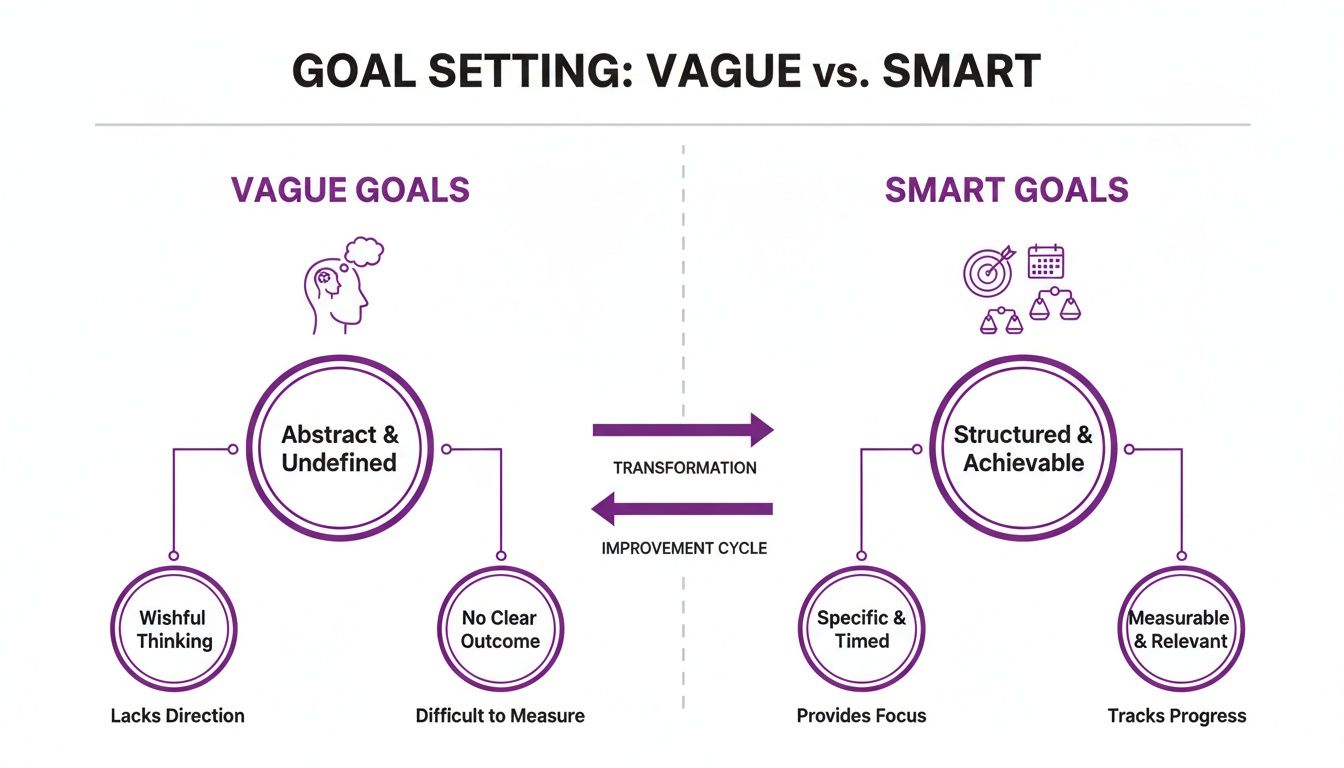
Turning a fuzzy thought into a clear, measurable plan is the secret to building habits that stick.
Pillar 3: Training for a Stronger, More Efficient Metabolism
While a brisk walk or a run is fantastic for your heart, strength training is the unsung hero of sustainable fat loss. Its biggest benefit isn't the calories you burn during the workout, but what it does for your metabolism 24/7. Building and maintaining muscle is one of the best ways to boost your basal metabolic rate (BMR)—the energy your body uses just to stay alive.
Here’s the problem with dieting alone: you often lose both fat and muscle. Losing muscle is a disaster for long-term weight management because it slows your metabolism down, making it harder to continue losing weight and much easier to regain it later.
By adding resistance training to your routine, you tell your body to protect and even build that precious muscle while it burns fat. This creates a stronger, leaner body composition and turns your metabolism into a more efficient engine.
Keep Your Strength Work Simple and Effective
You don’t have to live in the gym. Consistency beats intensity every time. Aim for two or three sessions a week, focusing on compound movements that give you the most bang for your buck.
- Squats: The king of lower-body exercises, hitting your quads, hamstrings, and glutes.
- Push-ups: A brilliant upper-body builder for chest, shoulders, and triceps. Start on your knees if you need to!
- Rows: Essential for a strong back and better posture. You can use dumbbells, resistance bands, or a gym machine.
- Glute Bridges: Great for firing up your glutes and strengthening the muscles that support your lower back.
Pillar 4: Leaning on Expert Support for Guidance and Safety
Trying to navigate a weight loss journey on your own can feel overwhelming. Having a team of clinical experts in your corner provides an essential layer of safety, accountability, and personalised advice—especially when medication is part of the plan.
Clinical supervision is non-negotiable because it ensures:
- Your safety comes first: A clinician will review your medical history, determine the right treatment for you, and monitor for any side effects, making adjustments as needed.
- Your progress is properly tracked: Regular check-ins keep you accountable and give you a chance to troubleshoot any challenges or plateaus with an expert who can offer real solutions.
- Your plan is actually yours: No two journeys are the same. Expert support means your programme can be adapted to fit your unique lifestyle, needs, and how your body responds.
This four-pillar framework—marrying medical science with smart nutrition, effective training, and professional guidance—creates a structured, supportive path to not just losing weight, but keeping it off for good.
Mastering the Lifestyle Factors Beyond the Scale

Lasting weight loss isn’t just about what you eat and how you move in the gym. The real secret weapon lies in managing the pillars of your lifestyle: sleep, stress, and daily activity. These are the powerful undercurrents that can either supercharge your progress or quietly sabotage your best efforts.
Think of it this way: ignoring these factors is like trying to drive with the handbrake on. You might inch forward, but you’re working far harder than you need to be. By getting a handle on them, you create a physiological environment that actively supports fat loss, making the whole process feel less like a battle.
The Critical Role of Sleep in Weight Management
Even one night of bad sleep can throw your body’s delicate hormone balance completely out of whack. When you're running on empty, your system ramps up production of ghrelin, the “I’m hungry” hormone, while simultaneously suppressing leptin, the hormone that tells you you’re full. It's a physiological double-whammy that triggers intense cravings, particularly for high-calorie, sugary foods.
On top of that, poor sleep sends levels of the stress hormone cortisol soaring. Chronically high cortisol is bad news for weight loss; it encourages your body to store fat (especially around the midsection) and can even break down muscle tissue—the very engine you need to keep your metabolism ticking over.
Think of sleep as your body's essential reset button. It’s when your hormones recalibrate and your muscles repair. Consistently getting seven to nine hours of quality sleep per night is one of the most effective, yet passive, things you can do for fat loss.
Improving your sleep doesn't require a complete life overhaul. Building a better routine, often called sleep hygiene, can make a huge difference.
- Create a Restful Environment: Make your bedroom a sanctuary—dark, quiet, and cool. Blackout curtains or a white noise machine can be game-changers.
- Establish a Wind-Down Routine: An hour before bed, it's time to power down. The blue light from phones and TVs messes with your body's production of melatonin, the sleep hormone. Swap screen time for reading a book or taking a warm bath.
- Be Consistent: Try to go to bed and wake up at roughly the same time every day, even at the weekend. This simple habit helps to regulate your body's internal clock.
Managing Stress to Prevent Weight Gain
In our high-pressure world, chronic stress feels almost normal. But just like a lack of sleep, persistent stress keeps cortisol levels elevated, setting off a chain reaction that works directly against your weight loss goals.
This constant state of high alert signals your body to conserve energy, which means storing more calories as fat. It also drives powerful cravings for "comfort food" as your brain desperately seeks a quick dopamine hit to soothe the feelings of stress. This is exactly why you might find yourself reaching for a biscuit after a tough day at work, even when you're not physically hungry.
Finding healthy ways to manage stress isn’t just a nice-to-have; it’s non-negotiable for long-term success. The key is to find what works for you.
Actionable Stress-Management Techniques:
- Mindful Movement: You don't need a gruelling workout. A gentle yoga session or a simple 10-minute walk outside can do wonders for lowering cortisol and clearing your head.
- Breathing Exercises: Feeling overwhelmed? Try "box breathing": inhale for four seconds, hold for four, exhale for four, and hold for four. Repeat a few times. It’s surprisingly effective.
- Scheduled Downtime: Actually block out time in your calendar for something you enjoy. Something that isn't work, chores, or "productive." Give yourself permission to switch off.
Mastering your lifestyle also extends to practical habits. Learning about reducing food waste, for instance, can help you become more mindful about consumption while also saving money.
Boosting Your Non-Exercise Activity Thermogenesis (NEAT)
Finally, let's talk about the sneaky impact of a sedentary life. Even if you smash a workout every morning, sitting at a desk for eight hours a day can bring your metabolism to a crawl. The antidote is to increase your Non-Exercise Activity Thermogenesis (NEAT).
That’s a fancy term for all the energy you burn from movement that isn’t planned exercise. It’s everything from fidgeting at your desk to walking to the printer to taking the stairs instead of the lift. These little bursts of activity really add up, significantly boosting your daily calorie burn without needing another trip to the gym.
Weaving more NEAT into your day is easier than you think.
- Take movement breaks: Set a timer to get up and walk around for five minutes every hour.
- Pace while you talk: If you're on a phone call, get on your feet and walk around the office or your home.
- Embrace inefficiency: Park a little further from the supermarket entrance. Choose the stairs every time. Make movement the default choice.
By weaving more activity into the fabric of your day, you keep your metabolism firing on all cylinders. This approach, combined with better sleep and stress management, is how you truly tackle weight loss from every angle. For more on this, our guide on how to reduce appetite naturally offers further practical insights.
Navigating Plateaus and Long-Term Success
Embarking on a weight loss journey is often full of early wins, but the real test comes when you hit the inevitable bumps in the road. Challenges like a frustrating weight-loss plateau or figuring out how to handle social events are a completely normal part of the process. Knowing how to manage them is what truly separates a short-term diet from lasting change.
The key is to shift your mindset from perfection to consistency. One off-plan meal or a single missed workout doesn't erase weeks of hard work. This section will walk you through the realities of the journey, giving you practical, evidence-based strategies to get past hurdles and maintain your results for good.
Understanding the Weight Loss Plateau
Sooner or later, almost everyone hits one: the dreaded plateau. After weeks of seeing the number on the scale go down, it suddenly grinds to a halt, even though you feel like you’re doing everything right. This isn’t a sign that you’ve failed; it’s a sign your body is adapting.
As you lose weight, your metabolism naturally slows down a bit. A smaller body simply needs less energy to function. This is a well-known phenomenon called metabolic adaptation. Your body, brilliantly designed for survival, becomes more efficient and burns fewer calories than it did at your starting weight. This narrows the calorie deficit that was initially driving your weight loss.
A plateau isn't a wall; it's a checkpoint. It’s your body’s signal that it’s time to reassess and make small, strategic adjustments to your plan, rather than resorting to drastic and unsustainable measures.
To push through, you just need to gently nudge your body out of its new comfort zone.
- Review Your Intake: Are you still tracking your food as carefully as you were at the beginning? It’s amazing how small portion increases or extra snacks can creep back in without you even realising. A quick, honest audit of your daily habits can often reveal the culprit.
- Increase Your Activity: This doesn't mean you need to double your time at the gym. Simply adding an extra 10-15 minutes to your daily walk or slightly increasing the weight you're lifting during strength training can be enough to kickstart progress again.
- Prioritise Protein: Make sure you're getting a good source of protein with every meal. It's fantastic for helping preserve muscle mass—which is vital for keeping your metabolism fired up—and it also keeps you feeling fuller for longer, making it easier to manage your overall calorie intake.
When to Consider Clinical Support for Weight Management
For some individuals, lifestyle changes alone may not be sufficient to overcome powerful biological barriers to weight loss. In these cases, a medically supervised programme can provide an important layer of support to help manage the complex physiological drivers of weight gain.
This is not a first-line approach for everyone, but it is an evidence-based option for those who meet specific clinical criteria. In the UK, healthcare professionals will typically consider prescription treatments for individuals with:
- A Body Mass Index (BMI) of 30 or higher, which is the clinical definition of obesity.
- A BMI of 27 or higher alongside at least one weight-related health condition, such as type 2 diabetes, high blood pressure, or high cholesterol.
These guidelines are in place to ensure that medication is used safely and for individuals most likely to benefit from its physiological effects on appetite and metabolism.
It is crucial to understand that these treatments are not standalone solutions. They are designed to work as one component of a comprehensive plan that must include tailored nutrition, physical activity, and expert clinical oversight. A consultation with a qualified clinician is the only way to determine if this path is a safe and suitable option for your individual health circumstances. They will assess your full medical history, discuss the potential benefits and side effects, and help create a responsible treatment plan.
Your Questions on Sustainable Weight Loss Answered
The world of weight management can be a confusing place, often leaving you with more questions than answers. To help clear things up, we've pulled together some of the most common queries we hear and provided straightforward, evidence-based responses. The aim here is to reinforce the core principles of losing weight for good, so you can move forward with confidence.
How Quickly Should I Expect to See Results?
A healthy, sustainable rate of weight loss is around 1 to 2 pounds (roughly 0.5 to 1 kg) per week. This steady pace is key because it ensures you're primarily losing fat while holding onto your metabolically active muscle tissue.
Faster loss usually comes from extreme, unsustainable diets that are incredibly difficult to stick with and often lead to rebound weight gain. While a medically supervised programme can help manage biological factors like hunger, the gold standard for long-term success remains this gradual, consistent progress.
Are Weight Loss Medications Necessary for Success?
Not for everyone. Many people achieve excellent, lasting results through consistent changes to their nutrition, activity levels, and daily habits alone. However, for those with a clinical diagnosis of obesity (typically a BMI of 30+, or 27+ with a related health condition), medications can be an invaluable tool.
These treatments are designed to address the underlying biological drivers of weight gain, such as intense hunger signals and persistent "food noise." They are most effective—and safest—when used as part of a comprehensive programme that includes expert coaching on diet and exercise. A clinical consultation is the only way to determine if this is a suitable and safe path for you.
The real goal isn't just to lose weight, but to establish a new, healthier baseline for your body. Medications can make this easier by helping you build and stick to the very habits that support long-term maintenance.
Why Prioritise Strength Training Over Cardio?
While cardio is fantastic for your heart, strength training is non-negotiable for sustainable fat loss. Why? Because building and maintaining muscle increases your basal metabolic rate (BMR). In simple terms, this means your body burns more calories throughout the day, even when you're resting.
Traditional dieting often leads to losing both fat and muscle. That's a problem because a loss of muscle can slow your metabolism, making it much easier to regain weight down the line. By prioritising strength training, you're sending a powerful signal to your body: preserve that precious muscle and use fat for fuel instead. This creates a healthier body composition and makes maintaining your results for good far more achievable.
What if I Fall Off My Plan for a Week?
An "off" week happens. It's a completely normal part of any long-term health journey, so the most important thing is to aim for resilience, not perfection. One off-plan meal or a few missed workouts doesn't undo all your hard work, so try to avoid that all-or-nothing mindset.
The best approach is to simply acknowledge what happened without judging yourself, think about any triggers, and get right back to your routine at the next opportunity. This is where having expert support is so valuable—it provides the accountability and guidance to help you turn a minor slip into a learning experience, rather than a reason to give up.
Ready to build a sustainable plan that works with your biology, not against it? Trim offers a clinically-proven, four-pillar programme that combines medication with expert support in nutrition and training. Start your free 5-minute consultation to see if you're eligible. Find out more at https://gettrim.co.uk.