
How to Lose Weight After Pregnancy a Realistic Guide for Mums

When it comes to losing weight after having a baby, the approach is all about gentle recovery, balanced nutrition, and easing back into exercise. Evidence-based strategies focus on healing first, then slowly weaving in sustainable lifestyle changes that support your body's new needs.
Understanding Your Post-Pregnancy Body

Before discussing weight loss, it’s vital to acknowledge the immense physiological journey your body has just completed. The pressure to ‘bounce back’ is an unrealistic and unhelpful narrative. It dismisses the profound changes that happen during pregnancy and childbirth. Your body needs time to heal, and the first step towards sustainable health is approaching this period with patience and self-compassion.
Pursuing immediate, aggressive weight loss is not only unsafe but can actively hinder your recovery. Your body is working overtime to heal tissues, rebalance hormones, and—if you’re breastfeeding—produce nourishing milk for your baby. Slashing calories can interfere with all these critical processes, leaving you exhausted and potentially affecting your milk supply.
The Reality of Postpartum Changes
Several key things are happening in your body after you give birth. Understanding them helps to normalise what you're going through and sets the stage for a realistic journey ahead.
- Hormonal Shifts: Your oestrogen and progesterone levels take a nosedive after birth, while prolactin (for milk production) and oxytocin ramp up. This hormonal rollercoaster can have a massive impact on your mood, energy, and even how your body stores fat.
- Fluid Retention: Your body holds onto extra fluid during pregnancy to support the baby. It can take weeks for this to clear out through sweat and urination, which means the initial number you see on the scales isn't all fat.
- Body Composition Changes: Pregnancy changes your body's makeup. You’ve gained the weight of your baby, placenta, and amniotic fluid, of course, but also increased your blood volume, uterine muscle, and essential fat stores.
Understanding Postpartum Weight Retention
The term postpartum weight retention refers to the weight that remains after childbirth, and it's a completely normal experience for new mothers.
For many, this is a real challenge. In the UK, maternal obesity in early pregnancy hit 26.2% in 2023-2024, with higher rates in more deprived areas. This context helps explain why so many women find it hard to lose weight after pregnancy, particularly as many pregnancies exceed healthy weight gain guidelines. You can explore the official UK government health data to get the full picture.
Your body has achieved something incredible. The goal isn't to erase the evidence of that journey but to nourish and strengthen yourself for the demands of motherhood. This guide is designed to help you do just that—safely, effectively, and with total respect for your body's need to recover.
Nourishing Your Body for Recovery and Weight Loss
When you start thinking about weight loss after having a baby, the first word that should come to mind is nourishment, not restriction. Your body has just done something incredible, and it now needs a wealth of nutrients to heal from childbirth, navigate the rollercoaster of hormonal shifts, and—if you’re breastfeeding—produce milk for your little one.
The goal here isn't a crash diet. It's about fuelling your recovery and encouraging gradual, sustainable weight loss. Think about what you can add to your plate, not just what you might take away. Let’s set aside the myths about "bouncing back" and focus instead on a balanced approach, rich in whole foods that will give you the sustained energy motherhood demands.
The Building Blocks of Postpartum Nutrition
Your body is in full-on repair mode after delivery. Giving it the right building blocks is crucial for rebuilding tissue, balancing hormones, and simply getting through those long days and even longer nights.
Here’s a simple breakdown of what to prioritise:
- Protein for Tissue Repair: Protein is absolutely essential for healing and muscle recovery. Try to include a source with every meal—think chicken, fish, eggs, lentils, or tofu. Not only does this help your body repair itself, but it also keeps you feeling full and satisfied for longer.
- Complex Carbs for Sustained Energy: The energy crashes new mums face are no joke. Complex carbohydrates like oats, quinoa, brown rice, and sweet potatoes are your best friends here. They provide a slow, steady release of energy, helping you avoid the dramatic spike and crash that comes with sugary snacks.
- Healthy Fats for Hormone Balance: It's time to stop fearing fat. Healthy fats—the kind you find in avocados, nuts, seeds, and olive oil—are vital for your brain health and play a key role in regulating your hormones, which can be all over the place in the postpartum period.
Creating a Gentle Calorie Deficit
Weight loss does require a calorie deficit, but the keyword here is gentle, especially if you’re breastfeeding. Slashing your calories too drastically can leave you feeling exhausted and, importantly, can impact your milk supply. Remember, breastfeeding itself burns an extra 300-500 calories per day, which naturally contributes to your overall energy output.
The most effective strategy is to tune into your body’s hunger signals. Instead of getting bogged down counting every calorie, focus on eating nutrient-dense foods when you feel hungry and stopping when you’re satisfied. This intuitive approach helps sidestep the stress of restrictive dieting.
For nursing mums, learning more about how to increase your milk supply can support both you and your baby, making the process feel much more manageable.
Hydration and Key Micronutrients
Staying hydrated is non-negotiable. Water is vital for literally every function in your body, including milk production and metabolism. Aim for at least eight glasses a day, and maybe a few more if you're breastfeeding or starting to exercise again.
Your body also needs a top-up of specific micronutrients after birth:
- Iron: Pregnancy and childbirth can deplete your iron stores, leading to that all-too-common postpartum fatigue. Lean red meat, spinach, and fortified cereals are great sources.
- Calcium: Crucial for your bone health, especially while breastfeeding. You can find it in dairy products, fortified plant milks, and leafy greens.
The Connection Between Sleep, Stress, and Weight
It's impossible to talk about postpartum weight loss without talking about sleep and stress. The chronic sleep deprivation that comes with a newborn elevates your cortisol levels. This stress hormone is notorious for cranking up your appetite, triggering cravings for sugary, high-calorie foods, and telling your body to store fat, particularly around your middle.
Of course, "get more sleep" is easier said than done. But even small wins count. Try to nap when the baby naps, and don't be afraid to ask your partner, family, or friends for help so you can catch a few hours of uninterrupted rest.
For a deeper dive into building a sustainable eating plan, our guide on nutrition tips for weight loss can offer more practical advice. By focusing on whole foods and listening to your body, you’re laying the best possible foundation for healthy, lasting weight management.
Rebuilding Strength with Postpartum Exercise
Once you've started to refuel your body correctly, the next piece of the puzzle is bringing movement back into your life. Any conversation about how to lose weight after pregnancy has to start with healing. This means your return to exercise needs to be a gentle, step-by-step process.
Forget about high-intensity workouts for now. The initial focus is simply on reconnecting with your body, especially your core and pelvic floor, which have been through enormous changes.
The first six weeks after birth are all about recovery. This isn't the time to break a sweat; it’s about gently reawakening key muscle groups that have been stretched and strained. Starting with deep, diaphragmatic breathing is a brilliant first step. It helps regulate your nervous system and starts to engage those deep core muscles in a subtle, safe way. From there, pelvic floor activation exercises (often called Kegels) are essential for restoring stability and function.
These early movements might feel incredibly small, but they are the most important work you can do right now. Think of it this way: a strong pelvic floor and a functional core are the foundation for everything else. They provide the stability you need to carry your baby, push the buggy, and eventually return to more challenging activities without risking injury or common issues like lower back pain.
Your Phased Return to Postpartum Exercise
It’s crucial to wait until you have the all-clear from your GP or a women's health physiotherapist before you ramp things up. This isn't a race; it's a slow and steady progression designed to build strength without overwhelming your body as it recovers. The most important rule? Listen to your body. Some days you'll have more energy than others, and that’s completely normal.
A structured, phased approach is the safest way to ensure you don't do too much, too soon. Here's a typical timeline to guide you.
| Phase | Typical Timeline | Focus | Example Activities |
|---|---|---|---|
| Recovery | Weeks 0-6 | Healing & Gentle Reconnection | Deep breathing, pelvic floor activation (Kegels), and short, slow walks as you feel up to it. |
| Reintroduction | Weeks 6-12 | Low-Impact Movement | With medical clearance, increase walk duration. Introduce postnatal yoga, Pilates, or swimming. |
| Rebuilding | Beyond 12 Weeks | Foundational Strength | Begin incorporating bodyweight exercises like squats, lunges, and glute bridges to rebuild muscle. |
This gradual progression respects your body's healing timeline and sets you up for long-term success without setbacks.
Remember, proper nutrition is what makes this physical activity possible. It's the fuel that powers your recovery and workouts.
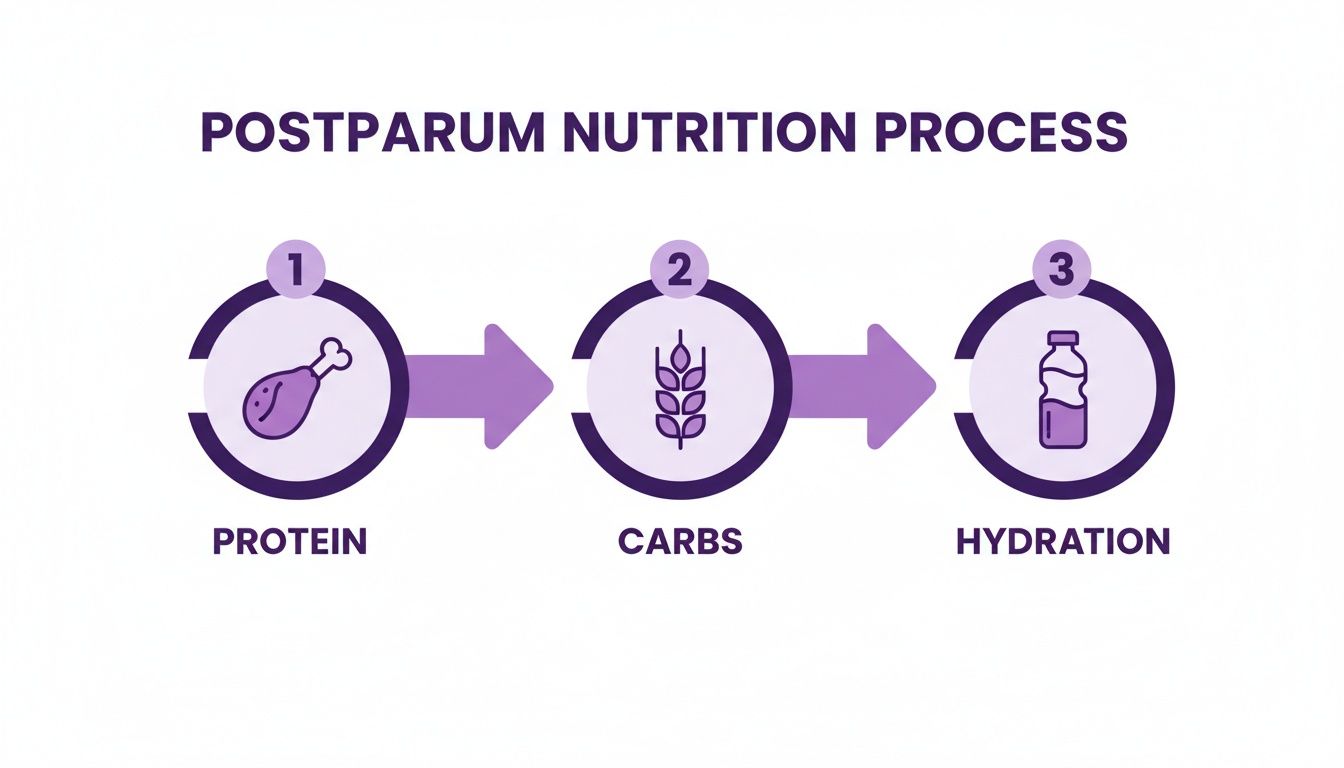
As you can see, fuelling your body properly is the non-negotiable first step. Only then can you start to feel ready for more activity.
Listening to Your Body and Spotting Red Flags
Your body is brilliant at sending signals when you're pushing too hard. Learning to recognise these red flags and pulling back when you need to is key to avoiding setbacks.
Pay close attention to any increase in postpartum bleeding (lochia), a feeling of heaviness or bulging in your pelvic area, any urinary leakage during exercise, or sharp, persistent pain. These are clear signs to stop, rest, and check in with your healthcare provider.
If you're dealing with common postpartum issues, it doesn't mean you have to stop moving altogether, but you do need to be smart about it. For instance, if you're concerned about exercising with a hemorrhoid, there is specific guidance available to help you adapt safely.
Integrating Strengthening Exercises Safely
Official UK guidelines recommend building up to 150 minutes of moderate-intensity activity per week, plus strength exercises twice a week. But for new mums, getting there is a gradual journey that must start with that foundational pelvic floor work.
As you feel stronger and more confident, bringing in bodyweight movements is a fantastic way to rebuild muscle tissue, which in turn helps to boost your metabolism. To get a better understanding of how this works, take a look at our guide on strength training for fat loss.
By combining gentle cardio with targeted strength work, you create a balanced routine that supports sustainable weight loss and helps you feel strong enough to handle all the demands of motherhood.
Setting Goals You Can Actually Achieve
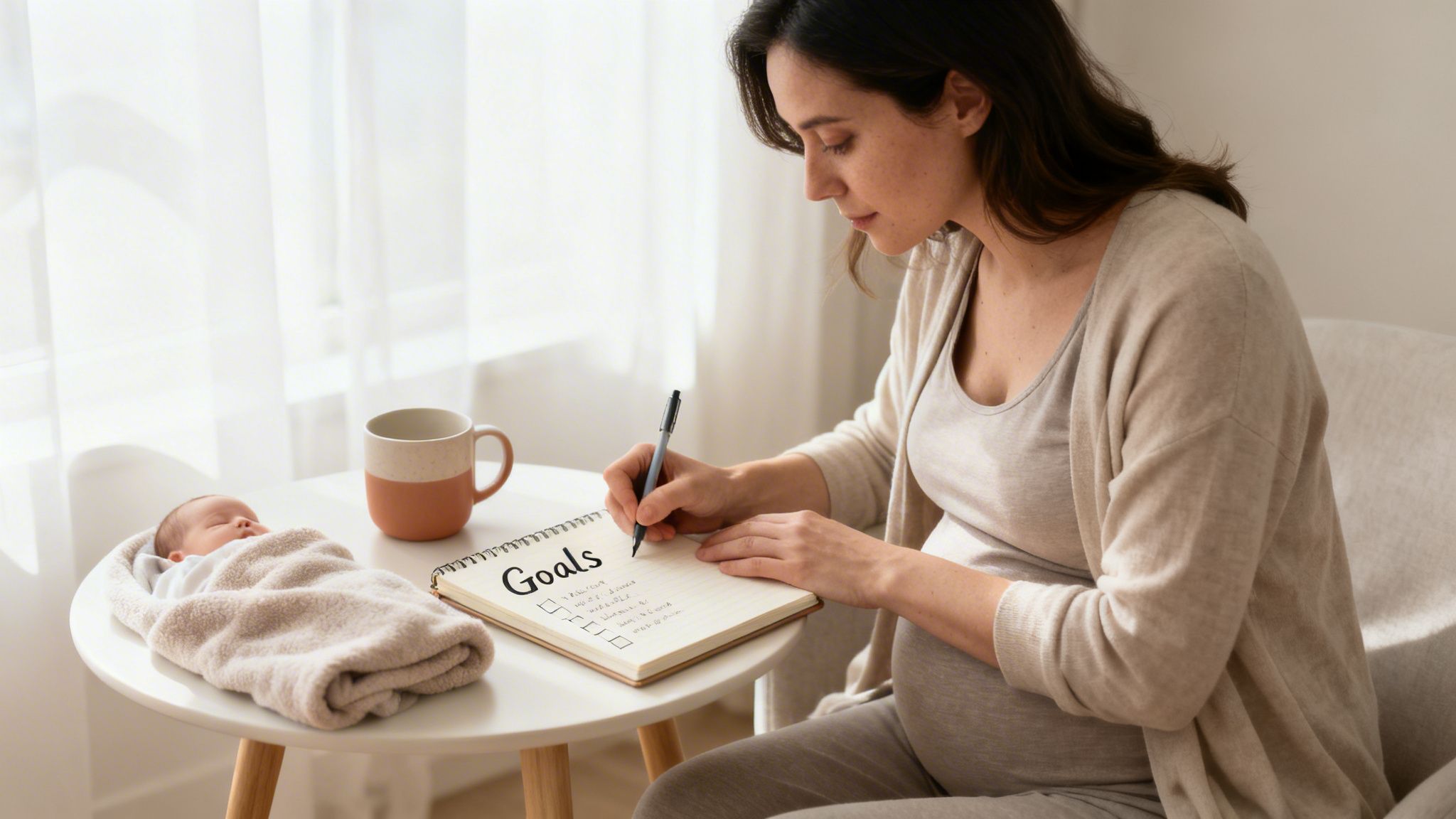
The physical side of postpartum weight loss gets a lot of attention, but the mental journey is often where the real work begins. The pressure to "bounce back" is immense and, frankly, damaging. It pushes new mums toward impossible goals that only lead to burnout and feeling like you've failed.
It’s time to completely reframe what success looks like.
Forget fixating on the scales for a moment. Instead, shift your focus to how you feel. Do you have a little more energy for that late-night feed? Are your pre-pregnancy clothes starting to feel just a bit less snug? These are what we call non-scale victories, and they're powerful reminders that you're moving in the right direction.
Redefining Your Postpartum Goals
Your life has been turned upside down, so it only makes sense that your goals need to change too. The old way of measuring success probably doesn't serve you right now. A much kinder, more effective approach is to set small, manageable targets that fit into your new reality.
This is where the SMART goal framework can be a game-changer.
- Specific: Instead of a vague goal like "I want to be fitter," get precise: "I will go for a 20-minute walk."
- Measurable: Swap "I'll walk more often" for "I will walk three times this week."
- Achievable: Let’s be realistic. Is a 20-minute walk with a newborn doable? Absolutely. Is a 90-minute gym session? Probably not.
- Relevant: Does walking help you feel stronger and more energised? Yes. It's perfectly aligned with your real goal.
- Time-Bound: "This week" gives you a clear and immediate timeframe to focus on.
Suddenly, a wish becomes an actual plan. A goal like "walk for 20 minutes, three times this week" feels achievable and helps you build positive momentum.
Tracking Progress Beyond the Scales
The number on the scales can be a fickle friend, fluctuating wildly thanks to hormones, how much water you've drunk, and whether you managed more than two hours of sleep. Relying on it can be completely demoralising.
It’s far more empowering to track your progress in ways that reflect your growing strength and well-being.
Give these methods a try:
- Take Your Measurements: Once a month, use a tape measure to check in on your waist, hips, and thighs.
- Note Your Fitness Gains: Can you walk a little further before feeling knackered? Can you manage one more squat than you could last week? That's progress.
- The Clothing Test: See how that favourite pair of jeans or a comfy top fits over time. It’s often a more telling indicator than the scales.
It's crucial to accept that progress isn't a straight line. You will have days where you're just too exhausted to move, or you find yourself reaching for comfort food. That’s not failure; it's just part of being a new mum. Show yourself some grace.
Understanding the Bigger Picture
Setting realistic goals is also about safeguarding your long-term health. The pressures on new mothers in the UK are significant. We also know from health data that underlying conditions like obesity can make the postpartum journey more complex. Pre-pregnancy obesity affects roughly one in five women and can present extra challenges.
Reports from MBRRACE-UK highlight why a gradual, health-first approach is so important. Between 2019 and 2021, there were 241 maternal deaths in the UK during or shortly after pregnancy. You can read more about these maternal health findings here.
The goal isn't a rapid transformation. It's about building sustainable habits that support your health for many years to come. Celebrate every small win, be kind to yourself on the tough days, and remember that slow, steady progress is the most powerful kind there is.
Exploring Medically Supervised Support Options
For some new mothers, even with a consistent focus on nutrition and exercise, significant weight loss can be challenging. This may be particularly true for those who had a higher body weight before pregnancy, or for individuals a year or more postpartum who feel they have reached a plateau.
In these situations, considering medically supervised support is a proactive step towards long-term health management.
UK healthcare guidelines outline specific clinical criteria for when medical intervention may be appropriate. It is not considered a first-line treatment but becomes a viable option when sustained lifestyle modifications alone have not achieved the desired health outcomes.
This pathway is typically reserved for individuals who meet certain criteria, ensuring treatments are used responsibly. A discussion about medical support may be initiated if you have:
- A Body Mass Index (BMI) of 30 or higher.
- A BMI of 27 or higher combined with a weight-related health condition, such as high blood pressure.
- Retained significant weight more than 12 months postpartum despite consistent efforts with diet and exercise.
An Educational Overview of Prescription Treatments
When lifestyle changes are insufficient on their own, a clinician may discuss the role of prescription weight management medications. These are not cosmetic solutions, but evidence-based treatments designed to work in conjunction with a structured plan for healthy eating and physical activity.
It is important to note that these options are generally contraindicated during breastfeeding.
A prominent class of medication used for weight management is the GLP-1 receptor agonist.
Administered via injection, these medicines are based on the action of a naturally occurring gut hormone, glucagon-like peptide-1. This hormone plays a crucial role in appetite regulation and blood sugar control. By activating the same receptors in the brain, these medications can:
- Reduce appetite and the psychological preoccupation with food, which can make adhering to a calorie deficit more manageable.
- Delay gastric emptying, which promotes a longer-lasting feeling of fullness after meals.
Clinical trial data for these medications is robust. For instance, large-scale studies on semaglutide (the active compound in Wegovy) demonstrated that participants achieved an average body weight loss of approximately 15% over a 68-week period when the medication was combined with lifestyle interventions.
Another established medication is orlistat, which functions differently by acting directly on the digestive system. As a lipase inhibitor, it works by reducing the absorption of dietary fat by about one-third.
These medications are intended to be one component of a comprehensive weight management strategy. Their efficacy is maximised when used as part of a holistic programme supervised by medical professionals, which includes nutritional guidance and physical activity.
Potential Side Effects and Considerations
As with any medication, there are potential side effects that should be discussed thoroughly with a clinician. For GLP-1 receptor agonists, the most common side effects are gastrointestinal in nature and are typically mild to moderate.
These may include:
- Nausea
- Diarrhoea
- Constipation
- Vomiting
These effects are often most noticeable at the beginning of treatment or after a dose increase and tend to subside as the body adapts. Medically supervised programmes mitigate these by starting with the lowest possible dose and titrating upwards slowly.
The Role of a Clinical Support Programme
A responsible approach to medical weight management involves more than just a prescription. A structured clinical programme provides a comprehensive framework for achieving and maintaining results.
This typically includes:
- Expert Clinical Oversight: Assessment, prescription, and ongoing monitoring by a UK-registered clinician.
- Tailored Nutritional Guidance: Practical advice to ensure the body is properly nourished during treatment.
- Strength-Focused Exercise Plans: Guidance designed to help preserve lean muscle mass, which is vital for maintaining a healthy metabolism during weight loss.
This integrated support system is designed not just for weight reduction, but for building sustainable health habits. For more detailed clinical information, our guide on Mounjaro and postpartum weight management offers further reading. Combining evidence-based medicine with expert care creates a safe and effective path forward.
Your Postpartum Weight Loss Questions Answered
The postpartum period brings a whirlwind of changes and, understandably, a lot of questions. When it comes to your body and getting back into shape after pregnancy, the sheer amount of information can feel overwhelming. Let's cut through the noise with some clear, evidence-based answers to the questions we hear most often from new mums.
How Long Does It Really Take to Lose Baby Weight?
There’s no magic number here, and if there’s one thing to embrace, it’s patience. Most healthcare professionals agree that a realistic goal is to return to your pre-pregnancy weight within six to twelve months after giving birth.
But that’s just a guideline. This timeline is shaped by so many different factors—your starting weight, how much you gained during pregnancy, your diet, activity levels, and even your genetics all have a say.
The safest and most sustainable way forward is to aim for a gradual loss of about 1-2 pounds per week. This pace ensures you're losing fat, not just water or precious muscle mass that your body needs for strength and recovery.
The key is to focus on building consistent, healthy habits rather than chasing a date on the calendar. Remember, it took nine months to grow and nurture your baby; it's only fair to give your body at least that long to recover and readjust.
Can I Safely Lose Weight While Breastfeeding?
Yes, you absolutely can. It's perfectly safe to lose weight gradually while breastfeeding. In fact, the process itself gives you a gentle metabolic boost. Producing milk is hard work for your body and requires a lot of energy, burning an extra 300-500 calories each day on average.
The most important thing to avoid is any kind of crash diet or severely restrictive eating plan. Drastically cutting your calorie intake won't just leave you feeling depleted and exhausted (which no new mum needs), but it can also interfere with your milk supply.
A modest, sensible calorie deficit is the ideal approach. This usually means eating about 500 calories less than your total daily energy needs, focusing on nutrient-dense foods to keep your energy up. As long as you don't make any sudden, extreme cuts, most women find their milk supply remains stable while they slowly and safely lose weight.
What Are the Signs I Am Pushing Myself Too Hard with Exercise?
Learning to listen to your body is one of the most critical skills you can develop in the postpartum period. Your body is smart and will give you very clear signals if you’re overdoing it with exercise.
Keep an eye out for these red flags:
- Increased Bleeding: If you notice your postpartum bleeding (lochia) gets heavier or turns bright red again after a workout.
- Profound Exhaustion: Feeling completely wiped out after exercise, rather than gently energised.
- Persistent Pain: Any sharp, ongoing pain in your joints, pelvis, or back that feels different from normal muscle soreness.
- Pelvic Heaviness: A sensation of dragging, bulging, or pressure in your pelvic area, which can signal pelvic floor strain.
- Urinary Leakage: Leaking urine during or after a workout is a sign your pelvic floor isn't ready for that level of intensity just yet.
If you experience any of these symptoms, it's a non-negotiable sign to stop, rest, and check in with your GP or a women's health physiotherapist before continuing.
Is a Mum Pouch Normal and Will It Go Away?
The "mum pouch" is incredibly common, so please know you are not alone in this. It’s usually a combination of a few things: weakened abdominal muscles, excess skin that was stretched during pregnancy, and a layer of subcutaneous fat.
For many women, this area does reduce significantly over time with the right approach—a consistent combination of a healthy diet, overall fat loss, and, most importantly, targeted core exercises.
It's crucial to understand that traditional ab exercises like crunches can sometimes make the problem worse, especially if you have diastasis recti—a separation of the abdominal muscles. A women's health physio can properly assess you for this and provide a specific programme of deep core strengthening exercises. This is by far the most effective way to help heal the muscle separation and improve the appearance of your midsection.
Ready to explore a supportive, medically guided path to your postpartum health goals? At Trim, we provide a comprehensive programme that combines evidence-based medicine with expert clinical care, tailored nutrition, and strength-focused training. Take our 5-minute consultation to see if a personalised treatment plan is right for you. Find out more at https://gettrim.co.uk.