
Best Weight Loss Clinic: UK Choice Guide

People searching for the best weight loss clinic tend to start with the wrong question. They ask which service is fastest, cheapest, or most aggressive with prescriptions, when the central issue is whether the clinic can manage obesity as a chronic health condition with proper screening, supervision, and follow-up. In the UK, that distinction matters because weight management is tied to a long clinical history, not a cosmetic quick fix, and the evidence base now points to governance, maintenance, and eligibility as the markers of quality.
| Clinic check | Why it matters |
|---|---|
| Eligibility screening | Confirms the service checks BMI, comorbidities, and relevant contraindications before treatment |
| Prescriber oversight | Shows medication is handled by a registered clinician, not an automated checkout flow |
| Follow-up and maintenance | Indicates the clinic plans for side effects, review points, and what happens if weight loss slows or stops |
| Behavioural support | Confirms treatment is paired with diet, activity, and habit change rather than medicine alone |
| Safety governance | Helps you verify pharmacy oversight, product legitimacy, and escalation pathways |
Table of Contents
- Redefining the Best Weight Loss Clinic
- Clinical Governance and Regulatory Standards
- Comparing Treatment Options and Eligibility
- The Reality of Weight Regain and Maintenance
- Evaluating Clinic Claims Against National Guidelines
- Pathways for Diverse Patient Needs
- Building a Sustainable Weight Management Strategy
Redefining the Best Weight Loss Clinic
The most common mistake in clinic comparisons is treating speed as a proxy for quality. A service that issues a prescription quickly can still be clinically weak if it doesn't document screening, explain eligibility, or plan for what happens when treatment changes. In the UK, that matters because obesity prevalence remains high, and regulated care has to account for long-term risk, not just short-term appetite suppression.
A better definition of the best weight loss clinic starts with continuity. A service should treat weight management as a supervised pathway with review points, adverse-effect monitoring, and a plan for maintenance or discontinuation. That's the only way to separate a real clinical service from a transactional online sales funnel.
For people comparing options, a useful lens is simple: does the clinic behave like a healthcare provider or like a pharmacy cart?
Practical rule: if the clinic's main selling point is instant access, treat that as a warning sign, not a benefit.
For patients who want a more structured way to think about ongoing habits alongside treatment, adaptive weight loss routines can be a helpful framework, but the clinic still needs to provide medical oversight and clinical follow-up. A strong service doesn't outsource responsibility to the patient after the first consultation. It keeps track of eligibility, dose changes, side effects, and progress over time.
That approach matters because weight management isn't one decision, it's a sequence of decisions. The clinic you choose should be judged on whether it can support those decisions safely.
Clinical Governance and Regulatory Standards
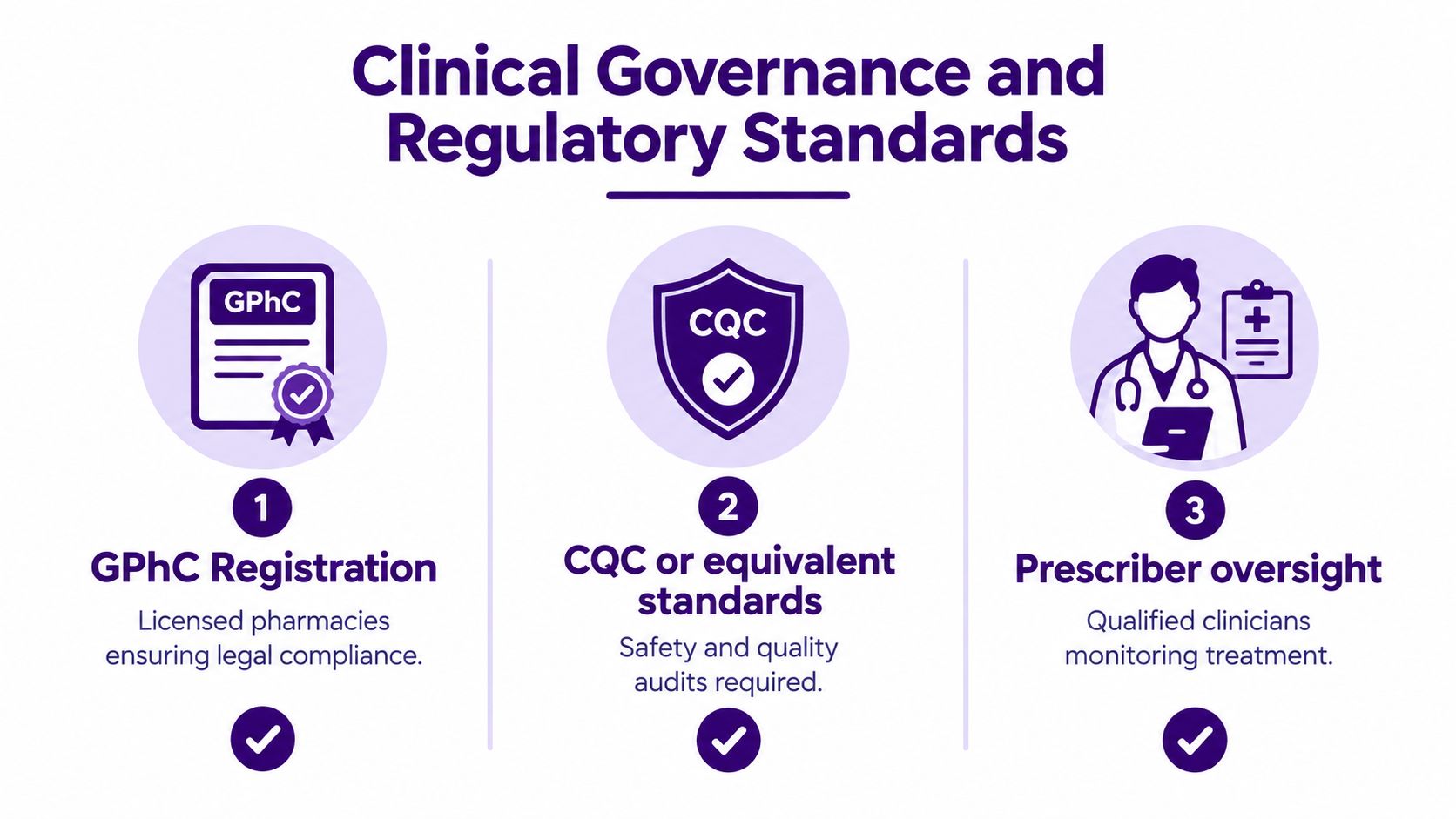
A legitimate clinic starts with governance, not marketing. The MHRA says GLP-1 medicines for weight management are prescription-only and should be prescribed under medical supervision by a registered healthcare professional. It also warns that common gastrointestinal side effects may affect more than 1 in 10 patients and can require structured follow-up rather than a one-off purchase, which is why any serious service should build in review, triage, and escalation pathways. MHRA safety guidance on GLP-1 medicines
That regulatory standard should show up in visible clinic behaviour. If a service skips identity checks, avoids asking about pregnancy or contraindications, or can't explain who the prescriber is, it's failing before treatment even begins. The same goes for pharmacy governance, because an authorised product, clear storage standards, and accurate dosing instructions aren't extras, they're the basics of safe prescribing.
A clinic that can't explain how it handles side effects doesn't have a safety system, it has a checkout page.
The best way to verify a clinic is to ask for specific operational details. Who reviews suitability? How is prescribing authority documented? What happens if symptoms become severe? What is the process for missed doses, treatment interruptions, or referral onward if the patient needs in-person care?
If you want an example of how a properly inspected service frames this issue, see this discussion of GPhC inspection and safety standards. The point isn't to praise one brand, it's to recognise the standard a clinic should meet if it claims to be clinically credible. In practice, the safest services make governance visible, explainable, and auditable.
Comparing Treatment Options and Eligibility
The NHS draws clear distinctions between the main medication classes, and that distinction should shape how you judge a clinic. Semaglutide and tirzepatide are appetite-related medicines that reduce appetite and increase fullness, while orlistat works by reducing the amount of dietary fat absorbed from food. NHS guidance on overweight and obesity A clinic that lumps them together as interchangeable is flattening important clinical differences.
| UK Weight Management Medications Overview | |||
|---|---|---|---|
| Medication Class | Mechanism of Action | Standard NICE BMI Threshold | Administration |
| GLP-1 medicines such as semaglutide | Reduce appetite and increase fullness | Depends on the licensed indication and eligibility criteria | Injection |
| Dual-action medicines such as tirzepatide | Reduce appetite and increase fullness | BMI of at least 35 kg/m² with a weight-related comorbidity in NICE guidance | Injection |
| Orlistat | Reduces the amount of dietary fat absorbed from food | BMI of at least 30 kg/m², or 28 kg/m² with associated risk factors | Oral capsule |
That table is useful only if the clinic uses it properly. NICE says weight-management programmes should be multicomponent interventions, combining behaviour change around physical activity, eating behaviour, diet quality, and energy intake. NICE final scope So even when medication is appropriate, it should sit inside a broader programme rather than replace one.
A sensible clinic also checks ethnicity-adjusted BMI thresholds where relevant. NICE notes that for people from South Asian, Chinese, other Asian, Middle Eastern, Black African, or African-Caribbean backgrounds, BMI thresholds are usually reduced by 2.5 kg/m². That's not a footnote, it changes eligibility.
If you're comparing service models, a useful product-style reference point is a guide to peptide dosing and scheduling, but dosing support alone isn't enough. The clinic still has to manage eligibility, diet, activity, and review. For a practical overview of how medication fits into a supervised pathway, this internal reference is also useful: weight-loss medication in the UK.
The right conclusion is straightforward. A clinic shouldn't be judged by whether it offers the newest injection first. It should be judged by whether it matches the right treatment to the right patient under the right clinical criteria.
The Reality of Weight Regain and Maintenance
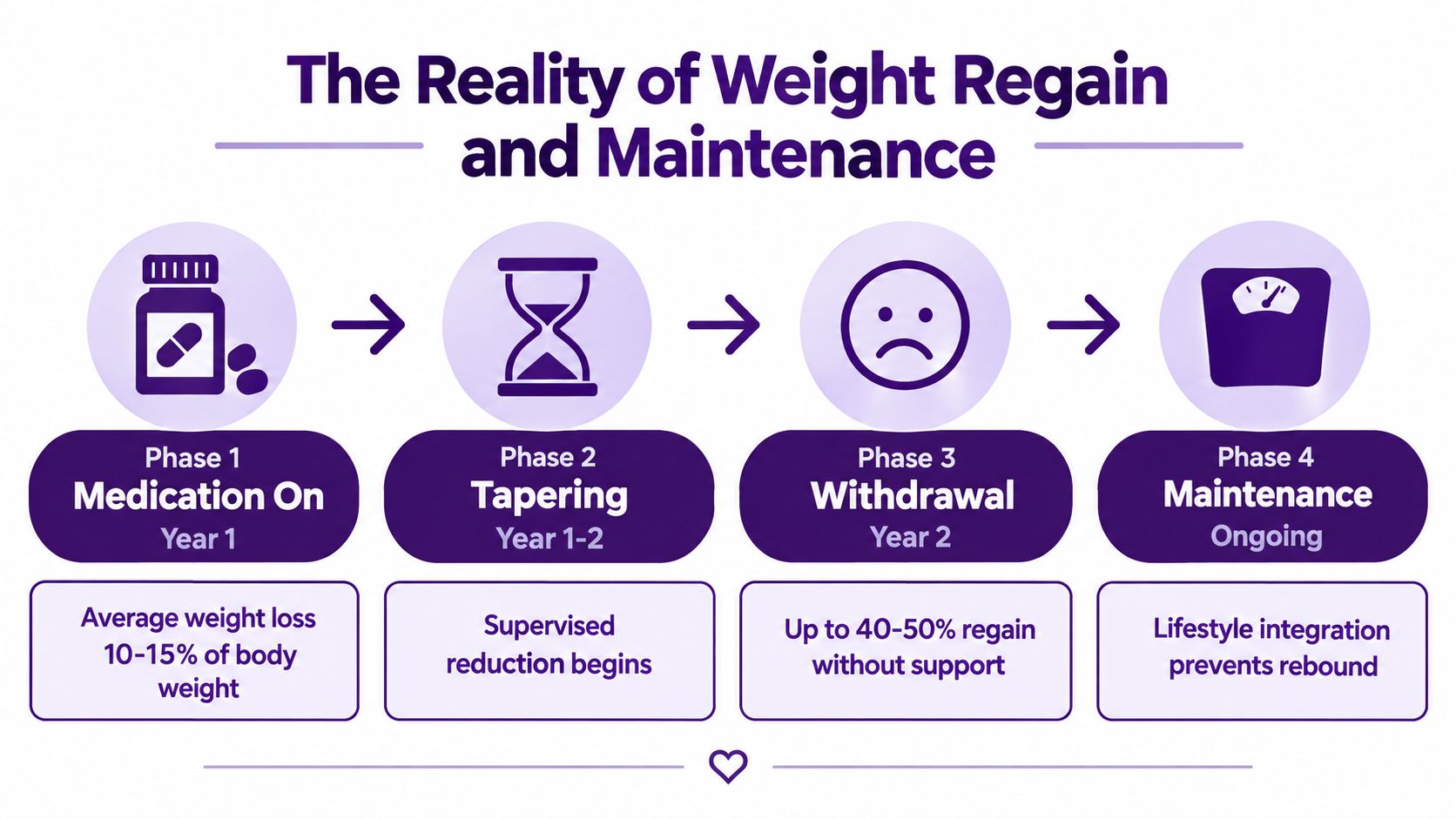
The weak point in many clinic models is not the prescription phase, it's the exit phase. Recent evidence from a review of 37 studies involving 9,341 adults found that weight increased by an average of 0.4 kg per month after weight-management medication was discontinued, and regain averaged about 0.8 kg per month for newer medicines such as semaglutide and tirzepatide. Oxford review on weight regain That makes maintenance planning a clinical necessity, not an optional extra.
What this means in practice is that a clinic should talk about treatment as a lifecycle. Appetite can return, routines can loosen, and the habits that supported weight loss can fade once the medication stops. A service that only celebrates initiation is not preparing the patient for the more difficult part of the journey.
Clinical takeaway: the best clinic is the one that already has a plan for when treatment is paused, reduced, or no longer affordable.
The most credible services build their pathways around continuity. They review protein intake, strength-focused activity, behavioural support, and follow-up structure before stopping medication becomes an issue. That matters because post-treatment support isn't just about preventing scale rebound, it's also about preserving the habits that made progress possible in the first place.
NICE quality standards now recommend at least one year of post-treatment support, which makes the maintenance question even more important. A clinic that can't describe what happens after the first course of treatment hasn't solved the hardest part of medical weight loss. It has only delayed it.
The internal guide on how to maintain weight loss is relevant here because maintenance should be planned alongside treatment, not after it. That's also where clinics separate themselves in real life. Some support a patient through tapering, relapse risk, and follow-up. Others disappear after the first success message.
Evaluating Clinic Claims Against National Guidelines
NICE gives patients something far more useful than marketing language, a performance threshold. The practical benchmark for weight-loss medication is at least 5% loss of initial body weight after 6 months, and treatment should be reviewed if that benchmark is not achieved. NICE committee discussion That standard matters because it shifts the conversation from vague promises to measurable response.
What to ask before you start
A clinic that works to national standards should be able to answer these questions clearly:
-
What was my baseline BMI and how was it calculated?
The clinic should document the starting point rather than rely on informal estimates. -
What comorbidities were checked?
A proper assessment looks at relevant conditions, not just body weight. -
How will dose escalation be monitored?
Safe prescribing includes review as treatment changes. -
What happens if I don't meet the 6-month benchmark?
A serious service will have a plan for non-responders. -
How are side effects, interruptions, and maintenance tracked?
Progress without safety data is incomplete.
You should also expect more than body weight alone. A stronger clinic records waist circumference, blood pressure, glycaemic markers where relevant, and any adverse effects or interruptions. Those details matter because they show whether the service is practising medicine or just chasing scale changes.
If you hear a clinic lead with testimonials before evidence, be cautious. Testimonials can be real, but they don't replace a review structure. The key question is whether the clinic knows how to interpret results against a recognised threshold and whether it will pause or change treatment if the numbers don't justify continuation.
Pathways for Diverse Patient Needs

A man trying to lose fat while keeping muscle, a postpartum patient trying to stabilise appetite, and someone managing weight during menopause do not need the same plan. They may all be suitable for weight management support, but the clinic has to adapt its clinical oversight, nutrition advice, and follow-up to the person in front of it. Generic online services often fail at that point.
NHS England says primary-care eligibility for certain weight-management injections may require a BMI of at least 35, adjusted for ethnicity, together with diagnosed conditions such as dyslipidaemia, hypertension, or type 2 diabetes. NHS England weight-management injections guidance That matters because treatment should follow clinical thresholds, not a blanket promise that anyone can qualify if they want faster results.
A strong clinic also answers questions that people do not always think to ask. It should review pregnancy or postpartum status, check for interacting medicines, and explain why someone may not be suitable for treatment. It should also signpost an NHS route if needed and account for digital exclusion, language confidence, or affordability if treatment becomes ongoing.
Clinics that ignore access barriers often look convenient to the healthiest, most connected patients, while offering less value to everyone else.
The best clinic is not always the one with the slickest sign-up flow. A capable service makes room for individual physiology and individual constraints, then explains the clinical reasoning in plain English. The right pathway for one patient may be inappropriate for another, even when their weight-loss goals sound similar.
For people who also need joint-friendly movement ideas during treatment, the guide to osteoarthritis support gear may be useful in a broader lifestyle plan. The clinic still has to lead with medical suitability, because equipment and advice only help when they match the patient's needs.
Building a Sustainable Weight Management Strategy
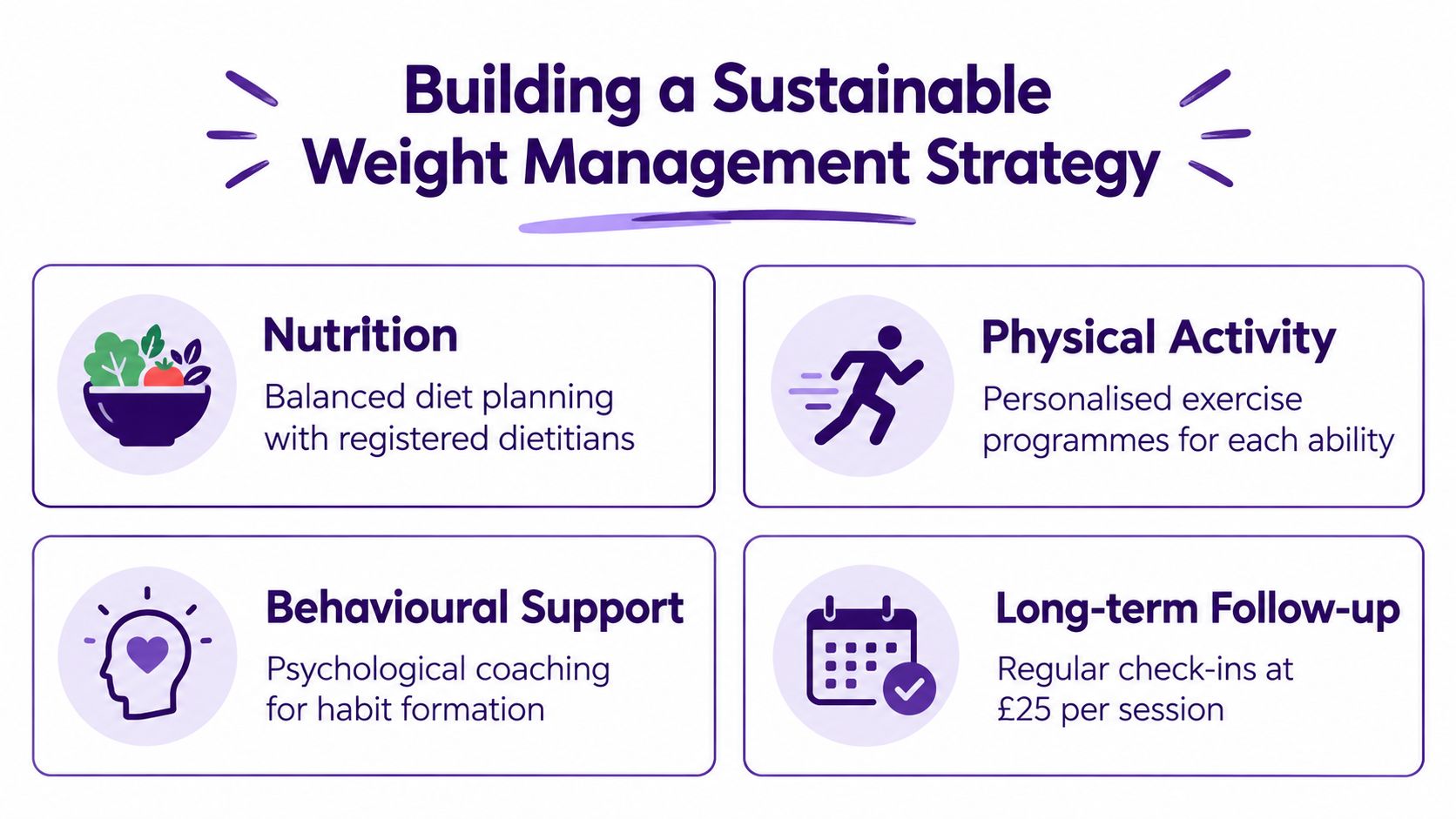
NICE is explicit that weight-management programmes should combine behaviour-change strategies addressing physical activity, eating behaviour, diet quality, and energy intake, with multicomponent interventions as the treatment of choice. NICE final scope That means medicine can help, but it can't carry the whole programme. A clinic that understands sustainability treats prescribing, nutrition, movement, and support as a single system.
The strongest services do a few things consistently. They explain how treatment fits with regular meals, they encourage activity the patient can maintain, and they keep reviewing the plan when weight loss slows or side effects appear. They also recognise that success is more than initial loss, because maintenance, adherence, and confidence matter after the first few months.
A clinical service that is worth your trust should sound measured, not dramatic. It should talk about suitability, monitoring, and long-term habits rather than treating the prescription as the end point. If it doesn't, it's not really offering a weight-management strategy, it's selling a short-term intervention.
For readers who want a structured example of a medically supervised UK pathway, Trim combines clinician review, pharmacy oversight, and ongoing support within a digital service model. That matters in a category where the biggest risks are usually not the medicine itself, but weak governance, poor follow-up, and no plan for maintenance.
Choose the clinic that can explain how it will support you after the first result. If you want a service that treats weight loss as a regulated clinical process rather than a quick transaction, visit Trim and review how its medically supervised model aligns with the standards discussed here.