
Weight Loss and Inflammation: What Works and Why

You've lost a few kilos, your jeans sit looser, and a blood test still flags inflammation. Or the opposite happens. You feel less puffy, yet the scale barely moves. That mismatch is common, and it is easy to read as failure.
Weight and inflammation run on two tracks. They often change at different speeds. The number on the scale is only the visible track. The inflammatory track sits in abdominal fat, immune cells and the liver, and it does not reset the week the dial drops.
What follows sticks to clinical evidence. It explains what weight loss and inflammation research does and doesn't show, without treating any medicine as a shortcut that replaces food, movement or medical review.
Table of Contents
- Why Excess Fat Keeps Inflammation Switched On
- How Much Weight Loss Shifts Inflammation Markers
- Why Inflammation Lags Behind the Scale
- Eating Patterns That Calm Inflammation Without Strict Rules
- Movement, Sleep, Stress and Gut Health as Inflammation Levers
- Medication Options and When to Seek Medical Supervision
- Tracking Progress and Knowing When to Book a Review
Why Excess Fat Keeps Inflammation Switched On
Think of an enlarged fat cell as an overfilled storage unit. The door won't close, and the unit starts sending out alarm signals. Immune cells rush in to investigate, and they stay.
That picture is closest to visceral fat, the fat packed around the abdominal organs rather than the fat you can pinch on an arm. When those storage cells enlarge, they release chemokines and cytokines, chemical messages that call in macrophages, a type of immune cell. More immune cells in the tissue means more ongoing signalling, not a one-off response to a cut or a cold.
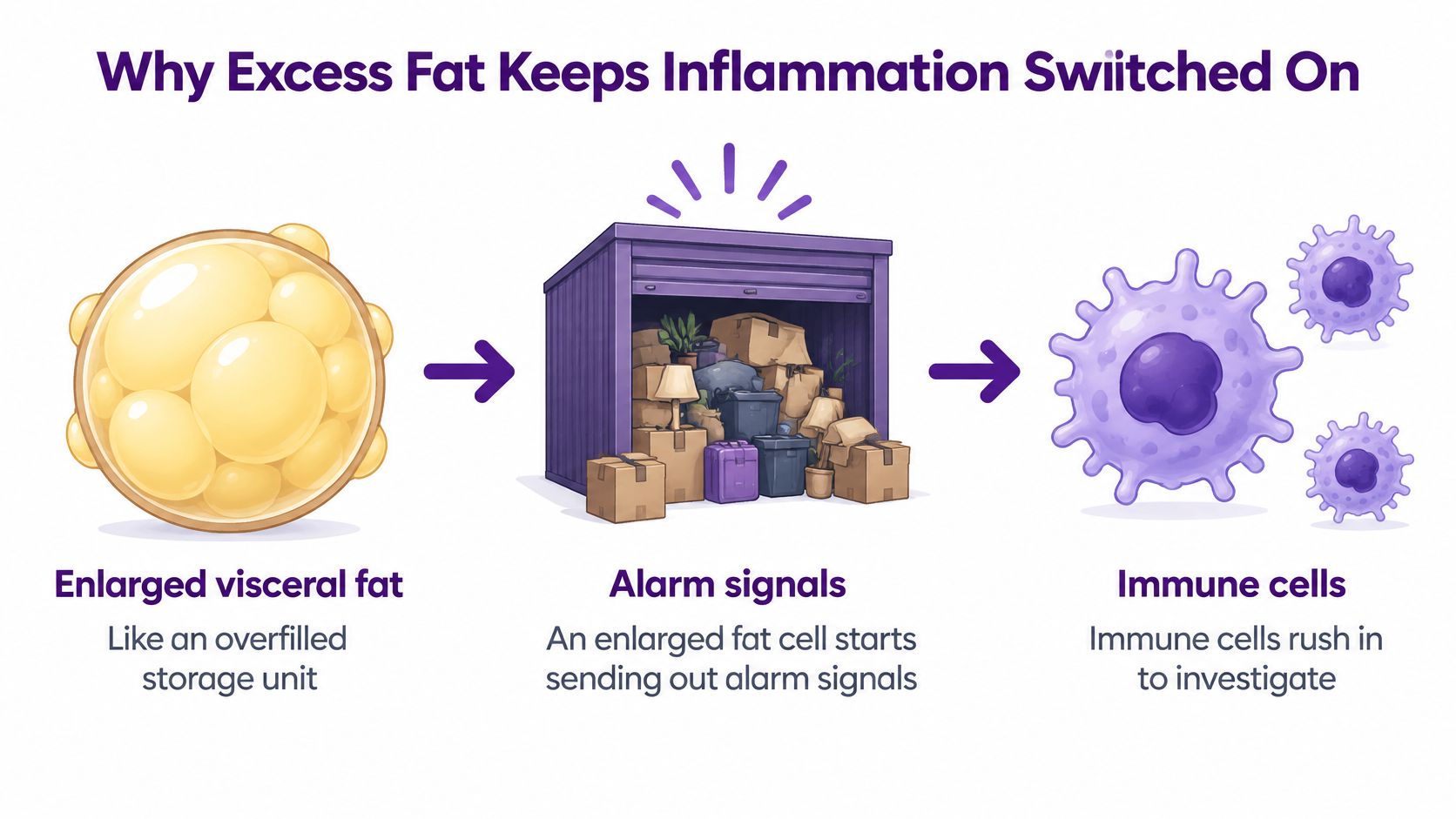
From fat cell to a blood marker
The chain has one more link. Enlarged fat cells also spill more free fatty acids into the circulation. That extra flux promotes inflammatory signalling and pushes the liver to make more C-reactive protein (CRP), an acute-phase protein produced mainly by the liver when cytokine signals arrive. CRP is a blood marker of that process. It is not the inflammation itself, and it is not a diagnosis you can read at home.
A UK Biobank analysis of CRP in common chronic conditions found that diabetes was associated with 42% higher CRP before adjustment. After body-mass index was accounted for, that link was fully attenuated. Excess adiposity largely explained the elevation. Similar patterns were reported for myocardial infarction, hypertension and sleep apnoea.
Practical rule: waist circumference and metabolic risk tell you more about inflammatory burden than the scale alone.
For adults in a medically supervised programme, a smaller waist can matter more than an identical drop in kilos if the loss came from central fat. People managing weight loss with insulin resistance often see this split, because insulin resistance and visceral fat travel together.
CRP still needs a clinician's eye. Infection, injury and chronic disease can raise it too. A persistently high reading is a reason for clinical assessment, not a cue to self-treat with supplements or to assume every ache is "just inflammation."
How Much Weight Loss Shifts Inflammation Markers
The first useful benchmark is about 5% of body weight. In dietary weight-loss trials, reductions in circulating interleukin-6 (IL-6) became statistically significant once losses passed that line. Around 10%, kept off rather than regained, is where reviews see the broadest biomarker shift. A Ulster University review of weight loss and inflammation reported falls in CRP, tumour-necrosis factor-alpha, IL-6 and leptin, plus rises in the anti-inflammatory hormone adiponectin, with the largest improvements at losses of at least 10%.
Below 5%, don't expect a clean lab change. Evidence for tumour-necrosis factor-alpha (TNF-alpha) stays inconclusive even above that line.
How to read the benchmarks
| Weight loss | Reported inflammatory change | Strength of evidence |
|---|---|---|
| Under 5% body weight | TNF-alpha changes inconclusive; IL-6 not reliably reduced | Limited; track progress but do not expect biomarker change |
| Over 5% body weight | IL-6 reductions become statistically significant in dietary weight-loss trials | Moderate; systematic review evidence |
| Around 10% body weight | Broadest biomarker improvement, including CRP, TNF-alpha, IL-6, leptin and adiponectin | Moderate; review evidence, strongest when the loss is maintained |
| 9.6% over 12 weeks (ProBE-TDR) | Falls in cholesterol, blood fats, insulin and inflammation markers | Single programme; not a result for every adult |
| Semaglutide 2.4 mg over 68 weeks (STEP 1 to 3) | CRP lower than placebo alongside weight loss | Exploratory analysis; an association, not proof that disease is prevented |
Read the rows as averages from groups, not as a personal guarantee. "Moderate" means several studies point the same way, not that every marker moves in every person.
What the trials actually measured
In the ProBE-TDR low-calorie diet replacement study, people on a 12-week programme lost an average of 9.9 kg, equal to 9.6% of starting weight. The control group gained 1.4 kg (1.4%). The weight-loss group also showed reductions in total cholesterol, blood fats, insulin and markers the study described as inflammation. The summary doesn't name every inflammatory marker, so this is a concrete example of a near-10% loss sitting beside metabolic change, not proof that every biomarker improves equally.
Three 68-week phase 3 trials, STEP 1, STEP 2 and STEP 3, looked at semaglutide 2.4 mg and CRP. Those CRP differences are set out in the medication section, because the analysis was exploratory and shouldn't be read as disease prevention.
A practical sequence is 5% first, then about 10%, with the loss maintained. Pairing a lower energy intake with resistance training helps fat mass fall while lean tissue is protected. A clinician should decide which markers to check, and when. Not every symptom is inflammation.
Why Inflammation Lags Behind the Scale
A common belief is that any amount of weight loss clears inflammation. The evidence doesn't support that. Visible loss and tissue recovery are different jobs, and they finish on different days.

Refurbishing a house is a fair comparison. The rooms you walk through get cleared first. The wiring behind the walls takes longer. Weight is the cleared room. Adipose-tissue recovery is the wiring.
What fat tissue still does after the kilos drop
A 2025 UK-linked analysis of 171,247 fat-tissue cells from 70 people found that weight loss reduced obesity-related macrophage infiltration and reversed cellular senescence. It did not fully reverse macrophage activation. Those cells stayed biologically primed to contribute to weight regain and metabolic dysfunction.
That single finding answers a question clinics hear often. What if weight, symptoms and blood markers improve at different speeds?
- A plateau isn't automatic failure. The scale can stall while tissue signals are still changing, or the reverse.
- Loss doesn't reset inflammation. Improvement can be real and still incomplete.
- Earlier benchmarks are group averages. They describe what often happened in trials, not a promise for one body.
An adult can lose a meaningful share of body weight and still have a high CRP. The useful response is a clinician review, not a new supplement stack.
CRP, IL-6 and related markers are not interchangeable tests. One can move while another stays put. They belong in a clinical interpretation, not in a home dashboard treated as a diagnosis.
A short explainer on how inflammatory signalling is discussed in weight research sits below. It is background, not a personal treatment plan.
If your weight has moved and you still feel unwell, bring both facts to the same appointment. The gap between them is information, not a verdict that treatment has failed.
Eating Patterns That Calm Inflammation Without Strict Rules
There isn't a single anti-inflammatory food, and there isn't a branded diet that does the job by name alone. The pattern of ordinary meals matters more.
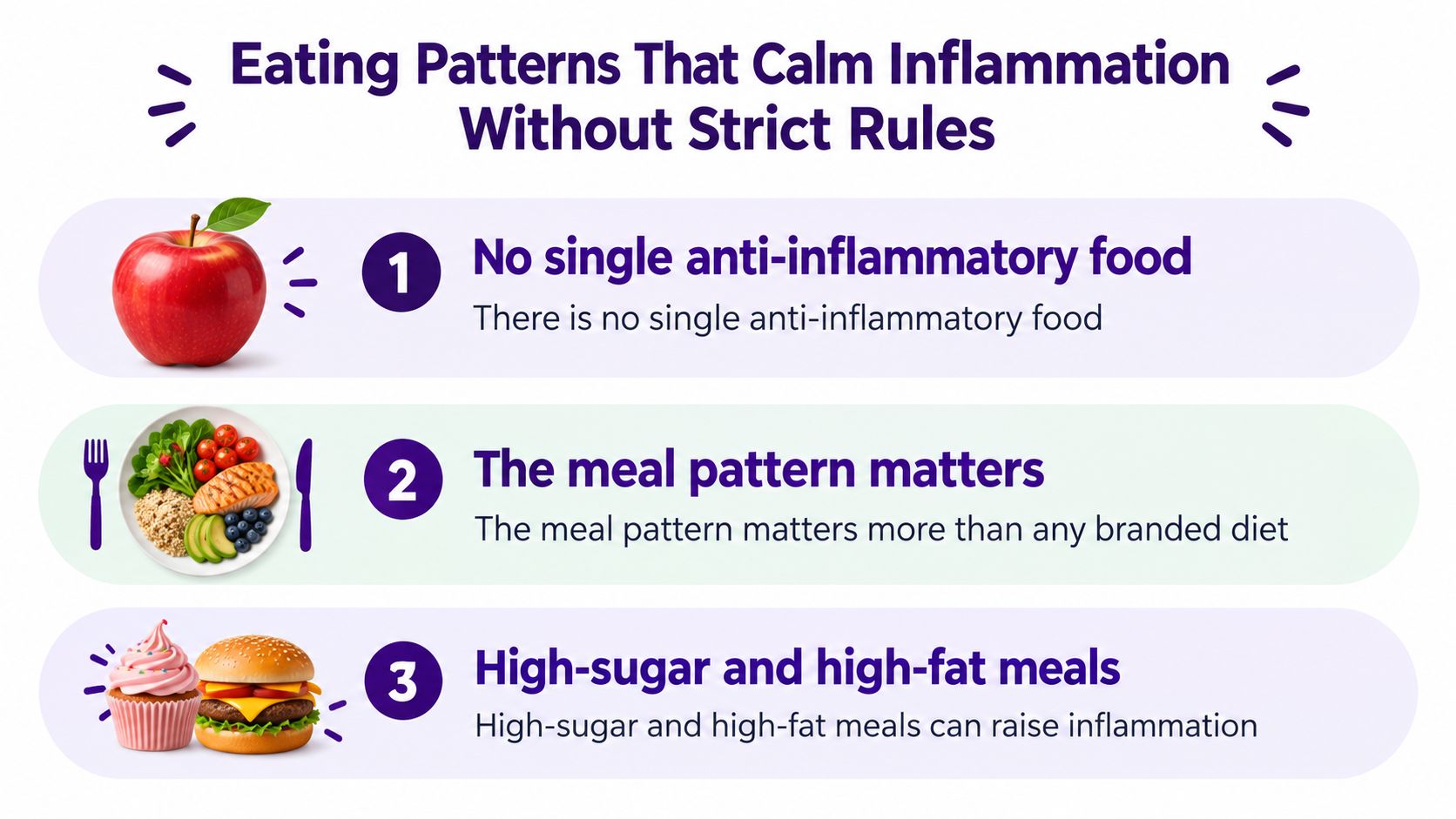
A British Journal of Nutrition review of diet and low-grade inflammation indicates that high-simple-sugar and high-fat meals can raise inflammation in the hours after eating, while fibre, plant polyphenols and omega-3 fats may partly blunt that response. Much of that human evidence wasn't gathered specifically in people with obesity, so treat it as a steer, not a personal guarantee. A separate review linked Mediterranean-diet adherence with 9% lower odds of excess weight, and it also said evidence tying anti-inflammatory dietary patterns to outcomes is still limited.
Build the plate, don't ban a food group
| Food group | Role in inflammation control | Practical UK example |
|---|---|---|
| Vegetables and salad | Fibre and plant polyphenols that may blunt post-meal responses | Half the plate at lunch and dinner; frozen veg counts |
| Pulses (lentils, chickpeas, beans) | Fibre and protein with slow digestion | Three tablespoons cooked, in soups, stews or salads |
| Wholegrains | Fibre that supports steadier blood sugar after meals | Porridge oats, brown rice, wholemeal wraps |
| Oily fish | Omega-3 fats | One to two portions weekly, tinned fish included |
| Nuts and seeds | Unsaturated fats and fibre, calorie-dense | A 30 g handful, measured rather than eaten from the bag |
| Unsaturated oils | Replace saturated fats in cooking | A tablespoon of rapeseed or olive oil instead of butter or lard |
| Lean protein | Helps protect muscle while energy intake falls | Eggs, chicken, tofu or Greek yoghurt, including smaller portions |
If you want worked examples of this style of eating, you can find anti-inflammatory meal plans that stay with everyday ingredients rather than elimination lists. The same idea applies to the hidden load in ultra-processed foods: frequency and the rest of the plate matter more than a single "bad" item.
When appetite drops
Nausea or appetite suppression can reduce your intake of fibre and protein, the two parts of the pattern that are easiest to skip. On those weeks, use smaller portions you can finish. Try yoghurt with oats, tinned fish on toast, lentil soup, or frozen vegetables stirred into eggs.
Postpartum and menopausal needs change the same plate, not the principle. Iron-rich foods, calcium and enough protein still belong, and a clinician or dietitian should set those targets if you're breastfeeding or on hormone treatment. Cultural dishes stay. Swap the cooking fat, add a pulse or an extra vegetable, and keep the meal recognisable. A restrictive elimination diet isn't required for inflammation control, and it is harder to sustain.
Movement, Sleep, Stress and Gut Health as Inflammation Levers
Food and weight loss are not the only dimmer switches. Movement, sleep, stress and gut habits turn the same lighting down a notch. None of them is a separate cure, and none replaces the fat-loss benchmarks already covered.
Movement that keeps muscle
Aim for about 150 minutes of moderate activity a week, the usual UK activity steer, plus resistance work on two days. Brisk walking, cycling or swimming covers the aerobic share. Resistance work is the part people drop, and it is the part that protects lean tissue while fat mass falls. Two short sessions, using bands, body weight or gym machines, count. You don't need a heroic programme in week one.
Sleep and sleep apnoea
A steady 7 to 9 hours is a sensible target. Short or broken sleep is tied to a stronger appetite and to higher inflammatory markers in observational work. If you snore loudly, stop breathing in your sleep, or feel wiped out in the daytime, ask a GP about sleep apnoea. That condition sits on the same CRP pattern described earlier, and it needs assessment rather than another early night alone.
Stress feeds the loop through comfort eating and through cortisol that stays high. A fixed walk, a few minutes of slow breathing, and an evening that isn't packed with screens are enough to start. If worry is what keeps you awake, a practical guide to calming anxiety before bed is more useful than adding another supplement.
Fibre before probiotic products
Build toward about 30 g of fibre a day from varied plants: veg, fruit, pulses, oats, nuts and seeds. That amount is a direction, not a target to hit on a sore stomach. Probiotic capsules aren't a substitute for that diet, and evidence on specific strains is mixed. Fermented foods can sit in the pattern if you like them. They don't replace the plate.
Try one change this week, not four at full dose:
- Movement: add two 10-minute walks on days you already leave the house.
- Sleep: set a lights-out time you can keep four nights out of seven.
- Stress: put one walk or breathing slot in the diary before the week fills up.
- Gut: add one pulse or an extra portion of veg to a meal you already cook.
If a habit makes nausea, joint pain or exhaustion worse, scale it back and mention it at your next review. Levers only help if you can keep using them.
Medication Options and When to Seek Medical Supervision
Medicines don't replace the eating, movement and sleep habits above. Where they're used, they support weight loss, and the biomarker changes travel with that loss. A GP or a specialist weight-management service decides eligibility. In UK practice, NICE criteria generally start at a BMI of 30 or above, or 27 or above with a weight-related condition. Those figures are a framework for assessment, not a promise that a prescription will follow.
What the options are for
| Option | How it works | Usually considered for | Inflammation evidence |
|---|---|---|---|
| Lifestyle programme alone | Lower energy intake, activity, sleep and stress changes | Everyone, as the first-line approach | Losses in the 5 to 10% range linked with IL-6 and broader marker changes |
| Semaglutide (Wegovy) | GLP-1 receptor agonist; slows stomach emptying and reduces appetite | Adults who meet NICE criteria, after clinician review | CRP lower than placebo in STEP 1 to 3; exploratory |
| Tirzepatide (Mounjaro) | Combined GLP-1 and GIP receptor agonist; reduces appetite | Adults who meet NICE criteria, after clinician review | Not established in the sources reviewed here |
| Orlistat | Reduces fat absorption in the gut | Adults with obesity, used under supervision | Not established in the sources reviewed here |
A UCL-linked analysis of the STEP trials reported that semaglutide 2.4 mg reduced CRP relative to placebo by 44% in STEP 1, 39% in STEP 2 and 48% in STEP 3. All three differences were statistically significant. STEP 2 included adults with type 2 diabetes. STEP 1 and STEP 3 did not. Within STEP 2, the 2.4 mg dose reduced CRP by 49%, compared with 42% for the 1.0 mg dose, and that dose-to-dose gap wasn't statistically significant. The falls sat alongside weight loss and appeared across different baseline BMI, weight and glycaemic groups.
Those CRP results support an association. They do not prove that a lower CRP, by itself, prevents inflammatory disease.
Evidence in the sources reviewed here is thinner for tirzepatide and for orlistat on inflammatory markers. Absence from those papers isn't proof they do nothing. It means this article won't invent a percentage for them. Some UK services, including Trim, provide clinician-led online assessment for eligible adults alongside lifestyle support. Any prescription still depends on individual review, not on a web page.
Before any medicine starts, a clinician should check medical history, pregnancy plans and other medicines. Warning symptoms don't belong in a dosing discussion. Use the red-flag list in the next section, and seek care the same day if one of them applies.
Tracking Progress and Knowing When to Book a Review
Start a baseline before you change food, activity or treatment. Write down weight, waist, a typical day's meals, sleep hours and the symptoms that bother you. That page is what you compare later, when memory gets slippery.
What to measure, and how often
UK cardiometabolic guidance treats a waist above 88 cm in women and 102 cm in men as higher metabolic risk. Measure waist monthly, at the midpoint between the lowest rib and the top of the hip bone, after a normal breath out. Weigh yourself in similar conditions and use a weekly average, not a single morning. Daily swings from fluid and hormones will otherwise look like progress or disaster.
Inflammation blood tests, including CRP, should be requested by a clinician at intervals they set. They aren't a home kit you repeat whenever you feel off. A guide to blood tests used in weight-loss care explains why the panel is chosen with your history, not copied from someone else's results.
Red flags that need prompt contact
- Fever with joint swelling: contact a GP or urgent care the same day.
- Chest pain or breathlessness: call 999.
- Severe or persistent abdominal pain: urgent clinical review, not a wait-and-see week.
- Yellowing of the skin or eyes: same-day medical contact.
- Persistent vomiting or inability to keep fluids down: urgent review, especially if you're on a weight-loss medicine.
- Low mood or thoughts of self-harm: contact your GP the same day, use NHS 111, or call 999 if you're in immediate danger.
- Unexplained rapid weight loss: book a GP review rather than treating it as a win.
Book a GP or prescriber review at about 12 weeks. Bring the baseline record and a short symptom diary. Agree which markers to recheck, and agree in advance what a plateau should trigger. Sometimes that is a waist and symptom review. Sometimes it is a change in dose, food or activity. It is rarely a reason to abandon a plan that is only half way through the biology.
Trim provides a UK clinician-led weight-management service that pairs eligibility assessment with nutrition, activity and progress tracking, so inflammatory risk is judged on more than the scale. If you want that kind of supervised plan, visit Trim and start with a consultation rather than a self-directed supplement experiment.