
Orlistat Side Effects Liver: What UK Patients Need to Know

UK product information lists hepatitis as a possible but frequency-unknown liver reaction to orlistat, while a UK study of 94,695 orlistat users found no increased risk of definite acute liver injury during treatment. Serious liver harm is therefore rare and not clearly caused by the drug, but new liver symptoms should always be assessed promptly.
What if the timing tells a different story from the warning leaflet? Many people search for orlistat side effects liver concerns after reading that hepatitis can be serious, then assume any abnormal result must mean the medicine damaged their liver. UK evidence is more nuanced. It separates a possible reaction listed for safety from a proven causal effect, and it gives you a clearer rule. Watch for specific symptoms, act quickly if they appear, and don't panic about expected bowel effects that have a different cause.
Table of Contents
- Orlistat Side Effects Liver Risk Explained
- How Orlistat Works and Why Liver Effects Are Different
- What the UK Clinical Evidence Actually Shows
- Warning Signs That Need Medical Attention
- Risk Factors and Other Causes of Liver Changes
- How Orlistat Compares with GLP-1 Treatments
- Key Takeaways and Your Next Steps
Orlistat Side Effects Liver Risk Explained
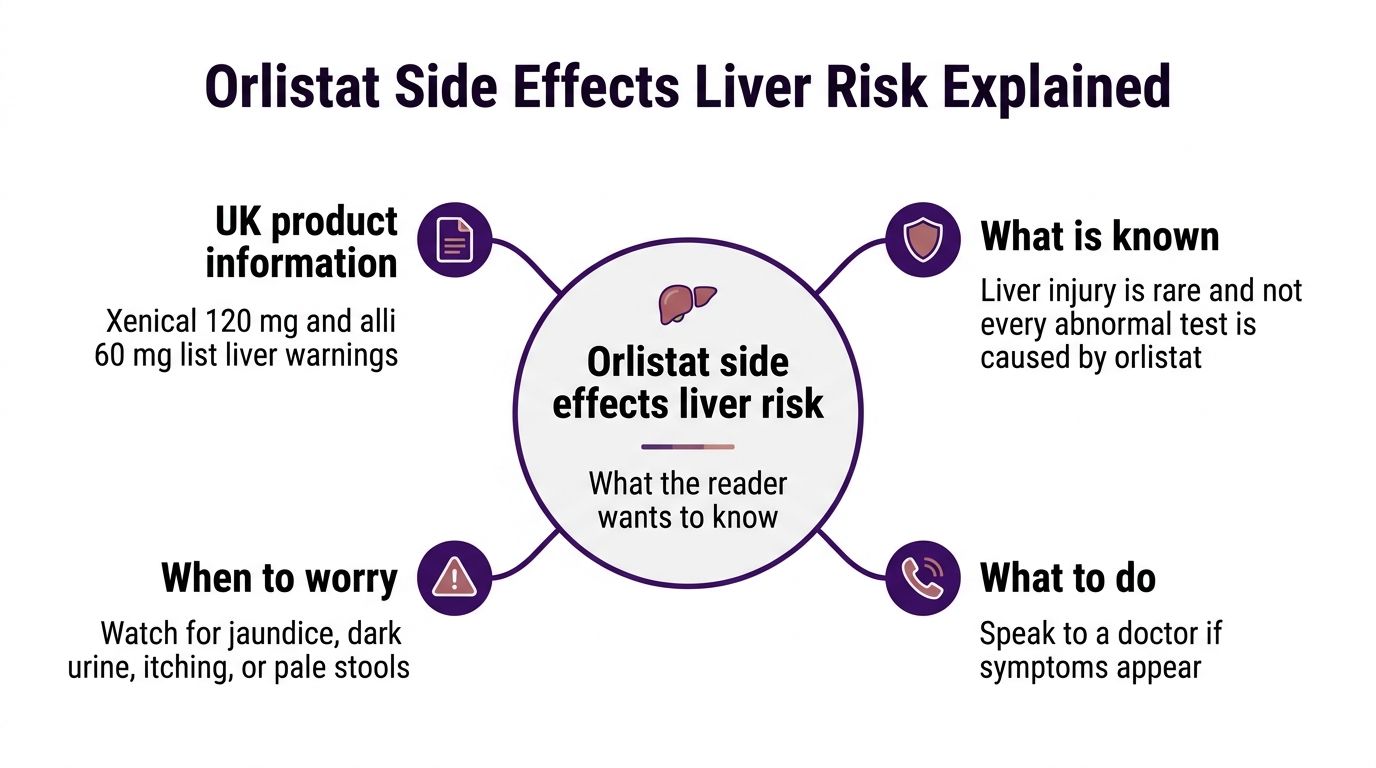
Does orlistat damage your liver? That's the fear behind most searches, and it deserves a direct answer rather than alarm or dismissal. UK product information does list liver problems, but it doesn't describe them as common or predictable.
The UK Summary of Product Characteristics for Xenical 120 mg lists increased liver transaminases and alkaline phosphatase among reported laboratory abnormalities, and lists hepatitis under hepatobiliary disorders. It states hepatitis may be serious and that some reported cases were fatal or required liver transplantation. The lower-dose non-prescription product alli 60 mg carries the same warning.
What Frequency Unknown Actually Means
Frequency unknown is a regulatory category. It means regulators can't calculate a dependable percentage from clinical trial and post-marketing data. It isn't code for common, and it isn't proof that every reported case was caused by orlistat.
That distinction matters. A medicine can list a serious possible reaction because cases have been reported and clinicians must watch for it. Listing it doesn't prove the medicine caused those cases, especially when people starting weight-loss treatment may already have health problems under investigation.
- Listed possible reaction: Hepatitis appears in UK product information because serious cases have been reported.
- Demonstrated causal risk: UK population evidence hasn't shown a clear increase in definite acute liver injury during treatment.
- Practical meaning for you: Treat new liver symptoms seriously, but don't assume orlistat is the only explanation.
Why the Warning Still Matters
Rare doesn't mean irrelevant. If hepatitis occurs, it can be life-threatening, so early assessment matters more than debating probability at home. Yellowing skin, dark urine or pain under your right ribs shouldn't wait for a routine review.
A listed warning tells you what to watch for. It doesn't, on its own, tell you how likely that outcome is for you.
You'll get the most useful picture by holding two ideas together. Serious liver harm is rare and not clearly caused by orlistat, and individual symptoms still need prompt medical assessment. Population averages can't rule out a problem in one person, and one person's abnormal test can't prove causation for everyone else.
How Orlistat Works and Why Liver Effects Are Different
Orlistat works in your gut, not on your appetite. It reduces absorption of some dietary fat, so more fat passes through your bowel. Think of it as a partial filter at the point of digestion rather than a medicine designed to act directly on liver cells.
That mechanism explains its best-known effects. Oily stools, urgency, wind and loose stools happen because unabsorbed fat has to leave your body. They're unpleasant and often worse after fattier meals, but they're expected tolerability problems linked to how the medicine works.
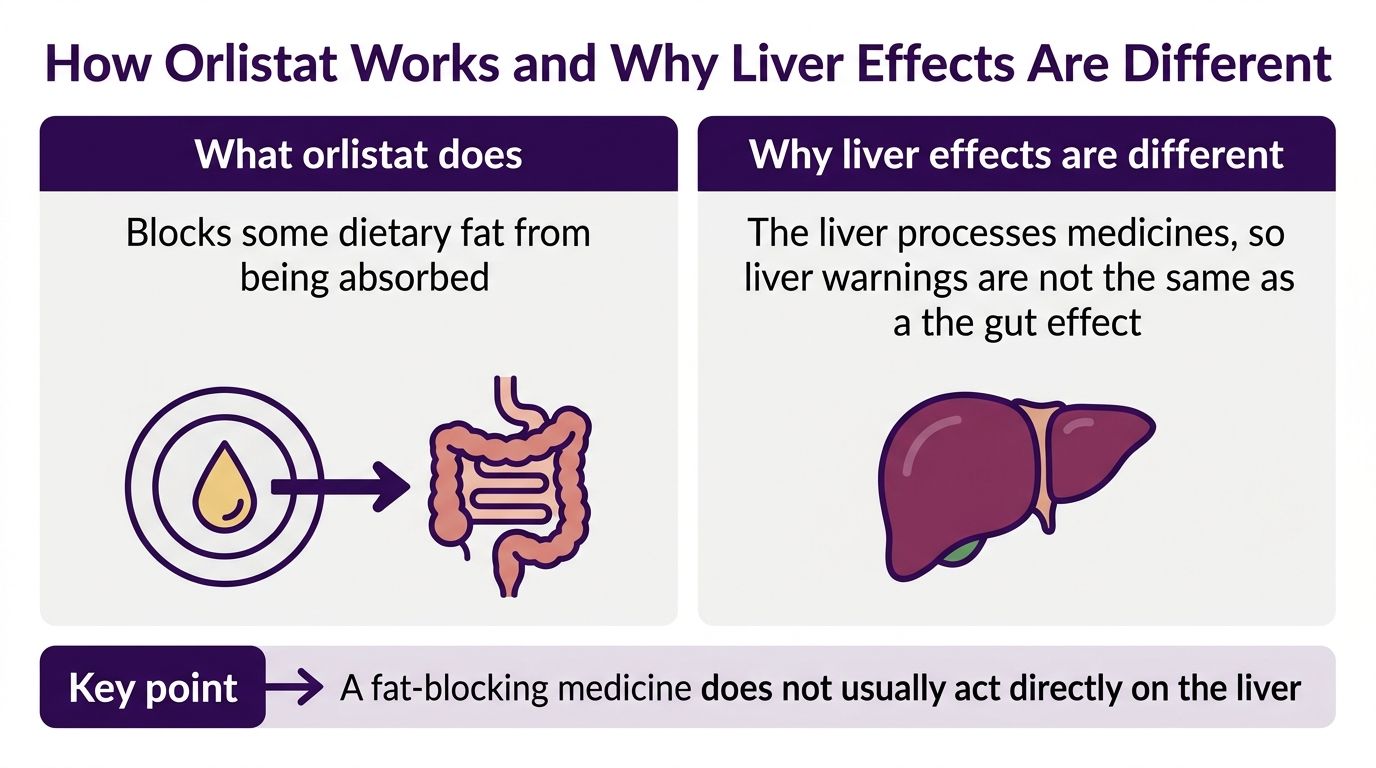
Liver effects sit in a different category. They aren't the direct, predictable result of fat passing through your gut in the same way oily stools are. That doesn't make liver warnings meaningless, but it helps you avoid treating every bowel symptom as a liver warning, or every liver test change as proof of drug damage.
The Trial Context Behind Tolerability
The UK alli product information supports efficacy from two double-blind, randomised, placebo-controlled adult studies in participants with a body mass index of at least 28 kg/m². Participants took 60 mg three times daily, which is 180 mg per day, alongside a reduced-calorie, lower-fat diet.
That diet context matters when you interpret side effects. Trial participants weren't eating unrestricted amounts of fat, so real-world bowel effects can feel worse if meals stay high in fat. For a broader educational overview of dosing and expected effects, see this guide to orlistat for weight loss.
- Gut effects: Directly linked to fat malabsorption and meal composition.
- Liver signal: Much rarer, frequency unknown, and not a simple dose-by-meal effect.
- Nutrient effect: Separate from both, and easy to overlook.
Fat-Soluble Vitamins Are a Separate Issue
Because orlistat reduces fat absorption, it can also interfere with absorption of fat-soluble vitamins and other fat-soluble nutrients. That's a monitoring consideration for nutrition, not evidence of liver injury. Keeping these categories separate helps you and your clinician respond to the right problem. Bowel urgency after a fatty meal usually points to diet and mechanism. Jaundice or dark urine points somewhere else entirely and needs medical assessment.
What the UK Clinical Evidence Actually Shows
A UK population-based self-controlled case-series study offers the clearest answer to the causation question. Instead of only comparing orlistat users with different people who never took it, researchers compared periods of risk within the same individuals. That design helps reduce confusion from fixed differences between people.
The UK Clinical Practice Research Datalink study linked to Hospital Episode Statistics analysed 94,695 people prescribed orlistat and identified 988 acute liver-injury episodes, comprising 335 definite and 653 probable cases. Incidence was higher in the 90 days before treatment started and in the first 30 days after starting, then returned to baseline with longer exposure.
Liver Injury Incidence-Rate Ratios Around Orlistat Treatment
| Time Period | Incidence-Rate Ratio | 95% CI |
|---|---|---|
| 90 days before initiation | 1.50 | 1.10 to 2.06 |
| First 30 days after initiation | 2.21 | 1.43 to 3.42 |
| First 90 treatment days compared with preceding 90 days | 1.02 | 0.67 to 1.56 |
Read the last row carefully. When researchers compared the first 90 treatment days directly with the preceding 90 days, the ratio was 1.02, which doesn't show an increase. The analysis restricted to definite cases also found no increased risk during treatment.
Why Timing Can Mislead
If orlistat were straightforwardly causing injury, you wouldn't expect risk to be raised before the first capsule. The pre-treatment rise suggests confounding by indication. In plain language, people often start weight-loss treatment when their health is already deteriorating or being investigated, so liver problems may be detected around that time for other reasons.
- Before treatment: Risk was already high, which weakens a simple drug-cause explanation.
- Soon after starting: Detection and underlying illness may still explain part of the rise.
- With longer use: Incidence returned to baseline rather than continuing to climb.
Core interpretation: A problem appearing after a medicine starts is a reason to investigate. Timing alone isn't proof the medicine caused it.
That conclusion shouldn't make you complacent. New liver symptoms soon after starting still require prompt assessment because clinicians can't diagnose the cause from timing alone. The study changes how you interpret the overall risk. It doesn't give any individual person a reason to ignore jaundice, dark urine or right-sided abdominal pain.
Warning Signs That Need Medical Attention
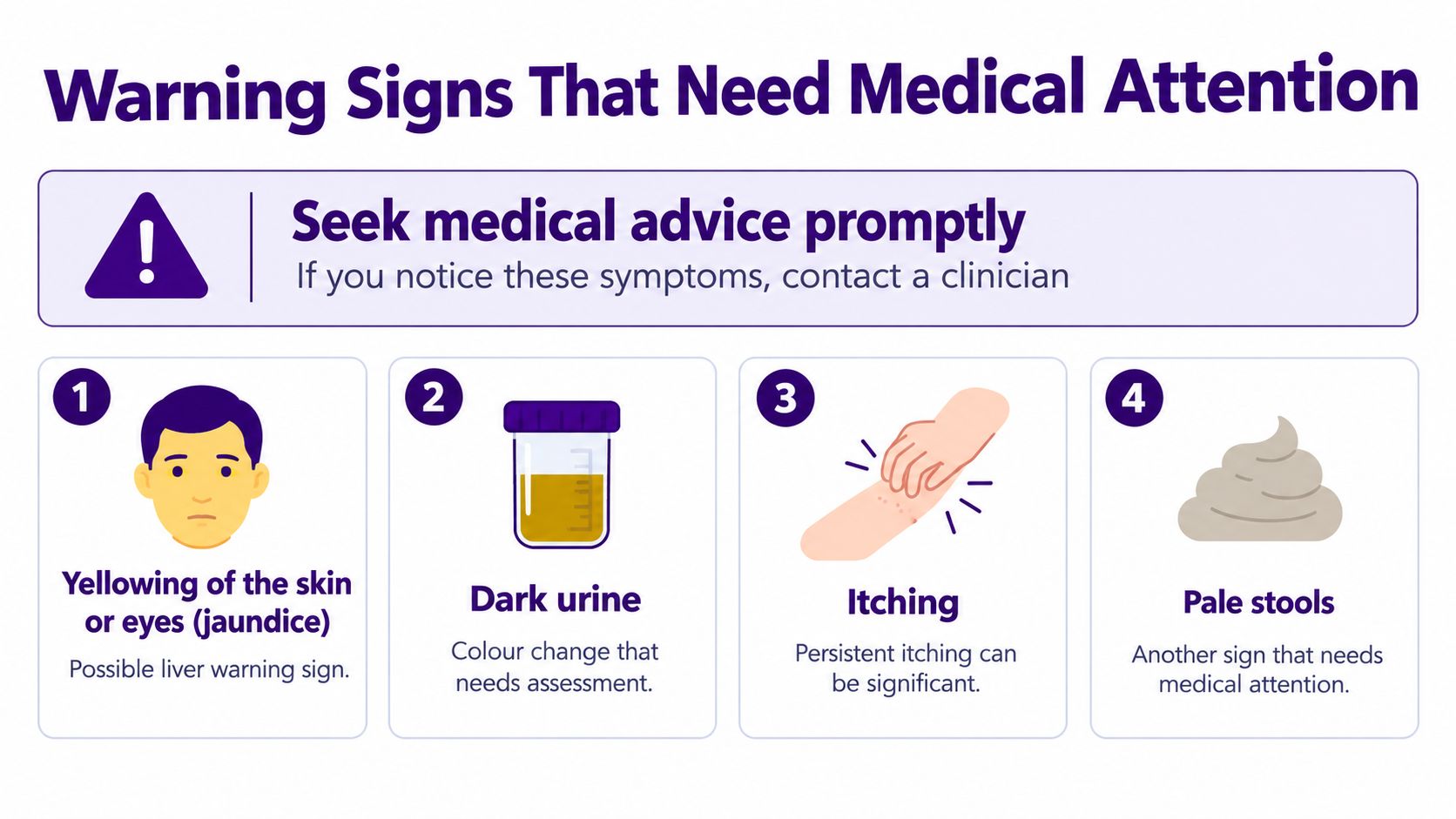
Use symptoms, not anxiety, as your action threshold. UK guidance is symptom-led because serious reactions are uncommon or frequency unknown, but they need rapid recognition when they occur. If warning signs appear, stop orlistat and seek medical advice.
The MHRA orlistat safety update states post-marketing and clinical trial reviews found insufficient evidence that Xenical or alli cause more serious liver disorders than those already described in product information. It also keeps the practical warning clear. Patients developing jaundice, itching, abdominal pain or liver tenderness should stop treatment and get assessed.
Symptoms That Should Prompt Prompt Advice
- Yellowing of the skin or eyes: Often called jaundice, this is a key liver warning sign.
- Itching: Persistent itching is listed among the associated warning symptoms.
- Dark urine: A noticeable colour change needs assessment rather than watchful waiting at home.
- Abdominal pain: Especially pain linked with other liver symptoms.
- Tenderness beneath the right rib cage: This area sits over the liver and tenderness there matters.
Don't try to rank these by severity yourself. One clear warning symptom is enough to contact a clinician promptly. If you're learning how liver tests are usually checked, this explanation of how to check liver function at home can help you understand the process, but home information doesn't replace assessment when symptoms are present.
Expected Effects Versus Warning Signs
Oily stools, urgency and wind are expected effects of fat malabsorption. They're usually managed by reviewing meal fat content and discussing tolerability with your prescriber. They don't by themselves signal liver injury.
Liver warning signs look different. They involve skin or eye colour, urine colour, itching, pain or tenderness under the right ribs. A clinician will typically take a history, consider alternative causes and arrange liver-function testing when symptoms or clinically indicated abnormalities occur. Mention manageable bowel effects at your next review. Seek help now for liver warning signs.
Risk Factors and Other Causes of Liver Changes
Not every abnormal liver test during orlistat treatment is caused by orlistat. Clinicians look for other explanations first, especially because people may start treatment when obesity-related health problems are already prompting review. A raised enzyme result is a starting point for questions, not a final diagnosis.
The image below shows the kind of conversation that helps. You bring symptoms, timing and your medicine list. Your clinician interprets blood results alongside your history rather than in isolation.

Raised Enzymes Are Not the Same as Liver Failure
The NHS summary of the UK orlistat liver injury study notes 99% of liver events occurring during treatment were raised liver-function tests, and serious events were rare. That helps separate a laboratory abnormality from clinically significant hepatitis or liver failure.
A mildly raised result may need repeat testing and review of causes. Hepatitis involves liver inflammation and can be serious. Liver failure is a further, much more severe outcome. Using one phrase, liver side effect, for all three creates unnecessary confusion.
The video below can support a general discussion about symptoms and monitoring. Watch it as background education, then base decisions on your own history and test results.
Causes Clinicians Consider
- Existing liver disease: Baseline liver health changes how any new result is interpreted.
- Gallstone disease: Cholelithiasis is itself listed among hepatobiliary abnormalities and can cause pain or abnormal tests.
- Rapid weight loss: Weight change can independently affect the liver and gallbladder.
- Other medicines and health changes: A full medicine and medical history helps identify competing explanations.
People with existing liver conditions or several medicines may warrant closer monitoring and a lower threshold for testing. That doesn't support routine discontinuation for everyone solely because an association has been reported. If you're worried but have no warning symptoms, speak to your prescriber rather than stopping purely from anxiety. If warning symptoms are present, don't wait for that routine conversation.
How Orlistat Compares with GLP-1 Treatments
Comparing orlistat with GLP-1 treatments starts with mechanism. Orlistat acts locally in the gut to reduce fat absorption, so bowel effects dominate day-to-day tolerability. GLP-1 medicines such as semaglutide (Wegovy) and tirzepatide (Mounjaro) work through hormonal pathways involved in appetite and glucose regulation, so their monitoring conversations differ.
That doesn't make one category automatically safer for your liver. Each medicine has its own eligibility criteria, side-effect profile and review needs. Rapid weight loss itself, gallstone disease and pre-existing liver conditions can complicate interpretation whichever treatment you use.
What to Compare in Practice
- Mechanism: Orlistat blocks some fat absorption in the gut. GLP-1 options act systemically through metabolic hormone pathways.
- Expected effects: Orlistat commonly raises questions about oily stools and urgency. GLP-1 care focuses more on appetite, nausea, dose escalation and metabolic suitability.
- Liver interpretation: For orlistat, distinguish raised enzymes from hepatitis and check gallstone or pre-existing causes. For any treatment, new jaundice or dark urine needs assessment.
- Oversight: You need a clear route for symptom review, medicine history checks and liver-function testing when clinically indicated.
This comparison is educational, not a recommendation to start, stop or switch a prescription medicine. For a structured side-by-side discussion, see this weight-loss injections versus orlistat comparison. Suitability remains a clinical decision based on your history, other medicines and treatment goals.
Medically supervised means someone qualified reviews your baseline risk, listens when symptoms change, and can arrange tests or stop treatment when indicated.
One example is Trim, a UK GPhC-registered service where UK-registered clinicians assess suitability through a digital consultation and may prescribe GLP-1 medicines or orlistat when appropriate. Its programme combines medicines with clinical guidance, personalised nutrition and strength-focused training, plus ongoing support. The service model matters less than the principle. Don't manage liver concerns alone with search results when a prescriber can review your history and symptoms directly.
Key Takeaways and Your Next Steps
The balanced UK position is straightforward. Serious liver reactions to orlistat are listed as possible, their frequency is unknown, and population evidence doesn't show a clear causal increase in definite acute liver injury during treatment. Your safety plan should therefore be symptom-led, not fear-led.
What to Remember
- Frequency unknown isn't common: UK information can't provide a reliable percentage for the most serious liver events.
- Timing isn't proof: Liver problems were also more likely just before treatment started, suggesting underlying health often explains the association.
- Raised tests need context: An abnormal liver-function result isn't the same as hepatitis or liver failure.
- Warning symptoms override reassurance: Jaundice, dark urine, itching, abdominal pain or tenderness under your right ribs need prompt advice.
Don't stop orlistat purely because you're anxious without speaking to a clinician. Abrupt decisions can leave the cause uninvestigated and your weight-management plan unsupported. Equally, don't dismiss genuine warning signs because population data are reassuring.
Your next step depends on your situation. If you have warning symptoms now, stop orlistat and seek medical advice promptly. If you have no symptoms but you're worried about existing liver disease, other medicines or a recent blood result, book a review with a UK-registered clinician. Bring a list of medicines, note when symptoms or tests changed, and ask whether liver-function testing is indicated.
That conversation can also cover whether orlistat still fits your goals or whether another medically supervised option should be considered. You don't need certainty from the internet. You need a clinician who can interpret uncertainty against your history and act if the picture changes.
If liver concerns are shaping your decision about orlistat or a GLP-1 treatment, Trim offers assessment by UK-registered clinicians who can review your history, symptoms and suitability before prescribing. Start with its digital consultation to discuss your options, ask whether liver-function testing is indicated, and build a supervised plan with ongoing clinical support.