
How to Break a Postpartum Weight Loss Plateau

A stalled scale after birth is common, and it is rarely a willpower problem. A 2025 UK-focused review in Frontiers in Public Health reported that around 25% of women were unable to lose weight during the first one to two years after delivery. That figure reframes a postpartum weight loss plateau. The stall is a checkpoint across feeding, sleep, mood, activity and health, not a verdict on effort.
Diet on its own will not fix every cause. Fluid, broken nights, pelvic-floor limits and untreated illness can all freeze the number while your habits look steady. The next four weeks are for measuring the stall, matching the change to how your baby is fed, and knowing when a clinician should take over.
Table of Contents
- Checking Whether Your Plateau Is Normal for Your Timeline
- What Is Really Stalling Your Progress
- Adjusting Your Plan for Feeding, Sleep and Stress
- How to Break the Plateau Step by Step
- Red Flags That Need a Clinician Now
- Medical Options to Raise With Your Clinician
- Decide Whether to Hold, Adjust or Escalate Your Plan
Checking Whether Your Plateau Is Normal for Your Timeline
A few weeks without a clear change can be a useful checkpoint. Define a postpartum weight loss plateau as no meaningful movement in your seven-day average weight over three to four weeks, rather than a handful of unchanged weigh-ins. Your stage after birth matters, and one study cannot establish what is typical for every person across the UK.
The linked maternal and child health study is not a sound basis for the precise cohort figures sometimes repeated online, so those numbers should not be used as personal benchmarks. Weight after birth varies with recovery and circumstances. A comparison group can offer context, but it cannot tell you what your own weight should be or explain why it has stalled.
| Checkpoint | What it can tell you | What to note |
|---|---|---|
| Your current timeline after birth | Whether you are comparing like with like | Record how many weeks or months have passed |
| Current weight and pre-pregnancy weight | The overall direction of change | Use the same scale and similar conditions |
| Weight at six months, if available | How your pattern has changed over time | Treat it as a reference, not a target |
| Waist, strength and daily function | Changes the scale may not show | Note how clothes fit and what feels easier |
| Feeding method, sleep, mood and activity | Context for interpreting a stall | Record what has changed over the past few weeks |
Before changing meals, write down your current weight, pre-pregnancy weight and, if known, your weight at six months. Look at the wider picture too. Fluid shifts, reduced muscle use and inconsistent weighing can mask change, while a scale cannot show whether your strength or daily function is improving. For context on how the body can change after birth, see this guide to postpartum body changes.
A plan should fit how your baby is fed and what your days allow. Breastfeeding and formula feeding bring different practical needs, while broken sleep, low mood, limited time or difficulty accessing nutritious food can affect what is realistic. A calorie target alone may miss those constraints. If your weight remains unchanged and you feel unwell, or you have concerns about your recovery, involve a clinician rather than treating the plateau as a willpower problem.
What Is Really Stalling Your Progress
Most plateaus have several contributors. Rank them. Do not hunt for one villain.
In UK postnatal care the usual order is energy, then sleep and weighing habits, then movement, mood and pelvic floor, and only then blood tests. Run one quick check per row. A three-day food note, a week of same-time weigh-ins, or a simple sleep tally is enough.
| Likely cause | How to check it | What it tends to look like |
|---|---|---|
| Energy gap while breastfeeding | Compare a three-day food log with your feeding needs | Hunger is high, energy is low, and the scale barely moves |
| Over-restriction | Count meals and check protein and fluids on a typical day | Fatigue, irritability, and a plateau after a strict phase |
| Fluid shifts and weigh-in timing | Compare same-time weighings across seven days | Day-to-day jumps of 1 to 2 kg with no change in waist |
| Poor or broken sleep | Note the number of wake-ups and total sleep for seven days | Evening snacking, cravings, and slower loss on the same intake |
| Low activity and deconditioning | Measure waist and time a 30-second chair stand test | Waist and strength unchanged, with little daily movement |
| Stress or low mood | Ask about anxiety, interest in things, and comfort eating | Skipped meals, late-night eating, and low motivation |
| Pelvic floor or physical limits | Ask about leaking, heaviness or pain during activity | Avoiding exercise or stopping walks early |
| Thyroid, anaemia or blood sugar problems | Blood tests arranged by your GP | Persistent tiredness, cold intolerance, pallor, or thirst |
| Medication effects | Review current prescriptions with your GP or pharmacist | Plateau began after a new medicine was started |
| Retained pregnancy weight | Compare current weight with pre-pregnancy weight | Weight still well above pre-pregnancy at six months with stable habits |
Restriction can look like stubborn fat
A strict phase often backfires. Take a parent who drops to about 1,200 kcal, feels wiped out, and stops the daily walk. Three weeks later the average has not moved. Lower energy, more fatigue and less movement explain that stall better than "stubborn fat". A single-day jump of 1 to 2 kg is usually fluid, which is why the weekly average matters more than Monday's reading.
When the check needs a blood test
Persistent tiredness, feeling cold, pallor or unusual thirst are not fixed by a tighter meal plan. If those signs sit alongside a flat average, ask your GP about thyroid function, anaemia and blood sugar. You can explore blood testing after childbirth so you know which markers are often discussed, then let your own clinician interpret the results.
Pick the two causes that match at least two of your own signs. Those two drive the next four weeks.
Adjusting Your Plan for Feeding, Sleep and Stress
Your feeding pattern, sleep and mood are useful checkpoints when the scale stalls. They help show whether the next change should be to meal portions, routine or support. Copying a calorie target designed for someone who is not postnatal can leave you tired, hungry or concerned about milk supply.
UK guidance in the SACN summary on nutrition and maternal weight estimates that exclusive breastfeeding in the first six months requires about 330 additional kcal a day. This is an allowance, not a weight-loss target. The gradual weekly ceiling discussed elsewhere in this article is a separate guide to the pace of loss, not a reason to cut intake sharply. Energy needs differ with feeding pattern and recovery.
| Feeding pattern | Energy approach | Change to make first |
|---|---|---|
| Exclusive breastfeeding | Account for the additional energy needs of feeding | Keep meals regular and watch for changes in hunger or supply before reducing portions |
| Mixed feeding | Needs vary as the balance of feeds changes | Review feeding, hunger and portions weekly; make small adjustments |
| Formula feeding | Use a balanced eating pattern without a breastfeeding allowance | Start with regular meals and a manageable activity routine; aim for gradual change |
| Any pattern with broken sleep | Feeding needs still guide intake; disrupted sleep can increase hunger | Arrange a longer sleep block if support is available, and plan an evening snack |
What the breastfeeding data actually show
In a UK UPBEAT cohort analysis, women with obesity who reported any breastfeeding at six months had about 1.81 kg less retained weight than those who reported none. The UPBEAT secondary analysis reports a 95% confidence interval of about 0.75 to 2.88 kg. This is an association, not proof that breastfeeding caused the difference. Feeding duration, diet, activity and income may also matter, so the finding should not be used to predict an individual's progress or judge a flat scale. For practical guidance on adjusting intake while feeding, read about breastfeeding and weight loss.
Sleep and stress change appetite, not your character
Broken sleep can make hunger and evening eating harder to manage. If a partner or relative can help, arrange one longer sleep block. A planned evening snack may also be easier to manage than grazing when you are exhausted.
Mood deserves a place in the checkpoint too. A brief daily mood note can help you spot whether stress is affecting meals or activity. A short outdoor walk may offer a manageable pause, but it is not a treatment for persistent low mood. Speak with a clinician if your mood is affecting daily life or you are worried about how you are coping.
For example, one parent replaced a strict low-calorie plan with regular meals and a planned evening snack. Hunger settled, walks resumed, and the weekly average began to fall within a month. Results will vary, and diet alone cannot resolve every cause of a plateau. Note your feeding pattern, sleep and mood, then choose one change that fits the picture.
How to Break the Plateau Step by Step
A flat scale reading is a checkpoint, not a verdict on your effort. First check whether recovery, feeding, sleep, mood and activity make weight loss a safe focus right now. Diet alone cannot address every cause of a stall, so use the next four weeks to build a steady routine and notice what changes.
NHS postnatal fitness guidance advises breastfeeding women who are overweight that a balanced diet and moderate activity can support gradual weight loss without harming milk quality or quantity. The page does not prescribe a daily walk. If you are breastfeeding, avoid aggressive restriction and discuss concerns about intake or milk supply with a clinician. If you are formula feeding, the same gradual approach can help, but breastfeeding-specific energy needs do not apply. Recovery and individual health still matter.
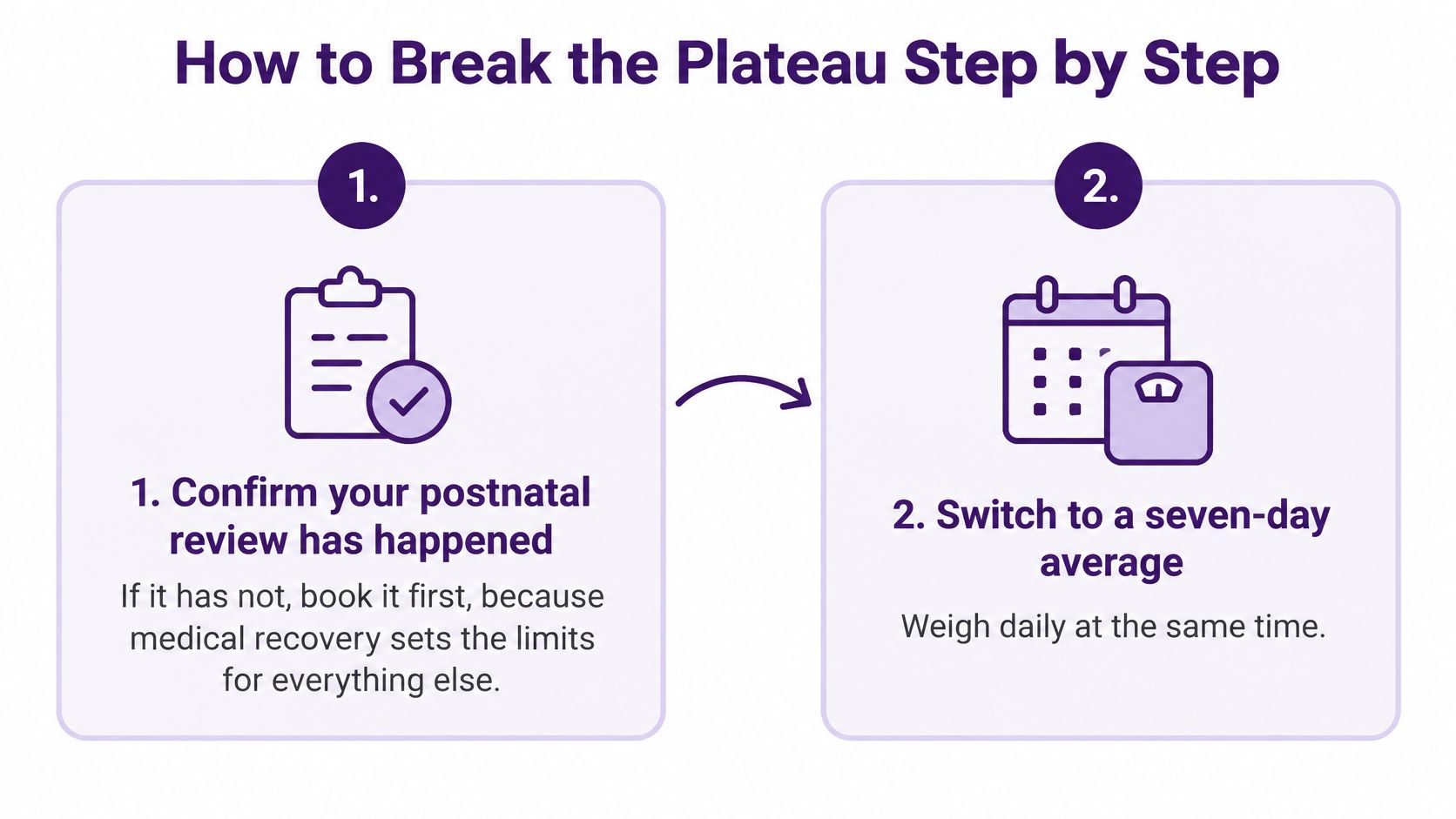
- Check your recovery first. If you have not had your postnatal review, arrange it before adding strenuous exercise or actively pursuing weight loss. Ask what walking and strength work suit your recovery.
- Track a weekly trend. Weigh under similar conditions and compare weekly averages, rather than judging one morning. Day-to-day changes often reflect fluid, much like a tide moving around a steady shoreline.
- Record two other signs of progress. Every couple of weeks, note waist measurement and a practical strength marker, such as how controlled sit-to-stands feel. Changes in fitness or body shape may show up before the scale does.
- Make meals regular and nourishing. Include a protein source, fruit or vegetables, fibre-rich foods and fluids. If breastfeeding, avoid cutting food sharply; if formula feeding, do not assume the breastfeeding allowance applies. Either way, a rigid diet can worsen tiredness and make a routine harder to sustain.
- Start with comfortable walking. Choose a pace and duration your recovery allows, then build gradually. If you leak urine, feel heaviness, or have been advised to rehabilitate your pelvic floor, ask a clinician or pelvic health physiotherapist for guidance.
- Add strength when cleared. Begin with manageable movements such as glute bridges, sit-to-stands, band rows and squats. Increase repetitions before adding resistance, and stop if you develop pain or symptoms that concern you.
- Review after four weeks. Look at the overall pattern in meals, movement, sleep and mood. If your routine was inconsistent, work on that first rather than cutting food further. If it was steady and the trend remains unchanged, ask a clinician whether medication, thyroid changes or another health factor needs checking.
Keep the scale on a hard floor and record readings in a notes app. A written trend is more useful than reacting to a single number.
A short walk-through of the sequence is available below.
Red Flags That Need a Clinician Now
A weight plateau can wait for a review. Some symptoms cannot. Use this checklist to match the warning sign with the right level of help, rather than responding with a stricter diet.
| Warning sign | What it may point to | Action |
|---|---|---|
| Chest pain, sudden breathlessness or leg swelling | Serious clot or heart risk | Call 999 or go to A&E now |
| Thoughts of harming yourself or your baby | Severe postnatal mental illness | Call 999 or go to A&E now |
| Red, hot, painful breast with fever | Mastitis or breast infection | Contact your GP or NHS 111 the same day |
| Pale skin, dizziness or breathlessness on light activity | Anaemia | Contact your GP the same day |
| Excessive thirst and passing lots of urine | Blood sugar problem | Arrange a GP blood test this week |
| Tiredness, feeling unusually cold, constipation or weight gain | Thyroid problem | Arrange a routine GP blood test |
| Low mood, anxiety or loss of interest lasting two weeks or more | Postnatal depression | Ask your GP or health visitor for a review this week |
| Weight falling quickly while breastfeeding or feeling unwell | Inadequate intake or illness | Pause weight-loss efforts and arrange a clinician review |
| Leaking, heaviness or pain during exercise | Pelvic-floor problem | Ask about pelvic health physiotherapy |
If you have thoughts of harming yourself or your baby, seek urgent help now. For other mood changes, tell someone you trust and contact your GP or health visitor. They may use the Edinburgh Postnatal Depression Scale as a screening tool. A screening result is not a diagnosis, and you deserve support even if you are unsure how serious your symptoms are.
A plateau should prompt a broader check, not blame. Feeding method, sleep, mood and activity can all affect recovery, while anaemia, blood sugar problems or thyroid changes need clinical assessment. Diet changes alone will not treat those causes.
If you contact a clinician, bring your seven-day weight average and a brief note of symptoms, when they began, and whether you are breastfeeding. Blood results need to be interpreted by a clinician, who can advise whether a change to your eating or activity is safe.
If your weight is dropping rapidly while breastfeeding, or you feel unwell, pause any calorie deficit and ask a clinician for advice.
Medical Options to Raise With Your Clinician
Think of care as a ladder. Start at the bottom. Medicines are not the first rung, and nothing here is a product pitch.

First, a GP or health visitor review. This suits anyone whose average is flat and whose checks from earlier point to thyroid disease, anaemia, blood sugar, mood, pelvic-floor limits or a new medicine. Tests come before treatment.
Second, a dietitian or an NHS weight-management service. This suits people who need intake planned around feeding, budget and time. A clinician-led food plan beats a calorie figure copied from someone who is not postnatal.
Third, pelvic health physiotherapy and mental health support. These suit leaking, heaviness, pain on walks, or low mood that is blocking meals and movement. Fixing those often restarts progress without a lower calorie target.
Fourth, medicines, and only when feeding and recovery allow. Most licensed weight-loss medicines, including GLP-1 receptor agonists such as semaglutide (Wegovy) and tirzepatide (Mounjaro), are not recommended while breastfeeding. Clinicians usually defer them and decide timing case by case once feeding has ended and recovery is complete. Background on that timing is in this guide to Mounjaro and postpartum weight management. A plateau does not mean you need a prescription this month.
Structured behaviour support is what UK research is testing first. The Supporting MumS trial was designed to see whether a 12-month, theory-based text-message programme could produce and maintain weight loss in postpartum women with overweight or obesity. The protocol planned to recruit 888 women with a BMI of at least 25 kg/m², within 24 months of birth, across five UK sites, with weight change at 12 months as the primary endpoint, as set out in the Supporting MumS protocol. That design sits alongside usual care. It does not assume a stall needs immediate medication.
Four questions for the appointment:
- Is my plateau inside the normal range for my timeline?
- Which causes have been tested?
- What is safe for my feeding pattern?
- What applies if progress has not started within eight weeks?
If you cannot get a timely NHS slot, an online clinic such as Trim can arrange a clinician consultation. A responsible service will ask about breastfeeding, recovery and medical history before any treatment is discussed.
Decide Whether to Hold, Adjust or Escalate Your Plan
You only need one branch today.
Hold if your average sits in the usual range for your timeline, you feel well, and sleep and meals are steady. Hold too if weight is easing inside the gradual weekly ceiling, or if weight is flat while waist and strength are improving. Keep the log. Do not add a new rule.
Adjust if the seven-day average has been flat for four weeks and your notes show steady intake and walking. Change one thing only. That might be meal timing, one longer sleep block, or an extra set of strength work. Recheck after another four weeks.
Escalate if any red flag is present, if weight has stayed stuck for eight weeks or more despite logged changes, or if mood has dipped. Book a GP review this week. Bring the average and the symptom note.
Tomorrow morning, start the seven-day average if you have not already. Write down the single adjustment you will try, and only after any outstanding postnatal or GP review is booked. Recovery, milk supply and mood come first. A plateau handled in that order usually has a clear next step.
If you want a clinician to look at a postpartum weight loss plateau in the context of feeding, recovery and your medical history, Trim offers UK clinician consultations for medically supervised weight management once that history is reviewed. The service is educational and clinical, not a substitute for urgent care or your postnatal check. If your stall has lasted and you are ready for a structured conversation, visit Trim and start with the consultation.