
Menopause Weight Gain and Joint Pain: A UK Guide

Your waistband feels tighter, your knees complain when you get up, and the walk that used to clear your head now leaves you sore. You haven't deliberately changed what you eat, so being told to eat less and move more feels frustrating rather than helpful.
Menopause weight gain and joint pain can be connected, but they aren't automatically the same problem. Hormonal changes, muscle loss, activity and joint loading can interact. The useful approach is to identify pain that needs its own diagnosis, then build a plan that protects movement and muscle rather than judging everything by the scales.
Table of Contents
- How Falling Oestrogen Drives Weight Gain and Joint Pain
- Menopause Joint Pain or Something Else
- The Pain and Weight Cycle That Feeds Itself
- Strength and Low-Impact Exercise for Painful Joints
- Nutrition That Protects Muscle and Joints
- Pain Relief That Fits a Weight Plan
- HRT and Medical Weight-Loss Options Compared
- Book a GP Review and Track Symptoms for Six Weeks
How Falling Oestrogen Drives Weight Gain and Joint Pain
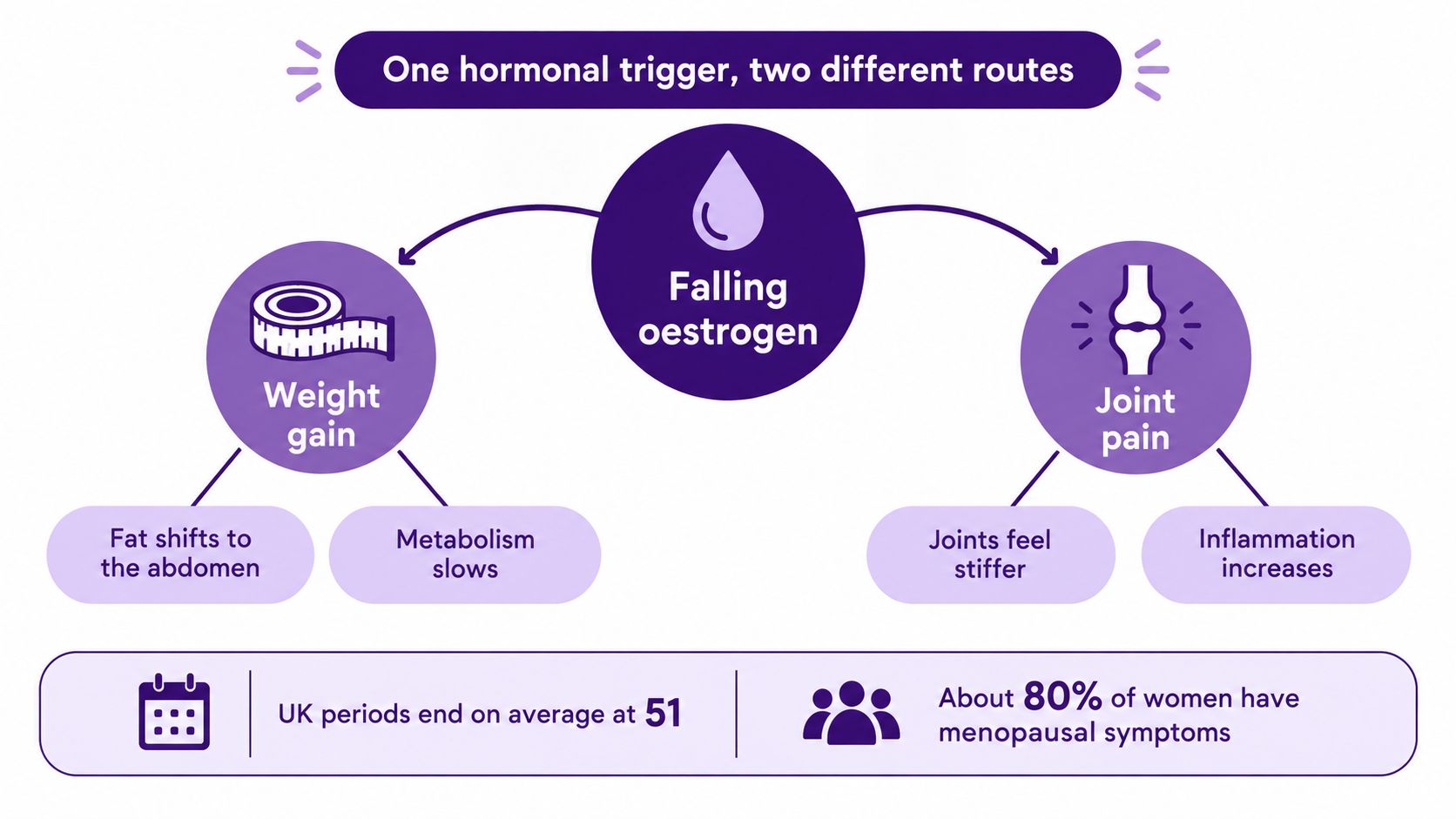
Weight and joint symptoms can share a hormonal trigger, then develop through different routes. Falling oestrogen is linked with changes in fat distribution and musculoskeletal tissues. Ageing, sleep, eating patterns and activity also shape what you experience, so hormones are one part of the picture.
In the UK, periods end at an average age of 51, and approximately 80% of women experience symptoms associated with the sharp fall in oestrogen, according to the British Dietetic Association's menopause guidance. Resting energy use can also decline as muscle mass falls with age and during the menopausal transition. The size of any menopause-specific change varies, so familiar habits may affect weight differently over time.
This diagram shows how hormonal changes can connect with weight and joint symptoms through separate pathways.
Why your waist can change before your weight
During the menopausal transition, fat tends to accumulate more centrally, while maintaining muscle may become harder. Muscle uses energy even at rest, but small changes in muscle cannot explain every change in weight. If pain leads you to move less, that can also affect the balance between energy used and consumed.
For example, a woman whose meals have stayed much the same since her mid-forties may now walk less and have lost some muscle. Her usual meals may then provide more energy than she uses. Her clothes can fit differently even if the scales barely change, because body composition and fat distribution are not the same as total weight.
Why joints can feel different too
Falling oestrogen is associated with stiffness, muscle discomfort and changes affecting tendons and ligaments. The body's systems work like parts of a building: energy use is one system, muscles and tendons form part of its structure, and joints carry loads. A change affecting several systems can make more than one symptom noticeable, but it does not mean every problem has the same cause.
That distinction matters when deciding what to do. A plan focused only on eating less may overlook muscle and movement, while persistent or worsening pain still needs assessment in its own right. The aim is to interrupt the loop: pain can restrict activity, and less activity can make it harder to maintain strength and manage weight.
The change is about where and what you carry, not only how much you weigh.
Menopause Joint Pain or Something Else
This table is a triage tool, not a diagnosis. The timing of pain around perimenopause can be a clue, but it doesn't exclude osteoarthritis, inflammatory arthritis, injury or a bone-health problem. Several conditions can coexist.
Public Health Wales awareness findings summarised in an NHS menopause and musculoskeletal health resource found that 52% of respondents recognised aches and joint pain as a menopause symptom; the resource also describes approximately 40% having no structural cause identified for their musculoskeletal pain. These are different measures, not diagnostic probabilities. No structural explanation doesn't mean pain is imaginary or that assessment is unnecessary.
Joint pain patterns, likely causes and next steps
| Pattern | Usually points to | Next step |
|---|---|---|
| Stiff, achy joints on both sides, starting in perimenopause, without swelling | Possible menopause-related joint pain, or arthralgia | Track symptoms while starting gentle strength work; arrange a GP review if symptoms aren't settling |
| Knee or hip pain after activity, easing with rest, with bony swelling | Possible osteoarthritis | GP or physiotherapy review, with a weight and strength plan where appropriate |
| Prolonged morning stiffness with warm or swollen small joints | Possible inflammatory arthritis | Prompt GP assessment rather than waiting for lifestyle changes to work |
| Pain after a fall, twist or sudden onset in one joint | Possible ligament, tendon or cartilage injury | Assessment; urgent care if you cannot bear weight |
| Back or hip pain with height loss, or a fracture after a minor fall | Possible fragility fracture or osteoporosis | Clinical assessment, with a bone density scan if indicated |
| A single hot, red, very swollen joint with fever | Possible infection; gout is another possibility | Same-day medical care because infection must be excluded |
What the hormone-treatment evidence actually shows
The NICE menopause evidence review describes a randomised trial involving 6,594 menopausal women without joint pain at enrolment, which found no significant difference in musculoskeletal symptoms after one year between oestrogen and placebo. That population detail matters: this wasn't just a trial treating women who already had menopause-related joint pain.
The finding doesn't establish that nobody's aches improve with HRT. It does mean you shouldn't assume a reliable pain-relieving effect or postpone investigating persistent symptoms while waiting for hormones to help.
Before an appointment, record these practical clues:
- Morning stiffness: Note how long it lasts and whether movement helps.
- Joint pattern: Mark exactly which joints hurt, including swelling or warmth.
- Night symptoms: Record whether pain wakes you and whether changing position helps.
The Pain and Weight Cycle That Feeds Itself
Say your knees become uncomfortable, so you stop walking to the shops and avoid stairs. You also stop chair exercises because you're worried that discomfort means damage. Each decision makes sense in isolation, but together they can leave you doing much less.
With less regular use, your legs may become weaker. Standing up feels harder, so you use your arms more and avoid lower chairs. If your food intake stays unchanged while daily movement falls, weight management can become more difficult.
How the loop develops
The relationship isn't that weight causes pain in a straight line. Pain can change behaviour first, and the resulting loss of capacity can make both problems harder to manage.
- Pain reduces activity: You shorten walks and avoid strength work.
- Reduced activity affects muscle: Tasks demand more of the strength you have left.
- Daily energy use falls: Less movement changes the balance between intake and expenditure.
- Additional weight adds demand: Weight-bearing joints must carry more during everyday activities.
- Confidence drops: Fear of another painful evening encourages further avoidance.
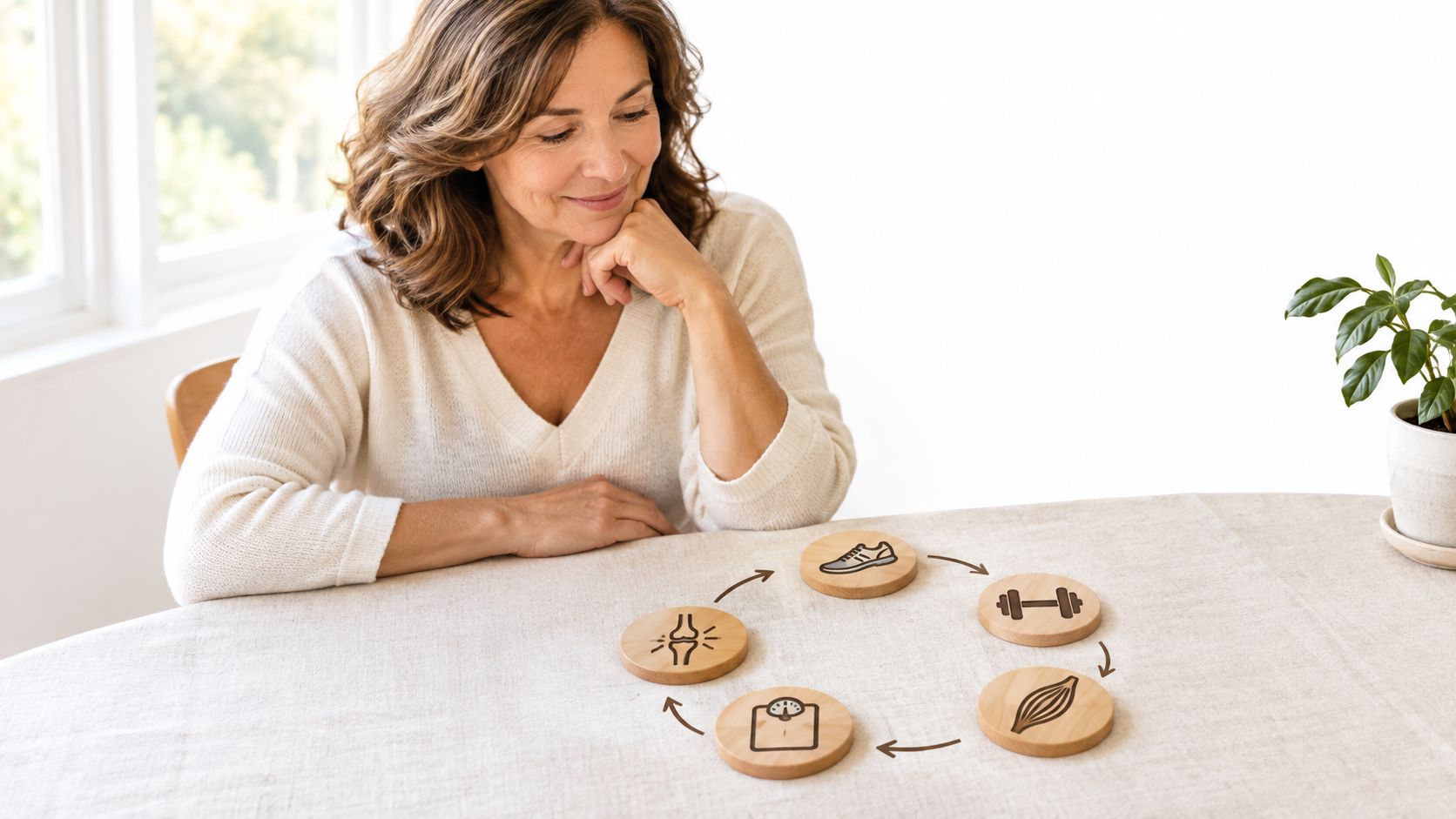
The cycle below is a reminder to address movement, strength and symptoms together.
Think of a bridge carrying heavier traffic while its support cables weaken. Reducing traffic may help, but repairing the cables still matters. For painful joints, that means protecting muscular support rather than pursuing weight loss at the expense of strength.
Find the first manageable change
You don't need to solve every part simultaneously. If walking hurts but cycling is comfortable, cycling can maintain activity while you seek advice about the walking pain. If getting up is difficult, practising an adapted chair rise may be more useful initially than chasing a step target.
Watch for a falling step count, increasing difficulty getting out of a chair and knees that ache more by evening. These clues don't establish a diagnosis, but they show that your plan needs adjustment.
Practical rule: Use relative rest to settle a flare, not indefinite rest as the whole treatment plan.
Weight reduction may lessen mechanical demand when excess weight is present. Strengthening addresses a different need: making everyday movement more manageable while your weight changes.
Strength and Low-Impact Exercise for Painful Joints
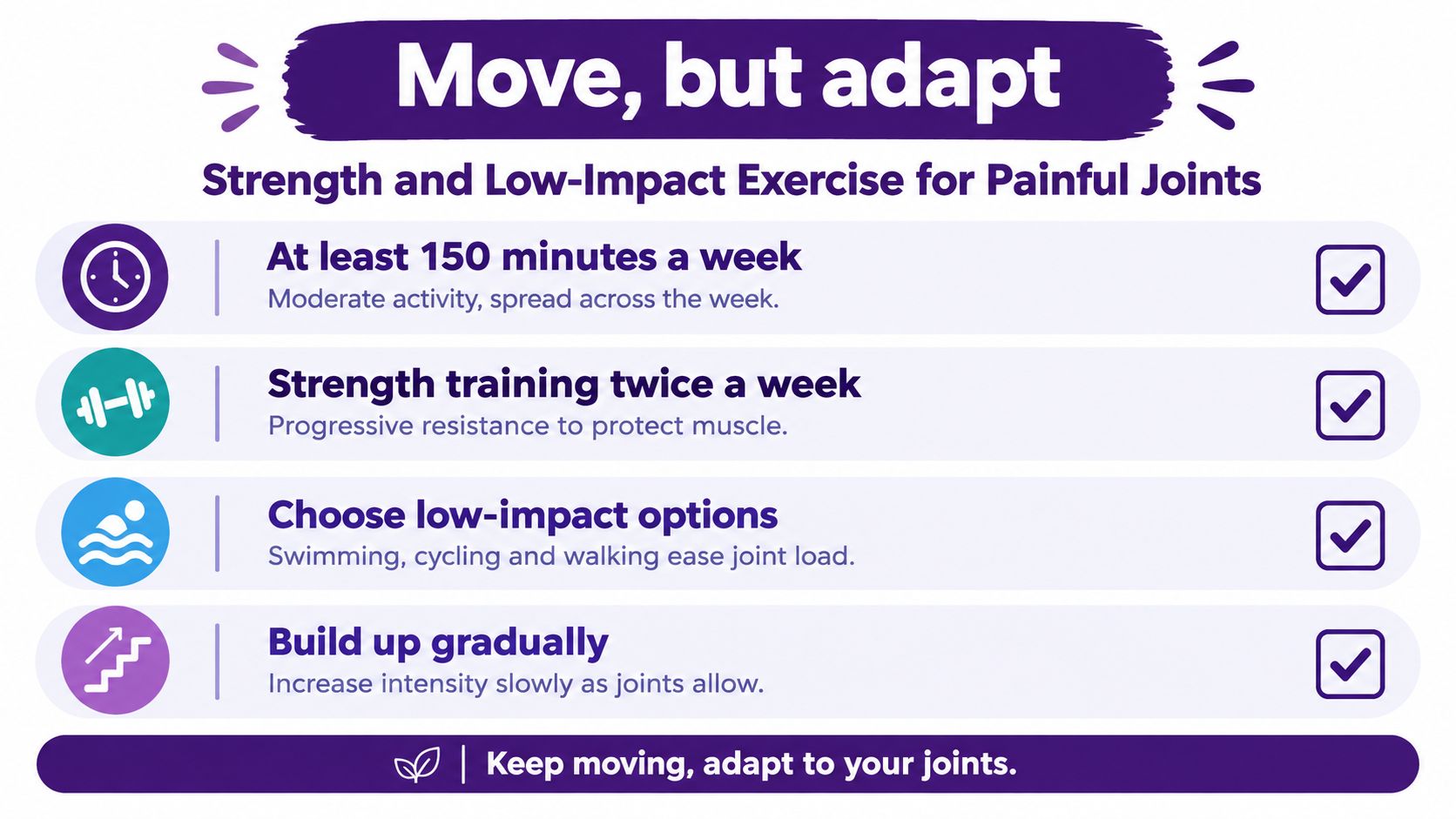
Move, but adapt. The aim isn't to prove that you can push through pain. It's to find a tolerable level of activity, repeat it consistently and progress without a sustained flare.
NHS physiotherapy guidance on menopause supports approximately 150 minutes of moderate activity weekly, alongside progressive resistance training at least twice weekly. Treat that as a destination, not a requirement to meet immediately when you're sore or deconditioned.
These principles help you work towards that destination without treating all exercise as equally suitable.
Low-impact and strength options by joint load
These are example starting doses, not a personalised prescription. Joint load depends on technique, resistance, range and your diagnosis, so an activity labelled low-impact can still provoke symptoms.
| Activity | Joint load | Best for | Where to start |
|---|---|---|---|
| Walking on flat ground | Moderate, weight-bearing | Everyday stamina and activity | Try 10 minutes, once daily; add another walk only if comfortable |
| Stationary cycling | Low-impact | Knees and hips uncomfortable with impact | Try 10 minutes at low resistance with a comfortable seat height |
| Swimming or water walking | Very low weight-bearing load | Supported movement during flares | Try 10 easy minutes; use shallow water for water walking |
| Rowing machine | Low-impact, but repeated knee and hip bending | Conditioning if bending is comfortable | Try 5 light minutes after checking technique |
| Sit-to-stand from a chair | Low-impact, with meaningful joint loading | Getting up and managing stairs | Try 2 sets of 8 from a firm chair, using hands if needed |
| Wall or chair squats | Low to moderate, depending on depth | Progressive leg strength | Try 2 sets of 8 through a shallow, comfortable range |
| Resistance band rows and presses | Low-impact | Upper-body strength | Try 2 sets of 8–10 with light resistance |
| Gentle mobility and stretching | Very low | Comfortable range of movement | Try 5–10 relaxed minutes without forcing the joint |
Let recovery guide progression
A universal pain score can't tell everyone what's safe. Mild, familiar discomfort that settles promptly may be acceptable, but sharp pain, new swelling, limping or symptoms that remain worse the following morning mean you should reduce the load and seek advice if they persist.
For a hypothetical four-week build-up, begin with short sessions of walking or cycling and a manageable chair exercise. Add a little duration only after comfortable recovery, then increase strength repetitions or resistance, not everything together. A second strength day can follow when you recover well between sessions.
The strength training for menopause guide offers additional exercise context. A physiotherapist can help with chair height, squat depth, band resistance and alternatives when a particular movement repeatedly hurts.
For a visual exercise reference, the following video may help you discuss suitable movements with your physiotherapist.
Stop and arrange assessment for marked warmth, swelling or rapidly declining function rather than treating these as ordinary training soreness.
Nutrition That Protects Muscle and Joints
Choose calorie-aware eating, not crash dieting. A large restriction can make it difficult to eat enough protein and other nutrients, particularly when pain already limits activity. Your eating plan should support training and daily function, not leave you too depleted to move.
A practical plate can contain plenty of vegetables or salad, a palm-sized protein portion, a fist-sized portion of wholegrain or starchy food and a small amount of added fat. This isn't a precise calorie calculation, but it's a useful starting framework when you don't want to weigh every ingredient.
For example, lunch could be lentil soup with wholegrain bread and yoghurt, rather than a small salad that leaves you hungry shortly afterwards. Dinner might combine fish or tofu, potatoes and vegetables, with olive oil measured rather than freely poured.
Nutrient targets and food sources for midlife women
The table uses food-based actions rather than presenting an individual prescription. Protein requirements and supplement decisions need particular care if you have kidney disease, malabsorption or another condition affecting nutrition.
| Nutrient | UK reference or target | Food sources | Why it matters |
|---|---|---|---|
| Protein | Include a substantial source at each main meal; individualise the amount | Eggs, fish, Greek yoghurt, tofu, lentils | Helps maintain muscle during weight loss |
| Calcium | Include calcium-rich foods regularly; assess intake before supplementing | Milk, yoghurt, calcium-fortified soya drinks, sardines with bones | Supports bone health |
| Vitamin D | Follow current NHS seasonal advice; ask whether you need year-round supplementation | Oily fish, eggs, fortified foods and suitable supplements | Supports bone and muscle function |
| Omega-3 fats | Include oily fish where suitable, without treating it as pain medicine | Salmon, mackerel, sardines | Contributes to a balanced eating pattern |
| Fibre | Include fibre-rich foods across meals and increase gradually | Wholegrains, beans, pulses, vegetables | Supports fullness and bowel health |
| Fruit and vegetables | Eat a varied selection daily | Fresh, frozen or suitable tinned options | Provides fibre and micronutrients |
| Alcohol | Keep intake low and include alcohol-free days | Alcohol-free or lower-alcohol alternatives | Helps limit liquid calories and sleep disruption |
Make the pattern workable
A Mediterranean-style approach provides a useful menu template: vegetables, pulses, wholegrains, olive oil and fish, rather than a collection of expensive specialist products. Don't promise yourself that a particular food will repair cartilage or remove menopause-related pain. Food can support health without functioning as a joint treatment.
Sugary drinks, frequent alcohol and energy-dense snacks are sensible places to review portions. However, processing alone doesn't determine nutritional value: frozen vegetables, tinned beans and plain yoghurt can make balanced meals easier.
The guide to menopause and muscle loss explains why preserving muscle deserves attention during weight management. Ask a pharmacist, GP or dietitian before taking high-dose vitamin D, calcium or multiple overlapping supplements, especially if you take other medicines.
Pain Relief That Fits a Weight Plan
A painkiller may make walking easier, but it does not explain a swollen joint or heal an injury. Good pain relief should help you stay active while the cause of pain is assessed. That matters in a weight plan because pain can restrict movement, while reduced activity can make weight management harder.
Medicines and their cautions
- Paracetamol: It may help with short-term symptoms, although relief for osteoarthritis can be limited. Follow the packet instructions and check cold remedies or combination painkillers for hidden paracetamol. Ask a pharmacist about the dose if you are underweight, have liver disease, drink heavily or need it regularly.
- Ibuprofen and other NSAIDs: Use the lowest effective dose for the shortest necessary time. Check with a pharmacist or GP first if you have had stomach ulcers, have kidney disease, high blood pressure or heart problems, or take anticoagulants. Do not combine different NSAIDs unless specifically advised.
- Topical anti-inflammatory gels: Diclofenac gel may be considered for localised osteoarthritis pain. Less of the medicine reaches the rest of the body than with tablets, but the gel still has risks. Follow its instructions and check that it is suitable for you.
- Joint supplements: Glucosamine and multi-ingredient joint products may not provide meaningful relief. They can add cost, interact with medicines and distract from assessment or rehabilitation.
CBD is not an established treatment for menopause-related joint pain. If you are considering choosing quality CBD for joint pain, ask a pharmacist to check possible interactions with your medicines before use.
Non-drug measures that support movement
Gentle warmth before activity may ease stiffness. A wrapped cold pack may help after a joint becomes irritated. Protect your skin, and avoid heat or cold if sensation or circulation is impaired.
A physiotherapist can match strengthening exercises to the movement that is difficult, such as climbing stairs, walking or opening jars. Suitable footwear, a walking aid or changing chair height may also make daily tasks easier.
Pain relief works best when it helps you return to tolerable activity, rather than masking worsening symptoms so you can push harder.
An injection may sometimes be appropriate after a diagnosis and clinical review, but it is not a general remedy for menopausal aches. Persistent pain needs a plan that supports function, not just repeated courses of symptom relief. Track whether pain, walking and sleep improve alongside changes in waist and strength, rather than judging progress by the scales alone.
HRT and Medical Weight-Loss Options Compared
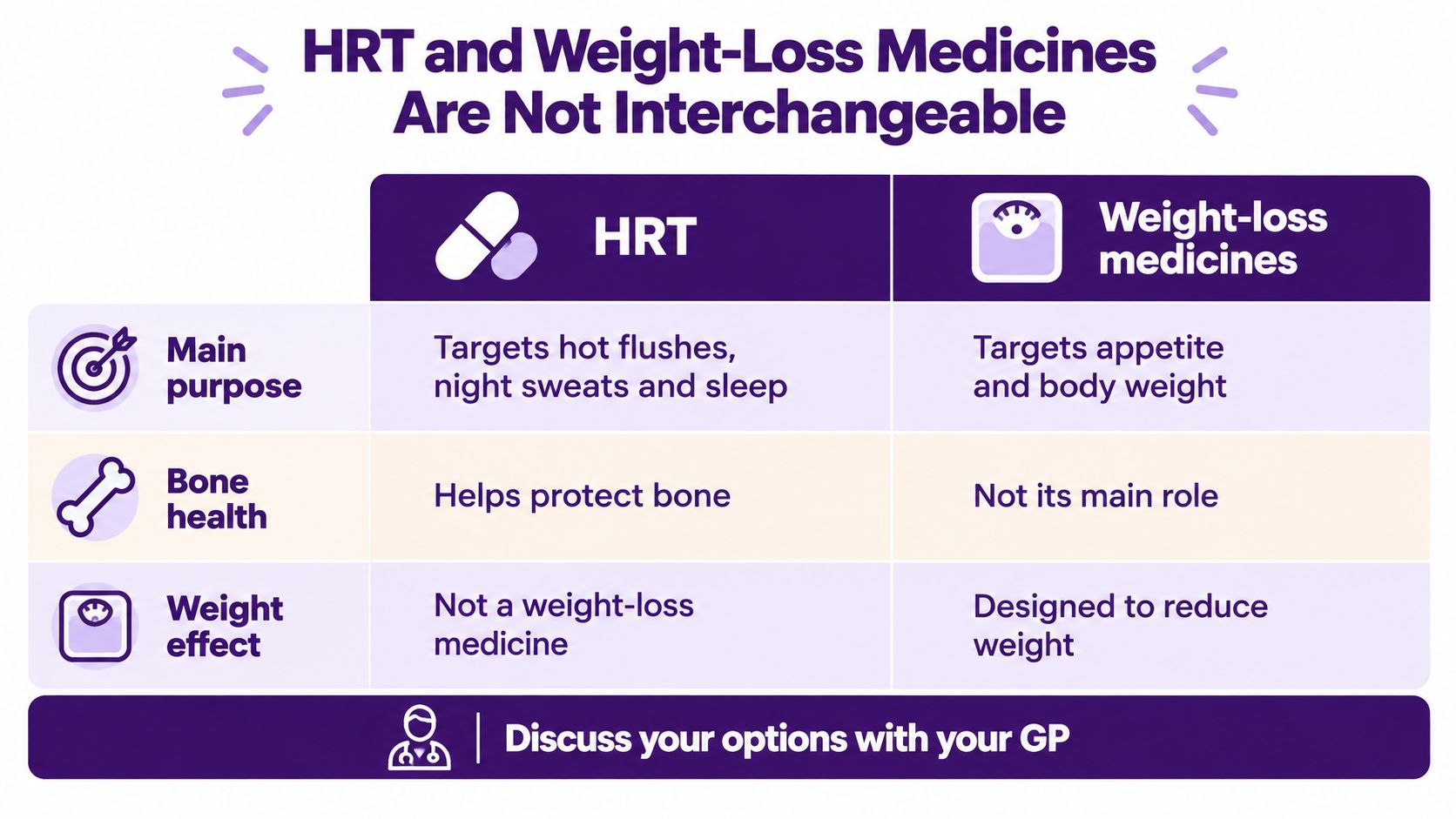
HRT and weight-loss medicines aren't interchangeable. HRT is considered for menopausal symptoms and associated health needs; it isn't prescribed as a weight-loss medicine. Weight management addresses excess adiposity and related risks, but doesn't replace treatment for hot flushes or genitourinary symptoms.
NICE's menopause recommendations support discussing symptoms and maintaining muscle mass and strength through physical activity. Treatment decisions should start with the problem you're trying to improve, not with a medicine chosen in advance.
This comparison highlights the different treatment goals.
Medical options for menopause weight and joint symptoms
| Option | Main target | Effect on joints | Key considerations |
|---|---|---|---|
| HRT, usually oestrogen-based with additional endometrial protection where needed | Hot flushes, night sweats and other menopausal symptoms; bone protection | Some people report improvement, but a dependable joint benefit isn't established | Not a weight-loss medicine; individual benefit-risk assessment |
| Lifestyle programme involving nutrition, strength and walking | Body fat, muscle and function | Can improve capacity and reduce mechanical demand where weight falls | Needs adaptation, consistency and practical support |
| Incretin-based medicines, including semaglutide, for example Wegovy, and tirzepatide, for example Mounjaro | Appetite and calorie intake | Weight reduction may reduce joint loading; these aren't general joint treatments | Eligibility assessment, side-effect counselling, contraception advice and monitoring |
| Orlistat | Reduced absorption of dietary fat | No direct joint treatment effect | Modest weight effect; oily stools and other gastrointestinal effects; meal-related dosing |
What a prescribing discussion should cover
Semaglutide acts at GLP-1 receptors; tirzepatide acts at both GIP and GLP-1 receptors. Both can reduce appetite, but suitability depends on your health, medicines and treatment goals rather than menopause status alone.
Nausea, constipation and diarrhoea are common considerations, particularly during initiation or dose changes. They're not suitable during pregnancy, and anyone who could become pregnant needs a contraception and pregnancy-planning discussion. Tirzepatide requires specific advice about oral contraception when starting treatment and increasing the dose.
NHS access is governed by NICE recommendations and local implementation, with phased access affecting availability. Private eligibility and NHS funding aren't identical, so a private prescription doesn't establish entitlement to NHS treatment.
Orlistat works differently by reducing fat absorption from meals. Its gastrointestinal effects can be difficult to manage, and the prescriber should explain how to take it and whether vitamin or medicine interactions need attention.
For hormonal treatment context, this guide to hormone replacement therapy can help you prepare questions. With any online service, check GPhC registration, who prescribes, what assessment occurs and how follow-up and adverse effects are handled.
Judge treatment against waist, strength, walking tolerance, pain, sleep and function, not weight alone. Reduced appetite isn't a complete success if you're eating poorly, becoming weaker or unable to manage side effects.
Book a GP Review and Track Symptoms for Six Weeks
Book a GP review if pain or unexplained weight change persists, and don't wait through a tracking period when warning signs appear. A six-week diary can organise an ordinary review, but it isn't a diagnostic threshold or a reason to delay care. Rapid deterioration needs earlier assessment.
When to seek urgent help
- A hot, red, very swollen joint with fever: Seek same-day medical assessment because joint infection needs urgent exclusion.
- Inability to bear weight after a fall: Get urgent assessment for a possible fracture or significant injury.
- New chest pain or significant breathlessness: Seek emergency help, especially with faintness, sweating or severe symptoms.
- Unexplained weight loss: Arrange a prompt GP assessment; seek urgent help if you're also acutely unwell.
Book a routine but timely appointment for persistent prolonged morning stiffness, swelling in several joints, pain waking you most nights or any fracture after a minor fall. Mention new height loss, changing function and symptoms elsewhere in the body.
Keep a useful symptom diary
Use a notebook or phone note rather than relying on memory. A simple routine is enough:
- Record pain consistently. Use the same personal rating scale each day and name the affected joints.
- Time morning stiffness. Note when you can move normally, rather than writing only that you felt stiff.
- Log sleep. Record duration, night sweats and whether pain woke you.
- Record activity. Note walking, exercise and any flare afterwards, including recovery the next morning.
- Track body changes weekly. Measure waist at the same position and weigh under similar conditions, without interpreting every fluctuation as fat change.
Bring your medicine and supplement list, menstrual history and diary to the appointment. Ask which investigations fit your symptoms rather than requesting every test automatically.
A GP may consider thyroid testing, HbA1c, inflammatory markers or vitamin D testing when clinically indicated. A fragility fracture may warrant bone-health assessment and a DEXA scan; persistent movement difficulty may warrant physiotherapy.
Ask for a menopause review and, where appropriate, a separate weight-management discussion. Before starting treatment, make sure you understand its purpose, likely benefits, important risks and what would trigger reassessment.
Trim offers clinician-assessed weight management alongside nutrition guidance and strength-focused support, which can help you plan around menopause-related changes without overlooking muscle preservation. Visit Trim to explore the service and its assessment process, while arranging a GP review for persistent or concerning joint symptoms.