
Menopause and Muscle Loss: A Practical UK Guide

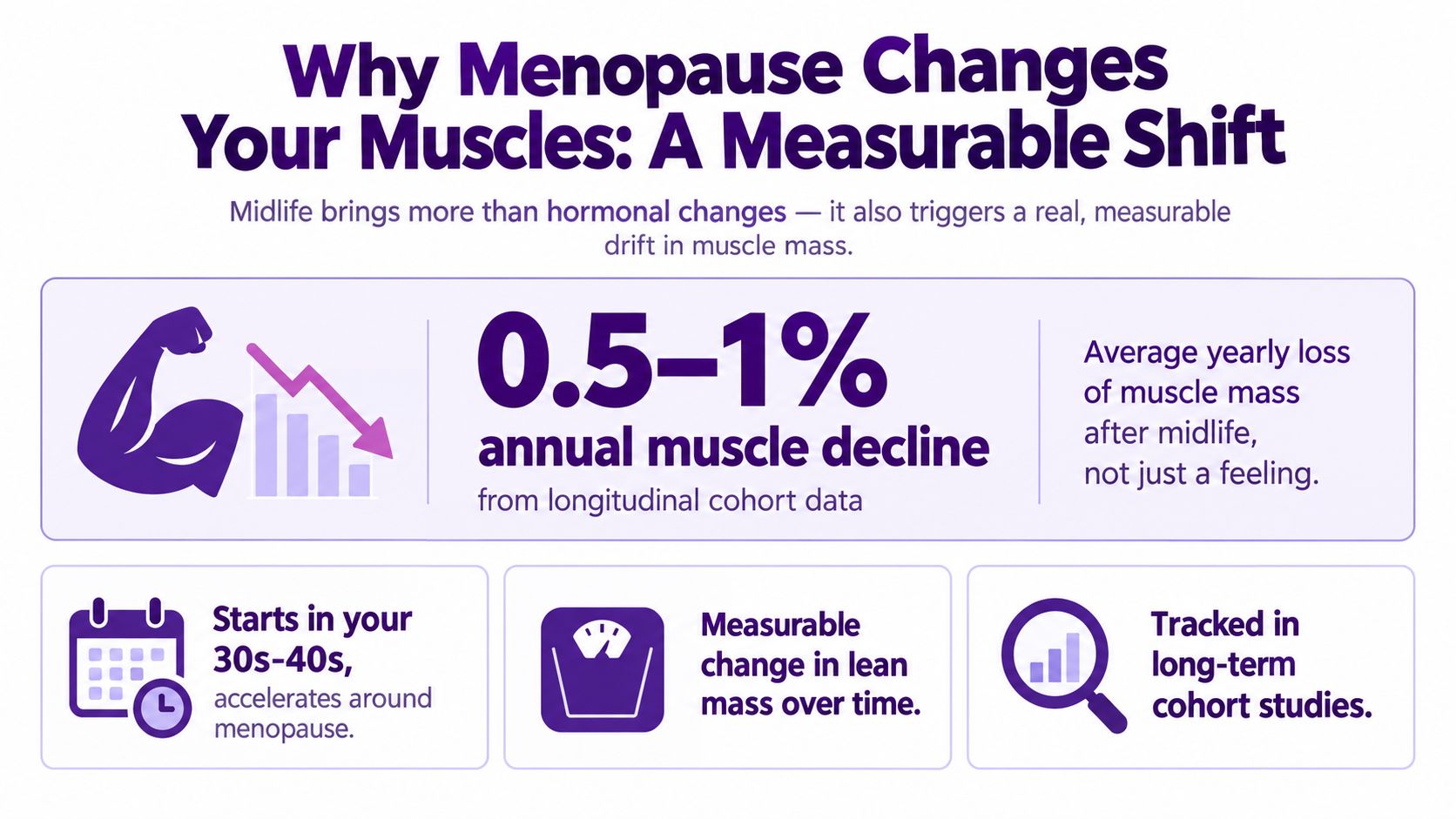
Muscle loss in midlife isn't just a feeling. Skeletal muscle mass typically declines by about 0.5% to 1% per year after age 25, according to a NICE evidence statement linked to the menopause guideline update, and NICE now explicitly tells women that maintaining muscle mass and strength through physical activity matters during menopause (NICE menopause guidance update).
That single fact changes the conversation. Many women think the problem is only weight gain, or only hormones, or only getting older. In clinic, the more accurate question is often: am I losing the wrong tissue? That matters even more if you're trying to lose weight in midlife, including with GLP-1 treatment, because the goal isn't to become lighter. The goal is to lose fat while keeping the muscle that protects strength, balance, metabolic health, and independence.
Menopause and muscle loss are tightly linked, but they're also manageable. The biology is real. The changes are measurable. And the practical response is usually less dramatic than people expect: strength training done consistently, enough protein spread properly through the day, sensible recovery, and a calm look at whether medical support has a place.
Table of Contents
- Why Menopause Changes Your Muscles
- The Biology Behind Midlife Muscle Loss
- Recognising the Signs and Knowing When to Seek Help
- Building a Weekly Strength Routine That Actually Works
- Fueling Muscle With Protein, Vitamin D and Smart Nutrition
- HRT, GLP-1s and Other Medical Considerations
- Red Flags Worth a Conversation With Your GP
- A 12-Week Plan to Protect and Rebuild Muscle
Why Menopause Changes Your Muscles
Menopause and muscle loss become easier to understand when you stop thinking only about body weight and start thinking about body composition. NICE notes that skeletal muscle mass typically falls by about 0.5% to 1% per year after age 25, which helps explain why many women hit their 40s or 50s and feel that something physical has shifted, even if the scales haven't moved much (NICE menopause guidance update).
What changes during the transition
The menopausal transition often acts like an acceleration point. Muscle was already drifting down slowly with age, then the hormonal environment changes and women start noticing reduced strength, slower recovery, and a body that seems to respond differently to the same habits.
That doesn't always show up as obvious weight loss or gain. A woman can stay roughly the same weight while losing lean tissue and gaining fat tissue underneath the same dress size, or finding that clothes fit differently at the arms, thighs, or waist.
Why the scales can mislead you
A useful way to think about this is that the scale tells you how heavy you are, but not what you're made of. Muscle is active tissue. When you lose some of it, your resting energy use tends to fall as well, which makes it easier to regain weight on the same food intake.
UK-relevant evidence during the menopausal transition shows lean body mass declines at an average annual rate of about 0.5%, or roughly 0.2 kg per year, while fat mass increases by about 1.7% per year, around 0.45 kg (review on menopause-related body composition change). That's why many women say, “I haven't changed that much, but my body feels different.” They're usually describing a real composition shift.
Practical rule: If your weight is stable but you feel weaker, softer, or slower to recover, don't assume “it's just ageing”. Consider that muscle may be falling while fat is replacing it.
This is also why a midlife weight-loss plan needs a different standard of success. Losing kilos isn't enough. Protecting lean mass is part of the job.
The Biology Behind Midlife Muscle Loss
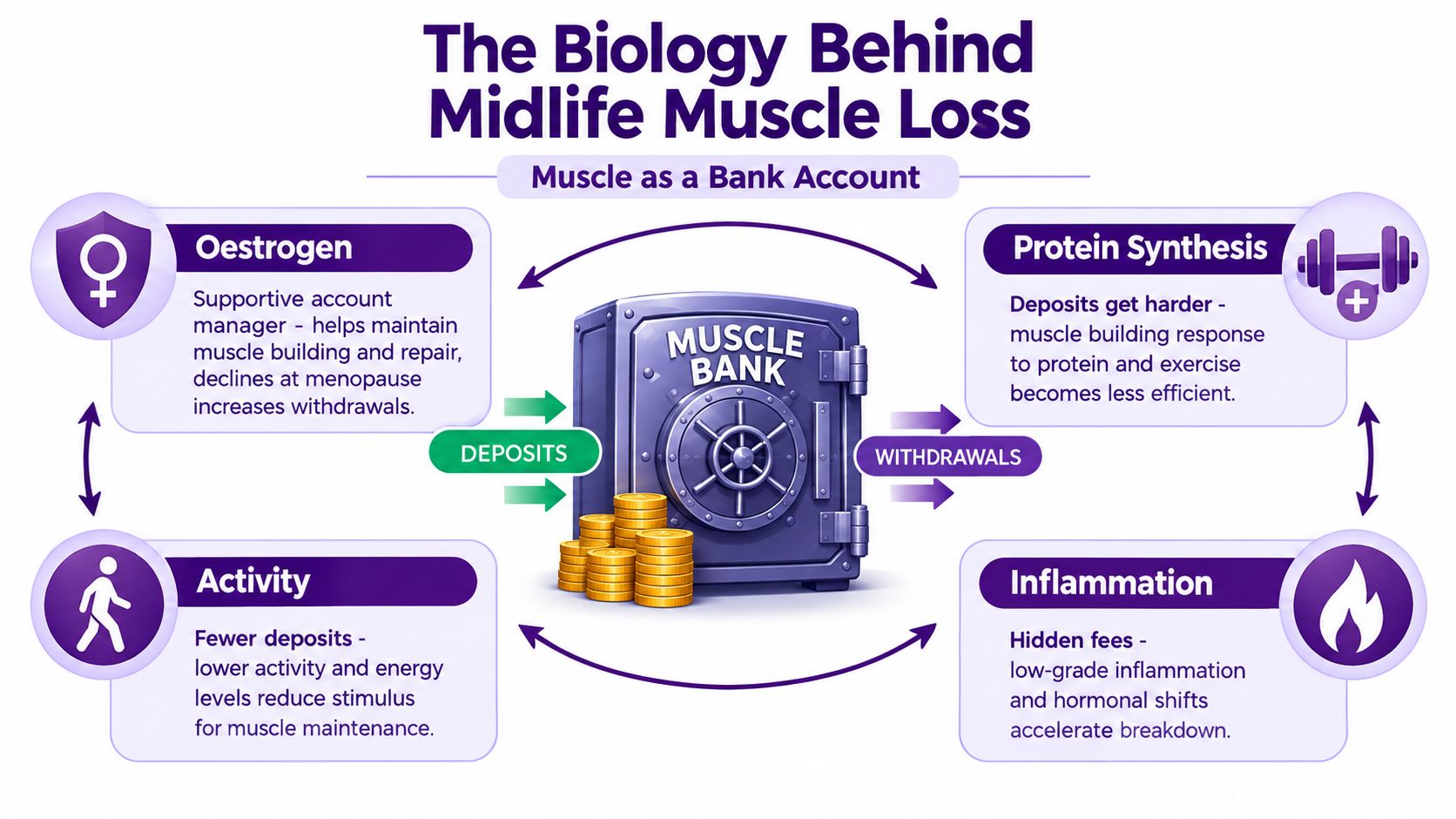
Muscle behaves a bit like a bank account. You make deposits with resistance exercise, good nutrition, and recovery. You make withdrawals through inactivity, under-fuelling, illness, poor sleep, and hormonal change. During menopause, the withdrawals often rise just as the deposits become harder to make.
Oestrogen changes the background conditions
UK clinical guidance from the British Menopause Society and NHS-linked materials frames postmenopausal muscle loss as an oestrogen-deficit problem that's modified by physical inactivity, insulin resistance, and obesity. The same guidance highlights regular aerobic work plus resistance training at least twice weekly, and describes strength exercise as the most efficient way to preserve or increase muscle mass and metabolic rate (NHS regional menopause guidance).
In plain English, oestrogen seems to support the environment in which muscle is maintained. When that support falls away, the body may become less efficient at repairing and rebuilding tissue after training.
Deposits still work, but you may need bigger ones
Resistance exercise is the main “deposit” signal. When muscle experiences enough challenge, the body gets a clear message to repair and strengthen it. If the challenge is too light, the signal is weak. That's one reason many women feel that the exercise that maintained them in their 30s no longer does enough in their 50s.
Protein is the raw material for the repair job. If training sends the message but meals don't provide enough building blocks, the response is limited. Recovery matters too. A tired, underfed body rarely builds well.
Why the same lifestyle can stop working
A woman who walked regularly, did the occasional class, and ate “pretty well” may have stayed lean and strong for years. Then perimenopause arrives and that same routine no longer protects muscle in the same way. She hasn't become lazy. The biology has changed.
Muscle in midlife usually needs a more deliberate plan, not more self-blame.
That's why the answer to menopause and muscle loss usually isn't a single product or a single hormone. It's a combination of training signal, protein intake, recovery quality, and medical context.
Recognising the Signs and Knowing When to Seek Help
The earliest signs of muscle loss are often subtle. You may notice jars feel harder to open, stairs feel steeper, or you need more recovery after gardening, a long walk, or a gym session. Some women say their legs feel heavy. Others notice their arms and thighs look smaller, even though their weight hasn't changed much.
NICE's menopause guidance recognises that muscle mass and strength matter for daily living. That helps separate ordinary midlife deconditioning from sarcopenia, which is the age-related loss of muscle mass and strength and deserves proper attention rather than dismissal (NICE full evidence guideline).
Everyday weakness and possible sarcopenia
| Feature | Everyday deconditioning | Possible sarcopenia |
|---|---|---|
| Daily tasks | Feels unfit after a period of inactivity | Routine tasks are becoming noticeably harder |
| Stairs | Puffing or leg fatigue if you've not trained much | Marked difficulty climbing stairs or rising from a chair |
| Recovery | Improves fairly quickly when activity resumes | Weakness persists despite trying to be more active |
| Body changes | General loss of tone | Visible reduction in muscle around arms, thighs, or overall frame |
| Function | Can still manage normal life independently | Strength, speed, or balance are starting to limit independence |
Why early recognition matters
A major 2026 systematic review reported mean lean-mass reductions of 2.5% in perimenopausal women and 5.7% in postmenopausal women compared with premenopausal women, and a 2026 UK Biobank analysis of 68,064 naturally postmenopausal women found 4,406 women with sarcopenia. In that analysis, each 5-year increase in time since menopause was linked to 13% higher odds of sarcopenia with OR 1.13, 95% CI 1.09 to 1.16 (systematic review and UK Biobank analysis).
That doesn't mean every woman will develop clinical sarcopenia. It means the risk is real enough to take strength loss seriously when it starts to affect function.
Simple ways clinicians assess the problem
In practice, clinicians may use a short symptom screen such as SARC-F, look at grip strength, or use functional checks such as sit-to-stand ability. These aren't about perfection. They help sort out “I'm out of condition” from “I may need a proper assessment”.
If you've noticed a clear drop in strength, speed, or steadiness, don't wait for frailty before acting.
Building a Weekly Strength Routine That Actually Works
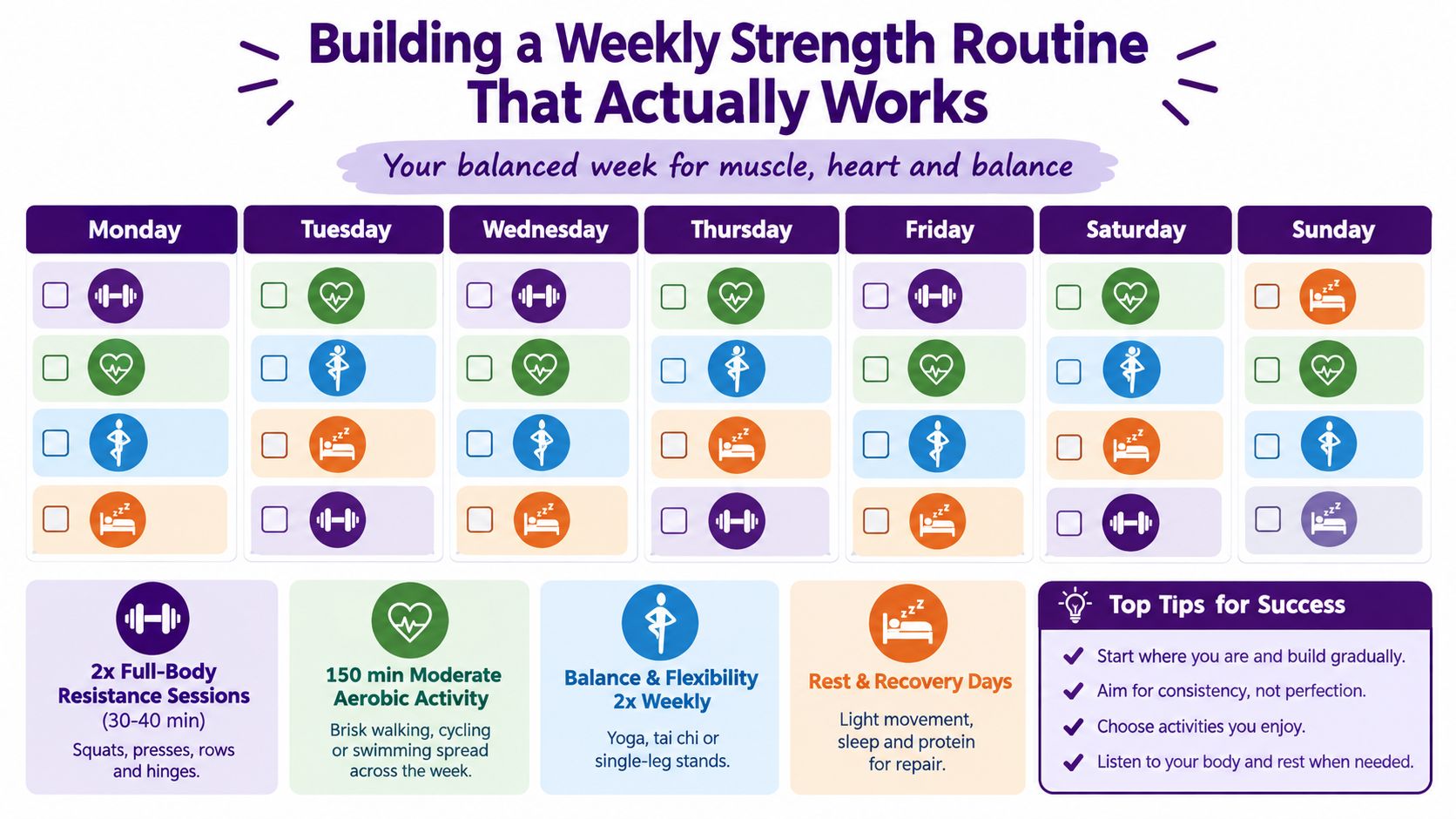
The NHS teaching material on menopause and muscle management is refreshingly practical. It advises 150 minutes of moderate exercise or 75 minutes of vigorous exercise per week plus 2 days a week of resistance training, and it gives examples such as wall squats, rows, step-ups, bicep curls, wall press-ups, leg press, heel raises, marching, and balance work (NHS menopause teaching slides).
A realistic weekly template
For most beginners or returners, a good base week looks like this:
- Two full-body strength sessions of about 30 to 45 minutes. Focus on pushes, pulls, squats, hinges, carries, and calf work.
- Aerobic movement across the week. Brisk walking, cycling, swimming, or intervals on a bike all count.
- Two short balance sessions. Single-leg stands, marching, heel-to-toe walking, or a short yoga flow can do the job.
- Recovery days with movement. Light walking and gentle mobility are usually better than complete inactivity.
A simple home session could include sit-to-stand from a chair, glute bridge, wall press-up, a hip hinge or kettlebell deadlift pattern, a row with a band or dumbbell, calf raises, and a loaded carry.
How hard should it feel
Most women under-train at first because they're worried about getting it wrong. Aim for a set that feels like a 7 to 8 out of 10 effort by the end. You should feel that you've worked, while still keeping control and good form.
Rest about 60 to 90 seconds between sets if you need it. Breathe out on the effort, such as standing up from the chair or pressing away from the wall. If an exercise never gets challenging, your body has no reason to adapt.
Don't let cardio do all the work. Walking is excellent for health, but it doesn't replace strength training if your goal is to preserve muscle.
For women using weights, bands, or bodyweight training as part of weight loss, this guide to the benefits of strength training for women gives a helpful overview of why resistance work matters.
Pelvic comfort also affects consistency. If workouts trigger irritation, friction, or discomfort, practical guidance on vaginal health during workouts can help you adjust clothing, hygiene, and recovery habits so training remains sustainable.
A short visual demo can make programming easier for beginners:
Fueling Muscle With Protein, Vitamin D and Smart Nutrition
Training is only half the job. Muscle needs materials. For menopausal women trying to preserve or rebuild lean mass, a practical protein target is about 1.2 to 1.6 g per kg of bodyweight per day, divided across meals so each meal does some repair work rather than leaving almost all protein until dinner.
A simple rule is to aim for roughly 25 to 30 g of protein across three meals. That often looks more manageable in real life than chasing a huge total.
Daily protein targets by bodyweight
| Bodyweight | Lower target (1.2g/kg) | Upper target (1.6g/kg) | Per-meal aim (3 meals) |
|---|---|---|---|
| 60 kg | 72 g | 96 g | about 24 to 32 g |
| 70 kg | 84 g | 112 g | about 28 to 37 g |
| 80 kg | 96 g | 128 g | about 32 to 43 g |
| 90 kg | 108 g | 144 g | about 36 to 48 g |
What that looks like on a UK plate
Useful staples include Greek yoghurt, eggs, tinned fish, chicken, tofu, lentils, cottage cheese, edamame, and milk-based drinks. Most women do better when they build the meal around the protein source first, then add vegetables, wholegrains, and healthy fats.
For example:
- Breakfast might be Greek yoghurt with seeds and fruit, or eggs on wholegrain toast.
- Lunch could be lentil soup with added tofu, or a chicken and bean salad.
- Dinner might centre on salmon, chicken, or tofu with potatoes or rice and vegetables.
If you get stuck on ideas, it can help to browse high protein dinner recipes that make higher-protein meals feel normal rather than restrictive.
Vitamin D and avoiding under-fuelling
The NHS hospital teaching material on menopause and muscle management includes protein and vitamin D as part of the core plan. In the UK, 10 micrograms of vitamin D daily during autumn and winter is a practical anchor, and some people may need year-round supplementation if sun exposure is limited.
Severe dieting is one of the quickest ways to lose the tissue you're trying to keep. A gentler calorie deficit is usually easier to pair with training and adequate protein than an aggressive one. If you're using a weight-loss plan and want to keep meals structured, this overview of protein intake for weight loss is worth reading.
HRT, GLP-1s and Other Medical Considerations
Medication can help some women, but it shouldn't replace the basics. NICE states that evidence suggests HRT may improve muscle mass and strength, although the evidence base is limited (NICE menopause guidance update). That's a sensible place to start the discussion. Possible benefit isn't the same as guaranteed benefit.
A 2020 systematic review and meta-analysis in postmenopausal women found that hormone therapy was not associated with a statistically significant improvement in muscle strength, with a pooled estimate of standardised mean difference 0.352, 95% confidence interval -0.098 to 0.803, p = 0.125 (meta-analysis on hormone therapy and muscle strength). So if HRT is used, it should be framed as one part of care, not as a muscle-preservation shortcut.
Where GLP-1 treatment fits
The question “am I losing the wrong tissue?” becomes especially important. GLP-1 medicines such as semaglutide or tirzepatide can be effective tools for weight loss, but any treatment that reduces appetite can make it easier to under-eat protein or skip the kind of resistance work that tells the body to hold onto muscle.
That doesn't mean GLP-1 treatment causes a bad outcome by default. It means the plan matters. Women usually do best when weight-loss treatment is paired with structured strength training, adequate protein, and attention to function rather than scale weight alone.
Other options and realistic expectations
Creatine often comes up in this conversation. It has one of the stronger evidence bases among supplements for supporting strength training, but it still works best as an adjunct to training rather than a replacement for it. Testosterone and other hormonal options need specialist assessment.
For women trying to connect symptom management, weight, and training readiness, broader reading on how women try to balance hormones for weight loss can be useful, as long as you keep a clinical lens and avoid oversimplified claims.
If you're considering how HRT and GLP-1 treatment may overlap in your own plan, this guide on HRT and Mounjaro gives a practical UK-focused starting point.
One factual option in the UK is Trim, a GPhC-registered online clinic and pharmacy that offers medically supervised weight-loss treatment after clinician assessment. For women in midlife, the relevant point isn't the medicine alone. It's whether the programme also addresses protein intake, activity, and muscle-preserving habits alongside weight loss.
Red Flags Worth a Conversation With Your GP
Some change in strength is common in midlife. Some change deserves a proper review. The key distinction is whether weakness is gradual and explainable, or whether it feels out of proportion, functionally limiting, or newly progressive.
Symptoms that shouldn't be brushed off
Ask for review if you notice any of the following:
- Rapid unintentional weakness over a short stretch of months, especially if stairs, carrying shopping, or getting up from a chair are suddenly harder.
- Falls or near-falls. Two or more falls, or one fall with injury, changes the conversation.
- Visible muscle wasting around the temples, thighs, or forearms.
- Unexplained weight loss along with weakness or reduced appetite.
- New chair-rise difficulty, particularly if you now need your arms to stand.
Medicines and medical factors that can contribute
A medication review is often worthwhile. Long-term oral corticosteroids, aromatase inhibitors, proton pump inhibitors, and excess thyroid replacement can all complicate muscle health. So can poor glycaemic control, low vitamin D, iron deficiency, and other long-standing medical issues.
Bring a written list. A short, organised summary makes a 10-minute GP appointment far more useful.
What to take to the appointment
A clinician-ready note can include:
- Symptom timeline. When did you first notice weakness, slower recovery, or balance issues?
- Current training pattern. How many days a week do you do resistance exercise, aerobic work, or balance practice?
- Protein estimate. Roughly how much protein do you eat in a day?
- Recent blood tests. If available, note vitamin D, ferritin, thyroid tests, and HbA1c.
- Specific request. Ask whether SARC-F screening, grip strength, physiotherapy referral, dietetic support, or DEXA is appropriate.
Early referral matters. It's much easier to rebuild function before frailty develops than after it begins to limit independence.
A 12-Week Plan to Protect and Rebuild Muscle
Around 1% of muscle mass is lost each year from midlife onwards if nothing is done to challenge it. That is the background many women are working against during menopause. If you are also trying to lose weight, the question becomes more specific. Are you losing fat, or are you losing some of the muscle you need for strength, balance, and independence?
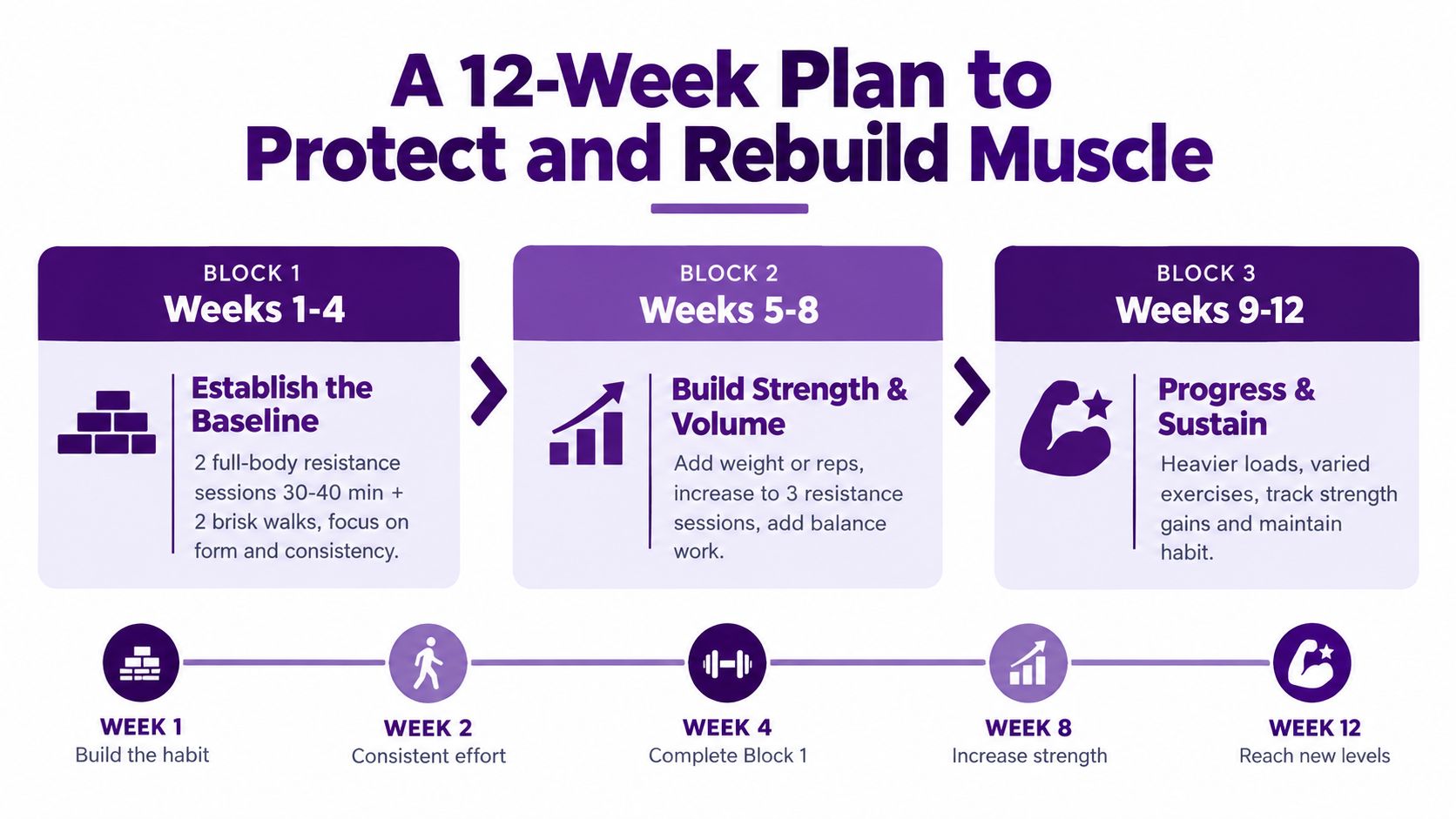
A useful 12-week plan gives your body three clear messages. Use the muscles regularly. Feed them well enough to repair. Check progress in ways that matter in real life, not only on the scales. That last point matters even more for women using GLP-1 weight-loss treatment, because rapid weight loss can include some lean tissue if protein and resistance training are not kept in view.
Weeks 1 to 4
Start with a routine that feels almost modest. Muscle is built by repeated signals, a bit like teaching your body a movement language it has not heard clearly for a while.
- Strength twice a week. Two full-body sessions, about 30 to 40 minutes each.
- Aerobic work twice a week. Brisk walking is enough to begin.
- Protein baseline. Aim for 1.2 g per kg of bodyweight daily, spread across three meals.
- Vitamin D routine. Consider 10 micrograms daily in autumn and winter if that applies to you in the UK.
- Tracking. Write down the exercises, sets, and how hard each session felt.
Keep the exercise menu simple. Sit-to-stand or squat, hinge, push, pull, carry, calf raises, and a small amount of balance work will cover a lot.
If you are on a GLP-1 medicine and appetite is lower, this first block is often where women spot the challenge. Eating less can help weight loss, but it can also make it easier to under-eat protein. A smaller appetite needs more deliberate meal planning, not less.
Weeks 5 to 8
Now the signal needs to become stronger.
You do not need a dramatic change. Add one layer at a time so recovery stays manageable.
- increase the load slightly on key exercises
- add a second set where you were doing one
- add a third weekly resistance session if recovery is good
- introduce single-leg balance practice
- move protein intake up towards 1.4 to 1.6 g per kg if training volume is rising and you are tolerating it well
Researchers at the University of Exeter reported that women before, during, and after menopause were still able to improve muscle function with resistance training, reinforcing a reassuring point for midlife women. The system remains trainable. Progress may be slower than it was at 25, but slower is not the same as impossible.
This is also a good stage to judge the quality of your weight loss. If body weight is dropping but your lifts are stable, your energy is reasonable, and everyday tasks feel easier, that usually suggests you are preserving more of the right tissue. If weight is falling and your strength, recovery, and steadiness are all slipping, the plan needs adjusting.
Weeks 9 to 12
The final block is about keeping gains and making them usable.
Use one lighter week if joints feel irritable or fatigue is building. Then continue with the same main movement patterns and a little more confidence. By now, the aim is less guesswork and more evidence from your own week. Can you rise from a chair more easily? Carry shopping with better control? Climb stairs without feeling that your legs have disappeared underneath you?
Those are meaningful markers because muscle is not only there for appearance or metabolism. It is your reserve. It helps you catch yourself, lift things, recover from illness, and stay independent.
At the end of 12 weeks, review four points:
- Strength. Are loads, repetitions, or control better than week 1?
- Function. Do daily tasks feel easier?
- Protein. Are you hitting the target on most days?
- Weight-loss quality. If you are losing weight, are you keeping strength and stability alongside it?
If the answer to that last question is no, raise protein intake, check that resistance training is regular enough, and discuss the wider picture with your clinician, especially if you are using GLP-1 treatment or have a low appetite.
Menopause-related muscle loss responds best to repetition, adequate protein, and sensible review when progress does not fit the usual pattern. Over 12 weeks, the goal is not perfection. It is to make sure the weight you lose is more likely to be fat, and the tissue you keep is the tissue you will miss if it goes.
If you're trying to lose weight in midlife without sacrificing strength, Trim offers UK clinician-supervised support that combines medical assessment with nutrition and strength-focused guidance. It's a practical option for women who want help thinking beyond the scale and protecting muscle while managing menopause-related weight change.