
Men's Weight Loss Diet Plan: Evidence-Based Steps

Nearly 7 in 10 men in England are overweight or living with obesity, with 69.1% of men in that category in 2021 to 2022 according to the UK government's obesity profile commentary, and this hasn't shifted enough through generic public health messaging (UK obesity profile statistical commentary). That changes the conversation. This isn't a niche gym problem. It's a mainstream men's health issue.
Most advice aimed at men still gets one thing badly wrong. It treats fat loss and keeping strength as two separate projects. In practice, they need to be handled together. If a man slashes calories, skimps on protein, keeps drinking through the weekend and does no resistance training, he often loses weight in the short term but doesn't like the result. Hunger rises, gym performance drops, the waist stalls, and the rebound starts.
A good men's weight loss diet plan has to fit British life as it is. Long work days, convenience food, pub habits, late eating, stop-start exercise, and the common wish to lose fat without looking or feeling smaller. That means using NHS and NICE principles, not bro-science and not imported meal plans that ignore how men live here.
Table of Contents
- Why Men in the UK Need a Different Approach to Weight Loss
- Setting Your Calorie Target and Protein Floor
- The Four Pillars of a Sustainable Men's Weight Loss Plan
- A Realistic Day of Eating on Around 1,900 kcal
- What the UK Clinical Evidence Actually Shows
- When Diet Alone Stops Working and Clinical Support Makes Sense
- Your First 28 Days and When to Check In With a Clinician
Why Men in the UK Need a Different Approach to Weight Loss
Men in England are more likely than women to be carrying excess weight, and the pattern gets worse through middle age. The Health Survey for England 2022 found that 67% of men were overweight or living with obesity, compared with 61% of women. It also reported that 28% of men were living with obesity, and that in men aged 55 to 64, the prevalence of overweight including obesity reached 80% (NHS Health Survey for England 2022).
That has practical consequences in clinic.
A 27-year-old man with a takeaway habit, patchy gym attendance and no medical problems needs a different plan from a 59-year-old with central weight gain, borderline blood pressure, poor sleep and aching knees. Giving both men the same advice to "eat less and move more" is lazy. It ignores appetite, muscle retention, recovery, routine, and the fact that men often want fat loss without becoming smaller and softer.
Why standard diet advice misses the point
A lot of diet content for men still treats fat loss and strength as separate jobs. In real life, they overlap. If calories drop too hard, protein stays low and resistance training is absent, scale weight may fall for a few weeks but the result is usually poor. Hunger climbs, training quality drops, and the man often looks flatter without losing much from the waist.
That is why a proper men's weight-loss approach combines calorie control, a clear protein floor, regular lifting, and habits that still hold up on Friday night and Sunday afternoon.
Men also face predictable friction that generic meal plans gloss over. Commutes run long. Lunch is bought, not prepped. Alcohol clusters at the weekend. Portion sizes drift up when stress and poor sleep kick in. Many men then try to "make up for it" with a punishing Monday diet or an extra gym session, which rarely fixes the weekly energy surplus.
Men rarely struggle because they have never heard of healthy food. They struggle because their plan does not survive work stress, social eating, and inconsistent training.
The UK context matters
UK guidance is clear that overweight and obesity management should be adapted to the person, with attention to behaviour change, comorbidities and realistic long-term follow-up, not quick fixes (NICE guideline on overweight and obesity management). That matters for men because the common failure pattern is not lack of effort. It is repeated stop-start dieting with no structure to protect muscle, appetite control or adherence.
A useful men's weight loss diet plan needs to do four jobs at once:
- Create an energy deficit that a working adult can maintain
- Protect muscle mass and strength while body weight comes down
- Reduce decision fatigue during busy weekdays and unstructured weekends
- Show when self-management is no longer enough, and when clinical support is the smarter option
That is the difference. The aim is not just to weigh less. The aim is to lose fat, keep function, and use a plan that still works after the first burst of motivation fades.
Setting Your Calorie Target and Protein Floor
The NHS uses 1,900 kcal a day for men in its weight-loss plan as a practical benchmark, alongside a typical loss rate of 0.5 kg to 1 kg per week for a sensible deficit (NHS weight-loss plan PDF). Use that figure as a starting point, not a badge of discipline.
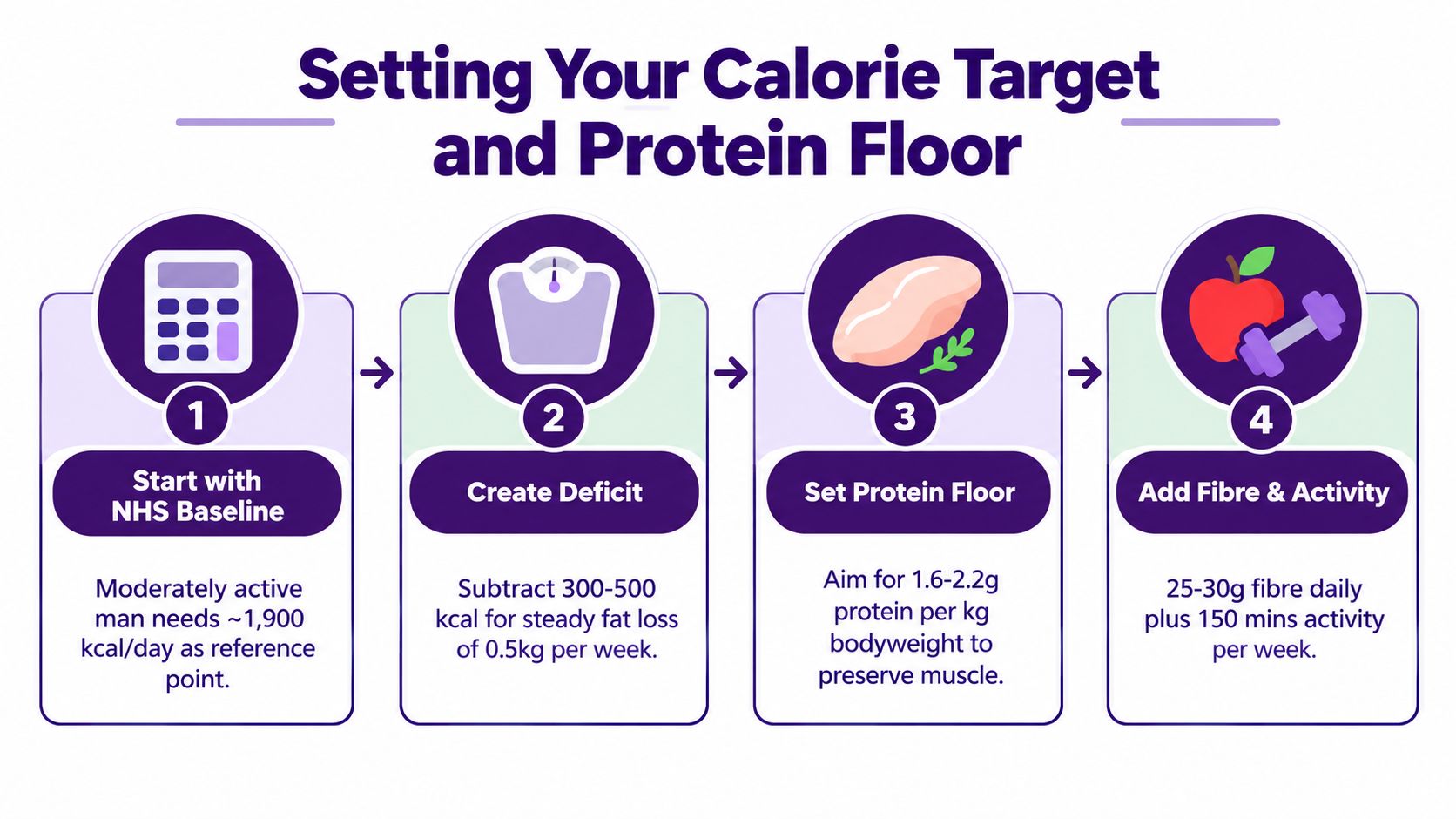
Men often go wrong in one of two ways. They either pick a number so low that training quality collapses by week two, or they avoid setting any number at all and call it “eating clean”. Neither works for long if the goal is to lose fat and keep strength.
A better approach is to run a short test phase. Start near 1,900 kcal if you need a safe baseline, keep protein high, and hold that steady for 14 days. Then judge the plan by four things: your weight trend, hunger, gym performance, and whether you can repeat the week without white-knuckling it. If your weight is static and portions have been honest, intake is probably too high. If you are flat in the gym, ravenous at night and thinking about food all day, the deficit is probably too aggressive.
Protein is the part many men treat as optional. It is not. If you want to drop body fat without watching your lifts slide backwards, set a minimum daily intake and build meals around it first. For a practical breakdown of how to set that up, see this guide to protein intake for weight loss.
Here is the trade-off. Lower calories can move the scale faster, but poor protein intake makes the result worse. You lose more than fat. Appetite usually gets harder to manage, recovery dips, and the diet starts to fight your training instead of supporting it.
In clinic, I would rather see a man hit his calorie target roughly and his protein target consistently than the other way round. A breakfast with eggs or Greek yoghurt, a lunch with chicken, fish, lean meat or beans, and a protein-based evening meal will do more for body composition than spending all day chasing tiny calorie savings from “healthy” snack foods.
Three rules keep this section practical:
- Set calories low enough to create progress, not so low that adherence and lifting fall apart.
- Set a protein floor you can hit daily, including weekdays at work, not just on organised days at home.
- Use ordinary high-fibre foods to make the deficit easier to live with. Oats, potatoes, pulses, fruit and vegetables usually do more than expensive diet products.
Food setup matters as much as the maths. If your only protein options are whatever happens to be in the office fridge, and your evenings start with “what can I pick up on the way home?”, your targets stay theoretical. The habit side matters here, and eating healthier with Rip Van gives a useful basic prompt on making better defaults.
Practical rule: if breakfast and lunch are both low in protein, most men spend the evening hungry and eat like they are trying to catch up.
The Four Pillars of a Sustainable Men's Weight Loss Plan
Men usually do better with a system than with motivation. Weight loss holds when food, training, daily movement and monitoring work together, because fat loss and muscle retention are the same job, not two separate ones.
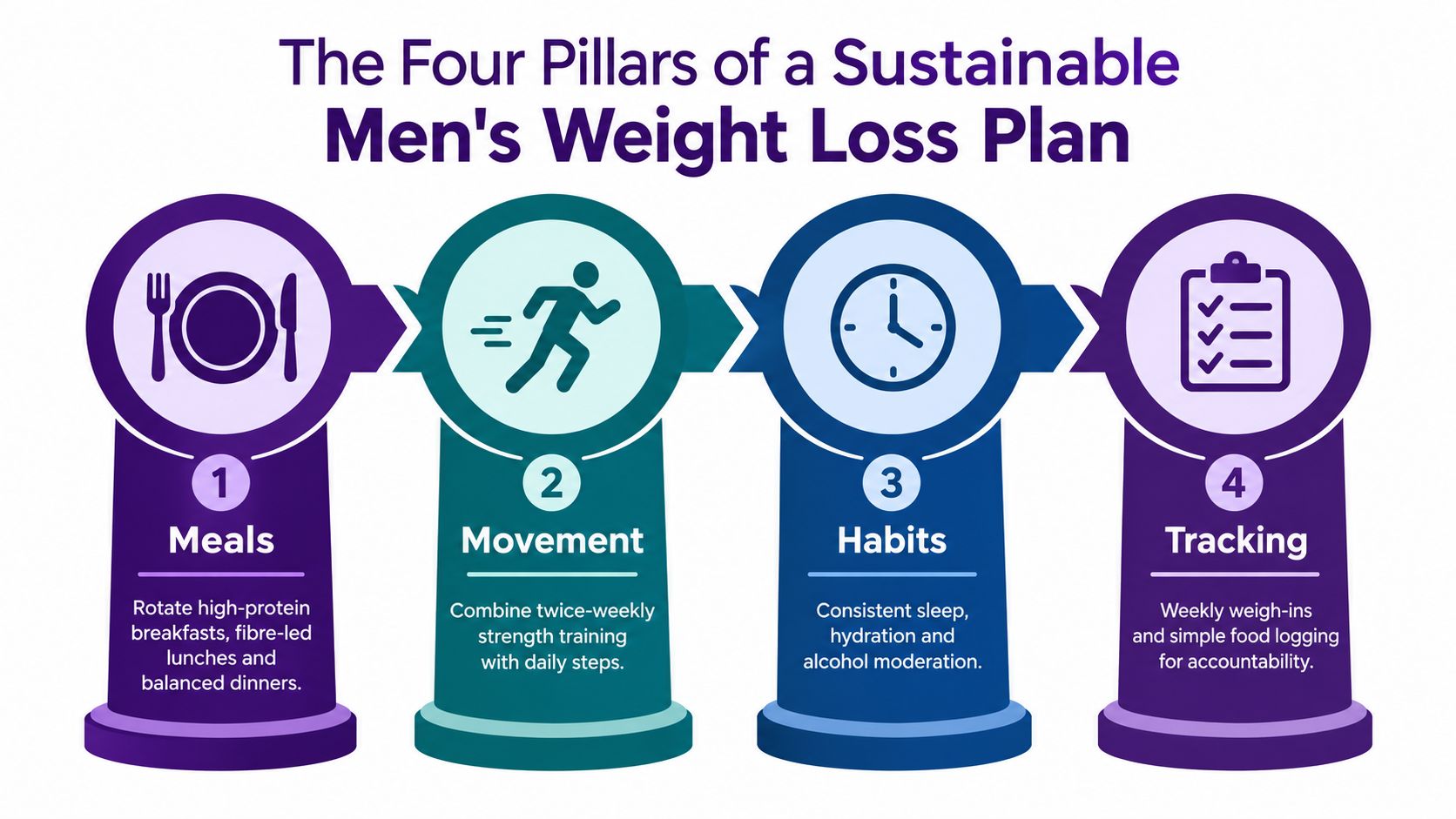
Start with meals. Men who keep losing fat without feeling constantly deprived usually rotate a short list of reliable options they can buy, cook and repeat during a busy week. Porridge, eggs, Greek yoghurt, chicken, tinned fish, lentils, potatoes, rice, frozen vegetables and fruit cover most of the job. Boring helps here. Fewer decisions usually means fewer impulsive calories.
Protein still needs planning, but not bodybuilding-level obsession. The aim is to spread it across the day so hunger stays steadier and training has some support. In practice, that often means a proper breakfast, a lunch that survives the office or van route, and an evening meal that is built around protein before anything else goes on the plate. Men who leave protein to chance at breakfast and lunch often spend the evening overeating foods that are easy to get down and poor at keeping them full.
Training is the second pillar, and many diet plans for men fall apart. They chase weight loss as if strength does not matter, then wonder why they look smaller, softer and feel more tired. Two or three sensible resistance sessions a week gives your body a reason to keep muscle while you diet. It also tends to keep men more engaged, because performance is a better marker than scale weight alone. If you want the body-composition side explained clearly, this guide on how to lose weight and keep muscle is a useful companion.
The third pillar is ordinary movement. Not punishment cardio. Not trying to erase a takeaway with an hour on a bike. Walking more, standing more, taking stairs, carrying shopping, breaking up long sitting periods. These low-drama habits often decide whether a calorie deficit stays intact across the week.
Then comes tracking, which is less glamorous and more useful than meal-prep photos. A weekly weigh-in under the same conditions, a waist check every couple of weeks, and a quick review of how many sessions, walks and unplanned meals happened tells you far more than daily scale panic. I would rather a man notice that his Friday drinks have become Friday and Saturday than argue about whether his porridge oats were weighed to the gram.
So the four pillars are simple, but they ask for honesty:
- Meals you can repeat during workdays, not just on organised Sundays
- Protein placed on purpose across the day
- Resistance training and daily movement kept in the plan together
- Tracking that shows trends early enough to correct them
For readers who want another plain-English overview of sustainable routines, the Venus Health Co. weight loss guide is a decent companion piece.
A Realistic Day of Eating on Around 1,900 kcal
Around 1,900 kcal is often enough to move fat loss along for a desk-based man who still wants enough fuel to train, recover and keep hunger manageable. It is not magic. It is a workable middle ground.
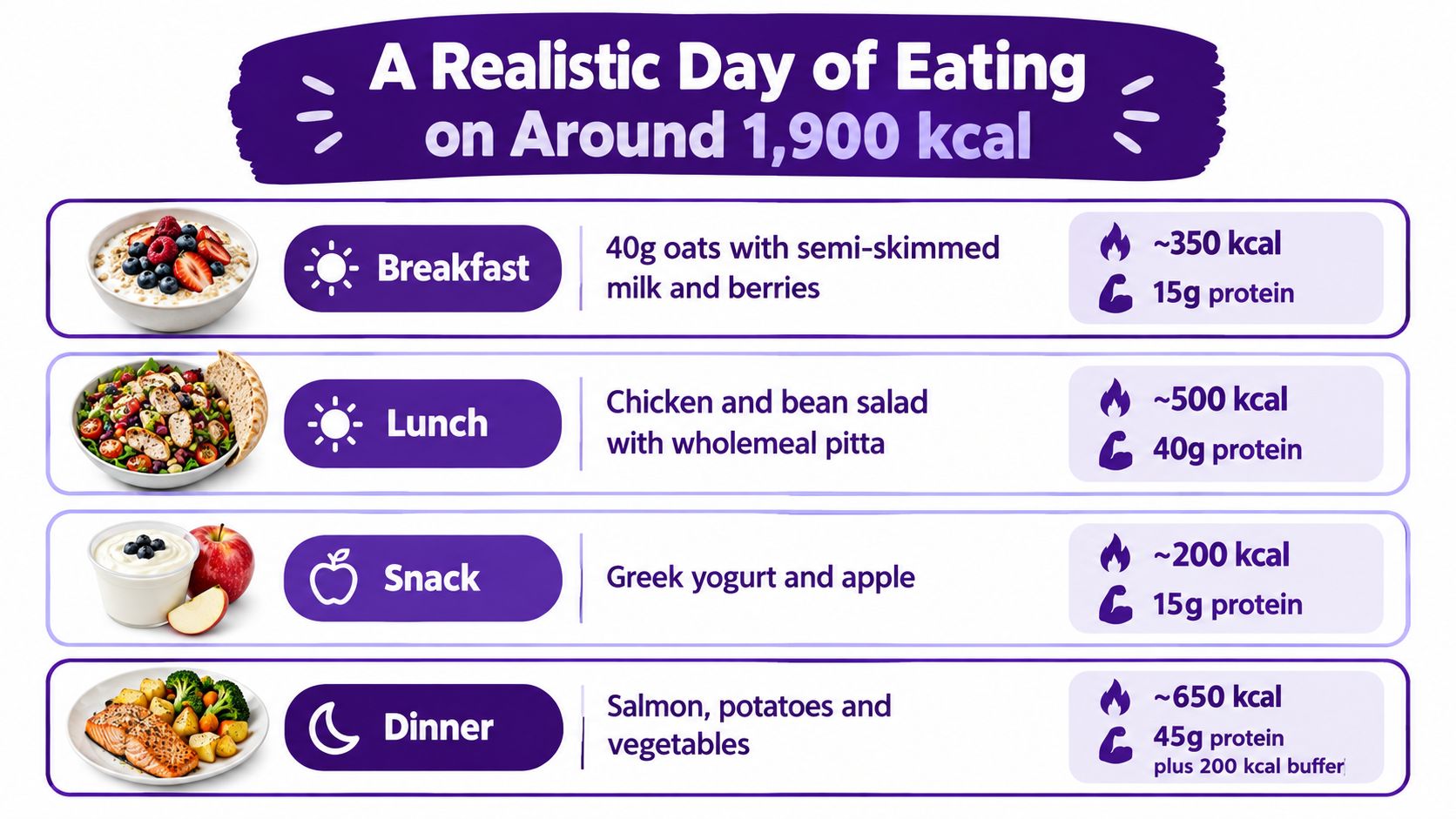
A day like this suits a man in his thirties or forties with a mostly sedentary job, two or three gym sessions a week, and a clear goal to lose body fat without watching his lifts fall apart. The point is not to eat like a fitness model. The point is to make the protein target achievable, keep meals repeatable, and stop the usual slide into biscuits, meal deals and late-night takeaways.
Morning starts. Oats made with semi-skimmed milk, whey stirred through, and a banana on the side gives a solid first meal that covers protein, fibre and enough carbohydrate to avoid the mid-morning slump. If breakfast is rushed, overnight oats do the same job with less friction.
By late morning, hunger usually needs managing rather than testing. Two boiled eggs and an apple travel well and stop lunch becoming a rescue mission. Lunch then needs to earn its place. A chicken, chickpea and roasted pepper salad with a wholegrain pitta is practical for work, higher in protein than the average supermarket sandwich, and less likely to leave you scavenging for crisps at 3 pm.
Training days need a small adjustment, not a second diet plan. If you lift after work, a rice cake with peanut butter, or yoghurt and fruit, is usually enough to take the edge off hunger without turning the session into a stomach-full event.
Dinner is where many men either hold the plan together or wreck it. Salmon, potatoes and broccoli is a good example because it is ordinary food, easy to portion, and supportive of training. Swap the salmon for lean mince, chicken thighs, white fish or tofu if cost or preference matters. The structure matters more than the specific ingredient. A clear protein source, a measured carb portion, and vegetables that take up space on the plate.
Then close the kitchen. Greek yoghurt with berries works well because it adds another hit of protein and draws a line under the day.
A rough version looks like this over the day:
- Breakfast: oats, semi-skimmed milk, whey, banana
- Snack: two boiled eggs, apple
- Lunch: chicken, chickpea and roasted pepper salad, wholegrain pitta
- Pre-training snack: rice cake with peanut butter
- Dinner: salmon, potatoes, broccoli
- Evening: Greek yoghurt, berries
What matters here is the pattern. Protein shows up repeatedly across the day rather than being dumped into one oversized dinner. Carbohydrate sits around activity and satiety, not around random cravings. Food volume is high enough to make the deficit livable.
That last point gets missed. Men often try to lose fat on meals that are too small, too low in protein, or too chaotic to survive a busy Wednesday.
There is room to adapt it. Men who train early may move more carbs to breakfast and lunch. Men eating with family often do better keeping breakfast and lunch fairly fixed, then sharing the evening meal and controlling portions rather than cooking a separate "diet dinner". Shift workers usually need the same foods in a different order.
Alcohol still counts. A couple of pints on Friday can wipe out much of the week's deficit if they come with a kebab on the way home and a heavy breakfast the next day. I would rather a man plan for that than claim he is "good all week" and wonder why the scale stays put.
A useful day of eating is rarely exciting. It is predictable, filling, protein-aware, and realistic enough to repeat next Tuesday. That is why it works.
What the UK Clinical Evidence Actually Shows
The most useful trial data doesn't support macho suffering. It supports structure.
NICE states that adult dietary approaches should create an energy deficit, supported by a suitably trained professional with follow-up to help maintain weight loss long term. It also says that restrictive, nutritionally unbalanced diets are ineffective in the long term and can be harmful (NICE overweight and obesity management guidance). That should end the argument about crash diets, but it rarely does.
What happens in real UK services
A large NHS specialist weight-management service study involving 1,838 patients found that men lost more weight than women overall, and that the service achieved 5 kg loss in 28% of participants at 12 months using LOCF analysis, rising to 54% among complete cases (BMJ Open study of UK specialist weight management services).
That's worth paying attention to. Men often assume they won't engage with structured services. In reality, many do well when the plan is concrete and someone is following up.
A separate NIHR-supported football-based intervention in the same source involved 747 overweight or obese men aged 35 to 65 years. It reported a mean 5.80 kg loss at 12 weeks and 5.56 kg at 12 months, with sustained loss still evident at 3.5 years. The lesson isn't that football is magic. It's that male-friendly structure, camaraderie and accountability improve follow-through.
The adherence lesson from meal provision
A UK randomised controlled trial in Hull compared a self-directed diet with a structured calorie-deficit plan that included full meal provision. Both groups were designed around an estimated 2,928 kJ a day (700 kcal a day) deficit, but at 12 weeks the meal-provision group lost 6.6% of body weight versus 4.3% with self-directed dieting. Also, 61% of the meal-provision group achieved at least 5% weight loss compared with 22% in controls (Hull randomised controlled trial).
That doesn't mean every man should buy pre-prepared meals. It means reducing friction works. Pre-logging meals, repeating lunches, keeping protein foods in the house, and removing trigger foods all borrow the same principle. The easier the plan is to execute, the better the outcome tends to be.
UK weight-loss trials at a glance
| Trial / Programme | Setting | Weight loss at 12 weeks | Key takeaway for men |
|---|---|---|---|
| Hull meal-provision RCT | Structured calorie-deficit plan with meal provision versus self-directed dieting | 6.6% body weight loss with meal provision versus 4.3% with self-directed dieting | External structure improves adherence |
| NHS specialist weight-management service | UK specialist service | Not reported at 12 weeks in the study summary cited here | Men can do well in supervised, behaviourally structured care |
| Football-based male intervention | Community male-engagement programme | 5.80 kg mean loss | Male-friendly settings can improve engagement and durability |
When Diet Alone Stops Working and Clinical Support Makes Sense
Nearly 7 in 10 men in England are overweight or living with obesity, according to a UK government update on men and weight loss. That matters because many men are still trying to solve a long-running weight problem with short bursts of harsher dieting. It rarely works for long if the plan strips calories too hard, leaves protein too low, and treats training as optional rather than part of the treatment.
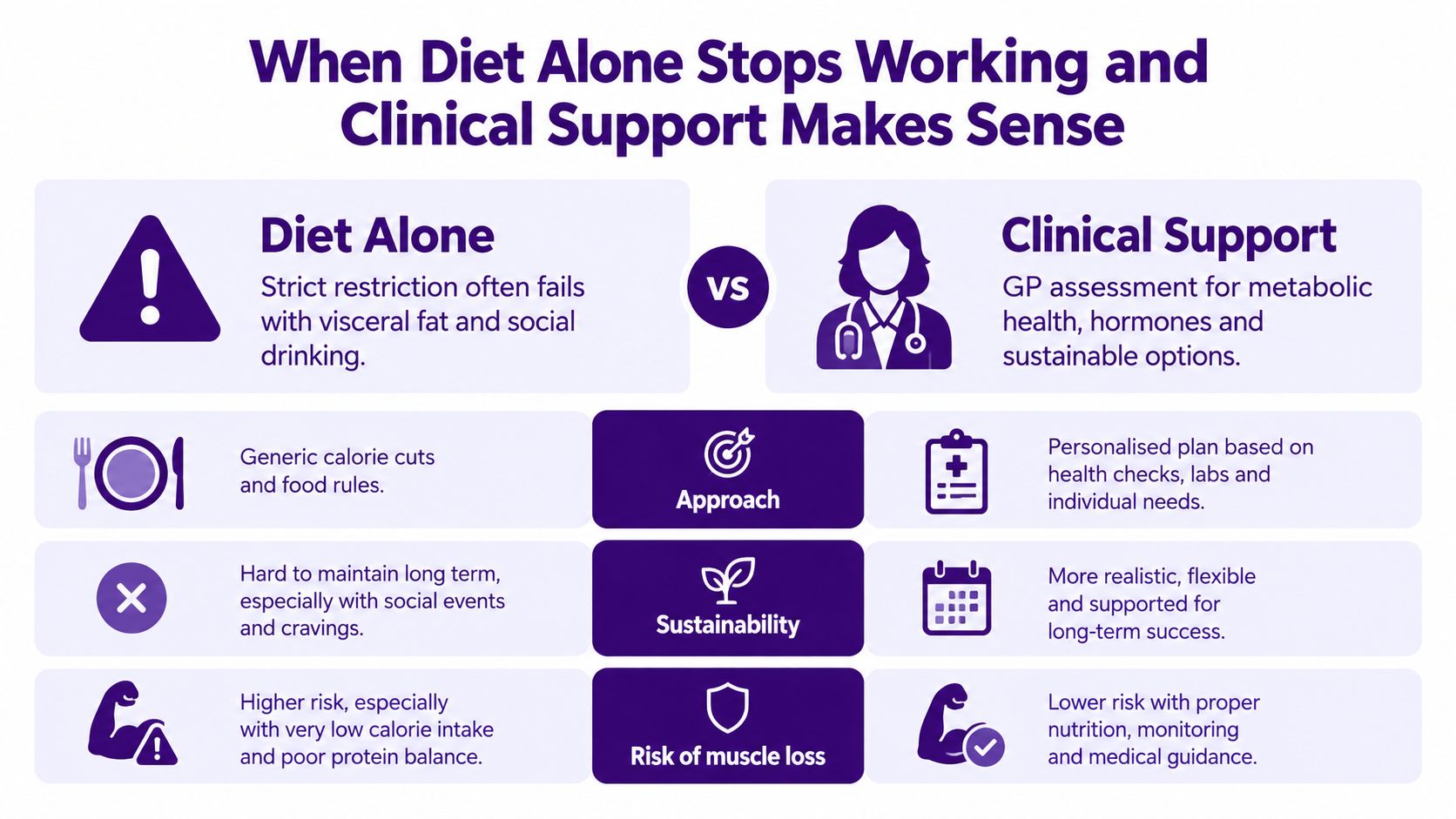
In practice, the warning signs are usually obvious. Hunger is high by late afternoon. Lifting numbers stall. Weekend eating wipes out the weekday deficit. Weight may drift down for a fortnight, then bounce back. Men often read that as a motivation problem. More often, it is a plan-design problem.
The UK government update also noted that male-friendly programmes tend to work better when they combine diet, physical activity and behavioural support, often in settings that feel practical rather than preachy (UK government update on men and weight loss). That matches what I see. Fat loss and strength hold together better when protein, resistance training and behaviour are built into the same plan.
Signals that diet-only isn't enough
Diet-only efforts deserve a rethink when the pattern keeps repeating or the health risk is rising.
Common triggers include:
- Waist size in the clinical risk range: NICE uses waist circumference in men as part of risk assessment. A waist of 94 cm or more signals increased health risk, and 102 cm or more signals substantially increased risk (NICE obesity guidance).
- Repeated regain after hard dieting: if each attempt starts aggressively and ends with rebound eating, the issue is usually the method.
- Weight gain with medical red flags: raised blood pressure, prediabetes, sleep apnoea symptoms, joint pain, or a strong family history all lower the value of a DIY approach.
- Training quality falling off: persistent fatigue, poorer recovery, and declining strength usually mean the deficit is too aggressive or the structure is poor.
- Loss of control around food or alcohol: evening eating, takeaway drift, and weekend drinking can keep intake high even when weekday meals look tidy on paper.
What clinical support can look like
Clinical support is broader than many men assume. It can mean a GP review, referral into an NHS weight-management service, a dietitian, or assessment for treatment options if BMI, waist and comorbidities put you in a higher-risk group. The point is to match the level of help to the level of difficulty.
For some men, support is mainly behavioural. They need monitoring, a clearer calorie range, help with binge or reward eating, and a plan that protects muscle while weight comes down. For others, treatment becomes reasonable because obesity is behaving like a chronic condition rather than a run of poor choices.
Trim is one example of a medically supervised UK service that assesses suitability, reviews treatment options for eligible adults, and pairs that with nutrition and training support. Used properly, that sort of service does not replace the basics. It gives some men enough structure to follow them consistently.
Clinical help is not a failure. It is often the more sensible route once repeated self-directed dieting has stopped producing results.
Your First 28 Days and When to Check In With a Clinician
Men who lose weight and keep more of their strength usually do the same few things early. They keep the plan simple, they measure what is happening, and they stop guessing. The first 28 days are not for chasing perfect eating. They are for building a routine you can repeat on a normal UK workweek, while checking that your calories, protein and training fit your life.
The first four weeks
Use the month to answer one question. Can you follow this plan well enough to lose fat without your training, energy or weekends falling apart?
4-Week Kickstart: Weekly Checkpoints and Decision Triggers
| Week | Focus | Decision Trigger | Action |
|---|---|---|---|
| Week 1 | Establish your baseline intake and meal pattern | You cannot describe what you eat on workdays versus weekends | Log meals, drinks, snacks and alcohol daily. Weigh yourself on the same morning each week |
| Week 2 | Lock in a repeatable protein-led structure and begin resistance training | Hunger climbs late in the day or after a low-protein breakfast and lunch | Build each meal around protein and add two full-body resistance sessions |
| Week 3 | Audit sleep, routine and alcohol | Intake looks controlled Monday to Friday but evenings or weekends undo the deficit | Set a plan for social meals, put limits on alcohol before the weekend, and tighten evening eating |
| Week 4 | Reassess trend, waist and function | Weight is flat, waist is unchanged, or energy and gym performance are dropping | Check portions, logging accuracy, liquid calories, and whether clinical input would save time |
What should be clearer by day 28
By the end of the month, "I'm trying" is not enough. You need a clearer read on whether the plan works in real life.
Ask four direct questions:
- Can you repeat it? A plan that only works on quiet weeks is not a plan.
- Is hunger under control? Constant hunger usually points to poor food structure, too little protein, or an over-aggressive deficit.
- Is your waist coming down? Scale weight can wobble. Waist trend often gives a cleaner signal.
- Are you holding strength reasonably well? Some drop in performance can happen in a deficit. A sharp decline usually means recovery, protein, calories, or training volume need work.
That last point matters. Many men split fat loss from strength work and end up doing both badly. The better approach is to judge them together. If body weight is falling but lifts are crashing, the setup needs adjusting, not more willpower.
When to involve a clinician
Use common sense first. If you develop chest pain, persistent fatigue, marked mood change, fainting, or rapid unintentional weight loss, speak to a clinician promptly.
There are also slower signals that DIY is no longer the smart option. Your waist stays high and does not shift. Weight repeatedly rebounds after short periods of control. Hunger, alcohol, evening eating, or binge-type patterns keep breaking the plan. Existing conditions such as sleep apnoea, hypertension, prediabetes, joint pain, or low mood make adherence harder and the health stakes higher.
If you have 4 weeks of honest records and little to show for it, that information is useful. A GP, dietitian, pharmacist prescriber, or NHS weight-management service can do more with a clear log of weight trend, waist, food intake, training, sleep and alcohol than with a vague report that things are "not working".
Trim offers UK adults a medically supervised route when a men's weight loss diet plan needs more than self-directed calorie cutting. If you want clinician review, treatment eligibility assessment, and support that combines nutrition with muscle-conscious weight loss, visit Trim.