
Mounjaro Half Life: What It Means for Dosing

You're packing for a holiday when you realise you've forgotten your injection. Or perhaps you're still feeling nauseous days after taking it and wondering why. If you're planning a pregnancy, the question becomes more personal: how long should you wait after stopping treatment? Understanding Mounjaro half life helps make sense of these situations, but the number alone isn't enough to guide a safe decision.
Table of Contents
- Why So Many Patients Ask About Mounjaro Half Life
- What a Half Life Actually Means in Plain English
- The Pharmacokinetic Numbers Behind Mounjaro
- How the Half Life Supports Once-Weekly Dosing
- Onset, Persistence, and the Duration of Side Effects
- How Tirzepatide Compares to Other GLP-1 Medicines
- Pregnancy, Contraception, and Other Special Considerations
Why So Many Patients Ask About Mounjaro Half Life
The question often starts with a mismatch between the calendar and how you feel. Your injection day has passed, yet your appetite still feels different. You've delayed a dose, but you're unsure whether taking it now would mean taking injections too close together.
It's understandable to look for a simple answer about when the medicine wears off. However, the amount of medicine in your body, the effects you notice, and the instructions for your next dose are different questions. Treating them as interchangeable can lead to unsafe decisions.
The question behind the question
Someone asking about half-life may need help with any of the following:
- A disrupted routine. A holiday, shift change or forgotten injection has made the usual schedule difficult.
- Persistent symptoms. Nausea hasn't settled, and they're considering delaying or stopping treatment.
- Pregnancy planning. They want to understand the difference between finishing treatment and being ready to try to conceive.
- An uncertain injection. They can't remember whether they administered a dose and are considering repeating it.
These aren't situations in which an online calculator can replace a conversation with your prescriber. A calculation can estimate how a medicine declines, but it can't establish whether you should inject today, whether symptoms need assessment, or whether restarting your previous dose is appropriate.
Why UK guidance matters
The most useful starting point is the UK Summary of Product Characteristics, often shortened to SmPC. This is the regulatory product information clinicians use alongside clinical judgement, rather than an account of someone else's treatment experience.
Pharmacokinetics means how the body absorbs, distributes and removes a medicine. Understanding it helps explain the licensed dosing pattern, but your registered UK prescribing team must translate that information into advice for your circumstances.
Practical perspective: Ask “What should I do about my next dose?” rather than relying only on “How much medicine might still be there?”
This is an educational explanation, not a recommendation to start treatment. The aim is to help you ask clearer questions and recognise when a personal decision needs clinical input.
What a Half Life Actually Means in Plain English
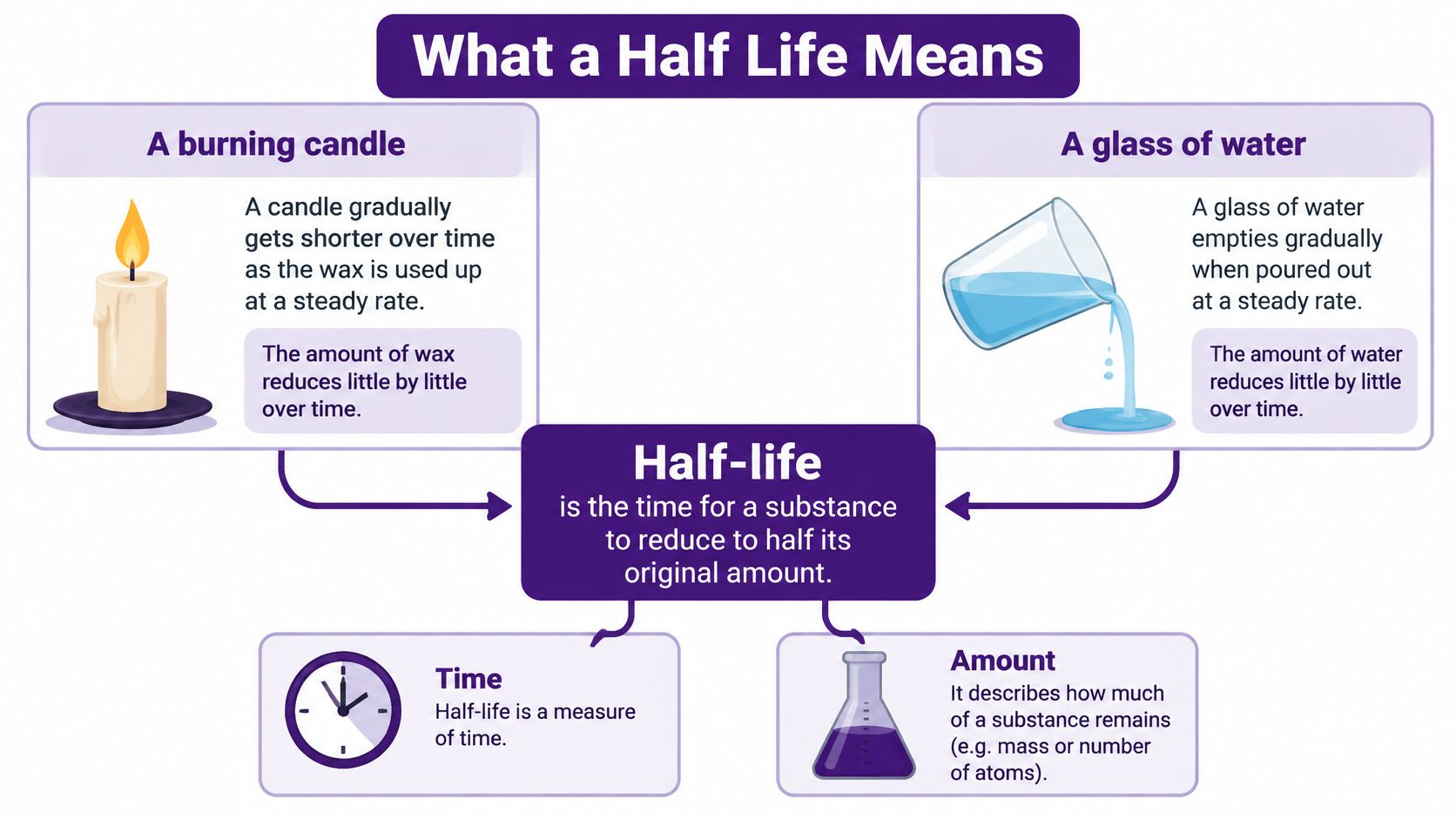
Think of a glass of water from which you repeatedly remove half of whatever remains. The first pour removes a larger amount than the next, even though the proportion removed stays the same.
That's a better model for half-life than a candle burning down at a constant speed. With medicines, the amount removed over each interval generally gets smaller as less medicine remains. The decline isn't a straight line ending at a predictable moment.
Half means half of what remains
Elimination half-life describes the time it takes for a medicine's concentration to fall by half during its elimination phase. It doesn't mean that half its benefits have ended, or that you're halfway through a fixed period of treatment activity.
The visual below introduces gradual reduction. For the closest analogy to drug elimination, focus on repeatedly halving the water rather than pouring out a fixed amount.
Several related terms help explain what happens during regular treatment:
- Elimination means the body removing the medicine.
- Accumulation means some medicine remains when the next prescribed dose arrives, so exposure builds during repeated dosing.
- Steady state means the overall pattern of exposure has stabilised with regular administration. It doesn't mean the concentration stays perfectly flat.
The UK Mounjaro product information describes the prolonged elimination underlying this pattern.
Presence isn't the same as effect
A laboratory measurement and your experience answer different questions. A medicine can remain measurable without producing the same noticeable effect it produced earlier.
Equally, feeling hungry again doesn't prove that no medicine remains. Feeling less hungry doesn't establish that your treatment is providing its intended clinical effect either.
A half-life is a description of drug elimination, not a countdown to the next injection or a measure of how strongly you should feel treatment working.
This distinction matters when interpreting appetite changes, persistent symptoms or a missed dose. Use symptoms to inform a conversation with your clinician, not as a substitute for the prescribed schedule.
The Pharmacokinetic Numbers Behind Mounjaro
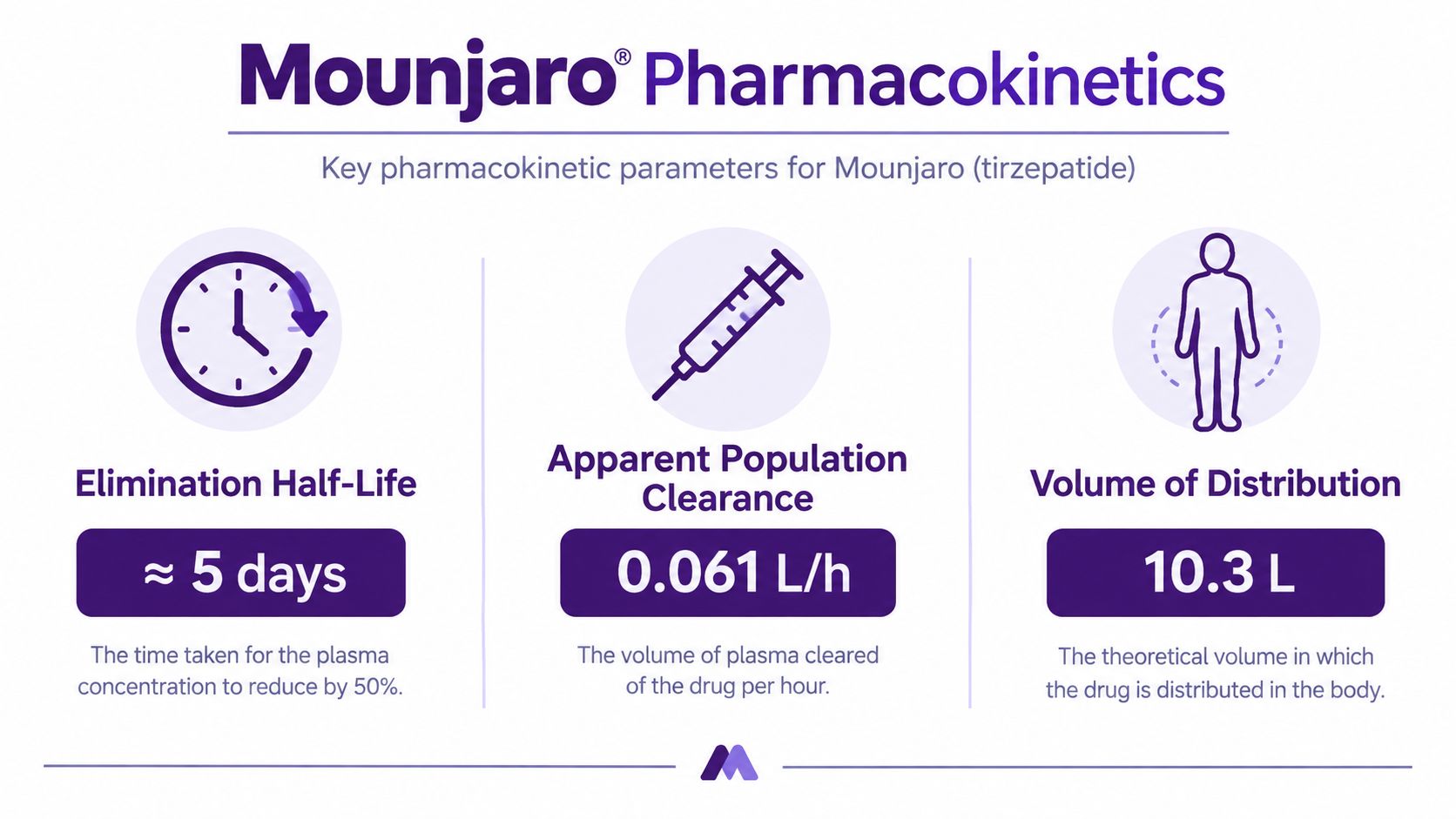
Mounjaro's active ingredient is tirzepatide. The UK SmPC records an elimination half-life of approximately 5 days, an apparent population mean clearance of around 0.06 litres per hour, and a C20 fatty-diacid component that promotes albumin binding and slows renal clearance, according to the Mounjaro KwikPen pharmacokinetic information.
Albumin is a protein in the blood. Binding to it helps tirzepatide remain in circulation rather than being removed rapidly. That molecular design helps explain why this isn't a medicine that disappears shortly after injection.
The infographic summarises the pharmacokinetic concepts. The rounded regulatory values and the explanation in the text should guide interpretation, rather than treating a diagram as an individual clearance calculator.
What the decline looks like
Using the SmPC half-life in a simplified first-order elimination model gives the following illustration. These are calculated proportions of a starting amount, not measurements from a particular patient.
| Time during the simplified elimination model | Approximate proportion remaining |
|---|---|
| After 5 days | 50% |
| After 10 days | 25% |
| After 15 days | 12.5% |
The table uses the regulatory estimate cited above. It assumes typical elimination and no further doses; it doesn't reproduce the full absorption and accumulation pattern during ongoing treatment.
Notice that each interval removes half of what remains, not an equal amount of the original dose. This is why substantial clearance takes several weeks rather than a few days, and why describing an exact moment of complete removal is misleading.
What clearance does and doesn't tell you
Clearance describes the body's capacity to remove drug from the circulation. It isn't the volume of an injection leaving your body each hour, and it can't be converted directly into a personalised date when treatment stops working.
These are population-average pharmacokinetic values. Your exposure also depends on the prescribed dose, treatment history and individual clinical circumstances.
The practical conclusion is modest but important: you shouldn't assume that missing or stopping an injection immediately removes previous exposure. Nor should you use the table to calculate a replacement dose or a shorter interval between injections.
How the Half Life Supports Once-Weekly Dosing
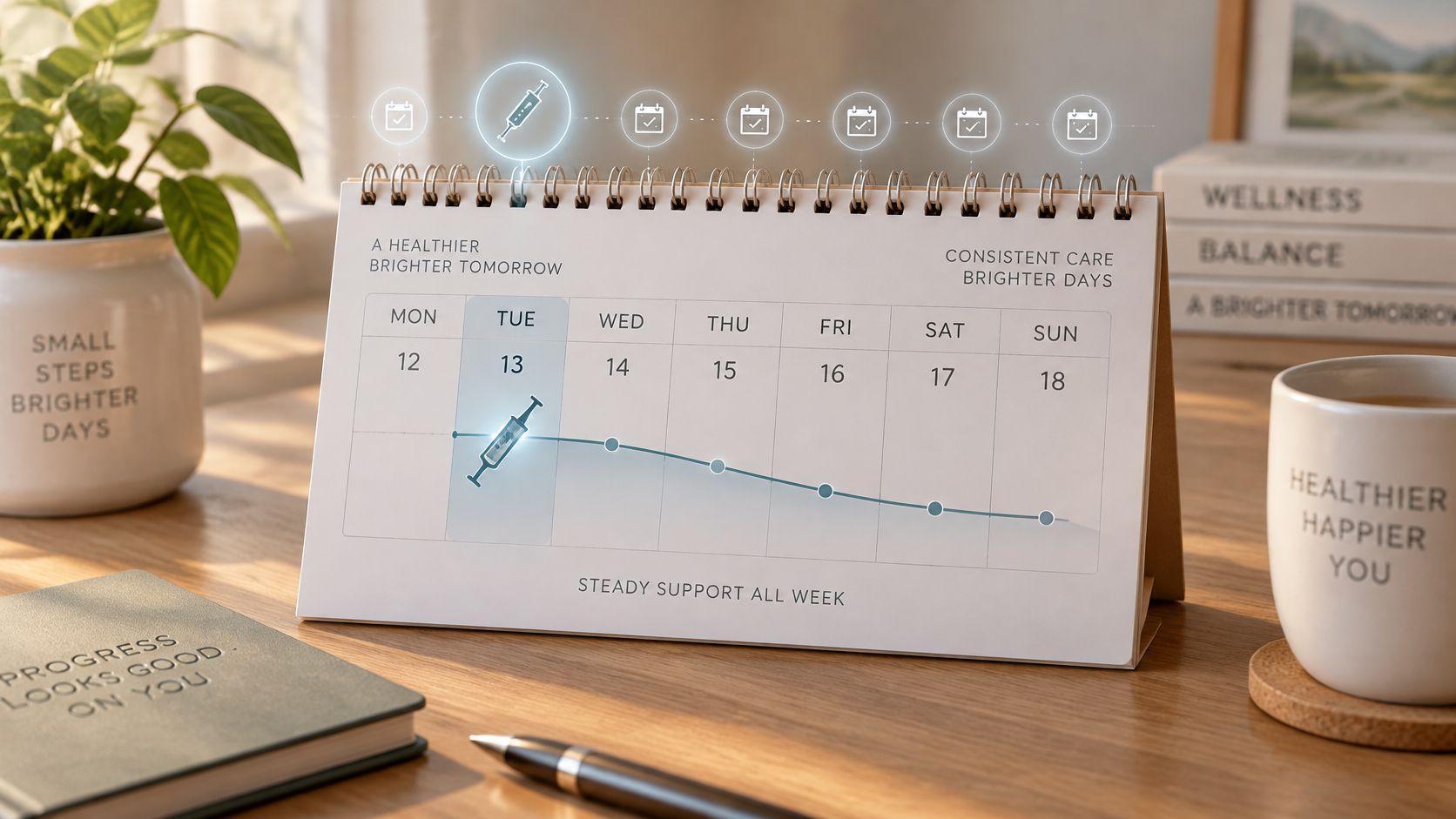
A weekly schedule doesn't mean an injection switches off just before the next one is due. The persistence described above allows the prescribed doses to form an ongoing treatment pattern.
A calendar is useful for recording what you administered, not just what you intended to take.
Apply the missed-dose rule, not a half-life calculation
UK guidance advises taking a missed dose as soon as possible within 4 days of the scheduled day; beyond that window, skip it and resume the usual weekly schedule, without doubling up, as set out in the NHS tirzepatide initiation guide.
For example, suppose your usual injection is on Saturday and you remember while preparing for a Tuesday holiday flight. That falls within the permitted missed-dose window. If you only remember on Friday, it falls outside it, so the missed injection should be skipped rather than squeezed in before the usual Saturday dose.
The important distinction is that residual medicine doesn't justify extra dosing. Taking additional medicine can add exposure on top of what remains, rather than replacing something that has vanished.
When the calendar isn't enough
A standard missed-dose rule can't resolve every situation:
- You're vomiting or struggling to drink. Ask for clinical advice about your symptoms and upcoming dose. Don't treat this as a scheduling problem.
- You're unsure whether you injected. Don't administer another dose on the assumption that the first didn't happen. Contact your prescribing team.
- You're travelling. Record your last injection and discuss any intended change of injection day before departure.
- You've interrupted treatment. Ask your prescriber how to restart rather than assuming your previous plan still applies.
Dose escalation should follow your prescription, not appetite changes or travel convenience. A guide to Mounjaro dosage can help you understand the terminology before discussing your individual plan.
Keep your written prescription and the supplied patient leaflet beside any additional educational material, including the video below.
Onset, Persistence, and the Duration of Side Effects
“When will I feel it?” and “When will this nausea stop?” sound like opposite questions, but neither has a reliable answer based on half-life alone. Drug concentrations, noticeable appetite changes and adverse effects aren't interchangeable measurements.
Maximum tirzepatide concentrations occur 8 to 72 hours after subcutaneous administration, while steady-state exposure develops after approximately 4 weeks of weekly dosing, according to the UK clinical-pharmacology summary. Neither figure identifies the moment an individual must notice appetite suppression or the day a symptom should end.
What clinical trials actually measure
Clinical trial outcomes provide stronger evidence than accounts of how someone felt after an injection. However, long-term weight outcomes don't establish a short-term timetable for symptoms.
In NICE's summary of SURMOUNT-1, mean body-weight reductions at 72 weeks were 15.0% with 5 mg, 19.5% with 10 mg and 20.9% with 15 mg of tirzepatide, compared with 3.1% with placebo, alongside diet and exercise support, according to the NICE clinical-effectiveness summary.
Those are trial averages, not promised individual results. They also aren't a reason to increase a dose faster or to tolerate symptoms that need medical assessment.
NICE describes SURMOUNT-1 as a randomised, placebo-controlled assessment, rather than an uncontrolled before-and-after comparison, in its discussion of the clinical evidence. That distinction supports interpretation of the treatment results without turning them into predictions for a particular patient.
Persistent symptoms need assessment, not just patience
The elimination pattern helps explain why effects may continue after the injection day or after stopping. It doesn't establish that every lingering symptom is caused by tirzepatide, or that waiting for clearance is always appropriate.
Safety point: Don't dismiss severe or worsening symptoms as something you simply have to endure until the medicine wears off.
If you have persistent vomiting, difficulty keeping fluids down, severe pain or feel significantly unwell, seek prompt medical advice. Suspected overdose needs urgent assessment: the UK SmPC's overdose guidance specifically notes that prolonged observation and treatment may be needed because elimination is slow.
For a non-urgent review, bring a record of injection dates, dose changes and symptoms. Information on Mounjaro side effects can help you prepare questions, but decisions about escalation or interruption belong with your prescriber.
How Tirzepatide Compares to Other GLP-1 Medicines
Mounjaro, Wegovy and Ozempic are often discussed together. That can make them sound interchangeable, particularly when people focus on injection schedules rather than the medicine, indication and prescribing instructions.
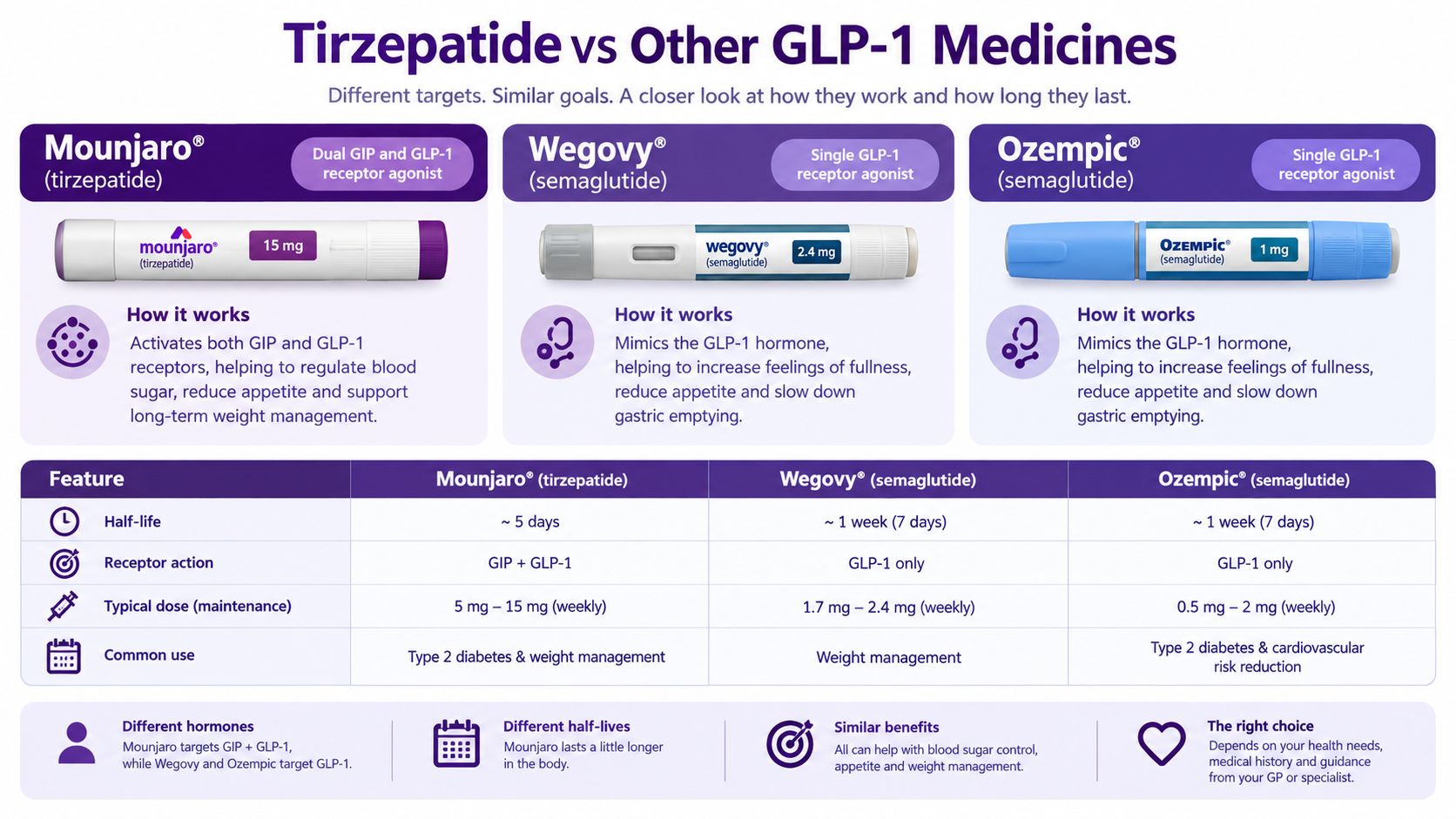
The important pharmacological distinction is that tirzepatide acts at both GIP and GLP-1 receptors, whereas semaglutide is a GLP-1 receptor agonist. The UK clinical-pharmacology summary cited earlier describes tirzepatide's dual-receptor activity; the word “dual” describes its mechanism, not a guarantee of a better result for every patient.
The comparison below is useful for orientation, but it shouldn't be used as a switching or dose-conversion chart.
What half-life can help you compare
Half-life helps explain persistence and the need for medicine-specific instructions when treatment changes. It doesn't tell you whether another medicine will suit you, produce fewer symptoms or achieve your treatment goals.
A longer-lasting medicine isn't automatically more effective. Nor does a similar-looking administration routine mean that doses are equivalent or that treatment can be substituted without review.
| Question | Why half-life alone can't answer it |
|---|---|
| Which medicine is appropriate? | A clinician must consider the indication, medical history and treatment goals. |
| Which will be better tolerated? | Your experience can't be predicted from elimination speed alone. |
| Can I switch immediately? | The prescriber must review previous exposure and the new treatment plan. |
| Will I achieve a particular result? | Trial averages don't guarantee an individual response. |
Compare evidence rather than impressions
Someone who feels fewer appetite changes than a friend hasn't necessarily received less suitable treatment. Equally, stronger nausea isn't evidence that a medicine is working better.
When comparing options, ask which clinical trial evidence applies to your circumstances and how the clinician will assess benefit and tolerability. Also ask what happens if treatment needs to be paused, changed or stopped.
A broader UK comparison of Mounjaro and Wegovy can help organise those questions. The useful outcome isn't choosing a medicine from a half-life ranking, but understanding the reasons behind a personalised prescribing decision.
Pregnancy, Contraception, and Other Special Considerations
Pregnancy planning requires a clear clinical plan rather than a home calculation of how much medicine might remain. A falling drug concentration isn't, by itself, confirmation that it's appropriate to try to conceive.
UK product information and government guidance advise stopping tirzepatide at least 1 month before planned pregnancy. MHRA guidance also recommends additional non-oral contraception for 4 weeks after starting Mounjaro and after each dose increase, as explained in the UK government's GLP-1 medicine safety guidance.
Separate the pregnancy and contraception timelines
The pre-pregnancy interval allows exposure to fall substantially. It doesn't mean the medicine becomes mathematically absent at the end of that interval, and it shouldn't be shortened using an individual estimate.
The contraception advice addresses a different concern: oral contraceptive reliability during treatment initiation and escalation. Speak to your prescriber or contraception service about a suitable method, particularly if you're experiencing gastrointestinal symptoms or are unsure how your contraceptive instructions apply.
For background on recognising cycle patterns, Venus Health Co.’s explanation of how to track ovulation naturally may help you understand fertility awareness. Cycle tracking doesn't replace the contraception precautions associated with tirzepatide or establish when it's safe to conceive.
Situations that need an individual plan
- An unexpected pregnancy. Contact your prescribing clinician promptly for advice rather than waiting to calculate clearance.
- Breastfeeding or plans to breastfeed. Discuss treatment suitability with a clinician. Don't assume that the pregnancy-planning interval answers a breastfeeding question.
- Kidney or liver conditions. Ask for an individual medication review rather than assuming that population-average pharmacokinetic values describe your circumstances.
- An unplanned treatment stop. Tell your prescriber why you stopped, when you last injected and whether you're experiencing symptoms. Don't restart or compensate for missed treatment without advice.
Bring your medicine list, contraception details and pregnancy plans to the discussion. If treatment also forms part of your diabetes care, ask how that care will be managed during any change.
The most useful understanding of half-life isn't knowing a percentage by heart. It's recognising which questions the science can answer, and which decisions require your clinical team.
Trim offers medically supervised weight-management care, clinical guidance and support with nutrition and activity. Visit Trim to explore its approach and discuss questions about dosing, treatment interruptions or suitability with its clinical team.