
Menopause Supplements for Weight Loss: 7 Options Reviewed

Menopause supplement marketing often implies that a capsule can counter abdominal fat, a slower metabolism and changing appetite. The clinical picture is less convenient. UK guidance doesn't support menopause supplements as a proven standalone method for weight loss, and the British Menopause Society recommends vitamin D for routine use, not a general “fat burner” category British Menopause Society guidance. This review separates products by what their evidence can support: a defined authorised weight-loss claim, indirect help with appetite, digestion or diet adherence, or no direct weight-loss evidence. Menopause can affect appetite, sleep, activity and body composition, so supplements belong beside calorie-aware nutrition, resistance training and clinical care, not in place of them. For a different look at a popular ingredient category, Pep Tea's comparison of matcha capsules is useful context, but matcha marketing shouldn't be confused with menopause-specific clinical evidence.
Table of Contents
- 1. Holland & Barrett Glucomannan Complex
- 2. Health & Her Weight Management Probiotic Multi-Nutrient
- 3. Probio7 Menopause
- 4. Wild Nutrition Food-Grown Menopause Complex
- 5. DR.VEGAN MenoFriend
- 6. MPowder Meno-Boost
- 7. Revive Active Meno Active
- Top 7 Menopause Weight-Loss Supplements Comparison
- Choosing Safely With Your Clinician
1. Holland & Barrett Glucomannan Complex
Glucomannan is the clearest example in this list of a supplement with a defined regulatory weight-loss claim. The konjac fibre expands when mixed with fluid, so taking it before meals may increase fullness and make calorie control easier. The relevant claim applies to 3 g per day, used with an energy-restricted diet, rather than to unlimited use or to a capsule taken without dietary change.
The Holland & Barrett Glucomannan Complex provides up to 3,000 mg per day according to its product information, taken before meals with water. That makes it the closest match here to the first evidence level, but the wording matters. An authorised claim isn't proof that every user will lose weight, and it doesn't show that glucomannan reverses menopause-related changes in fat distribution.
Practical rule: Treat glucomannan as a calorie-control aid, not a menopause fat burner.
The product is widely available and may be relatively accessible, while some versions include chromium or botanical ingredients. Those additions don't automatically strengthen the weight-loss case. Compare the exact label, because formulations can differ.
What to check before using it
Plenty of water is essential. Low fluid intake can increase the risk of swallowing difficulty or gastrointestinal discomfort. People with swallowing problems, bowel conditions or regular medicines should ask a pharmacist whether fibre could affect absorption or suitability. If you're comparing fibre formats, this guide to psyllium's potential benefits explains why different fibres shouldn't be treated as interchangeable.
Evidence level: defined authorised claim, only alongside an energy-restricted diet.
Interaction trigger: check with a pharmacist if you take oral medicines, have digestive or swallowing problems, or plan to combine it with other high-fibre products.
2. Health & Her Weight Management Probiotic Multi-Nutrient
The Health & Her Weight Management Probiotic takes a broader route. It combines a Lab4P probiotic complex with nutrients including B vitamins, magnesium and zinc, and uses a two-capsule daily routine. Its positioning focuses on gut health, energy and midlife support rather than a single stimulant-style fat-loss promise.
That distinction is important. UK survey data show strong interest in this subject: among 268 perimenopausal and menopausal women surveyed, 71.3% believed they had gained, or would gain, weight during menopause. The same percentage had searched for nutrition information, but the survey measured beliefs and behaviour, not supplement effectiveness UK menopause nutrition survey.
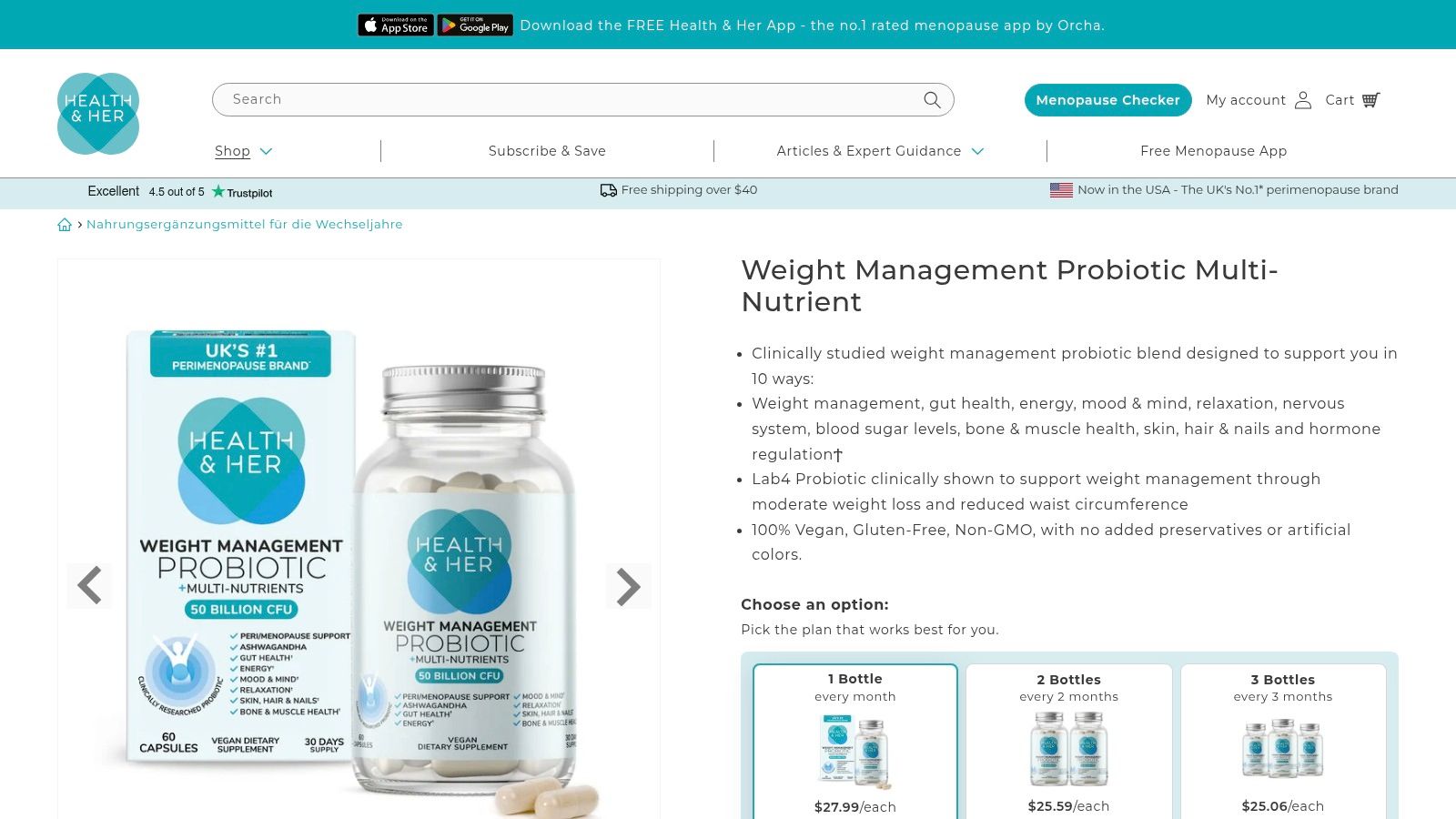
A probiotic could be useful if digestive comfort helps someone follow an eating pattern more consistently. That's an indirect pathway, not evidence that the formula causes fat loss. Probiotic results vary by strain, dose and population, so a menopause label doesn't solve the underlying evidence problem.
The brand also provides educational resources and research summaries, which can help with informed use. Those materials shouldn't be read as proof that this specific product produces clinically meaningful weight reduction.
Evidence level: indirect support for gut comfort and routine adherence, with no established direct weight-loss effect.
Interaction trigger: check the full nutrient panel with a clinician if you already take supplements, have kidney problems, or use medicines affected by magnesium or other minerals.
3. Probio7 Menopause
Probio7 Menopause is easier to assess from a label perspective because it names its bacterial strains. The Boots product listing identifies L. brevis KABP-052, L. plantarum KABP-051 and P. acidilactici KABP-021, with 1 billion CFU per capsule. It uses a single-capsule daily format and is sold through mainstream UK retail as well as the brand's own channels.
That transparency is useful, but strain identification isn't the same as a weight-loss trial. A probiotic may support digestive comfort for some users. It may also make a structured diet easier to tolerate if bloating or bowel symptoms are a barrier. Neither possibility demonstrates that the product reduces body fat.
The practical value is adherence
This product fits the second evidence level, indirect effects on digestion and diet adherence. That can still matter. A supplement doesn't need to be a fat-loss agent to have a place in someone's routine, but the reason for taking it should remain honest.
The British Dietetic Association links menopause-related weight change with metabolic and lifestyle changes, including a possible fall in metabolic rate and a shift towards abdominal fat. Its recommended response is calorie control, physical activity and healthy eating, not reliance on an individual supplement British Dietetic Association menopause guidance.
A named strain tells you what's in the capsule. It doesn't tell you that the capsule will change your waist measurement.
Take care with expectations. If digestive symptoms don't improve, or if weight remains unchanged despite a consistent trial, continuing indefinitely because the product is menopause-branded may not be rational.
Evidence level: indirect digestive support, no direct weight-loss evidence.
Interaction trigger: ask a pharmacist before use if you're immunocompromised, seriously unwell, or taking several medicines and supplements together.
4. Wild Nutrition Food-Grown Menopause Complex
The Wild Nutrition Food-Grown Menopause Complex combines vitamins, minerals and botanicals, including ashwagandha and hops. It is designed for broad menopause support rather than a defined weight-loss outcome. One-off and subscription purchasing may suit people building a longer-term routine.
Its relevance to weight is therefore indirect. Correcting a nutritional deficiency can support health, but it does not establish reduced body fat. The NHS advises adults to take 10 micrograms (400 IU) of vitamin D daily, which aligns with the BMS position cited earlier NHS vitamin D guidance. Other nutrients should have a specific reason for use, such as a confirmed deficiency or clinician recommendation.
Where it can fit
The formula may suit someone seeking general symptom support while improving food intake, protein consumption and strength training. “Food-grown” describes the brand's formulation method. It does not provide independent evidence of fat loss, and it should not be treated as a separate clinical benefit.
A dietary approach for menopausal women has a clearer role in body-composition goals than a botanical label. The supplement can accompany those habits, but it cannot replace them.
Check the full ingredient list before pairing it with another menopause multivitamin. Duplicate vitamins, minerals or botanicals can increase total exposure and make adverse effects harder to identify.
Evidence level: general supportive nutrition, no direct weight-loss evidence.
Interaction trigger: ask a GP or pharmacist before use if you take HRT, thyroid treatment, sedatives, or other botanical products.
5. DR.VEGAN MenoFriend
DR.VEGAN MenoFriend targets people seeking a vegan, plant-based menopause formula. It combines wild yam, sage, red clover and maca with B vitamins, vitamin K2, vitamin D3 and minerals. The MenoFriend product page lists cautions for people with oestrogen-positive breast cancer and those taking anticoagulants.
Those cautions matter more to weight-loss assessment than the product's plant-based positioning. NHS Remedy BNSSG menopause guidance explains that herbal menopause products may vary in regulation, quality, purity, constituent levels and safety. It also states that isoflavones, red clover, black cohosh and vitamin E are not recommended for people who have had breast cancer.
The available information provides no direct evidence for weight loss. Claims about energy, mood or hormone support do not demonstrate reduced body fat. Any value may therefore relate to symptom support, not a measurable weight-loss effect.
A higher-risk category for self-selection
Several botanicals in one formula can make medicine reviews less straightforward. Anyone using HRT, anticoagulants or treatment for a hormone-sensitive condition should obtain professional advice before starting it. The product's 60-day no-quibble guarantee may lower purchasing risk, but it has no bearing on interactions or clinical suitability.
A qualified professional can also assess whether the formula duplicates another supplement or introduces an avoidable ingredient risk. Stop and seek advice if new symptoms appear after starting it, particularly while taking regular prescription medicine.
Evidence level: no direct weight-loss evidence, with symptom-support positioning only.
Interaction trigger: speak to a GP or pharmacist before use if you take HRT, anticoagulants, cancer treatment, or any regular prescription medicine.
6. MPowder Meno-Boost
MPowder Meno-Boost uses a powder format, which changes how it can fit into a routine. Users can add the serving to a drink or protein shake, making it convenient for someone already prioritising protein intake and resistance training. The Meno-Boost formula includes red clover, KSM-66 ashwagandha and chromium picolinate, and is sold as a 30-day supply.
That convenience may support consistency, but it doesn't create a weight-loss effect. Chromium is often associated with blood sugar and nutrient metabolism claims, while the botanicals are positioned for broader menopause support. The evidence supplied for this review doesn't establish that this combination reduces menopause-related body fat.
The powder format is therefore best judged by behaviour. If it helps someone create a filling shake, maintain a more regular breakfast or avoid a less satisfying snack, its value may come from diet adherence. The calorie and protein content of the wider meal still determine the practical outcome.
Use the powder to support a routine you can measure. Don't use its presence in a shake as evidence that it burns fat.
Cost and interaction questions
The typical RRP is around £75 for 30 servings, according to the product positioning, so value depends on whether the user wants a powder rather than a standard capsule. The premium price doesn't indicate stronger clinical evidence.
Chromium and botanicals deserve a medicine review, especially for people using diabetes treatment, HRT or other products that affect blood sugar or hormone-related symptoms. For the body-composition question itself, this guide to menopause belly fat is more useful than assuming a powder can target one area.
Evidence level: indirect support through routine, satiety and dietary adherence, no direct weight-loss proof.
Interaction trigger: consult a pharmacist or GP if you have diabetes, use glucose-lowering treatment, take HRT, or combine several botanical supplements.
7. Revive Active Meno Active
Revive Active Meno Active takes an all-in-one approach. The daily system combines a powdered sachet with a capsule and contains around 31 active ingredients across both parts. The Meno Active product is sold as a 30-day pack in the UK and carries MTick accreditation, which signals a menopause-focused suitability review.
The convenience is obvious. One box may feel simpler than assembling several separate products, and the brand provides cautions about use alongside HRT and other medicines. But a large ingredient count also creates a larger review task. It becomes harder to identify which ingredient helps, which causes a side effect, or whether a duplicated nutrient appears elsewhere in the routine.
This is not a primary weight-loss agent. Its likely role is broad nutritional and symptom support while someone works on food intake, movement and strength training. MTick accreditation doesn't establish a fat-loss outcome, and an all-in-one format doesn't turn indirect support into direct evidence.
A decision based on complexity
The typical UK price is around £44.95 for a 30-day pack, so the purchase should be judged against both budget and ingredient necessity. Someone with a documented deficiency may need a targeted product instead. Someone taking several medicines may prefer a simpler formula that a pharmacist can assess more easily.
A UK clinical trial is currently investigating a different combination of myo-inositol, berberine, cinnamon and chromium against placebo in females aged 38 to 55, with outcomes including body composition, menopause symptoms and physical strength. Until those results are available, claims for that combination remain unverified trial information. The same caution applies broadly: a planned trial shows an evidence gap, not a proven product effect.
Evidence level: broad supportive formula, no direct weight-loss evidence.
Interaction trigger: review every ingredient with a clinician before use if you take HRT, prescription medicines, or other multi-ingredient supplements.
Top 7 Menopause Weight-Loss Supplements Comparison
| Product | Complexity (🔄) | Resource requirements (⚡) | Expected outcomes (⭐📊) | Ideal use cases (💡) | Key advantages |
|---|---|---|---|---|---|
| Holland & Barrett Glucomannan Complex | Low – take before meals with plenty of water; strict timing required 🔄 | Low – capsules + water; budget‑friendly, widely available ⚡ | ⭐ Supports satiety; 📊 weight‑loss effect only when used with an energy‑restricted diet (3 g/day) | Short‑term adjunct for appetite control during calorie‑restricted diets 💡 | EU‑authorised weight‑loss claim at defined dose; inexpensive; high street availability |
| Health & Her Weight Management Probiotic Multi‑Nutrient | Low – 2 capsules/day; straightforward dosing 🔄 | Moderate – probiotic multi‑nutrient formula; mid‑range cost; brand resources ⚡ | ⭐ Gut, energy and blood‑sugar support; 📊 evidence for direct weight loss is mixed | Menopause‑focused support alongside diet, exercise and medical care 💡 | Menopause‑specific positioning; Lab4P probiotic; supporting app and research summaries |
| Probio7 Menopause | Very low – single capsule daily; easy to use 🔄 | Low – 1 capsule/day; mainstream retail availability ⚡ | ⭐ Digestive comfort and gut balance; 📊 weight benefits are indirect (adherence to diet) | Trialling probiotic tolerance; digestive support during peri/post‑menopause 💡 | Named strains and CFU disclosure; low pill burden; retail accessibility |
| Wild Nutrition Food‑Grown Menopause Complex | Low – daily multi‑nutrient capsules; simple routine 🔄 | Moderate – multi‑nutrients + botanicals; subscription/discount options ⚡ | ⭐ Broad symptom support (energy, mood); 📊 not specifically demonstrated for fat loss | General supportive nutrition while managing diet, protein intake and training 💡 | Transparent ingredient list; supportive for overall menopause nutrition; subscription savings |
| DR.VEGAN MenoFriend | Low – 2 capsules/day; clear contraindication guidance 🔄 | Moderate – plant‑based botanical + micronutrient blend; retail presence ⚡ | ⭐ Mood, energy and hormone support claims; 📊 lacks direct weight‑loss evidence | Consumers seeking clean‑label, vegan menopause support; check meds/HRT first 💡 | Vegan, additive‑free formula; clear safety cautions; money‑back guarantee |
| MPowder Meno‑Boost | Moderate – powder requires mixing and scoop dosing 🔄 | Higher – premium price point; used with protein shakes for satiety ⚡ | ⭐ Supports satiety when combined with protein; 📊 not a primary fat‑loss product | Adding to shakes for satiety and body‑composition goals (training + diet) 💡 | Powder format mixes with protein; UK brand transparency; subscription available |
| Revive Active Meno Active | Moderate–High – two‑part daily system (sachet + capsule) 🔄 | Higher – multi‑ingredient system, higher price; MTick accreditation ⚡ | ⭐ Comprehensive nutrient coverage; 📊 not intended as a direct weight‑loss agent | Users wanting an all‑in‑one menopause regimen with broad nutrient coverage 💡 | Comprehensive formula in one pack; MTick accreditation; single‑box convenience |
Choosing Safely With Your Clinician
Start by identifying the product's actual evidence level. Glucomannan has a defined authorised claim when used at the stated dose with an energy-restricted diet. Probiotic and powder products may support digestion, satiety or routine adherence, but that's indirect. The menopause-focused botanical and multi-nutrient products reviewed here don't have direct evidence that they cause clinically meaningful weight loss.
Next, check the whole ingredient list against current medicines and HRT. Don't assess only the ingredient highlighted on the front of the packet. Combination products can contain several botanicals, minerals and vitamins, and the NHS warns that herbal preparations may interact with medicines and may not be suitable for some people, including those with hormone-sensitive cancers NHS menopause supplement guidance.
Use this short decision sequence:
- Clarify the purpose: Is the product intended to correct a deficiency, improve digestive comfort, support fullness, or claim fat loss?
- Check the dose: Compare the serving instructions with the evidence, especially for glucomannan and high-dose products.
- Review interactions: Ask a GP, pharmacist or menopause clinician about HRT, anticoagulants, diabetes treatment and cancer history.
- Avoid substitution: Keep calorie-aware nutrition, regular activity and resistance training central. The British Menopause Society recommends a sustained energy deficit of approximately 500 kilocalories per day, or 3,500 kilocalories per week, alongside aerobic and resistance exercise British Menopause Society guidance.
Agree a trial period with a clinician and log weight, appetite, waist measurement, symptoms and side effects. If nothing useful changes, or adverse effects appear, that record gives you a better reason to stop than a product's marketing claims give you to continue.
Trim provides UK adults with medically supervised weight management through a GPhC-registered online clinic, including assessment for clinically proven options and structured support around nutrition, activity and strength-focused training. For menopause-related weight changes, visit Trim to complete the digital consultation and see whether a clinician-guided programme is appropriate for you.