
Wegovy Cost vs Mounjaro in the UK

At maintenance-level dosing in the UK private market, Mounjaro can cost roughly twice Wegovy's listed price. For eligible NHS patients in England, the standard prescription charge is £9.90 per item, so the cheapest route depends first on access, not the medicine's private price.
The useful comparison isn't one monthly bill against another. Private prices rise as doses increase, clinical-trial averages don't predict an individual's result, and NHS eligibility doesn't guarantee a local service can offer treatment. To understand the cost difference between Wegovy and Mounjaro, consider the price at the dose you might reach, the support and monitoring included, and whether NHS treatment is realistically available to you.
| Comparison point | Wegovy | Mounjaro |
|---|---|---|
| Active ingredient | Semaglutide | Tirzepatide |
| Listed or reported private price by dose | £73.25 per pack at 0.25 mg, 0.5 mg and 1.0 mg, rising to £175.80 at 2.4 mg | Median prices from £154 at 2.5 mg to £299.99 at 15 mg |
| Trial benchmark cited for weight loss | Approximately 16% over 68 weeks | Approximately 22.5% over 72 weeks |
| NHS route | Specialist weight-management services, subject to eligibility and availability | Phased access, subject to eligibility, local capacity and prescribing arrangements |
The price and trial figures are benchmarks, not a personal quote or a prediction of your outcome. Their sources and limitations matter as much as the numbers.
Table of Contents
- Why Wegovy and Mounjaro Are Compared in the UK
- How Wegovy and Mounjaro Differ Clinically
- Wegovy Private Pricing in the UK by Dose
- Mounjaro Private Pricing in the UK by Dose
- NHS Eligibility and the Real UK Price for Most People
- Cost per Percentage Point and the Stopping Rule
- Which Route Fits Your Situation
- Practical Next Steps for UK Readers
Why Wegovy and Mounjaro Are Compared in the UK
A UK patient weighing up these two medicines faces an unusually wide listed price gap: Wegovy reaches £175.80 per pack at its 2.4 mg maintenance strength on NICE's pricing schedule, while a UK pharmacy comparison put the median private price of Mounjaro at £299.99 per month at 15 mg. Those figures aren't like-for-like quotes. One is a list price, the other a reported median across providers, and what a patient pays depends on the prescriber, dispensing fees and the dose reached.
The pair are compared because they compete for the same decision. Both are once-weekly injections licensed for weight management, both have been through NICE appraisal, and both sit on private price lists that climb as doses increase. For a prescriber choosing a treatment, or a patient funding one, they are the two names most likely to appear on the same shortlist.
NHS supply splits that shortlist into two very different decisions. An eligible patient may pay only the standard prescription charge, or nothing in Scotland, Wales and Northern Ireland, while someone outside the criteria pays the full private rate. Eligibility also doesn't guarantee supply, because specialist weight-management services have limited local capacity. The same two medicines can therefore cost one person a few pounds a month and another several hundred.
What changes the bill
- Access route: NHS treatment depends on eligibility, regional availability and service capacity. Private care means the provider's price, sometimes with separate clinical or prescription fees on top.
- Dose reached: Both medicines are titrated upward. A starting-dose price says nothing about the cost of the maintenance dose you may end up on.
- Time on treatment: A monthly figure is one line in a longer budget. A clinician should review ongoing treatment and the wider weight-management plan, not just the first prescription.
Private price lists are only a starting point. Compare like dose stages, check whether a quote covers clinical review and dispensing, and ask whether the medicine is available through your local NHS pathway. The sections below break that arithmetic down dose by dose, because the gap between the two medicines widens as titration progresses.
How Wegovy and Mounjaro Differ Clinically
Wegovy contains semaglutide, a GLP-1 receptor agonist. Mounjaro contains tirzepatide, which acts on both GLP-1 and GIP receptors. Both are weekly injections used alongside dietary changes and increased physical activity, but the dual-receptor action is the reason researchers expected tirzepatide to outperform a GLP-1-only medicine.
The NICE-reported benchmarks are approximately 16% mean body-weight loss over 68 weeks for semaglutide and 22.5% over 72 weeks for tirzepatide, at the doses evaluated in each evidence submission. The comparison of NICE-reported trial outcomes shows the scale of those averages, though the figures come from separate trial programmes rather than a single head-to-head design.
The SURMOUNT-5 head-to-head trial closed that gap in the evidence, finding tirzepatide produced roughly 6.5 percentage points more weight loss than semaglutide at maximum tolerated doses.
Why mechanism isn't a price verdict
A higher trial average does not settle which medicine offers better value. The figure that matters to a paying patient is the cost of each percentage point of expected loss on the dose they reach and tolerate, which is why the gap between these drugs needs pricing per unit of outcome rather than per monthly pack. Someone who cannot tolerate a higher dose, or who responds differently from the population average, will not reproduce the trial figure at any price.
NICE also notes limits in the tirzepatide evidence: the trial lasted 72 weeks, ran across nine countries without UK trial sites, and leaves longer-term effectiveness uncertain. NICE's committee discussion of tirzepatide evidence is a reminder that a controlled trial result and a guaranteed UK real-world outcome are two different things.
For readers weighing up the clinical side before the financial one, what to look for in a metabolic assessment can help frame the questions to raise with a qualified clinician. A plain-language overview of how GLP-1 medicines work supports the same discussion, though neither substitutes for an individual assessment.
Wegovy Private Pricing in the UK by Dose
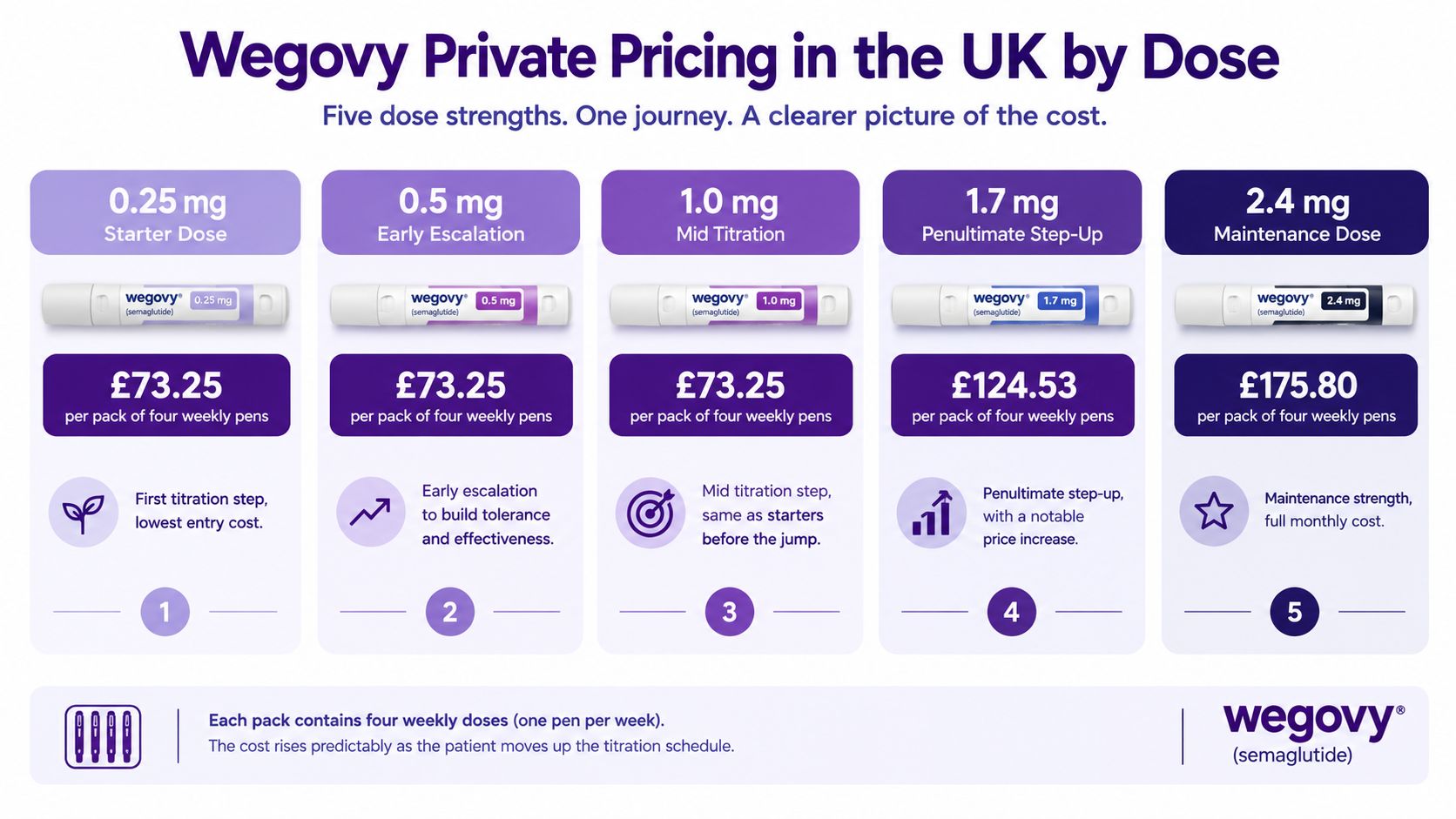
NICE's published list prices put Wegovy at £73.25 per pack for the 0.25 mg, 0.5 mg and 1.0 mg strengths, £124.53 for 1.7 mg, and £175.80 for the 2.4 mg maintenance strength. Each pack contains four weekly doses.
| Wegovy strength | NICE-listed price per four-dose pack | Cost pattern |
|---|---|---|
| 0.25 mg | £73.25 | Starting strength |
| 0.5 mg | £73.25 | Early escalation |
| 1.0 mg | £73.25 | Same listed price as the lower strengths |
| 1.7 mg | £124.53 | Higher step-up |
| 2.4 mg | £175.80 | Maintenance strength |
Three strengths share one price. That flat structure is unusual among weight-loss injections and it changes how the headline figure should be read: the £175.80 maintenance price is the ceiling of a private patient's spend, not the entry point.
What the escalation path actually costs
A patient increasing the dose every four weeks, the standard pattern, would spend £219.75 across the three lower-strength packs before reaching the £124.53 pack at 1.7 mg. By the time the first 2.4 mg pack is dispensed, cumulative spend sits at roughly £520. The early months therefore run well below the maintenance quote, and the monthly average over the first five months lands nearer £104 than £175.80.
That arithmetic cuts both ways. Quoting the £73.25 starter price flatters the drug if the prescriber's plan runs to maintenance, while quoting £175.80 overstates what the first months cost. The dose schedule itself is set out in the Wegovy dosing schedule, and the comparison that matters is total spend across the doses a patient reaches, not whichever single pack price appears in an advert. Listed prices are a reference point here rather than a guaranteed quote, since pharmacies set their own charges and fees for prescribing and follow-up vary between providers.
Mounjaro Private Pricing in the UK by Dose
Mounjaro's reported UK private prices climb far more steeply across the dose range than Wegovy's. The 82-pharmacy comparison cited above reported median prices of £154 at 2.5 mg, £185 at 5 mg, £244 at 7.5 mg, £268.99 at 10 mg, £288.96 at 12.5 mg and £299.99 at 15 mg, and the step pattern shows no flat stages.
| Mounjaro strength | Reported median monthly price |
|---|---|
| 2.5 mg | £154 |
| 5 mg | £185 |
| 7.5 mg | £244 |
| 10 mg | £268.99 |
| 12.5 mg | £288.96 |
| 15 mg | £299.99 |
Where Wegovy holds three strengths at one price, Mounjaro charges more at nearly every step. From starter to top strength, the median rises by roughly £146. Wegovy's listed prices, covered in the previous section, rise by about £103 across their range.
The interesting part is how the gap between the two drugs moves. At entry dose, £154 versus £73.25 means Mounjaro costs a little over twice as much. At the highest strengths, £299.99 against £175.80 narrows that to about 1.7 times. In proportional terms the gap shrinks; in cash terms it widens, from roughly £81 a month to roughly £124. A patient comparing only starter prices understates the monthly difference at the doses where long-term spend concentrates.
Reading the medians as cumulative spend
Escalating every four weeks at these medians, a patient reaching the 15 mg pack would have spent roughly £1,141 on the five preceding packs and about £1,441 across all six. The monthly average over that full run lands near £240, against the roughly £104 monthly average worked out for Wegovy's first five months earlier. The two drugs look closest at the start of treatment and furthest apart once a course has run.
Medians remain reference points rather than quotes, and individual pharmacies sit above or below them. The larger question is whether the higher spend buys proportionally more weight loss. That is a cost-per-percentage-point calculation, and no price list can answer it on its own.
NHS Eligibility and the Real UK Price for Most People
NHS access can matter more than the private price, but eligibility isn't the same as immediate availability. NICE recommended Wegovy in 2023 for adults with a BMI of at least 35 kg/m² and at least one weight-related condition. Access is through specialist NHS weight-management services, not unrestricted routine prescribing.
Mounjaro's obesity-treatment pathway is also restricted. NICE's recommendation focuses on adults with a BMI of at least 35 kg/m² and at least one related health condition, while NHS access is being phased rather than offered universally. NHS England estimates the potentially eligible tirzepatide cohort at around 3.4 million people. NHS England's interim commissioning guidance describes phased primary-care access, which means a large potential cohort doesn't translate into an immediate offer for every eligible person.

Eligibility is only the first gate
For eligible patients in England, the standard NHS prescription charge is £9.90 per item. Prescriptions are free in Scotland, Wales and Northern Ireland. But local commissioning rules, service capacity and referral pathways can affect whether a patient can access a medicine, and some regional guidance sets stricter criteria than the broad NICE recommendation.
For example, some regional guidance describes early access thresholds involving BMI of 40 or above, or BMI of 35–39.9 with at least four specified conditions, with lower thresholds for some ethnic groups. Some GP practices can choose whether to offer weight-management treatment and aren't required to prescribe tirzepatide for weight loss. Wegovy's specialist-service route adds a separate access pathway.
That creates a practical question: medical eligibility may not tell you which medicine your local service will offer, or how long you'll wait. The guide to NHS access for Mounjaro can help you prepare questions about referral and local provision, but your GP or specialist service must confirm the route available to you.
Cost per Percentage Point and the Stopping Rule
A lower sticker price can lose once the denominator is response. Using the head-to-head trial results introduced earlier, an adjusted gap of 6.5 percentage points, the maintenance benchmarks frame a crude value check: £299.99 minus £175.80 is £124.19, and £124.19 divided by 6.5 is about £19.11 per additional percentage point per month if those averages held for an individual patient. That is illustrative, not a forecast: the prices come from different reference points, trial means are not personal outcomes, and NHS supply can replace list-price arithmetic with a prescription-charge pathway.

Why the denominator can change
The denominator moves when dose, escalation speed, side effects or adherence change. NICE's recommendation document found tirzepatide 10 mg and 15 mg statistically more effective than semaglutide for weight loss, while 5 mg was less effective without a statistically significant difference; it also places treatment inside a reduced-calorie diet and increased activity. The cheaper-looking option is not automatically the better-value one: if response arrives at a lower dose, or access depends on local commissioning, the relevant cost is the funded plan that can be continued.
Duration is the second denominator. NICE's treatment discussion aid says that after stopping semaglutide people usually regain lost weight by about two years, with around two-thirds potentially returning within the first year. A short course should not be assumed to buy durable loss. The practical stopping rule is clinical and financial: continue only while benefit, tolerability and access justify the spend, and reassess before a pause turns into unplanned regain.
Which Route Fits Your Situation
The right starting point is your route to care, not a product ranking.
- You meet the broad NHS criteria in England: If you have a BMI of at least 35 kg/m² and a weight-related condition, ask your GP or specialist service whether treatment is available locally. If prescribed through the NHS, the standard charge is £9.90 per item, but access depends on local pathways and capacity.
- You're eligible but local access is limited: Ask which medicine your service can offer, whether a referral is needed, and what the waiting process looks like. If considering private care while waiting, compare the total price at the likely dose, not just the entry price.
- You live in Scotland, Wales or Northern Ireland: NHS prescriptions are free if you're eligible and receive treatment through the NHS. Local clinical pathways still determine whether a medicine is offered.
- You're below the relevant BMI threshold or don't have a related condition: You may not meet the NHS criteria described above. A private assessment may be an option, but a clinician must decide whether treatment is appropriate.
A higher-priced medicine could represent better value for one patient if it produces a suitable response and is tolerated. Another person may achieve adequate results with a lower-cost option, or may not be clinically suited to either medicine. Your medical history, current medicines, contraindications and preferences belong in the assessment. A price comparison can inform that discussion, but it can't make the prescribing decision.
Practical Next Steps for UK Readers
Before paying privately, verify that the pharmacy is registered with the GPhC and ask who assesses suitability, prescribes and monitors treatment. Take your medical history, current medicines and information about weight-related conditions to the consultation; ask how dose escalation, side effects and stopping or ongoing treatment will be reviewed.
Request an all-in quote for the dose plan, including any consultation, prescription and follow-up charges. These figures are educational benchmarks, not medical advice or a personal price guarantee. A qualified UK prescriber should decide whether either medicine is suitable for you.
If you're comparing private costs, Trim offers a UK-based clinical assessment and ongoing support for weight-management treatment, including Wegovy and Mounjaro where clinically appropriate. Review the service and its approach to supervised care at Trim before discussing your options with a qualified prescriber.