
Stopping HRT Side Effects: A Practical Guide for Women

You're holding a repeat HRT prescription and wondering whether you still need it. Perhaps your symptoms have eased, perhaps the side effects have become harder to tolerate, or perhaps a new diagnosis means your clinician has advised you to stop. The uncertainty is often less about the decision itself and more about what comes next: will stopping HRT bring the menopause symptoms back, and is tapering better than stopping straight away?
This guide focuses on stopping HRT side effects using UK guidance and evidence-based information. It separates situations where HRT needs urgent review from elective decisions, explains why symptoms can return, and gives you a practical way to discuss tapering, symptom support and follow-up with a clinician.
Table of Contents
- Why You Might Be Thinking About Stopping HRT
- What Happens in the Body When You Stop HRT
- Common Symptoms After Stopping and How Long They Last
- Who Is Most Likely to Have a Harder Time
- Tapering Versus Stopping Suddenly What the Evidence Says
- Lifestyle and Non-HRT Ways to Manage Symptoms
- When to Speak to a GP or Menopause Specialist
- Key Takeaways for Stopping HRT With Confidence
Why You Might Be Thinking About Stopping HRT
A woman may decide to stop HRT for several very different reasons. One person may feel she's completed the planned course and wants to see how she manages without it. Another may be dealing with breast tenderness, bloating or headaches that haven't settled. Someone else may have received a breast cancer diagnosis or experienced a venous thromboembolism event, making the safety conversation more urgent.
These situations shouldn't be treated as equivalent. A medical reason to stop takes priority over personal preference, and systemic HRT should be stopped for women diagnosed with breast cancer under the relevant UK guidance, because continuing it is considered off-label and may be associated with cancer progression or recurrence risk. Unscheduled vaginal bleeding is also a common side effect during the first three months of HRT, which is why the three-month review matters.
Elective stopping needs a plan
If your reason is bothersome side effects or curiosity about whether your symptoms have settled, you may have more flexibility. NHS guidance says HRT side effects usually improve over time and recommends continuing treatment for at least three months if possible. If symptoms remain troublesome, a GP may suggest changing the dose, formulation or route rather than stopping immediately. The NHS also describes review during treatment, while NICE recommends an ongoing, individualised approach rather than an automatic stop for everyone.
Some people also stop because they've read general information about hormone replacement therapy and become concerned about risks without knowing how those risks apply to their own formulation, medical history or age.
The practical gap
Many UK articles reduce the issue to “your symptoms may come back”. That's incomplete. NHS and NICE guidance says gradual reduction may reduce symptom recurrence in the short term but makes no difference to symptoms in the longer term. The key question, therefore, isn't whether tapering permanently prevents symptoms. It's whether a gentler reduction could make the transition more tolerable for you.
If you've been told to stop because of a new safety concern, follow the prescribing clinician's advice rather than creating your own taper. If stopping is elective, arrange a review and decide how much short-term comfort matters to you.
What Happens in the Body When You Stop HRT
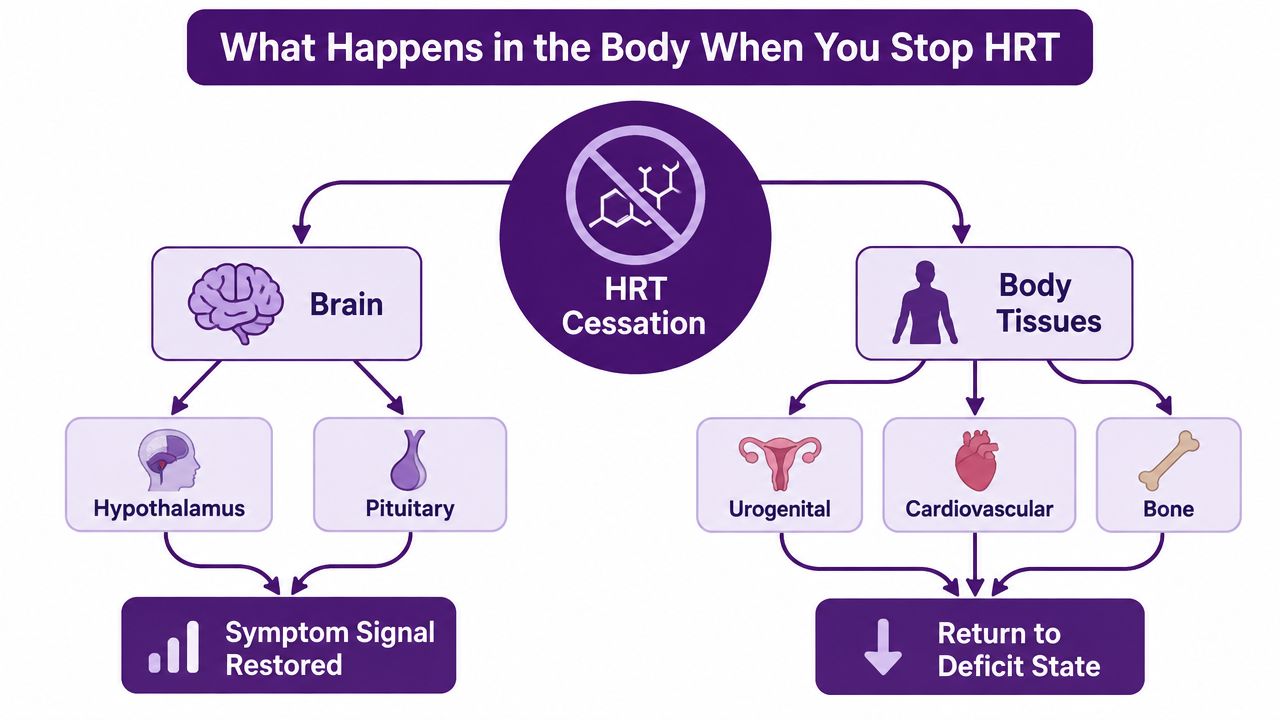
HRT replaces hormones the ovaries produce in lower amounts during and after the menopause. Depending on the treatment, that can include oestrogen and progesterone. When HRT is removed, the body is exposed again to the hormonal environment that contributed to the original symptoms.
The change affects several systems at once:
- The brain's temperature-control system. The hypothalamus helps regulate body temperature. Changes in oestrogen influence signalling involving noradrenaline and serotonin, which can make the temperature-control zone more sensitive. Small internal changes may then trigger a hot flush or night sweat.
- Vascular responses. Oestrogen withdrawal can alter how blood vessels respond, including endothelial nitric oxide signalling. That may contribute to flushing, a racing heartbeat or palpitations in some people.
- Urogenital tissues. Vaginal and bladder tissues rely partly on oestrogen support. When that support is removed, dryness, irritation, urinary symptoms or discomfort during sex may gradually reappear.
Withdrawal is not addiction
A useful analogy is a thermostat in a centrally heated house. After years of heating, turning the system off doesn't make the room collapse instantly. The temperature changes as the heat dissipates, and the occupants notice the difference while the system readjusts.
That's broadly what happens when HRT stops. The symptoms aren't evidence that your body has become addicted to HRT. They reflect the return of hormonal deficiency and the tissues' response to that change. The speed and intensity depend on the treatment, the dose, the route, your underlying menopause history and the reason you're stopping.
This distinction matters because “withdrawal” can sound like dependence. In this context, it's more accurate to think of symptom recurrence after hormone support is removed, although a sudden change can feel uncomfortable.
Common Symptoms After Stopping and How Long They Last
Stopping HRT can bring back symptoms that had been controlled, but the experience isn't identical for everyone. Some people notice changes quickly, while others have a slower return of symptoms or no meaningful recurrence.
The NHS lists side effects associated with HRT, including fluid retention, breast tenderness, bloating, nausea or dyspepsia, headaches, leg cramps and vaginal bleeding. If these problems don't settle within about three to six months, a clinician may need to review the dose, route, formulation or product rather than assuming stopping is the only answer.
A symptom-by-symptom view
| Symptom | Typical onset | Typical duration to settle |
|---|---|---|
| Hot flushes and night sweats | May return as hormone levels fall | Variable, with no guaranteed settling point |
| Sleep disturbance | May accompany returning flushes or mood changes | Depends on the underlying symptom pattern |
| Brain fog | Can reappear alongside sleep and vasomotor symptoms | Individual and variable |
| Mood changes or anxiety | May occur during the adjustment period | Seek help if low mood is severe or persistent |
| Joint and muscle aches | Can develop as symptoms return | May require assessment if persistent or disabling |
| Vaginal dryness or discomfort | Often develops gradually | May continue without local treatment or review |
| Lower libido | May shift with sleep, mood, dryness and symptoms | Variable |
NICE's menopause recommendations provide the most important timing principle. They say gradual reduction may reduce short-term symptom recurrence, but there's no difference in symptoms in the longer term compared with stopping immediately. That means a return of symptoms doesn't automatically show that your taper was too fast, nor does a slow taper guarantee a symptom-free outcome.
Bleeding deserves separate attention. Unscheduled vaginal bleeding is common during the first three months of starting HRT, but bleeding after that checkpoint or bleeding that concerns you should be discussed with a clinician. Don't assume every episode is part of stopping.
Practical rule: Track the symptom, when it began, how disruptive it is and whether it's improving. A short diary gives your GP more useful information than trying to remember several weeks of changes during an appointment.
Who Is Most Likely to Have a Harder Time
No single factor can predict exactly how someone will feel after stopping HRT. However, some circumstances make a difficult transition more plausible and deserve a planned conversation rather than an improvised stop.
| Risk factor | Why it matters | Practical implication |
|---|---|---|
| Long or complex HRT use | Symptoms may have been suppressed for a substantial period | Discuss whether a gradual reduction could improve short-term comfort |
| Older age or a longer time since menopause | Menopause-related symptoms and other health priorities may still need review | Ask for an individual assessment rather than relying on a fixed stopping rule |
| Surgical or premature menopause | Ovarian hormone production may have changed abruptly or occurred earlier than expected | Review symptom control and bone-health considerations with a clinician |
| Previous severe flushes or night sweats | The original symptom burden may return when hormonal support is withdrawn | Arrange support before reducing treatment |
| Breast cancer treatment | Cancer treatment can change the safety and appropriateness of systemic HRT | Seek specialist advice and follow the oncology plan |
The evidence supplied here doesn't establish a validated scoring system for predicting who will struggle. It would therefore be misleading to treat any list as a clinical test. Risk factors guide the conversation, they don't decide it.
A previous breast cancer diagnosis changes the threshold for seeking advice because NICE guidance states that systemic HRT should be stopped in women diagnosed with breast cancer. That's a safety decision, not a judgement about whether tapering would feel more comfortable.
Surgical or premature menopause also deserves individual review because the timing and cause of hormone loss differ from a typical menopause transition. If you fit several of these circumstances, bring your treatment history, current dose and symptom history to a GP or menopause specialist before making changes.
Tapering Versus Stopping Suddenly What the Evidence Says
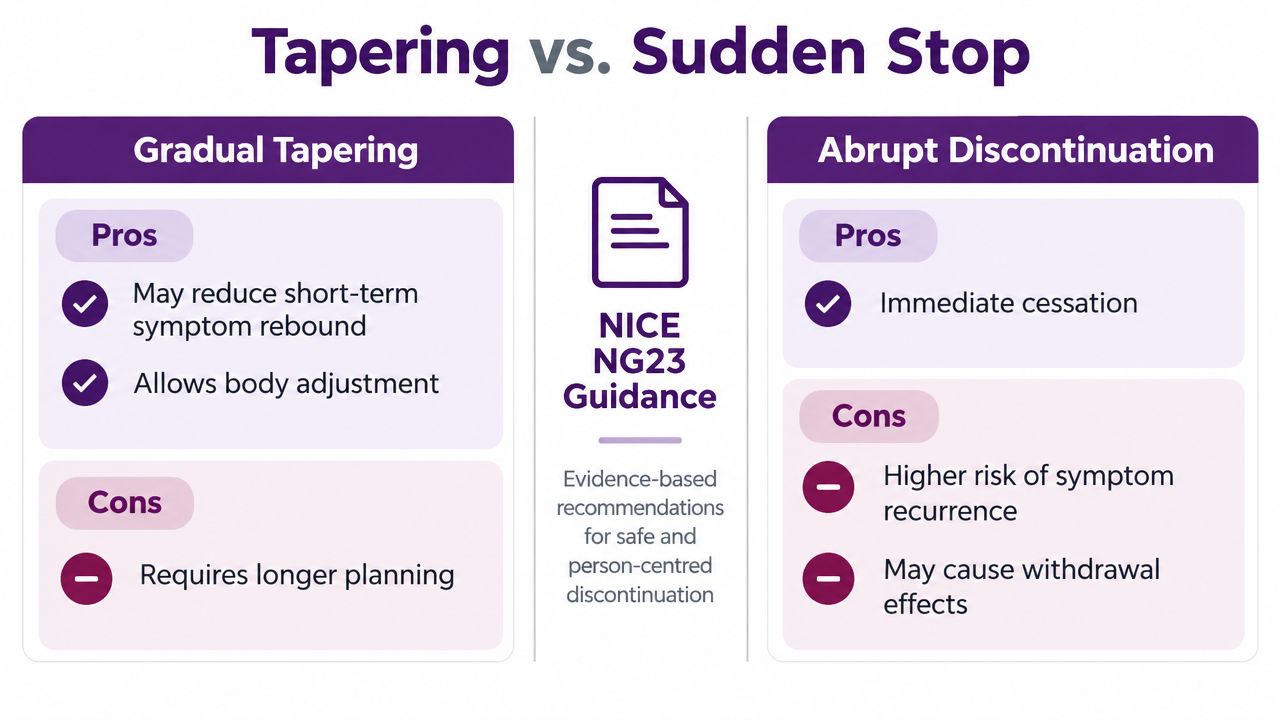
NICE gives people a choice between gradually reducing HRT and stopping immediately. The guidance is deliberately nuanced: tapering may reduce symptom recurrence in the short term, but it doesn't change the longer-term outcome. In other words, tapering is mainly a comfort strategy.
| Approach | Possible advantage | Limitation |
|---|---|---|
| Gradual reduction | May make short-term symptom recurrence easier to manage | Doesn't prevent symptoms from returning in the longer term |
| Immediate stopping | Ends treatment at once and may be necessary for safety reasons | Symptoms may feel more abrupt for some people |
A sensible decision rule
Choose gradual reduction if your main priority is limiting a possible short-term rebound, particularly if your original symptoms were severe or you've previously found dose changes difficult. Choose immediate stopping if your clinician says treatment must end promptly, or if tapering would prolong exposure to a treatment that is no longer considered safe for you.
Don't create a rigid schedule from general internet advice. HRT comes in different forms and strengths, and the correct adjustment depends on what you use. UK regional guidance says that, when tapering, the daily dose should be reduced rather than just changing the frequency, because changing how often treatment is taken can create hormone fluctuations. One regional guideline describes a reduction over three to six months rather than skipping doses.
The same principle applies whether you use patches, tablets or another formulation. A prescriber might alter the strength, change the product or adjust the oestrogen and progestogen components separately. Flexibility matters more than a universal timetable.
Tapering over a personally tolerable period can be reasonable for an elective stop, but it isn't a guarantee. Remaining on the lowest effective dose may also be a valid option for some women after an individual risk and benefit review.
Lifestyle and Non-HRT Ways to Manage Symptoms
Non-HRT measures work best when you match them to the symptom you're trying to control. They may be enough for mild symptoms, but moderate or severe flushes, sleep disruption, mood changes or genitourinary symptoms often need a clinician's input.
Start with practical adjustments
Wear breathable layers that can be removed quickly, keep the bedroom cool and use a fan or cooling pillow if night sweats disturb sleep. A consistent bedtime routine, regular waking time and reduced evening stimulation can support sleep, although these steps won't correct the hormonal trigger itself.
Paced breathing and menopause-adapted cognitive behavioural therapy can help some people respond differently to flushes, anxious thoughts and sleep disruption. Mindfulness may also be useful as a coping tool, but it shouldn't be presented as a guaranteed treatment.
For diet and activity, consider whether caffeine, alcohol or spicy food triggers symptoms for you rather than assuming every person needs the same restrictions. Regular cardiovascular activity and weight-bearing exercise support general health, strength and function. Advice about eating patterns during menopause is covered in this guide to the best diet for menopausal women.
Discuss non-hormonal treatments
NICE guidance includes non-hormonal options such as SSRIs, SNRIs, gabapentin and clonidine, as well as cognitive behavioural therapy in appropriate circumstances. These medicines have their own contraindications and side effects, so a prescriber needs to decide whether one is suitable for you.
Some people ask about complementary products, including CBD patches such as Hemp Well Ireland CBD patches. Treat these as products to discuss with a clinician, particularly if you take other medicines. A product being described as “natural” doesn't establish that it's effective, risk-free or suitable during menopause.
This video may help you think through symptom-management approaches, but it shouldn't replace personalised medical advice.
When to Speak to a GP or Menopause Specialist
A return of mild flushes, sleep disruption or joint aches can usually be discussed at a routine review, especially if you can manage day to day. A symptom diary, current medication list and a short record of when HRT was reduced or stopped will help your clinician identify patterns.
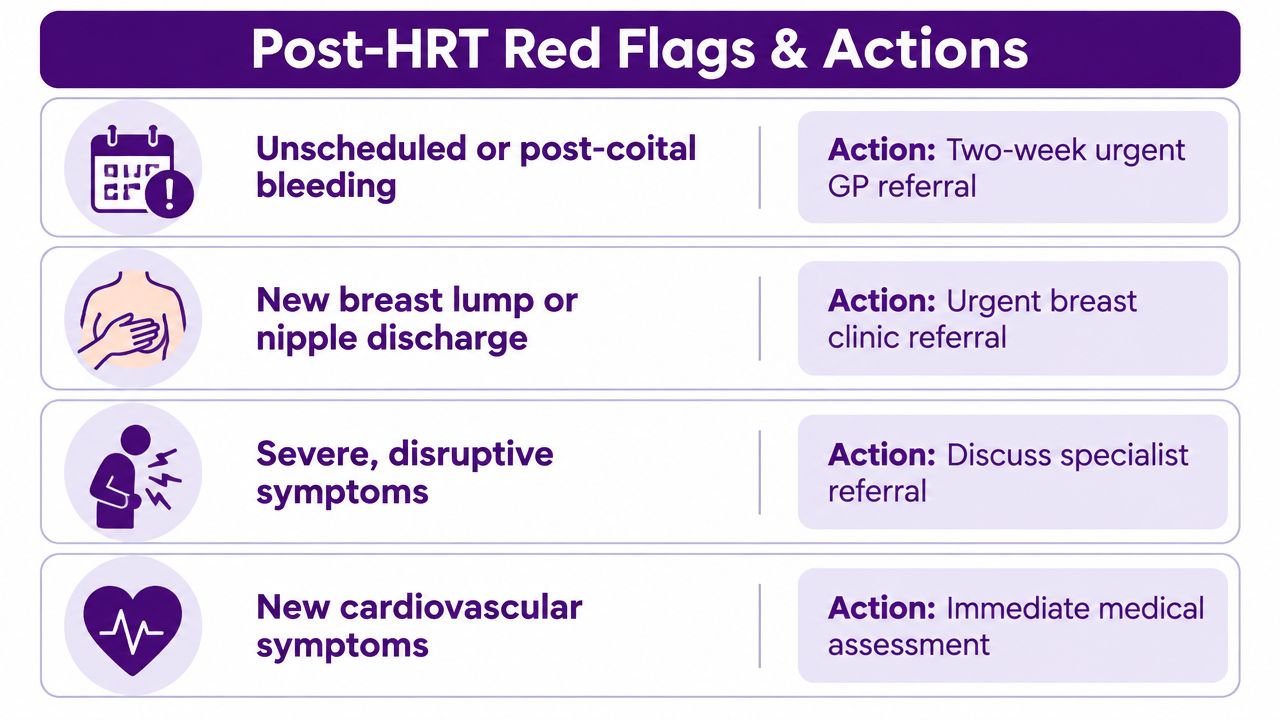
Some symptoms need faster action. Unscheduled or post-coital bleeding shouldn't be dismissed as a normal consequence of changing HRT. NHS and NICE guidance treats vaginal bleeding as an important area for reassessment, particularly after the early treatment period.
Know which symptoms need urgent attention
- Unscheduled or post-coital bleeding: Contact your GP promptly and ask how the bleeding should be assessed. The supplied clinical plan identifies this as a two-week urgent referral trigger.
- A new breast lump or nipple change: Arrange urgent clinical discussion rather than waiting for a routine HRT review.
- Severe or sustained low mood: Seek urgent mental health support if you feel unable to stay safe or have thoughts of self-harm. In an immediate crisis, contact emergency services.
- Chest pain, breathlessness or calf swelling: Seek immediate medical assessment because these symptoms can indicate a cardiovascular or thromboembolic problem.
Previous breast cancer, venous thromboembolism or liver disease should lower your threshold for contacting a clinician before changing treatment. The decision may involve your GP, oncology team or a menopause specialist, depending on the reason for stopping.
Stopping oestrogen also means losing the effects it may have been providing for symptoms and tissue support. That doesn't mean you should continue automatically, or that stopping creates an emergency, but it does make a medication review sensible. Your clinician can consider your symptoms, bone-health needs, screening history and other risk factors.
Before the appointment, write down your HRT name, dose, route, last change, current symptoms and the questions you want answered. You can also use the guide to HRT patches and weight gain to separate questions about treatment from broader menopause-related weight concerns.
Key Takeaways for Stopping HRT With Confidence
Stopping HRT isn't one identical event for every woman. Your experience depends on why you're stopping, the treatment you use, your previous symptom pattern and your wider medical history.
The central NICE decision rule is straightforward:
- Gradual reduction may soften short-term symptom recurrence.
- Tapering doesn't change the longer-term likelihood of symptoms returning.
- Immediate stopping may be necessary when a safety concern requires treatment to end.
- An elective stop should be planned around your symptoms and preferences.
That makes tapering a quality-of-life decision, not a permanent risk-reduction strategy. If you're worried about a difficult transition, discuss dose reduction, formulation changes and non-hormonal options before your final dose. Don't skip doses or change treatment frequency without advice, because some guidance specifically favours reducing the daily dose to avoid hormone fluctuations.
Returning symptoms are often predictable and manageable, but severe symptoms deserve support. Arrange a review point, keep a brief diary and seek urgent help for concerning bleeding, breast changes, serious mood symptoms or cardiovascular warning signs.
You don't have to choose between enduring symptoms alone and restarting treatment without thought. An informed plan with an appropriate UK clinician gives you room to adjust, reassess and choose the safest option for your circumstances.
Trim offers medically supervised weight management through a digital consultation with UK-registered clinicians, alongside nutrition, activity and ongoing support. If menopause-related weight changes are part of your wider health goals, visit Trim to learn how its clinically guided programme may fit alongside your menopause care.